
Finding Focus For Writing Projects

Finding focus for writing projects sounds simple until your brain decides that now, actually, is the perfect time to reorganize your desktop, check one tiny notification, research “best ergonomic socks,” and somehow end up watching a man restore a rusty waffle iron from 1924. Writing is weird like that. The blank page is quiet, but the internet is standing behind it with cymbals.
The good news: focus is not a magical personality trait granted at birth to people who own linen notebooks and drink tea near windows. It is a system. You can build it. You can defend it. You can become the slightly unhinged monarch of your attention kingdom. This guide walks through practical strategies, routines, and mindset shifts for finding focus for writing projects, whether you are drafting a novel, finishing client work, writing essays, reporting remotely, building a blog, or trying to finish one email without checking Reddit like a goblin with Wi-Fi.
We will cover how to reduce distractions, structure writing sessions, set better goals, manage research rabbit holes, protect your energy, and use tools like BlockChamp when your willpower starts wearing a paper crown.
Quick Answers
Why Writing Focus Is So Annoyingly Fragile
Writing demands more than “sitting at a keyboard.” It asks your brain to juggle ideas, structure, memory, word choice, tone, audience, logic, and emotional vulnerability. That is a lot of plates spinning. Then your phone lights up and one plate becomes a frisbee.
Research on attention consistently shows that switching tasks comes with a cost. The American Psychological Association explains that multitasking reduces efficiency and performance because the brain has to reorient itself every time you switch contexts. For writers, this is brutal. You are not just switching from “writing” to “checking Instagram.” You are leaving a half-built mental cathedral, wandering into a circus, then returning and wondering where the blueprint went.
That is why finding focus for writing projects requires more than motivational quotes. “Just write” is adorable advice, in the same way “just fly” is useful to a penguin. Writers need an environment that supports concentration before the session starts, during the messy middle, and after the first inevitable urge to flee into snacks or social media.
Focus breaks for three common reasons:
- External distractions: notifications, open tabs, social feeds, emails, messages, news, and that one shopping cart you keep visiting like it owes you money.
- Internal distractions: doubt, boredom, perfectionism, fatigue, unclear goals, and the sudden belief that your entire project is made of damp cardboard.
- Process distractions: messy notes, undefined next steps, endless research, no outline, or trying to edit and draft at the same time.
The fix is not becoming a productivity robot. The fix is designing a writing workflow that makes the right action easier than the wrong one. That is the whole throne room.
Start With a Writing Target So Clear It Could Wear a Name Tag
A vague goal like “work on my book” or “write article” is where focus goes to be gently murdered. Your brain sees a foggy task and immediately starts looking for an escape hatch. Specificity is the first crown jewel of writing focus.
Before each session, define exactly what “done” means. Not perfect. Not Pulitzer-ready. Done. A useful writing target should include a deliverable, a time frame, and a success condition.
Weak writing goals vs. focus-friendly writing goals
- Weak: “Write blog post.” Better: “Draft the introduction and first two sections of the blog post in 60 minutes.”
- Weak: “Work on novel.” Better: “Write 800 messy words of the scene where Mara confronts the mayor.”
- Weak: “Research report.” Better: “Find and summarize three credible sources for the section on remote work trends.”
- Weak: “Edit essay.” Better: “Revise the thesis, cut repeated points, and improve transitions in sections 2-4.”
Clear goals reduce decision fatigue. You do not have to keep asking, “What should I do now?” The answer is already on the royal scroll.
If you write creative work, you may also like this related guide on finding deep focus for creative projects, especially if your biggest battle is getting into that immersive, time-melting state where the work finally starts talking back.
Build a Pre-Writing Ritual: Your Brain Needs a Starting Bell
Most writers expect focus to appear the second they open a document. That is like expecting a boxing match to begin because someone placed gloves on a chair. Your brain needs cues. A pre-writing ritual tells your nervous system, “We are entering the arena now. Please stop thinking about whether raccoons have social hierarchies.”
A ritual does not need to be dramatic. No candles required, unless you enjoy pretending your Google Doc is an ancient manuscript. The best rituals are short, repeatable, and boring enough to work.
A simple 7-minute writing ritual
- Clear your desk of anything unrelated to the project.
- Open only the writing document and any essential notes.
- Write your session goal at the top of the page.
- Set a timer for 25, 45, or 60 minutes.
- Put your phone in another room or face down out of reach.
- Turn on a distraction blocker like BlockChamp if websites are your weakness.
- Take three slow breaths and write the first ugly sentence.
The first ugly sentence matters. Perfectionism loves a blank page because it has nothing to criticize yet. Once you write something imperfect, the spell breaks. Now you have clay. Weird clay, perhaps. Clay wearing one shoe. But clay can be shaped.
According to James Clear’s work on habit formation, cues and environment design are central to making behaviors repeatable. For writing, your ritual is the cue. Same place, same setup, same first action. Over time, your brain stops negotiating and starts complying. Mostly. It is still a brain, not a golden retriever.
Block the Obvious Villains Before They Enter the Castle
Let us be honest: if your writing project lives in a browser, your distractions live approximately one click away. You might begin with noble intentions and then, three minutes later, find yourself checking YouTube “for background ambience,” which becomes a 37-minute documentary about abandoned malls. Classic peasant maneuver.
Finding focus for writing projects gets much easier when you remove the websites that repeatedly ambush you. This is where a website blocker is not a luxury; it is a moat.
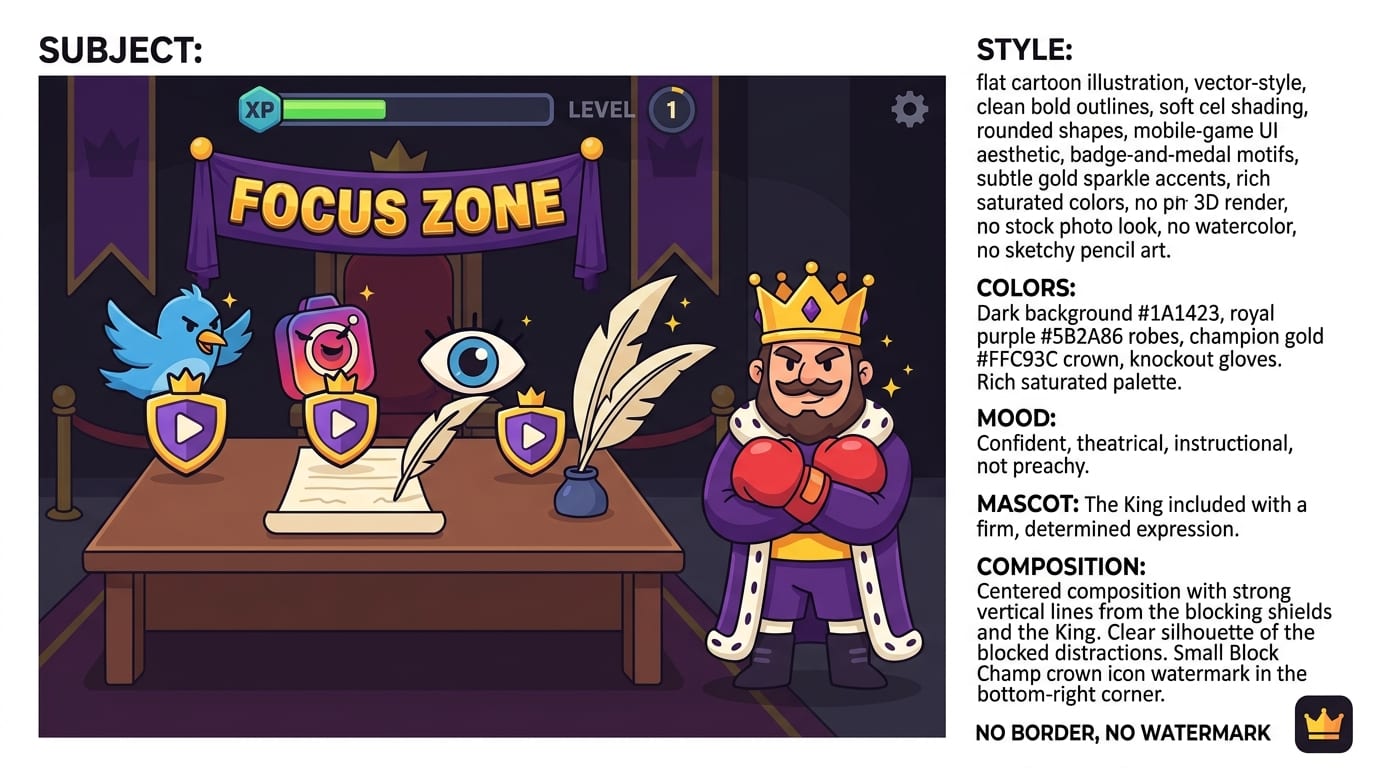
BlockChamp is built for exactly this problem. It is a gamified website blocker for Chrome that helps you block distracting sites, keywords, and categories while making focus feel like leveling up in a game. Instead of a sad gray screen whispering “no fun allowed,” BlockChamp gives you The King: a royal boxing mascot who judges your attempted distraction with a full-screen Stare-Down. Try to open YouTube during writing time and boom: “HALT. The King sees you, peasant.” Humiliating? A little. Effective? Also yes.
For writing sessions, you can block:
- Social media sites like Instagram, TikTok, Facebook, X/Twitter, Reddit, and LinkedIn.
- Video and streaming sites like YouTube, Netflix, Twitch, and Disney+.
- News sites if doomscrolling keeps stealing your paragraphs.
- Shopping sites if “research” becomes “what if I bought a standing desk shaped like ambition?”
- AI tools during drafting if you keep outsourcing every sentence before forming your own thoughts.
BlockChamp’s category bundles are useful because writers often underestimate how many little escape tunnels they have. Blocking one site helps. Blocking an entire category during writing hours is stronger. Champion users can also use recurring schedules, keyword blocking, and Hardcore Lockdown, which makes turning focus off require a cooldown timer or a boxing-riddle mini-game. Yes, really. The King makes you earn your surrender. Regal nonsense, but productive regal nonsense.
Use Time Blocks, But Do Not Worship the Timer Like a Tiny Plastic God
Time blocking works because it gives your writing session edges. Without edges, writing expands into the full emotional swamp of your day. With edges, you have a mission: write for this specific container of time, then stop or reset.
The classic Pomodoro method uses 25-minute focus sessions and short breaks. Many writers prefer longer blocks, such as 45 or 60 minutes, because it takes time to warm up. The best block length depends on the type of writing.
Choose the right time block for the writing task
- 25 minutes: good for warmups, emails, short edits, outlining, or getting unstuck.
- 45 minutes: good for drafting articles, essays, reports, or newsletter sections.
- 60-90 minutes: good for deep creative writing, complex arguments, research synthesis, and long-form drafting.
- 2-3 hours: useful for major writing sprints, but only if you protect breaks and avoid pretending you are a medieval monk with a caffeine subscription.
Cal Newport popularized the concept of deep work, describing it as cognitively demanding work performed in a distraction-free state. His overview of deep work principles is especially relevant for writers because writing is one of the clearest examples of work that gets better when attention is uninterrupted.
But here is the cheeky truth: a timer is not magic. If you set a 60-minute timer and spend 42 minutes checking tabs, you have not performed deep work. You have performed a one-person circus. Pair time blocks with blocked distractions, a clear target, and a defined break. That combo is where the knockout happens.
Separate Drafting, Editing, and Research Before They Start a Bar Fight
One major reason writers lose focus is that they try to do every part of writing at once. Drafting, editing, researching, fact-checking, formatting, and judging your entire life trajectory are different tasks. When you combine them, your brain gets overloaded and starts looking for emergency exits.
Instead, split writing projects into modes:
- Planning mode: clarify the angle, audience, structure, thesis, or scene purpose.
- Research mode: gather facts, quotes, sources, examples, and supporting evidence.
- Drafting mode: write new words without stopping to polish every sentence.
- Editing mode: improve structure, clarity, rhythm, transitions, and accuracy.
- Publishing mode: format, add links, upload, optimize, and proofread.
Each mode requires a different kind of attention. Research wants curiosity. Drafting wants momentum. Editing wants judgment. If judgment shows up too early, drafting hides under the bed.
For example, if you are writing a 2,000-word article, do not begin by opening 19 tabs and hopping between them while writing sentence one. Do this instead:
- Spend 20 minutes outlining the argument.
- Spend 40 minutes gathering only the sources you need.
- Close extra tabs and draft for 60 minutes.
- Mark missing facts with placeholders like [STAT HERE] instead of stopping.
- Return later for fact-checking and edits.
This approach is especially helpful for remote writers and reporters who juggle interviews, sources, deadlines, and the constant temptation to “just check the news.” If that sounds familiar, read finding focus for remote writing and reporting for more workflow-specific tactics.
Tame Research Rabbit Holes Without Becoming a Joyless Spreadsheet Wizard
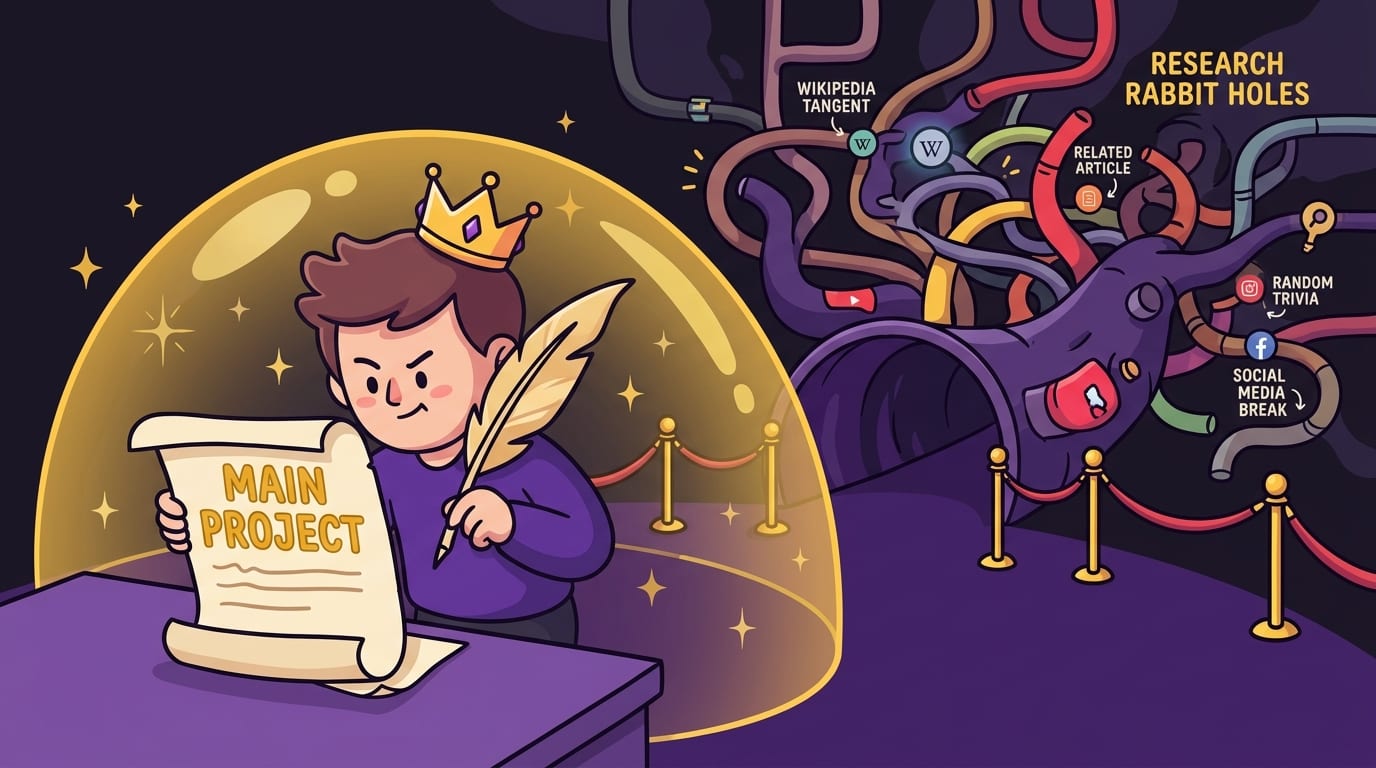
Research is necessary. Research is also a trench-coated distraction pretending to be responsible. One minute you are checking a source. The next you are reading the history of punctuation marks because “it might add texture.” Sir. Put down the semicolon documentary.
The trick is to define research boundaries before you begin. Otherwise, research becomes procrastination with better vocabulary.
Use a research parking lot
Keep a section in your document called “Parking Lot.” When a question pops up, write it there instead of chasing it instantly. Examples:
- [Find source for average time lost to distractions]
- [Check spelling of researcher name]
- [Add example from client interview]
- [Verify date of report]
This preserves momentum. You are not ignoring accuracy; you are scheduling it. Very royal. Very adult. Slightly suspicious, but it works.
Use source limits
Before researching, decide how much evidence is enough. For a blog post, you may need three to five credible sources. For academic work, more. For a novel scene, perhaps one map, one historical note, and one sensory detail. When you hit the limit, stop. The internet will always offer more. It is an all-you-can-eat buffet where the dessert is confusion.
For credible productivity and work behavior research, sources like McKinsey’s people and organizational performance insights, Buffer’s remote work and social media resources, and Hootsuite’s social media trend analysis can be helpful depending on your topic. The point is not to collect links like dragon treasure. The point is to support your writing.
Design Breaks That Actually Restore You
Breaks are not the enemy. Bad breaks are. A good break refreshes your attention. A bad break pours your brain into an algorithmic blender and hands it back wearing sunglasses.
If you spend your writing break scrolling social media, you may return more fragmented than before. Social platforms are designed to hold attention. The Pew Research Center’s internet and technology research regularly documents how deeply digital platforms are embedded in daily life. That does not mean social media is evil. It means it is powerful. Do not invite a attention-hungry dragon into a five-minute break and expect it to leave politely.
Better breaks for writers
- Stand up and stretch your shoulders, wrists, and neck.
- Walk outside for five minutes without headphones.
- Refill water or make coffee without opening apps.
- Do a quick breathing exercise.
- Read one page of a physical book.
- Write three messy notes about what comes next in the project.
A useful break should lower mental noise, not multiply it. If you use BlockChamp, keep distracting categories blocked during breaks too, unless your break plan intentionally includes leisure browsing. The Master Focus toggle can stay “On Guard” while you step away, so your return path is clean. The King keeps watch while you remember you have a spine.
Use Momentum Tricks When Your Brain Refuses the Throne
Some days, focus does not arrive politely. You sit down and your brain behaves like a raccoon trapped in a keyboard store. This is normal. Do not wait for inspiration to become majestic. Use momentum tricks.
The 10-minute bargain
Tell yourself you only have to write for 10 minutes. Not finish. Not write beautifully. Just begin. Most resistance lives at the starting line. Once you are moving, continuing becomes easier.
The ugly draft decree
Declare the first draft officially ugly. Give it permission to wobble. Write notes like “fix this later,” “better example needed,” or “this sentence is wearing clown shoes.” Ugly drafts are not failures. They are how good drafts enter the building without getting tackled by perfectionism.
The next sentence method
When overwhelmed, ask only: “What is the next sentence?” Not the next chapter. Not the final argument. The next sentence. Tiny steps are less glamorous than heroic marathons, but tiny steps actually show up for work.
The scene doorway
For fiction or narrative nonfiction, start with a concrete doorway into the scene: a sound, object, line of dialogue, or action. “The printer jammed again” is easier to continue than “This chapter must reveal the protagonist’s fractured identity.” One is a door. The other is a committee meeting wearing a scarf.
For more overlap between creative momentum and attention systems, check out finding focus for creative projects and finding focus to build creative projects. Writing rarely exists alone; it often sits inside a bigger creative kingdom with deadlines, decisions, and mildly dramatic caffeine intake.
Protect Your Writing Energy Like It Is a Tiny Royal Dragon
Focus is not just about blocking distractions. It is also about energy. If you are tired, hungry, stressed, dehydrated, or emotionally fried, your ability to concentrate drops. No app, timer, or productivity chant can fully compensate for being a crispy little burnout chip.
Start noticing when your writing focus is naturally strongest. Some people write best early, before the day starts throwing furniture. Others hit stride in the afternoon or evening. The goal is to match your hardest writing to your best energy whenever possible.
Energy questions to ask
- What time of day do I produce my clearest writing?
- Which tasks drain me fastest: drafting, editing, research, or publishing?
- Do I focus better with silence, ambient noise, or music without lyrics?
- How long can I write before quality drops?
- Which distractions appear when I am tired versus bored versus anxious?
Once you know your patterns, plan accordingly. Put demanding drafting sessions in your prime hours. Save admin, formatting, and light edits for lower-energy windows. If you are an entrepreneur or freelancer juggling writing with business chaos, this guide on finding focus as an entrepreneur offers useful strategies for defending creative work amid meetings, messages, and “urgent” nonsense wearing a blazer.
Create a Writing Environment That Makes Distraction Feel Inconvenient
Willpower is overrated. Environment is the heavyweight champ. If your phone is beside you, your inbox is open, Slack is pinging, and 14 tabs are screaming, you are not “bad at focus.” You are writing inside a carnival cannon.
Make distraction inconvenient. Not impossible, necessarily. Just annoying enough that your impulse has time to weaken.
Try this writing environment checklist
- Close every tab except your writing document, notes, and essential research.
- Turn off desktop notifications.
- Put your phone in another room or use Do Not Disturb.
- Use headphones or ambient sound if your space is noisy.
- Keep water nearby so you do not invent “hydration research” as an escape.
- Open BlockChamp and block your usual distraction sites before starting.
- Write your session goal somewhere visible.
The best environment reduces the number of decisions you need to make. You should not have to heroically choose focus every 90 seconds. That is exhausting. Set up the arena so writing is the default and distraction has to climb a wall while The King heckles it.
BlockChamp’s gamified system helps because it adds immediate feedback. Focus minutes earn XP. Surviving a Stare-Down earns XP. Keeping your blocks active builds your reign. That turns writing focus from a vague moral battle into a visible game. You are not merely “trying to be disciplined.” You are defending the throne. Much cooler. Slightly ridiculous. Excellent.
Track Progress Without Turning Writing Into a Spreadsheet Dungeon
Tracking can motivate you, but only if it stays simple. Writers sometimes build elaborate dashboards instead of writing, which is productivity cosplay. A useful tracking system should answer two questions: “Did I show up?” and “What moved forward?”
Track a small set of metrics, such as:
- Minutes spent in focused writing.
- Words drafted.
- Sections completed.
- Pages revised.
- Research questions resolved.
- Days you kept your writing appointment.
Do not track everything. Track what supports the habit. If word count motivates you, use it. If it makes you write bloated nonsense just to hit a number, track time or completed sections instead. The goal is momentum, not turning your writing life into a tax audit.
This is another place BlockChamp fits nicely. Its calendar view, XP, levels, badges, reigns, and leaderboard make focused time visible. Many writers underestimate their progress because deep work is quiet. A golden calendar or growing reign gives your effort a scoreboard. Not in a guilt-heavy way. More like, “Behold, champ, you did not spend the afternoon being devoured by TikTok.” Confetti may be spiritually appropriate.
A Practical 5-Day Focus Reset for Writing Projects
If your writing focus is currently hiding in a cave, do not overhaul your entire life overnight. Try a five-day reset. Small, structured, and harder to mess up than a 47-step productivity ritual invented by someone who owns too many whiteboards.
Day 1: Identify your top three distractions
Write down the websites, apps, habits, or thoughts that most often interrupt your writing. Be honest. If it is Reddit, write Reddit. If it is “checking email to feel productive,” write that. Then block or remove the obvious digital culprits during your next session.
Day 2: Create one repeatable writing ritual
Use the 7-minute ritual from earlier. Keep it simple. Your goal is to make starting feel familiar, not cinematic.
Day 3: Write in one protected time block
Choose 45 minutes. Define the task. Turn on your blocker. Write until the timer ends. If you get distracted, return without drama. The crown may wobble, but it does not fall.
Day 4: Separate modes
Pick one project and divide it into planning, research, drafting, editing, and publishing tasks. Then work in only one mode for the session. Notice how much calmer your brain feels when it stops hosting a committee brawl.
Day 5: Review and adjust
Ask: What helped? What still interrupted me? What time of day worked best? Which sites need blocking? What goal size felt realistic? Then repeat the parts that worked next week.
Five days will not magically transform you into the Grand Emperor of Literature, but it will give you evidence. Evidence beats vibes. Vibes are nice, but they wander off.
Conclusion: Win the Page Before the Internet Wins You
Finding focus for writing projects is not about becoming perfectly disciplined. Perfect discipline is fake. It lives in stock photos next to color-coded calendars and salads nobody wanted. Real focus is built with clear goals, repeatable rituals, protected time blocks, distraction barriers, energy management, and a willingness to write imperfectly until the good stuff appears.
Start by making your next writing session smaller and sharper. Decide exactly what you will write. Block the sites that usually ambush you. Set a timer. Draft badly on purpose. Take a real break. Come back. Repeat. That is the kingdom. That is the crown.
And if your writing focus keeps getting mugged by YouTube, Reddit, TikTok, news, shopping, or “just one quick search” that becomes an archaeological expedition, give BlockChamp a try. It helps you knock out distracting websites on Chrome, earn XP for staying focused, build your reign, and get roasted by The King when you try to wander off mid-project. Helpful? Yes. Slightly theatrical? Absolutely. But if a cartoon royal boxer is what finally gets your draft finished, long live the champ.
Now close the extra tabs, defend the throne, and go write the next sentence.
Related posts

Finding Focus For Fiction Writing

Learning To Focus In A Digital World As A Creative

Finding Focus For Personal Growth
