
Finding Focus For Personal Growth

Finding focus for personal growth sounds very noble, like something you’d write in a leather journal while sipping tea beside a mountain. In reality, it usually looks like opening your laptop to “work on yourself,” then accidentally spending 47 minutes watching a raccoon wash grapes. The raccoon is thriving. You, champ, are still on the login screen of your own life.
Here’s the good news: focus is not a magical personality trait reserved for monks, billionaires, and people who meal prep in matching glass containers. Focus is a trainable skill. More importantly, it is an environment you build, a routine you repeat, and a set of decisions you make before your distracted goblin brain starts negotiating with TikTok at 11:08 p.m.
This guide breaks down practical strategies for finding focus for personal growth: how to choose what matters, protect your attention, build routines, manage digital distractions, measure real progress, and recover when you inevitably wander off into the snack kingdom. No shame. No productivity cosplay. Just useful habits that help you become the person you keep pretending you’ll become “next Monday.”
Quick Answers
Why Finding Focus for Personal Growth Is So Ridiculously Hard
Personal growth requires attention. Annoying but true. Whether you want to learn a skill, write a book, improve your health, build a business, study harder, or stop living like your calendar was designed by a caffeinated raccoon, you need sustained attention long enough to do uncomfortable things repeatedly.
The problem is that modern life is basically a casino with Wi-Fi. Apps, feeds, notifications, autoplay, trending topics, and algorithmic recommendations are designed to pull you away from long-term goals and toward short-term novelty. According to the American Psychological Association, stress affects attention, decision-making, and behavior in very real ways. Add constant digital stimulation and your poor brain is trying to meditate inside a pinball machine.
Research from Gloria Mark and colleagues at UC Irvine has shown that interruptions can significantly affect how people work, increasing stress and effort as they try to return to tasks. Translation: every “quick check” is not quick. It leaves muddy little footprints all over your mental carpet.
Finding focus for personal growth is hard because growth tasks often have delayed rewards. Studying, exercising, reading, practicing, writing, planning, saving money, or learning a language rarely give instant fireworks. Meanwhile, your phone offers dopamine confetti every 12 seconds. That is not a fair fight unless you bring weapons.
The first weapon is clarity. The second is structure. The third is making distractions harder to access than your goals. If that sounds dramatic, good. Your attention is the throne. Defend it.
Start With One Crown Jewel Goal, Not Seventeen Tiny Chaos Goblins
Most people fail at focus because they are trying to become six new people at once. They want to learn Spanish, get shredded, start a newsletter, journal daily, meditate, become financially literate, read 52 books, wake up at 5 a.m., and finally understand what crypto people are yelling about. Admirable? Sure. Sustainable? Absolutely not. That’s not personal growth. That’s a software update with 900 tabs open.
To make focus usable, choose one crown jewel goal for the next 30 to 90 days. This is the goal that gets priority when time, energy, and motivation are limited. Not the only thing you care about, but the main thing you are actively building.
Ask yourself:
- What change would improve my life the most right now?
- What goal have I been avoiding because it matters?
- What skill or habit would create momentum in other areas?
- What would I be proud to have worked on consistently three months from now?
Good crown jewel goals are specific enough to guide behavior. “Be better” is fog wearing sneakers. “Study data analytics for 45 minutes, four days per week” is usable. “Get healthy” is a motivational poster. “Walk 8,000 steps daily and cook dinner at home four nights per week” is a plan.
Once you pick the goal, write a simple focus statement:
“For the next 60 days, my main personal growth focus is ______, and I will prove it by ______.”
Example: “For the next 60 days, my main personal growth focus is improving my writing, and I will prove it by writing 500 words every weekday before checking social media.” Beautiful. Regal. The King nods approvingly from his tiny throne.
If your goal is creative, you may also like this related guide on finding focus for creative work, especially if your brain likes to flee the moment a blank page appears.
Build a Focus Routine So Your Brain Stops Filing Complaints
Motivation is unreliable. It shows up wearing sunglasses, makes one inspiring speech, then disappears for eight business days. Routines are less glamorous, but they actually do the work. When you repeat the same cue, location, time, and action, your brain wastes less energy deciding what happens next.
A good focus routine has four parts:
- A start cue: something that tells your brain it is focus time.
- A defined workspace: physical or digital, ideally not the same place you doomscroll in bed like a Victorian ghost.
- A work block: a clear amount of time dedicated to one task.
- A shutdown ritual: a way to end cleanly and record progress.
For example:
- 7:30 a.m. — make coffee, open notebook, put phone across the room.
- 7:35 a.m. — turn on website blocking and start a 45-minute timer.
- 7:35–8:20 a.m. — work only on the personal growth goal.
- 8:20 a.m. — write down what got done and the next step for tomorrow.
This works because it removes negotiation. You are not asking, “Do I feel like improving my life today?” That question is dangerous. Your brain will answer, “Perhaps after nine videos about tiny kitchens.” Instead, the routine says: coffee means focus, focus means task, task means progress.
The habit loop framework popularized by James Clear emphasizes how cues, cravings, responses, and rewards shape behavior. You do not need to become a habit scientist in a lab coat. You just need to make your desired behavior obvious, easy to start, and rewarding enough to repeat.
BlockChamp helps here by turning the start of your focus routine into a clear “on guard” moment. You flip the Master Focus toggle, your blocks activate, and your reign begins. No solemn violin music required. Just: distractions are outside the castle now. Shoo.

Design Your Environment Like You Actually Know Yourself
One of the biggest mistakes in personal growth is designing systems for your imaginary best self instead of your actual current self. Your imaginary self wakes up early, drinks water, reads philosophy, and never clicks YouTube thumbnails titled “He Built a Mansion Underground.” Your actual self is tired, curious, and one mildly stressful email away from a scroll spiral.
So stop relying on heroic willpower. Build friction.
Friction is anything that makes bad habits harder and good habits easier. If your goal is reading, keep the book on your pillow and the phone in another room. If your goal is studying, keep your study materials open and your entertainment sites blocked. If your goal is better sleep, do not bring your phone to bed unless you enjoy being defeated by a rectangle.
For digital focus, environment design is especially important. A report from DataReportal’s Digital 2024 Global Overview shows that people spend hours per day online across platforms and devices. That does not mean the internet is evil. The internet gave us maps, recipes, and videos of capybaras being emotionally mature. But it does mean your growth goals are competing with a massive attention economy.
Try this quick digital environment audit:
- Which three websites steal the most time from your growth goals?
- Which apps do you open when you feel bored, anxious, or uncertain?
- Which notifications interrupt your best work?
- Which tabs do you keep open “just in case” but actually use for avoidance?
Then make changes:
- Remove distracting bookmarks from your browser bar.
- Log out of sites that pull you into autopilot.
- Turn off nonessential notifications.
- Use a website blocker during personal growth work blocks.
- Keep your goal-related tools one click away.
This is where BlockChamp fits naturally. You can block specific sites like YouTube, Reddit, X/Twitter, or shopping sites; use category bundles for social media, video, news, gaming, AI distractions, and more; and let The King throw up a hilarious Stare-Down when you try to sneak past your own boundaries. It is less “cold productivity jail” and more “royal boxing coach catches you reaching for the cookie jar.”
Use Time Blocks, But Keep Them Human-Sized
Time blocking is one of the simplest ways to turn vague ambition into action. Instead of saying, “I’ll work on my personal growth sometime,” you assign a specific block of time to a specific activity. Your calendar stops being decorative and starts doing push-ups.
But beware: many people time block like they are scheduling a robot, not a mammal with laundry. They create a 14-hour productivity fortress, fail by 10:12 a.m., then declare themselves broken. Dramatic. Incorrect.
For finding focus for personal growth, use human-sized blocks. Start with 25, 45, or 60 minutes. The goal is consistency, not pretending you are a marble statue of discipline.
A Simple Weekly Focus Plan
Here is a practical template:
- Monday: 45 minutes learning or studying.
- Tuesday: 45 minutes practicing or creating.
- Wednesday: 30 minutes review and planning.
- Thursday: 45 minutes deep work on your main goal.
- Friday: 30 minutes reflection, cleanup, and next steps.
If you are building a creative project, this pairs well with the ideas in finding focus for writing projects, where sustained attention matters more than waiting for inspiration to descend wearing a cape.
During each time block, define a “win condition.” Not “work on course.” Too squishy. Try “complete lesson 3 and take notes” or “draft 300 words” or “practice guitar chord transitions for 30 minutes.” Focus loves clarity. Vague tasks are where procrastination breeds like swamp mosquitoes.
Also schedule recovery. Breaks are not moral failure. Your brain needs pauses to consolidate learning and avoid turning into microwaved oatmeal. The trick is choosing breaks that refresh you rather than abduct you. A walk? Great. Stretching? Excellent. Opening TikTok “for two minutes”? Bold of you to challenge the dragon with a pool noodle.
Make Distractions Visible Before They Become Tiny Criminals
A lot of distraction happens invisibly. You do not decide, with full ceremony, “I shall now waste 38 minutes.” You check one thing, then another thing, then suddenly you know a stranger’s skincare routine and have opinions about a celebrity kitchen renovation.
To improve focus, track your distraction patterns without turning it into a courtroom drama. You are collecting data, not sentencing yourself to shame jail.
For one week, note:
- When you get distracted.
- What triggered it.
- What site or app you went to.
- How long it lasted.
- What emotion came before it: boredom, stress, confusion, fatigue, loneliness, avoidance.
You will probably notice patterns. Maybe you scroll when a task gets difficult. Maybe you check news when you feel uncertain. Maybe you online shop when you are tired. Maybe you use AI tools as “research” and accidentally ask seven follow-up questions about medieval soup. No judgment. But now you know what opponent you are fighting.
This is one of the reasons BlockChamp uses a focus calendar, reign timer, focus-hour counters, XP, badges, and stare-down counts. Personal growth feels abstract until you can see it. When your focused days turn into a visible streak, when your calendar gets more gold, when you survive a Stare-Down and earn XP instead of falling into the scroll pit, progress becomes tangible.
Visible progress matters because humans are motivated by feedback. The self-determination theory literature highlights the importance of competence, autonomy, and relatedness in motivation. In plain English: people keep going when they feel they are improving, choosing, and connected to something meaningful. Badges and streaks are not magic, but when used well, they make effort feel rewarding enough to repeat.

Protect Deep Work Like It’s a Tiny Royal Dragon Egg
Some goals require light focus. Others require deep focus: writing, coding, designing, studying complex material, strategic planning, therapy homework, business building, serious reflection, or creative problem-solving. Deep work is where a lot of personal growth actually happens because it forces you past surface-level activity into real capability.
Cal Newport’s concept of deep work describes focused, distraction-free concentration on cognitively demanding tasks. You can explore his ideas in more detail on Cal Newport’s writing archive. The core idea is simple: high-value work often requires uninterrupted attention.
To create deep work blocks for personal growth:
- Pick one demanding task.
- Set a clear duration, usually 60 to 120 minutes if you are trained, 25 to 45 minutes if you are starting.
- Remove digital temptations before you begin.
- Keep a distraction notepad nearby to capture random thoughts without acting on them.
- End by writing the next action so tomorrow starts easier.
If you are working on artistic or intellectual projects, the guide on finding deep focus for creative projects goes deeper into this exact battlefield. Bring snacks. And maybe a helmet.
BlockChamp’s Hardcore Lockdown can help when your impulse control is wearing flip-flops. With the Champion plan, you can use a cooldown timer or the boxing-riddle mini-game before turning focus off. That means if you try to surrender mid-session, The King makes you wait or complete a three-round glove combo. It sounds ridiculous because it is. It also works because it interrupts the impulse long enough for your wiser self to stagger back into the room.
Turn Personal Growth Into an Identity, Not a Punishment
Finding focus for personal growth gets easier when you stop treating growth like punishment for not being good enough. You are not a broken toaster. You are a person building skills, habits, and self-trust.
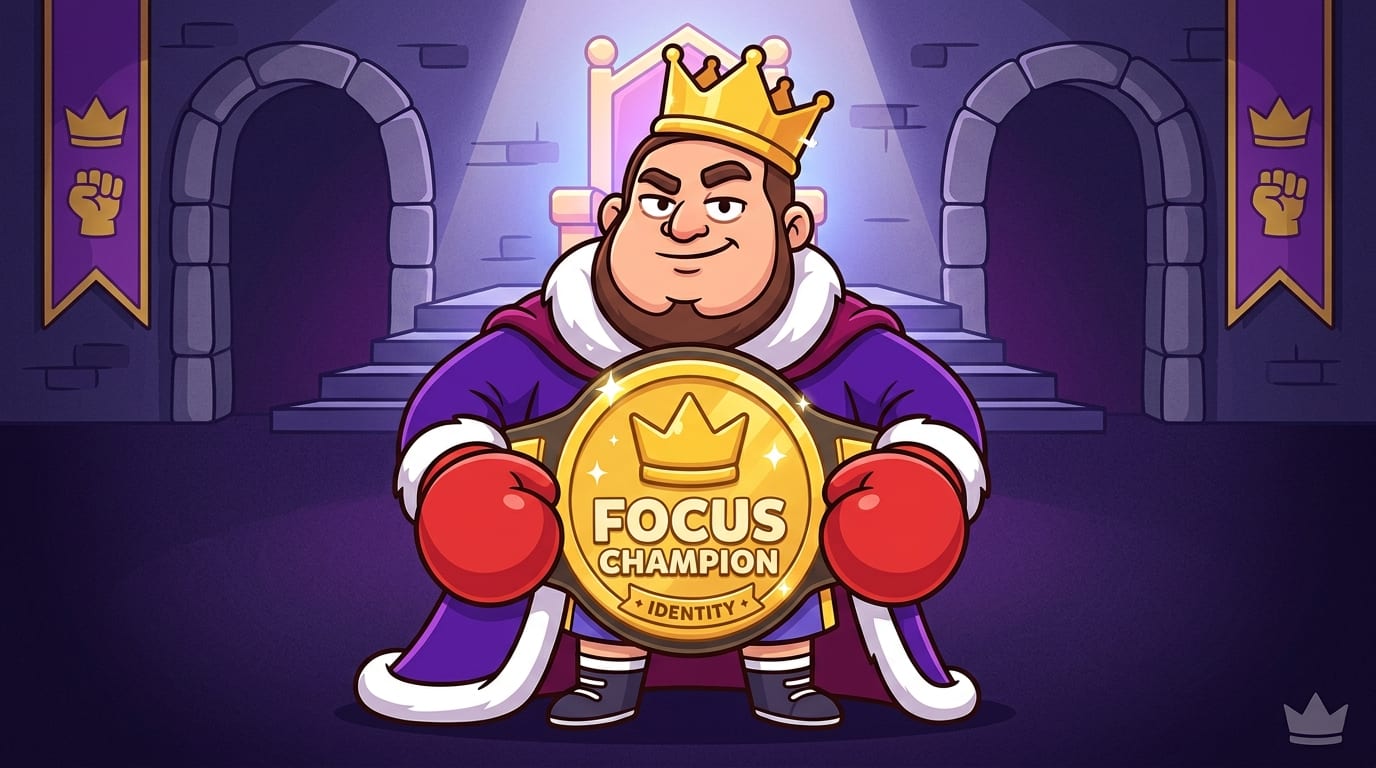
Identity-based habits are powerful because they shift the question from “What do I have to force myself to do?” to “What kind of person am I becoming?” A runner runs. A writer writes. A student studies. A focused person protects attention. A Block Champ does not hand the kingdom to a meme account at the first sign of boredom.
Try these identity statements:
- “I am someone who keeps promises to myself in small ways.”
- “I protect the first hour of my morning for growth.”
- “I do focused work before entertainment.”
- “I recover quickly when I slip.”
- “I build my life one focused block at a time.”
Then prove the identity with tiny votes. Ten minutes of reading is a vote. One workout is a vote. Blocking distracting websites during study time is a vote. Writing one paragraph is a vote. You do not need to become perfect; you need to become consistent enough that your self-image catches up.
This is also why gamification can be surprisingly useful. In BlockChamp, you start as a Peasant of Procrastination and climb through ranks like Squire of Focus, Knight of the Block, Duke of Discipline, and eventually BLOCK CHAMP — King of Your Time. Is it silly? Yes. Is silliness sometimes exactly what makes a habit stick? Also yes. The brain likes progress, status, rewards, and a little theatrical nonsense.
Track Meaningful Progress, Not Just Busy Little Checkmarks
Tracking matters, but only if you track the right things. If you track too much, your system becomes a second job. Congratulations, you invented admin-flavored procrastination. If you track too little, you cannot tell whether your focus is improving or just vibing in a fog.
Use a simple weekly review. Once per week, answer:
- How many focused sessions did I complete?
- How many total minutes or hours went toward my crown jewel goal?
- What distracted me most often?
- What environment changes helped?
- What is the next smallest improvement?
For example, if you planned four study sessions and completed two, do not scream into the motivational void. Ask why. Were the sessions too long? Scheduled at a terrible time? Did you leave Reddit unblocked like a fool opening the castle gate and saying, “Surely the goblins are busy today”?
Good tracking leads to adjustment. Maybe you need morning sessions instead of evening ones. Maybe you need shorter blocks. Maybe you need social accountability. If writing in community helps you stay consistent, check out finding focus through writing communities for a useful angle on accountability and momentum.
BlockChamp’s calendar and XP system can support this review because it shows focus hours, blocked attempts, streaks, and progress over time. You can see whether your attention is becoming more intentional. And unlike a guilt-heavy report that makes you feel like a productivity potato, BlockChamp rewards consistency and recovery. You get XP for focus minutes, active days, and surviving Stare-Downs. Even imperfect days can still count.
Plan for Slips, Because You Are Not a Spreadsheet
You will lose focus sometimes. This is not a prophecy of doom; it is basic human firmware. The key is not avoiding every slip. The key is reducing the damage and returning quickly.
Create an “if-then” recovery plan:
- If I miss a morning session, then I do a 15-minute backup session before dinner.
- If I get stuck and want to scroll, then I write the next tiny step on paper first.
- If I break my focus streak, then I restart within 24 hours.
- If I keep visiting the same distracting site, then I add it to my block list.
- If I feel overwhelmed, then I reduce the task to a 10-minute version.
This matters because shame is a terrible productivity coach. Shame says, “You failed, so why bother?” A good system says, “Interesting wobble, champ. Back on the horse. The horse has snacks.”
BlockChamp’s reign system makes this concrete without being cruel. Your reign continues as long as Master Focus stays on, and if you turn it off, the reign breaks. But you can start again. The King may be disappointed, crown drooping and all, but he is not writing a dissertation about your moral decay. He wants you back on guard.
A 7-Day Focus Reset for Personal Growth
If you want a practical way to begin, use this seven-day reset. It is simple, specific, and less annoying than buying 14 productivity apps you will abandon by Thursday.
Day 1: Pick the Goal
Choose one crown jewel goal for the next 30 days. Write your focus statement. Keep it visible.
Day 2: Identify the Villains
List your top three digital distractions. Be honest. If YouTube is eating your evenings, do not write “general media consumption.” Name the beast.
Day 3: Build the Routine
Choose your daily or weekly focus time. Add a cue, a location, a duration, and a shutdown step.
Day 4: Block the Escape Routes
Use a website blocker like BlockChamp to block your biggest distractions during focus blocks. Start with specific sites or category bundles. Let The King guard the gate while you do the heroic boring thing.
Day 5: Track One Metric
Track focused minutes or completed sessions. One metric. Not seventeen. We are building self-trust, not launching mission control.
Day 6: Review and Adjust
Ask what worked, what failed, and what needs friction. Shorten sessions if needed. Move the time. Block another site. Improve the system.
Day 7: Celebrate Like a Reasonable Champion
Celebrate consistency. Not with a six-hour binge that destroys the kingdom, but with something that reinforces your identity: a walk, a good meal, a new notebook, a guilt-free movie after your work is done. Crown polished. Throne defended.

Conclusion: Your Focus Is the Throne, So Stop Letting Raccoons Run the Kingdom
Finding focus for personal growth is not about becoming a productivity robot with perfect mornings and suspiciously organized drawers. It is about deciding what matters, protecting the time to work on it, reducing distractions before they pounce, and repeating small actions long enough that they change who you are.
Start with one crown jewel goal. Build a routine. Design your environment for your real brain, not your fantasy monk brain. Use time blocks. Track meaningful progress. Plan for slips. And when the internet tries to lure you into another scroll swamp, make it harder to surrender.
If distracting websites are stealing your best attention, give BlockChamp a try. It is a gamified website blocker for Chrome that helps you block sites, categories, and keywords, earn XP, build streaks, unlock badges, and get roasted by The King when you try to wander into distraction territory. It is focus with boxing gloves and a crown. Honestly, personal growth could use more of that.
Defend the throne. Crush the scroll. Become king of your time, champ.
Related posts

Finding Focus For Fiction Writing

Learning To Focus In A Digital World As A Creative

Nature Sounds Vs White Noise For Focus
