
Finding Focus For Creative Work

Finding focus for creative work is weirdly hard because creativity does not arrive wearing a tiny punctuality hat. It shows up when it wants, demands snacks, gets distracted by a bird outside, and then suddenly becomes brilliant at 11:47 p.m. when you should be asleep like a responsible mammal. But here is the good news: focus is not a mystical fairy blessing reserved for monks, novelists in cabins, or people who own suspiciously expensive notebooks. It is a repeatable environment, a set of habits, and a few ruthless boundaries around your attention.
If your creative work involves writing, design, music, coding, video editing, illustration, research, strategy, or building anything from the swampy soup of your imagination, you already know the enemy: context switching. One second you are shaping a great idea; the next, you are on YouTube watching a man restore a rusty toaster from 1943. The toaster wins. Your masterpiece weeps quietly in a corner.
This guide is your practical, no-incense-required playbook for finding focus for creative work. We will cover routines, distraction defense, deep work blocks, creative rituals, recovery, and tools like BlockChamp that help you defend your mental kingdom from the algorithm goblins. Crown on. Gloves up.
Quick Answers
Why Creative Focus Feels Like Wrestling an Octopus in a Wind Tunnel
Creative work is not the same as answering emails, filing receipts, or renaming 47 documents “final_FINAL_v3_reallyfinal.” Creative work asks your brain to hold ambiguity, make connections, solve fuzzy problems, and tolerate the mild existential panic of a blank page. That takes cognitive space. Lots of it.
The trouble is that modern digital life is designed to shred that space into confetti. Notifications, feeds, messages, news, shopping tabs, and “quick research” all create tiny interruptions that feel harmless. But interruptions have a cost. Research from the University of California, Irvine found that after interruptions, it can take people significant time to return to their original task, and interrupted work is often associated with more stress and effort. You can read more in Gloria Mark’s research on interrupted work.
Creative focus also has a unique problem: the work often looks like nothing from the outside. Thinking, sketching, outlining, staring, pacing, muttering “what if the villain is the accountant?”—all of that is real work. But because it does not always produce immediate visible output, your brain may panic and reach for quick dopamine. Enter social media, the royal court jester of procrastination.
The goal is not to become a robot. Robots are terrible at poetry and even worse at vibes. The goal is to build a focus system that protects the delicate early stage of creative work before the internet barges in wearing roller skates.
Start by Defining the Creative Target, Not the Whole Dragon
A huge reason people struggle with finding focus for creative work is that they sit down with a goal like “work on my book” or “make content” or “build the project.” That is not a task. That is a fog bank with a deadline.
Creative focus improves when you define the next visible action. Not the whole project. Not your destiny. Just the next thing your hands can do.
Turn vague creative goals into focus-friendly tasks
Instead of:
- “Write my novel.”
- “Design the brand.”
- “Make a video.”
- “Work on my portfolio.”
Try:
- “Draft the opening scene for 45 minutes, even if it smells like wet cardboard.”
- “Create three logo directions using only black and white.”
- “Outline the video intro, three main points, and closing call-to-action.”
- “Choose five portfolio pieces and write one sentence describing each.”
This matters because your brain can focus on a defined target. It cannot focus on “be more creative,” which is basically telling a cat to do taxes.
Before every creative session, write one sentence: “By the end of this session, I will have…” Then complete it with something tangible. A messy draft counts. A rough sketch counts. A bad melody counts. The first version is allowed to be goblin-grade. Goblins are part of the process.
If you want to go deeper on project momentum, BlockChamp has a related guide on finding focus to build creative projects, which pairs nicely with this approach. Think of it as your blueprint for turning “someday” into “today, peasants.”
Build a Pre-Focus Ritual So Your Brain Knows the Crown Is On
Waiting to “feel focused” before starting creative work is like waiting for a raccoon to politely return your wallet. It might happen, but please do not build your life around it.
A pre-focus ritual is a short, repeatable sequence that tells your brain: we are entering creative mode now. It does not need to be dramatic. You do not need a gong, a velvet cape, or a raven named Productivity. Unless you already have those, in which case, respect.
A simple 7-minute creative focus ritual
- Clear the battlefield: close unrelated tabs, apps, and documents.
- Write the session target: one specific outcome for this block.
- Set a timer: choose 25, 45, 60, or 90 minutes.
- Block distractions: turn on your website blocker or focus mode.
- Open only the tools you need: document, canvas, editor, DAW, notebook, whatever the work requires.
- Do a tiny warm-up: freewrite, sketch, hum, brainstorm, or review yesterday’s work.
- Begin ugly: make something imperfect immediately.
That last step is important. Perfectionism often disguises itself as “preparation.” You rearrange your desk. You adjust the font. You choose a playlist. You research competitors. You sharpen pencils you do not own. Suddenly the session is over and your creative output is one emotionally complex cup of coffee.
Your ritual should make starting easier, not more theatrical. The ritual is the doorway, not the castle.
Use Time Blocks, But Match Them to the Type of Creative Work
Not all creative work needs the same kind of focus. Some tasks are exploratory and messy. Others are execution-heavy and precise. If you use the same work rhythm for everything, you may accidentally bring a butter knife to a dragon fight.
Match your focus block to your creative mode
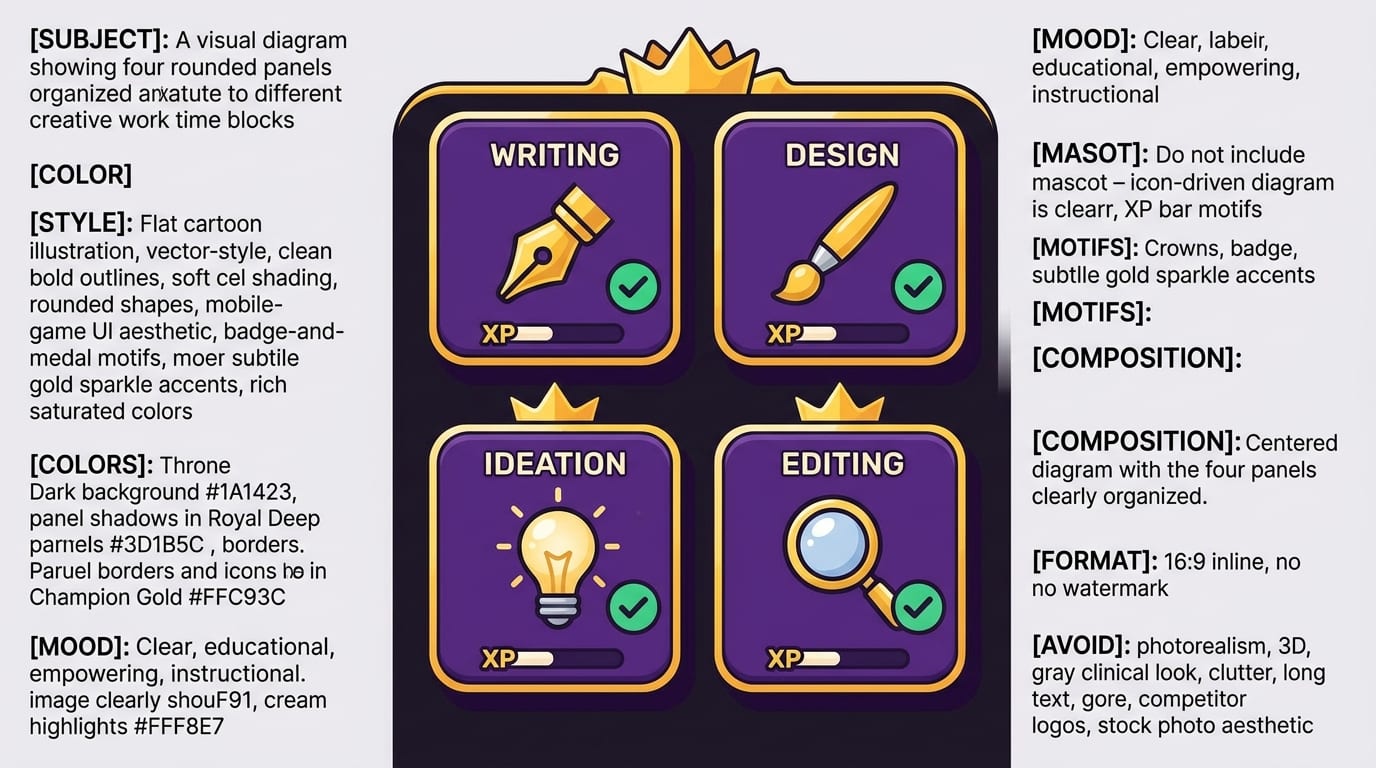
- Ideation: 20–30 minutes. Great for brainstorming, mind mapping, thumbnails, hooks, rough concepts, and options.
- Drafting: 45–90 minutes. Best for writing, composing, designing, coding, or building a first version.
- Editing: 30–60 minutes. Useful for refining, cutting, reorganizing, color correcting, mixing, or polishing.
- Admin around creative work: 15–30 minutes. Scheduling, uploading, naming files, sending invoices, preparing assets.
- Deep strategy: 60–120 minutes. Brand direction, story structure, product thinking, big-picture creative decisions.
Cal Newport popularized the concept of deep work: focused, cognitively demanding work performed without distraction. His overview of deep work principles is especially relevant for creators because high-quality creative output usually requires extended, uninterrupted concentration.
But you do not need to go full “hermit in a stone tower” every day. Start with one protected creative block. Just one. Make it sacred. Defend it like a tiny golden kingdom.
For example, a freelance designer might schedule 9:00–10:30 a.m. for concept work, then leave client emails until 11:00. A writer might draft from 7:30–8:30 a.m. before the world starts throwing Slack confetti. A musician might reserve 45 minutes after dinner for melody experiments, with no mixing or tweaking allowed.
Creative focus improves when each block has a job. Otherwise every session becomes a chaotic buffet: a little brainstorming, a little editing, a little admin, a little panic. Delicious? No. Productive? Also no.
Remove Distractions Before You Need Willpower, Because Willpower Is a Tiny Intern
Willpower is useful, but it is not built to fight a billion-dollar attention economy with infinite scroll and recommendation engines. That is not a fair fight. That is a squirrel with a pool noodle versus a tank.
According to DataReportal’s Digital 2024 Global Overview Report, people spend an average of hours per day online, with social platforms taking a major share of attention. The exact number varies by country and demographic, but the trend is obvious: the internet is not a neutral workspace. It is a carnival with Wi-Fi.
The best strategy is to remove temptations before your creative session begins. This is where BlockChamp earns its crown. It is a gamified website blocker for Chrome that lets you block distracting sites, keywords, and categories like Social Media, Video & Streaming, News, Shopping, Gaming, Gambling, Adult, and AI Distractions. One master toggle puts The King “On Guard,” which is a much better vibe than “sad gray productivity prison.”
For creative work, consider blocking:
- Social feeds: Instagram, TikTok, X/Twitter, Facebook, Reddit.
- Video rabbit holes: YouTube, Twitch, Netflix.
- News sites during drafting or ideation.
- Shopping sites, because “researching ergonomic chairs” is often procrastination in a trench coat.
- AI tools if they become avoidance machines instead of creative assistants.
BlockChamp’s Stare-Down page is especially helpful because it turns slips into a funny interruption pattern. Try to visit a blocked site and The King catches you. Not with shame. With royal judgment. The site appears on a gold plate, your reign is on the line, and you get nudged back to work. Every stare-down survived earns XP, which makes resisting distraction feel less like punishment and more like leveling up your focus character.
If distractions are currently dropkicking your creative sessions, you may also enjoy this guide to finding deep focus for creative projects. Same battlefield, bigger sword.
Create a “Distraction Capture” System So Your Brain Stops Screaming Side Quests
During creative work, your brain will generate unrelated thoughts with the urgency of a medieval town crier. “Buy toothpaste!” “Check that message!” “What if penguins had knees?” “Look up whether your old classmate became a DJ!”
Most of these thoughts are not important. But if you try to suppress them, they get louder. The trick is to capture them without obeying them.
Use a side-quest list
Keep a notepad beside you, physical or digital, titled “Later.” Whenever a distracting thought appears, write it down and return to the work. Do not investigate. Do not open a tab. Do not “just check.” The words “just check” have destroyed more creative empires than bad coffee.
Your side-quest list might include:
- Look up camera lens comparison.
- Reply to Maya.
- Find reference image for castle door.
- Check invoice status.
- Google “do penguins have knees” after work. Important science.
At the end of the session, review the list. Most items will no longer feel urgent. Some will be useful. A few will be nonsense from the goblin department. Either way, you protected the creative block.
This technique works because it reassures your brain that the thought has not been lost. You are not ignoring it forever. You are saying, “Not now, tiny chaos gremlin. The crown is busy.”
Design Your Environment for Creative Momentum
Your environment is either helping you focus or quietly pickpocketing your attention. There is rarely a neutral kingdom.
Start with physical space. You do not need a perfect studio. Many great works have been created at kitchen tables, in libraries, on trains, and in bedrooms with laundry piles that look legally sentient. But you do need cues that support the kind of work you want to do.
Make the desired action obvious
If you write, leave your draft open. If you draw, set out your tablet or sketchbook. If you compose music, open your project template before the session. If you edit video, preload the footage. Reduce the number of steps between “sit down” and “make thing.”
James Clear’s writing on habit design explains how environment shapes behavior, especially by making cues obvious and friction low. His Atomic Habits resources are useful if you want to understand why tiny environmental changes can create big behavioral shifts.
Make distractions annoying to access
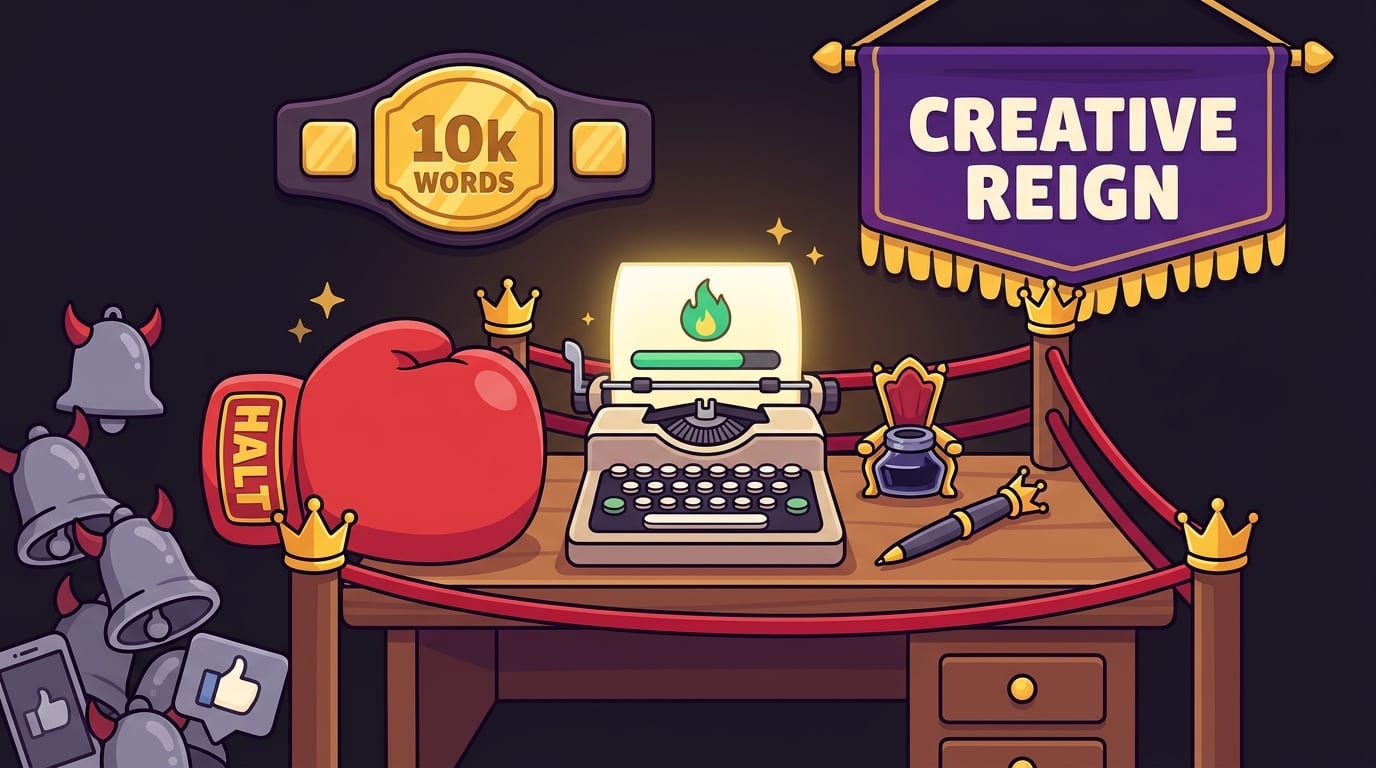
Creative focus loves friction in front of bad habits. Log out of social media. Move apps off your home screen. Keep your phone in another room. Use browser profiles: one for creative work, one for general browsing. Turn off notifications. And yes, use a blocker when your hands cannot be trusted. No judgment. Our hands are little raccoon accomplices.
BlockChamp’s Champion features are built for this exact moment. Recurring focus schedules can automatically activate blocking during your creative hours, and Hardcore Lockdown can add a cooldown timer or boxing riddle before you turn focus off. Is it ridiculous to solve procrastination with a royal boxing mini-game? Absolutely. Does ridiculous sometimes work better than another beige dashboard? Also absolutely.
Separate Creative Input From Creative Output
Creators need input. Reading, watching, listening, studying references, exploring trends, analyzing examples—this is fuel. But input can easily become avoidance. You tell yourself you are researching, and three hours later you know everything about medieval bread ovens but have written zero paragraphs. Congratulations, Duke of Sourdough.
The solution is to separate input sessions from output sessions.
Input sessions
Use input sessions for gathering material, studying, collecting references, watching tutorials, reading articles, or exploring inspiration. These sessions should have a clear question, such as:
- What visual styles could work for this landing page?
- How do other creators structure video essays?
- What are three examples of strong opening paragraphs?
- What technical step do I need to learn before editing this scene?
Output sessions
Output sessions are for making. During output, block or avoid input sources unless they are absolutely necessary. Your goal is production, not consumption. If you need a reference, use a prepared folder or limited notes rather than opening the entire internet buffet.
This distinction is especially important because platforms are built to keep you consuming. A Hootsuite digital trends report highlights how social and digital platforms continue to compete aggressively for user attention. That competition does not pause because you have a screenplay to finish. Rude, but true.
Try this rule: for every 30 minutes of creative input, schedule at least 60 minutes of creative output. Inspiration is lovely, but at some point the muse needs to stop scrolling Pinterest and pick up a hammer.
Use Constraints to Beat the Blank Page Beast
The blank page is terrifying because it contains infinite possibilities. Infinite possibilities sound poetic until your brain freezes and decides that reorganizing bookmarks is suddenly urgent.
Constraints are focus boosters because they reduce decision overload. They give your creativity a smaller box to fight inside. Weirdly, that often makes the work better.
Helpful creative constraints
- Write 500 words in 30 minutes without deleting anything.
- Create three thumbnail sketches using only circles and rectangles.
- Compose a 16-bar melody using only five notes.
- Design a landing page hero section with one headline, one image, and one button.
- Edit a video sequence to under 60 seconds.
- Draft 10 title ideas, and at least five must be terrible on purpose.
Constraints also reduce perfectionism. If the goal is “write a perfect essay,” you will probably stare at the cursor until your soul leaves through the ceiling. If the goal is “write one messy opening in 20 minutes,” you can begin. Creative focus likes beginnings. Momentum is easier to steer than stillness.
For meaningful creative work, this is crucial. You are not trying to produce genius every minute. You are trying to create enough raw material that genius has somewhere to land. Related reading: finding focus for meaningful work covers how to protect attention for projects that actually matter, not just urgent inbox confetti.
Plan Recovery Like It Is Part of the Work, Because It Is
Creative focus is not endless. Your brain is not a bottomless smoothie machine. Deep concentration uses energy, and if you never recover, your output gets stale, brittle, and weird in the bad way.
Recovery does not mean collapsing into four hours of doomscrolling and calling it “rest.” That is not rest. That is being slowly marinated by the feed.
Better recovery options after creative blocks
- Take a walk without listening to anything.
- Stretch or do light movement.
- Make food and look out a window like a mysterious cottage person.
- Read something unrelated but nourishing.
- Clean a small physical area.
- Talk to an actual human, ideally not in comment-section combat mode.
- Nap if your schedule allows and your cat permits it.
The brain often solves creative problems during downtime. This is why ideas appear in showers, walks, and moments when you are not aggressively squeezing your forehead for brilliance. Rest is not laziness. It is part of the creative loop.
That said, make recovery intentional. If you want to watch a video, watch one video. If you want to check messages, set a time box. If your “break” regularly becomes an accidental expedition into the swamp, use BlockChamp to keep certain categories blocked until your workday ends. The King is not anti-fun. The King is anti-losing-your-afternoon-to-reaction-videos-about-a-drama-you-do-not-understand.
Track Focus Wins, Not Just Finished Masterpieces
Creative projects can take weeks, months, or years. If you only reward yourself when the whole thing is finished, motivation gets very hungry. And hungry motivation becomes cranky motivation. Cranky motivation starts wearing sweatpants and muttering about quitting.
Track process wins instead:
- Number of focused sessions completed.
- Minutes or hours spent in deep creative work.
- Drafts created.
- Sketches made.
- Scenes edited.
- Distraction attempts resisted.
- Days you showed up even when the muse was being dramatic.
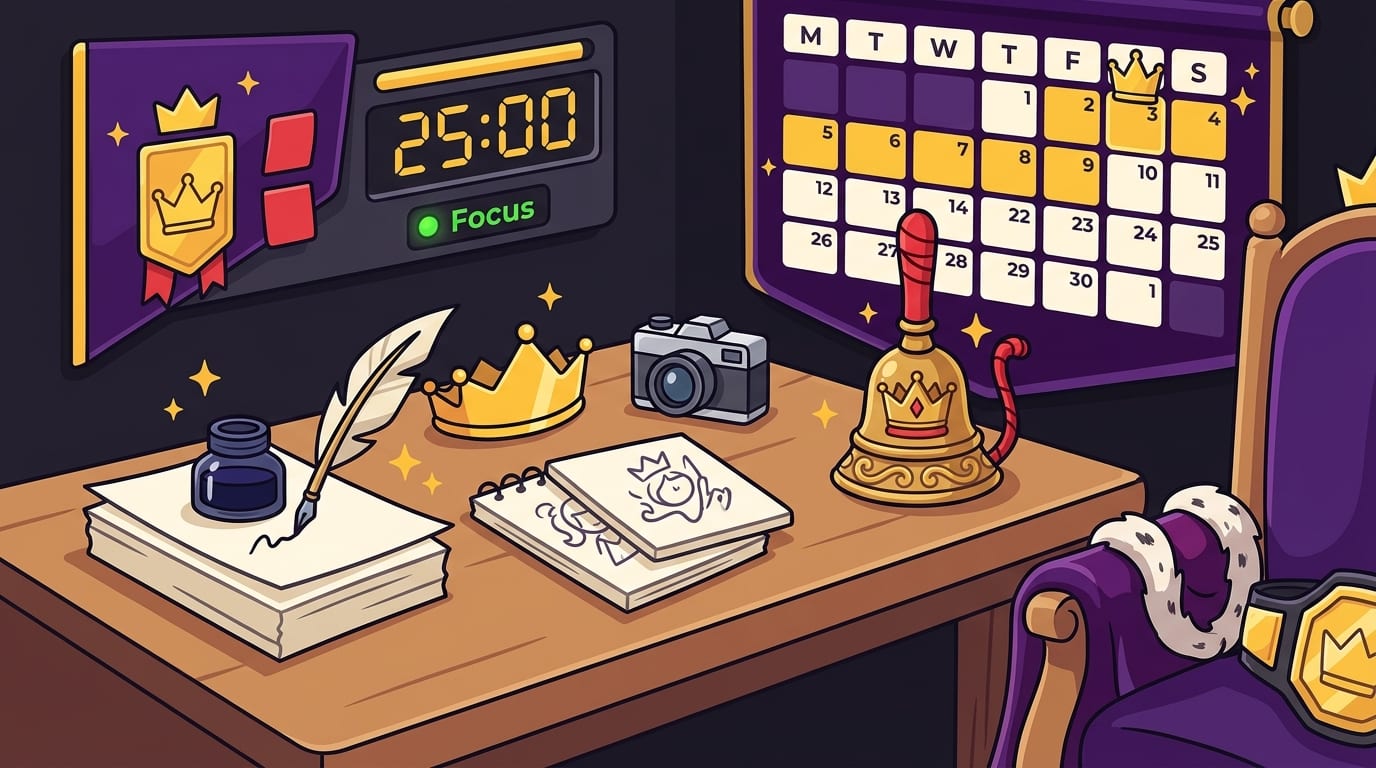
This is one reason gamified focus systems can be powerful. BlockChamp gives XP for focus minutes, active focus days, and surviving Stare-Downs. It also tracks reigns, levels, badges, and calendar progress. That turns invisible discipline into visible progress. Instead of “I only wrote a rough draft,” you get “I defended my focus for 75 minutes and kept my reign alive.” Much more regal. Much less sad trombone.
If you enjoy the relationship between creativity, work, and actual living—not just grinding until your eyeballs unionize—check out finding focus for work well and play more. Because the point of focus is not to become a productivity skeleton. It is to make better things and still have a life.
A Step-by-Step Routine for Finding Focus for Creative Work
Let’s put the whole royal recipe together. Here is a practical routine you can use tomorrow. No monastery required. No cold plunge. No 5 a.m. buffalo chant.
The 90-minute creative focus routine
- Choose one creative target: define what will exist at the end of the session. Example: “Draft the first 800 words,” “create three layout concepts,” or “record a rough vocal take.”
- Prepare your tools: open only the relevant document, app, notes, or project file.
- Activate distraction defense: turn on BlockChamp or another blocker. Block social, video, news, shopping, and whatever personally owns your attention like a tiny digital landlord.
- Set a timer for 60–90 minutes: shorter if you are new to deep work, longer if you are trained in the ancient arts.
- Warm up for 5 minutes: freewrite, sketch, review notes, or make a bad first attempt.
- Work in one mode: draft, edit, brainstorm, or polish—but do not mix all four unless chaos is your brand.
- Capture side quests: write distracting thoughts on a “Later” list.
- Stop when the timer ends: note what you accomplished and what the next step is.
- Recover deliberately: walk, stretch, hydrate, or stare nobly into the middle distance.
Repeat this routine consistently and your brain starts to learn the pattern. Creative focus becomes less about heroic effort and more about entering a familiar arena. The King rings the bell. You throw punches. The distractions wobble. Crowd goes wild.
Common Focus Mistakes Creative People Make
Even smart creators fall into predictable traps. Let us roast them gently and move on with our dignity mostly intact.
Mistake 1: Waiting for inspiration
Inspiration is wonderful, but unreliable. Build a starting ritual instead. Inspiration often arrives after you begin, fashionably late and pretending it was invited.
Mistake 2: Confusing research with progress
Research is useful until it becomes a hammock. Time-box it. Then produce.
Mistake 3: Leaving all tabs open
Every tab is a tiny attention invoice. Close them. Your browser should not look like a porcupine.
Mistake 4: Editing too early
Drafting and editing use different mental muscles. If you polish every sentence before the idea exists, you will move like a snail wearing ankle weights.
Mistake 5: Making focus too serious
If your productivity system feels like punishment, you will rebel against it. Add play. Track XP. Use streaks. Celebrate small wins. Let The King roast you when you try to wander into YouTube during a writing sprint. Comedy is underrated behavioral design.
Final Bell: Defend the Throne, Make the Thing
Finding focus for creative work is not about becoming perfectly disciplined, deleting joy, or living inside a beige spreadsheet monastery. It is about protecting the fragile, powerful space where ideas become real. That space needs boundaries. It needs rituals. It needs clear targets, fewer distractions, smart recovery, and a little momentum.
Start small. Pick one creative block this week. Define the outcome. Close the tabs. Capture side quests. Block the usual suspects. Make something ugly, then make it better. Repeat until your creative kingdom has walls, banners, and maybe a suspiciously confident royal boxer guarding the gate.
If distracting websites keep sneaking into your sessions wearing fake mustaches, give BlockChamp a try. It is a Chrome website blocker that turns focus into a game with XP, badges, reigns, leaderboards, and The King’s glorious Stare-Down when you try to betray your own schedule. Knock out your distractions. Become king of your time. Then go make the thing only you can make.
Related posts

Finding Focus For Fiction Writing

Learning To Focus In A Digital World As A Creative

Finding Focus For Personal Growth
