
Finding Deep Focus For Creative Projects

Finding deep focus for creative projects sounds romantic until you sit down to make The Thing and suddenly develop an urgent need to reorganize your desktop, research ergonomic spoons, and watch a 42-minute video titled “I Built a Tiny House for My Hamster.” Creative work is weird like that. It needs freedom, but not chaos. It needs inspiration, but not 19 open tabs and a dopamine casino wearing a TikTok hat.
If you write, design, code, compose, film, draw, build, edit, research, or generally wrestle ideas into existence, deep focus is not a luxury. It is the forge. It is where vague thoughts become real work. It is where the crown is earned, champ.
This guide breaks down practical strategies for finding deep focus for creative projects: how to set up your environment, block digital ambushes, time-block your best hours, warm up your brain, protect flow once it arrives, and build routines that survive real life. No monk cave required. Though if you have one, please add Wi-Fi blocking and tasteful candles.
Quick Answers
Why Creative Focus Is So Slippery, Sneaky, and Occasionally Feral
Creative work is not like clearing your inbox or folding laundry. You cannot always “just start” and expect instant magic to gallop in wearing a cape. Creative projects often involve ambiguity, emotional risk, and dozens of micro-decisions. That makes them prime targets for avoidance.
Your brain loves clear rewards. Social media gives you novelty now. Email gives you completion now. Shopping carts give you imaginary new-life energy now. Creative work gives you… maybe a satisfying result later, after you spend 90 minutes making something that looks like a raccoon assembled it during a power outage.
This is why finding deep focus for creative projects requires more than willpower. You need systems. You need friction against distractions. You need a ritual that tells your brain, “We are entering the arena now. Put on your little helmet.”
Research backs up the idea that attention is fragile. A well-known study from the University of California, Irvine found that after an interruption, it can take over 20 minutes to return to the original task. You can read more about interruption costs in Gloria Mark’s research on interrupted work. For creative projects, that cost can feel even higher because you are not just resuming a task—you are rebuilding a mental world.
And then there is the modern attention economy. Apps are designed to be sticky, shiny, and emotionally spicy. The Pew Research Center’s social media research shows how deeply social platforms are woven into everyday life. That does not mean you are broken for checking them. It means you are up against professional-grade distraction machinery. Tiny peasant thumbs versus billion-dollar scroll engines. Unfair fight.
So the goal is not to become a focus robot. The goal is to build a creative focus system that protects your attention long enough for real work to happen.
Start With a Creative “Why” That Is Not Fluffy Motivational Soup
Before tweaking your workspace or downloading tools, clarify what the creative project actually means to you. Not in a “follow your dreams, sparkle wizard” way. In a practical way.
Deep focus becomes easier when your brain understands the stakes. A vague task like “work on my novel” is mush. A concrete mission like “draft the scene where the detective realizes the dog is the accountant” is workable. Weird, but workable.
Turn the project into a mission
Ask yourself these questions before each focus session:
- What specific part of the project am I moving forward today?
- What does “done for today” look like?
- What decision am I avoiding because it feels scary or unclear?
- What would make this session a win, even if the work is imperfect?
For example, instead of writing “work on portfolio,” write: “Choose three case studies, outline the first one, and collect screenshots.” Instead of “make music,” write: “Build a 16-bar drum groove and test two bassline ideas.” Instead of “design app,” write: “Sketch three onboarding screen concepts and pick one direction.”
Creativity loves room to roam, but focus needs a fence. A mission gives your brain that fence. Not a prison fence. More like a royal garden wall with fewer raccoons.
If your project is big and foggy, you may also like BlockChamp’s related guide on finding focus to build creative projects, which digs into turning big creative ambitions into workable sessions without losing your crown to overthinking.
Design a Focus Environment That Does Not Invite Chaos to Tea
Your environment is either helping you focus or quietly mugging your attention in an alley. The good news: you do not need a perfect studio. You need fewer visual hooks, fewer digital traps, and a repeatable setup.
Physical space: boring is beautiful
A focus-friendly creative environment should reduce decision fatigue. Keep the tools you need visible and the tools you do not need out of reach. If you are writing, keep your notebook, outline, water, and keyboard ready. If you are drawing, prep the tablet, reference folder, and brush set. If you are editing video, open the project file and close the browser tab where chaos lives.
Try this five-minute reset before creative work:
- Clear your desk of anything unrelated to the project.
- Put your phone across the room, face down, preferably under something mildly annoying to move.
- Open only the apps and files required for the session.
- Set water or coffee nearby so you do not wander into the kitchen and accidentally become a snack archaeologist.
- Write your session mission on a sticky note or in a visible document.
Noise matters too. Some people focus best in silence; others need ambient sound, instrumental music, or coffee-shop background noise. The key is consistency. If you use the same soundscape every time you enter deep work, your brain starts associating it with creation. Pavlov, but with lo-fi beats and fewer bells.
Digital space: the true battlefield
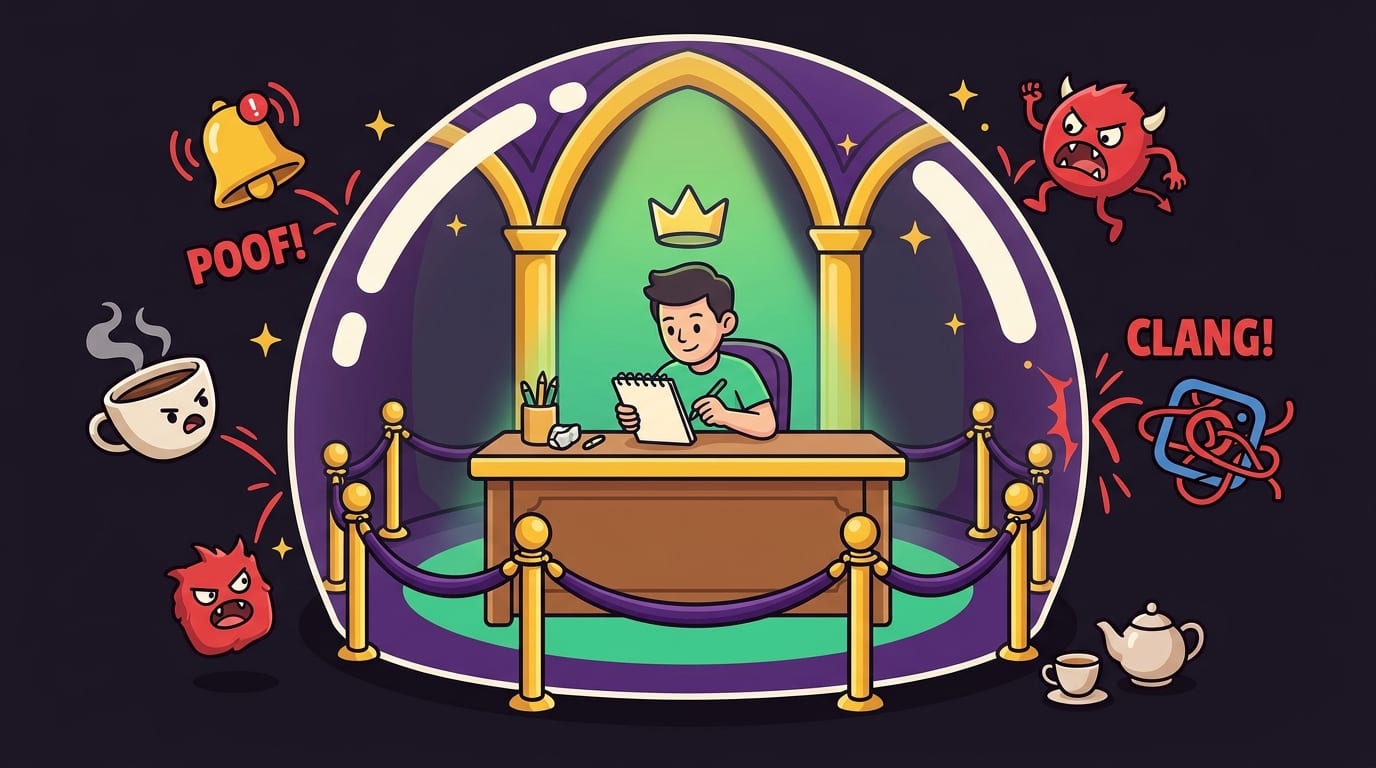
Your browser is probably where creative focus goes to be turned into soup. You open one reference image and somehow wake up inside a Reddit thread about medieval bread laws. This is where intentional blocking helps.
A tool like BlockChamp is useful because it turns distraction defense into a game instead of a punishment dungeon. You can block specific sites, categories like Social Media or Video & Streaming, and—if you go Champion—keywords that keep pulling you off mission. When you try to visit a blocked site, The King gives you a full-screen Stare-Down instead of a bland error page. It is surprisingly effective to have a royal boxer silently judge your attempt to “just check YouTube for research.” Sure, buddy. Research.
The point is not to block the whole internet forever. The point is to remove the most obvious escape hatches during your creative sessions so your attention has a fighting chance.
Time-Block Your Best Creative Hours Like They Are Royal Treasure
Finding deep focus for creative projects gets much easier when you stop hoping focus appears randomly and start scheduling it like a serious appointment. Your creative time deserves a calendar slot, not whatever crumbs are left after notifications have eaten the kingdom.
Time-blocking works because it reduces negotiation. You are not asking, “Should I work on my project now?” You are following the plan Past You made when Past You was wiser and less tempted by snack videos.
Find your creative prime time
Not everyone is a 5 a.m. phoenix person. Some people do their best creative work at night when the world is quiet and their inbox has stopped screaming. Track your energy for a week and look for patterns:
- When do ideas feel easiest?
- When do you have the fewest interruptions?
- When does your brain feel sharp instead of pudding-adjacent?
- When are you least likely to be pulled into meetings, chores, or social obligations?
Once you find a promising window, defend it. Start with 60 to 90 minutes. That is long enough to enter meaningful focus but not so long that your brain files a complaint with management.
The American Psychological Association has discussed how multitasking and task switching reduce efficiency; their overview on the costs of multitasking is a good reminder that “quickly checking something” is often not quick at all. It is a tiny attention tax collector wearing a fake mustache.
Use theme blocks, not just task blocks
For creative projects, time blocks work better when they match the type of mental energy required. Separate your work into modes:
- Generate: drafting, sketching, brainstorming, composing, prototyping.
- Refine: editing, polishing, arranging, revising, improving details.
- Research: gathering references, studying examples, collecting data.
- Admin: uploading, formatting, emailing, organizing, publishing.
Do not mix all four in one session unless you enjoy mental spaghetti. A writer might draft in the morning and edit in the afternoon. A designer might research on Monday, prototype Tuesday, refine Wednesday. A YouTuber might script one day, shoot the next, edit in a separate block.
Theme blocks make deep focus easier because your brain knows which gear to use. You are not shifting from imagination to criticism every six minutes like a squirrel operating heavy machinery.
Create a Pre-Focus Ritual So Your Brain Knows It Is Go Time
Rituals sound fancy, but they are just repeatable cues. Athletes warm up before competing. Musicians tune before performing. Creative workers need a ramp into deep focus, too. Otherwise you go from “checking messages” to “inventing a universe” with no transition, which is rude to your nervous system.
Your ritual should be short, simple, and repeatable. Ten minutes is plenty. The goal is to signal: the throne is guarded, the tabs are closed, the work begins.
A simple 10-minute creative focus ritual
- Minute 1: Put your phone away and activate your blocker.
- Minutes 2-3: Clear your workspace and open only project materials.
- Minutes 4-5: Review your session mission and define the finish line.
- Minutes 6-8: Do a tiny warm-up: freewrite, sketch thumbnails, play scales, review yesterday’s work.
- Minutes 9-10: Set a timer, take one deep breath, and begin with the smallest next action.
If you use BlockChamp, this is a great moment to flip the Master Focus Toggle to “On Guard.” Blocking becomes part of the ritual. The King stands guard, your reign continues, and every focused minute earns XP. It is the productivity equivalent of putting on boss music before entering the arena.
For more routine-building ideas, BlockChamp’s post on finding focus for creative projects pairs nicely with this guide, especially if your main struggle is getting started rather than staying started.
Protect Flow Once It Arrives, Because Flow Is a Skittish Little Deer
Flow is that magical state where time gets weird, the work starts pulling you forward, and you briefly become the person your notes app thinks you are. It is powerful. It is also fragile. One notification can punt you out of it like a medieval catapult.
Psychologist Mihaly Csikszentmihalyi popularized the concept of flow, describing it as a state of deep absorption where challenge and skill are well matched. The Britannica overview of flow psychology gives a clear summary of the concept if you want the brainy version without falling into a 12-tab academic swamp.
Keep the challenge level just right
If the task is too easy, you get bored. If it is too hard, you panic and flee to Instagram like a tiny digital coward. Flow lives between those extremes.
Adjust the task until it feels challenging but possible:
- If it feels too hard, shrink it: “Write the opening paragraph” instead of “finish chapter.”
- If it feels too easy, add a constraint: “Create three logo concepts using only two colors.”
- If it feels too vague, define an output: “Export a rough 30-second edit.”
- If it feels emotionally loaded, lower the stakes: “Make a bad first version on purpose.”
That last one is sneaky powerful. Bad first versions are creative crowbars. They pry open momentum. You can improve ugly work; you cannot revise a blank page sitting there smugly like a little ghost.
Use a distraction capture list
During deep work, your brain will throw random thoughts at you: pay bill, look up camera lens, text Maya, learn Portuguese, become beekeeper. Do not obey these thoughts. Capture them.
Keep a small notepad or document called “Later.” When a non-project thought appears, write it down and return to the work. This reassures your brain that the thought is not lost, while preventing you from leaving the creative cave to chase it.
Think of it as a moat around the kingdom. The thoughts can splash around out there. They do not get the drawbridge.
Block the Right Distractions, Not the Entire Civilization
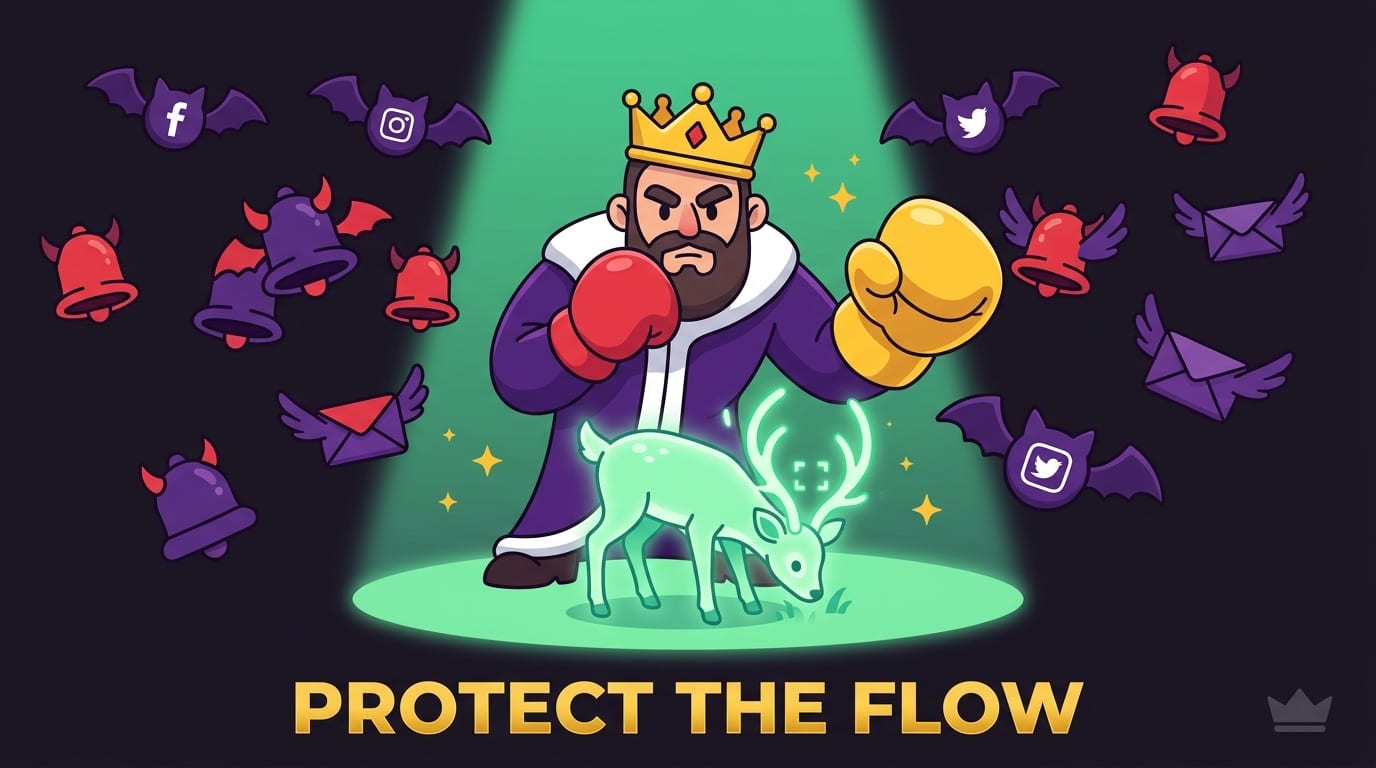
One common mistake is trying to create a perfect distraction-free life. That usually lasts 11 minutes, then collapses under the weight of normal human existence. A better approach: identify your top distraction villains and block those during creative time.
For most creators, the usual suspects are:
- Social media platforms you check automatically.
- Video sites that start as “research” and end as “man restores rusty axe for 27 minutes.”
- News sites that feed urgency but not output.
- Shopping sites that turn creative anxiety into cart-building.
- AI tools used as avoidance instead of assistance.
- Chat apps that make everyone else’s priorities feel like yours.
Notice the AI point. AI can be useful for brainstorming, outlining, coding help, and research support. But it can also become another shiny cave where you keep asking for “one more version” instead of making a decision. Sometimes finding deep focus for creative projects means blocking even helpful tools temporarily so you can develop your own thinking.
BlockChamp makes this practical with category blocking. If your creative session is for drafting, block Social Media, Video & Streaming, and News. If you keep falling into AI tinkering, Champion users can block AI Distractions or use keyword blocking for specific rabbit holes. Free users can still block up to three sites and enable two categories, which is enough to knock out the biggest offenders.
If your creative life overlaps with writing professionally, this related BlockChamp article on finding focus to write for a living is worth reading. Writing for money adds deadlines, clients, and pressure goblins. Different beast. Same crown.
Use Breaks Like a Pro, Not Like a Person Who “Accidentally” Opens TikTok
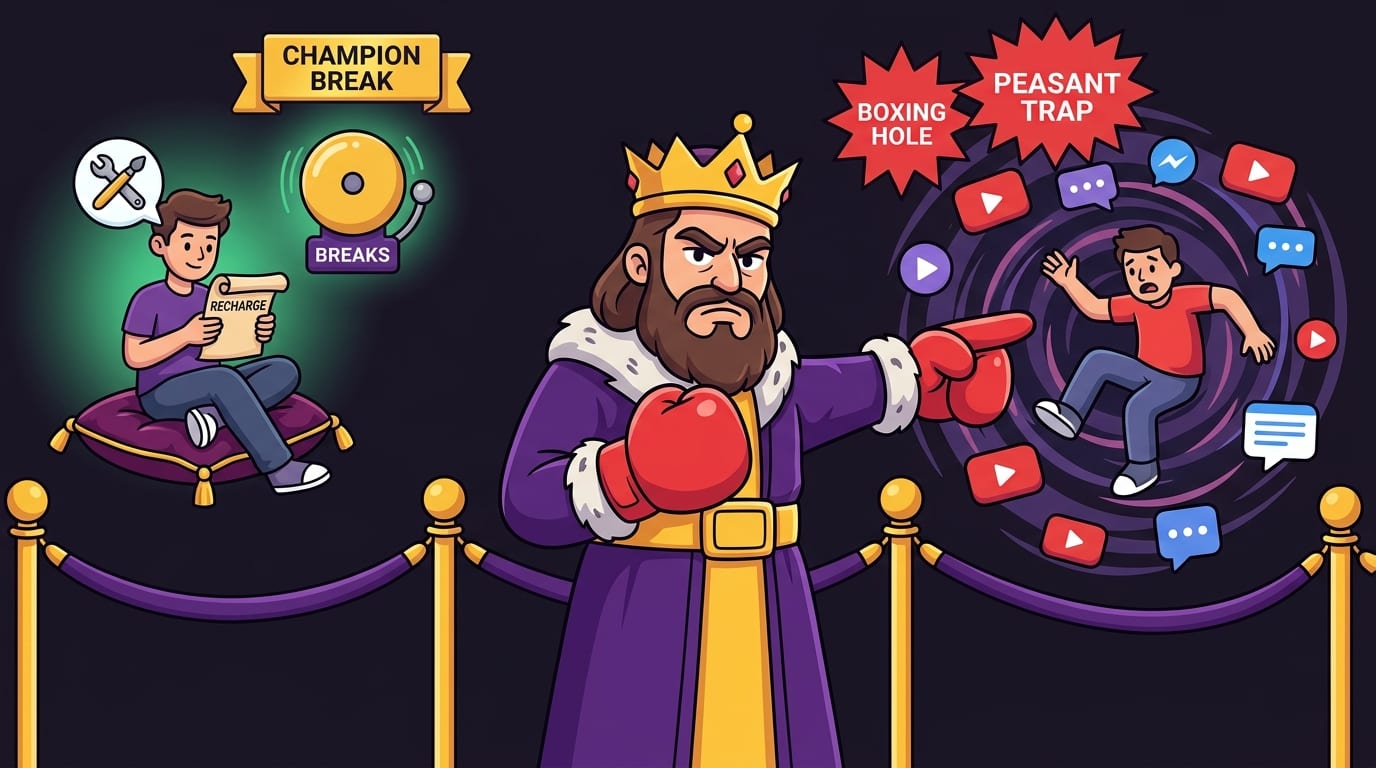
Breaks are not the enemy. Bad breaks are the enemy. A good break restores attention. A bad break detonates it and leaves your focus in a decorative crater.
The best creative breaks are low-input and embodied. Move your body. Look out a window. Make tea. Stretch. Walk around the block. Do not immediately feed your brain a slot machine of novelty. Your attention is trying to recover, not enter a glitter tornado.
The 90/15 deep focus rhythm
Many creators do well with a 90-minute work block followed by a 10- to 15-minute break. Ninety minutes is long enough for immersion; the break prevents burnout. If 90 minutes feels too big, start with 45/10 or 50/10.
During breaks, try:
- Walking without headphones for five minutes.
- Stretching your neck, wrists, hips, and back.
- Refilling water and eating something that is not just panic cereal.
- Writing one sentence about what to do next when you return.
- Stepping outside for natural light.
That “what to do next” sentence is clutch. It creates a re-entry ramp. When you come back, you do not waste 12 minutes asking, “Where was I?” like a confused wizard.
If you use BlockChamp, keep Focus Mode on during breaks unless the session is truly over. The whole point is to avoid turning a break into surrender. The King can keep standing guard while you stretch your hamstrings and question your chair choices.
Train Your Mindset: Focus Is a Practice, Not a Personality Trait
Some people talk about focus like you either have it or you do not. Nonsense. That is like saying you are either a marathon runner or a sofa. Focus is trainable. Creative stamina grows through repetition, feedback, and compassion that does not become excuse-making.
Deep focus will not feel amazing every time. Some sessions are glorious. Some are gritty. Some produce three useful sentences and one drawing that looks personally offended. That is normal. The win is showing up consistently enough that your brain trusts the routine.
Use identity to make focus stick
Instead of saying, “I need to stop procrastinating,” try: “I protect my creative time.” Instead of “I am bad at focus,” try: “I am training deep work like a skill.” Identity-based habits are powerful because they turn actions into evidence of who you are becoming.
This is where gamification can help. BlockChamp’s XP, levels, badges, reigns, and leaderboard turn focus into visible progress. You are not just avoiding YouTube; you are defending a reign. You are not just closing Reddit; you are surviving a Stare-Down and earning XP. It sounds goofy because it is goofy. It also works because motivation likes feedback.
The habit research world often talks about cues, rewards, and environment design. James Clear’s writing on building better habits is a useful primer if you want a deeper dive into why small systems beat heroic bursts of willpower.
Do not aim for perfect focus. Aim for faster recovery. The difference between a distracted creator and a focused creator is not that the focused one never slips. It is that they notice sooner, return faster, and build systems that make the next slip less likely.
Build a Weekly Creative Focus System You Can Actually Repeat
A single great focus session is lovely. A repeatable weekly system is where projects get finished. The trick is to create a rhythm that matches your life instead of copying someone else’s productivity cosplay.
Here is a simple weekly structure for creative projects:
- Monday: Plan the week, define project milestones, choose focus blocks.
- Tuesday: Deep creation block for new work.
- Wednesday: Second deep creation block or research block.
- Thursday: Refinement, editing, testing, critique, or iteration.
- Friday: Ship, publish, share, archive, or review progress.
- Weekend: Optional playful exploration with low pressure.
This does not need to be rigid. If you work shifts, study full time, parent small chaos goblins, or juggle freelance clients, adjust the days. The principle is what matters: separate planning, making, refining, and shipping.
At the end of each week, run a 10-minute review:
- What did I finish or move forward?
- Where did I lose focus most often?
- Which time block worked best?
- Which distraction needs stronger blocking next week?
- What is the first creative mission for next week?
BlockChamp’s focus calendar can make this review more concrete by showing which days you stayed focused and where your reign held strong. You can see patterns instead of relying on vibes, and vibes are notoriously bad project managers.
If your creative work connects to academic research, long-form studying, or complex information gathering, check out finding focus for academic research. Research-heavy creativity has its own trap: “just one more source” until the sun explodes.
When You Get Stuck, Do Not Immediately Blame Your Discipline
Creative blocks are not always focus problems. Sometimes you are tired. Sometimes the next step is unclear. Sometimes the project has a hidden decision you have not made yet. Sometimes your draft is bad because drafts are allowed to be bad. Shocking legal development.
Before calling yourself lazy, diagnose the stuckness:
- If you feel bored: Add challenge, constraints, or a clearer goal.
- If you feel anxious: Lower the stakes and make a deliberately rough version.
- If you feel scattered: Reduce inputs and block distracting sites.
- If you feel confused: define the next decision, not the whole project.
- If you feel exhausted: rest, eat, move, or sleep. You are a mammal, not a spreadsheet.
One useful method is the “next visible step” rule. Ask: What is the smallest action I can see clearly? Not the entire strategy. Not the five-year plan. Just the next visible step. Open the file. Name the scene. Sketch the layout. Import the footage. Write the ugly headline. Momentum often arrives after action, not before.
And if you keep escaping to the same site whenever discomfort appears, that is valuable data. Block it during creative blocks. Let The King roast the impulse before it becomes a 45-minute scroll spiral. The crown does not approve of “research” that somehow includes celebrity kitchen tours.
Conclusion: Defend the Throne, Make the Thing
Finding deep focus for creative projects is not about becoming a flawless productivity monk with a spotless desk and suspiciously calm hair. It is about building conditions where your best attention can show up more often: clear missions, protected time blocks, a distraction-resistant environment, smart breaks, and a mindset that treats focus as a trainable craft.
Creative work will always involve uncertainty. That is part of the deal. But you can stop making it harder by letting every app, tab, ping, and scroll goblin wander into your studio wearing muddy boots.
Start small. Pick one project. Choose one 60- to 90-minute focus block this week. Define the mission. Clear the space. Block your biggest distractions. Begin before you feel perfectly ready, because perfectly ready is a scam wearing a fancy hat.
And if your browser keeps betraying you, let BlockChamp stand guard. Block the sites, earn the XP, build your reign, survive The Stare-Down, and become king of your time. Your creative project does not need more doomscrolling. It needs you, champ. Gloves up. Crown on. Make the thing.
Related posts

Finding Focus For Fiction Writing

Learning To Focus In A Digital World As A Creative

Finding Focus For Personal Growth
