
Finding Focus For Academic Research

Finding focus for academic research is a little like trying to read a fragile medieval manuscript while a circus performs inside your browser. One tab says “peer-reviewed literature.” Another tab says “just one quick Reddit thread about why medieval peasants had surprisingly good teeth.” Suddenly it is 1:17 a.m., your coffee is cold, your Zotero library is chaos, and your research question has evolved into “What am I doing with my life?”
Academic research demands a rare blend of curiosity, patience, structure, and stubbornness. You need to explore widely without wandering forever. You need to read deeply without drowning in PDFs. You need to write clearly while your brain begs for dopamine snacks from YouTube, TikTok, news, email, and the cursed notification goblin.
This guide gives you practical, step-by-step strategies for finding focus for academic research: narrowing your topic, setting research goals, mapping literature, time-blocking your work, managing digital distractions, and turning your research process into something less like a swamp and more like a kingdom. Crown optional. Sanity recommended.
Quick Answers
Why Academic Research Feels So Unfocused in the First Place
Before we fix the problem, let’s stop pretending you are “just bad at focus.” Academic research is structurally messy. It involves uncertainty, ambiguity, long feedback loops, and a terrifying amount of reading. Unlike answering emails or folding laundry, there is rarely a clear finish line. Your brain loves finish lines. Research gives it fog and says, “Good luck, champ.”
There are three big reasons research focus collapses:
- Too many possible directions: Every article points to five more articles, and every theory has cousins, enemies, and weird uncles.
- No immediate reward: Reading a dense paper for two hours may produce one usable sentence. Congratulations, scholar. Here is your invisible trophy.
- Digital temptation: Most research happens on the same device that contains social media, streaming, shopping, gaming, AI tools, and your favorite “quick break” traps.
Research on attention supports what every student already knows in their bones: interruptions are expensive. A widely cited study from the University of California, Irvine found that after an interruption, it can take people over 20 minutes to return to their original task context. You can read more about Gloria Mark’s work on interruption and attention through this research paper on interrupted work. In academic research, that context is not just “where was I?” It is “which argument was this author making, how does it relate to my framework, and why did I highlight the word ‘ontological’ like it owed me money?”
The goal is not to become a robot scholar who never gets distracted. The goal is to build a system that makes focused research easier to start, easier to continue, and harder to casually abandon for a 37-minute video essay about cereal mascots.
Start With a Research Question That Does Not Eat the Entire Universe
The first step in finding focus for academic research is narrowing the battlefield. A vague topic creates vague work. If your topic is “social media and mental health,” you do not have a research project. You have a continent. Bring hiking boots.
A focused research question gives your brain a target. It tells you what to read, what to ignore, what evidence matters, and what belongs in the “interesting but not today, little gremlin” folder.
Use the Funnel Method
Start broad, then narrow by population, timeframe, place, method, theory, or outcome. For example:
- Broad topic: Social media and mental health
- Narrower: Social media use and anxiety among university students
- More focused: The relationship between TikTok use and academic anxiety among first-year university students
- Researchable question: How does nightly TikTok use relate to self-reported academic anxiety among first-year university students during exam periods?
That final question is not perfect, but it is researchable. It has a population, platform, outcome, and context. The crown fits a little better.
Try the “So What?” Test
Once you have a question, ask “So what?” three times. This forces you to clarify why the question matters.
- Question: How do remote graduate students build academic community?
- So what? Because belonging affects persistence and motivation.
- So what? Because remote students may lack informal campus support networks.
- So what? Because universities designing online programs need evidence-based support structures.
Now the project has stakes. It is not just “remote students: vibes?” It has purpose. Beautiful. The King nods approvingly from the throne.
Build a Literature Map Before Your PDFs Form a Rebellion
A major enemy of research focus is PDF hoarding. You download 83 articles, skim seven, cite two, forget 41, and develop emotional resentment toward the other 33. This is not a workflow. This is a dragon’s cave with DOI numbers.
A literature map helps you see the shape of the conversation. Instead of treating every article as a separate beast, you organize sources by theme, method, theory, findings, and gaps.
Create Five Columns for Every Source
Use a spreadsheet, Notion table, Google Sheet, Obsidian note, or the back of an envelope if you are feeling feral. Track:
- Citation: Author, year, title, journal.
- Main argument: One or two plain-language sentences.
- Method/data: Survey, experiment, interview, archival analysis, theoretical paper, etc.
- Useful evidence: Key findings, quotes, models, or statistics.
- Relevance: How it connects to your research question.
The last column is the most important. If you cannot explain how a source helps your project, it may be interesting but irrelevant. Academic research requires intellectual manners: not every source gets invited to dinner.
For a more formal overview of literature review structure, the University of North Carolina Writing Center has a helpful guide to writing literature reviews. It is clear, practical, and unlikely to call you a peasant, which is generous of them.
Sort Sources Into Camps
Once you have 15–30 sources, group them into categories:
- Foundational theories
- Recent empirical studies
- Methods you may imitate or critique
- Contradictory findings
- Gaps and limitations
- Definitions and key terms
This turns your literature review from “here are some papers I read while slowly fossilizing” into a structured argument. You are not summarizing sources one by one like a tired librarian in a thunderstorm. You are showing how the scholarly conversation works.
Turn Research Goals Into Tiny, Unembarrassing Tasks
“Work on dissertation” is not a task. It is a haunted mansion. “Read Smith 2021 and write five bullet notes about methods” is a task. It has edges. It can be completed before your brain stages a coup.
Focused academic work improves when you break giant goals into tiny next actions. This reduces friction and protects you from the classic research doom spiral: open laptop, stare into void, panic, check email, accidentally shop for desk lamps.
Use Outcome Goals and Process Goals
You need both:
- Outcome goal: What you want finished by a deadline. Example: “Draft the literature review section by Friday.”
- Process goal: What you will do today. Example: “Read three articles and write 300 words connecting them.”
Outcome goals give direction. Process goals create movement. Direction without movement is daydreaming in a blazer.
Use the “Next Visible Step” Rule
At the end of every research session, write down the next concrete step for tomorrow. Not “continue reading.” That is mush. Try:
- “Open Patel 2022 and summarize the limitations section.”
- “Add three sources to the methods comparison table.”
- “Write the paragraph explaining why self-report data is imperfect but useful.”
- “Search for studies on first-generation students and belonging published after 2020.”
This gives your future self a ramp back into focus. Future you is tired. Future you needs breadcrumbs. Be kind to that little academic raccoon.

Time-Block Like a Scholar, Not a Chaos Goblin
Academic research expands to fill every available hour if you let it. That does not mean you are working deeply the whole time. It often means you are orbiting the work: opening tabs, adjusting fonts, reorganizing folders, and pretending that color-coding your notes is basically analysis. It is not. It is academic interior decorating.
Time-blocking gives your research a container. It tells your brain, “For the next 90 minutes, we are doing one thing.” No vague all-day suffering. No heroic 11-hour “grind” followed by three days of burnout and dramatic soup consumption.
The evidence behind focused work intervals is practical rather than magical. The American Psychological Association has written about the cognitive cost of multitasking, noting that task switching can reduce efficiency and increase mental load. Their overview on multitasking and task switching is a useful reminder that your brain is not a browser with infinite tabs, even if it insists on behaving like one.
A Simple Research Time-Blocking Template
Try this structure for a two-hour research block:
- First 10 minutes: Review your research question and choose one task.
- Next 40 minutes: Deep reading or data analysis. No messaging. No “quick” anything.
- Next 10 minutes: Break. Stand up. Hydrate. Stare out a window like a Victorian poet.
- Next 40 minutes: Write notes, draft paragraphs, code data, or build your literature map.
- Final 20 minutes: Summarize what you learned and write the next visible step.
If you only have 45 minutes, shrink it:
- 5 minutes to choose the task
- 30 minutes to execute
- 10 minutes to summarize and set the next step
Short blocks count. Do not let perfectionism convince you that if you cannot do four majestic hours of candlelit scholarship, you might as well watch raccoon videos. That is how the raccoons win.
Protect Your Browser From Betraying You
For most academic researchers, the browser is both library and trapdoor. You need Google Scholar, JSTOR, library databases, citation managers, online archives, and maybe institutional portals that look like they were designed during the Bronze Age. But the same browser also contains Instagram, YouTube, Reddit, news, shopping, and whatever website tells you which soup matches your personality.
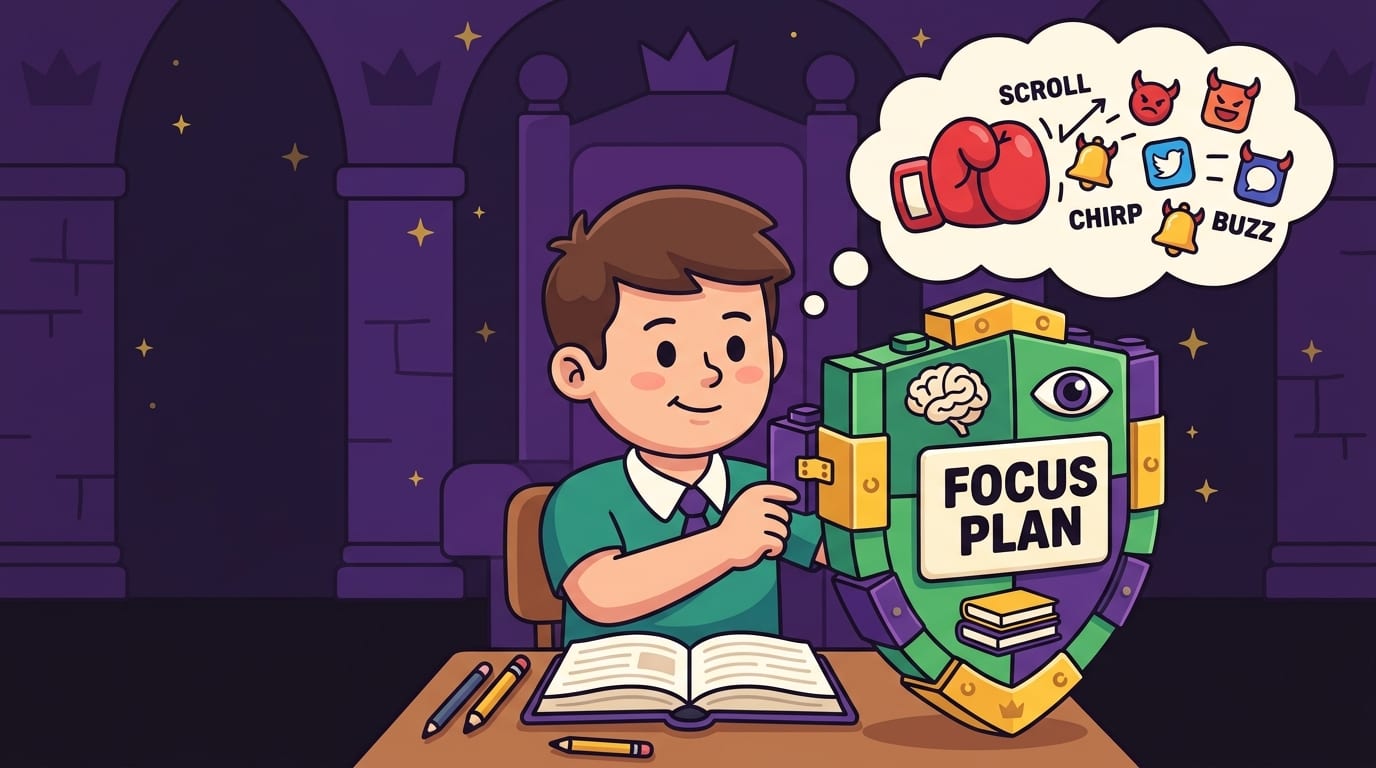
This is where environmental design matters. Willpower is cute, but it gets tired. Systems are better.
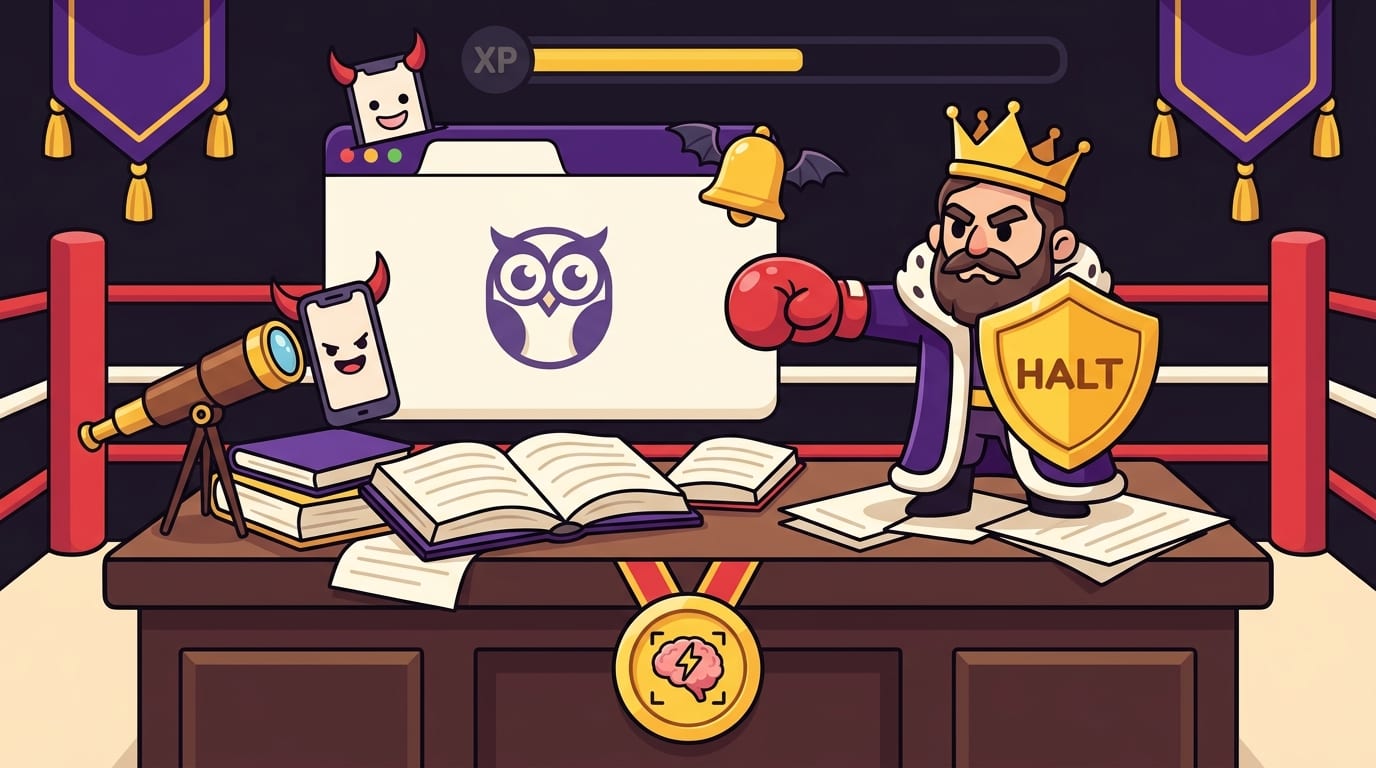
BlockChamp is built for exactly this problem: helping students, professors, writers, and researchers block distracting websites on Chrome without turning productivity into a beige punishment bunker. You can use it to block specific sites like YouTube or Reddit, toggle entire categories like Social Media, Video & Streaming, News, Shopping, Gaming, and AI Distractions, and keep your research hours protected with one Master Focus Toggle. When you try to sneak into a blocked site, The King delivers a full-screen Stare-Down and sends you back to work. It is basically peer review, but wearing boxing gloves.
If you are doing serious academic work, try creating a “research lockdown” list:
- Social media platforms you check compulsively
- Video sites that become “just one lecture” and then “why am I watching a man restore a toaster?”
- News sites during writing sessions
- Shopping sites during stressful deadlines
- AI tools when they become avoidance machines instead of genuine assistants
For related focus strategies, you may also like BlockChamp’s guide to finding focus as a professor and author, especially if your research life includes teaching, writing, meetings, and the occasional inbox avalanche. If your academic work overlaps with long-form writing, the post on finding focus to write for a living has useful tactics for protecting drafting time.
Separate Exploration Mode From Execution Mode
One reason finding focus for academic research is difficult is that research contains two very different activities: exploration and execution. Exploration is open-ended. Execution is focused. If you mix them constantly, you get the mental equivalent of trying to cook dinner while reorganizing the grocery store.
Exploration Mode
Exploration is for searching, browsing, following citations, discovering frameworks, and asking better questions. It is messy by design. During exploration, your job is to collect possibilities without committing too soon.
Good exploration tasks include:
- Searching databases for recent studies
- Reading abstracts to identify patterns
- Following citation trails from key papers
- Comparing definitions across authors
- Listing possible subtopics or variables
Execution Mode
Execution is for producing something concrete: annotated notes, a literature map, a paragraph, a coded dataset, a methods table, an outline, or a draft section.
Good execution tasks include:
- Writing 500 words on one theme
- Summarizing five sources in your literature matrix
- Creating a table comparing methods
- Drafting your research question and rationale
- Revising one section for clarity
Label your sessions before you begin. Say, “This is exploration mode” or “This is execution mode.” It sounds tiny. It is not. It prevents the classic mistake of “writing” for two hours while actually searching for more sources because writing is scary and databases feel productive. Sneaky little goblin behavior. We see you.
Use Writing as a Thinking Tool, Not a Final Boss
Many researchers postpone writing until they “understand everything.” Adorable. Dangerous. You will never understand everything. Academia is a buffet with no exit sign. Writing is how you discover what you understand.
Instead of treating writing as the final stage, use it throughout the research process. Write messy memos. Write one-paragraph summaries. Write “what I think this means” notes. Write questions you cannot yet answer. Your future paper, thesis, dissertation, or article will grow from these fragments.
Try Three Kinds of Research Notes
- Summary notes: What does this source argue?
- Connection notes: How does this source relate to another source?
- Use notes: How might I use this in my project?
That third category is gold. A source might help you define a concept, justify your method, explain a contradiction, support your argument, or identify a gap. If you only summarize, you create a pile. If you connect and apply, you create a scholarly argument.
If you struggle to move from idea to written output, BlockChamp’s article on finding focus for meaningful work pairs well with academic research because it deals with the emotional weight of important projects. Research is meaningful work. It is also occasionally annoying work wearing a tweed jacket.
Create a Distraction Protocol Before You Need One
Do not wait until you are tired, stressed, and one click away from “quickly checking” TikTok to decide how you will handle distraction. That is like deciding your fire escape plan after the dragon arrives.
Create a distraction protocol in advance. Simple. Written. Ruthlessly practical.
Your Academic Research Distraction Protocol
- Capture the urge: Keep a “later list” next to you. When you want to check something unrelated, write it down instead.
- Delay by 10 minutes: Tell yourself you can check it after the current focus sprint. Often the urge evaporates like a dramatic little ghost.
- Block the obvious traps: Use a tool like BlockChamp to block your known distraction sites during research hours.
- Define allowed tools: Decide which sites are permitted: library databases, Google Scholar, citation manager, university portal, document editor.
- End with a shutdown note: Record what you did, what remains, and the next step.
This helps you distinguish real research browsing from avoidance browsing. Looking up a cited paper? Research. Watching “Top 10 Medieval Castle Fails”? Possibly research if you are a castle historian. Otherwise, peasant behavior. Back to the throne.
Digital distraction is not imaginary. Data from DataReportal’s Digital 2024 Global Overview Report shows that internet and social media use remain deeply embedded in daily life worldwide. That does not mean the internet is evil. It means your focus environment needs guardrails because the attention economy did not show up to politely ask for a teaspoon of your concentration. It brought siege equipment.
Review Weekly So Your Research Does Not Wander Into the Woods
Focused researchers do not just work. They review. A weekly review keeps your project aligned with your question, deadlines, and evidence. Without review, research can drift. One week you are studying academic motivation. Three weeks later you are reading about medieval candle taxation. Fascinating? Yes. Relevant? The committee has concerns.
A 30-Minute Weekly Research Review
Once per week, answer these questions:
- What did I complete this week?
- What did I learn that changes my thinking?
- Which sources are most important so far?
- What is still unclear?
- Has my research question changed?
- What are my top three tasks for next week?
- What distractions or bottlenecks slowed me down?
This is also a good time to check your calendar and schedule research blocks before the week eats them. If you use BlockChamp, you can pair those blocks with Focus Schedule on Champion, so distractions get blocked automatically during your planned research hours. The King stands guard while you wrestle with theory. A fair division of labor.
For researchers whose projects involve creative synthesis, theory-building, or interdisciplinary work, the guide to finding focus for creative projects offers useful overlap. Academic research is not just mechanical. It is creative, especially when you are building arguments from scattered evidence and trying to make your literature review sound less like a hostage note.
Build a Research Focus System You Can Actually Repeat
The best focus system is not the fanciest. It is the one you will use when you are tired, busy, mildly under-caffeinated, and emotionally threatened by a blank document.
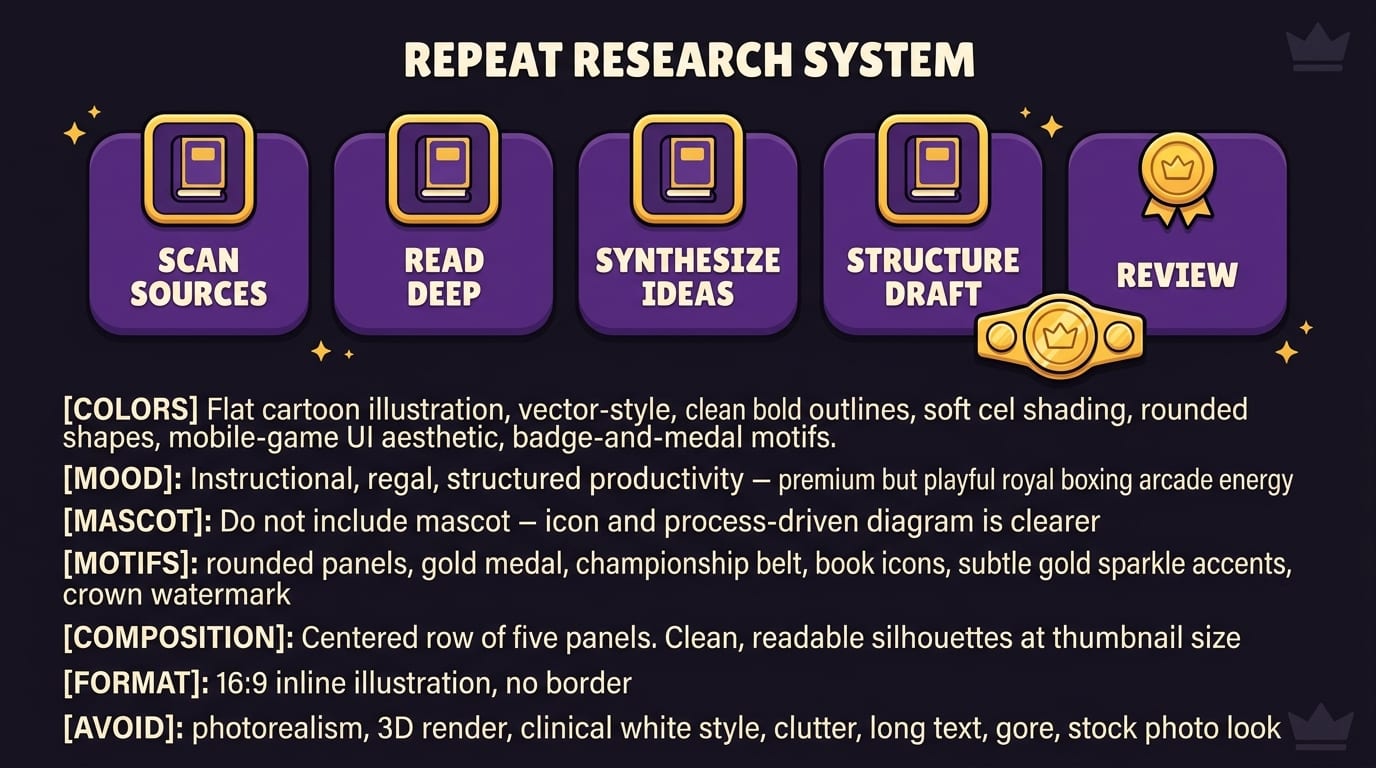
Here is a simple repeatable system for finding focus for academic research:
- Define the question: Keep one current research question visible.
- Choose the mode: Exploration or execution.
- Pick one task: Make it small enough to finish in one block.
- Set a timer: Work for 45–90 minutes.
- Block distractions: Protect the browser before temptation arrives.
- Produce an artifact: Notes, paragraph, table, outline, summary, coded data.
- Record the next step: Make tomorrow easier.
- Review weekly: Adjust your direction before you wander into academic Narnia.
You can make this more advanced later. Add citation workflows. Add reference manager tags. Add project dashboards. Add color-coded dragon stickers if necessary. But start with the basics. Research focus is built through repeatable sessions, not heroic suffering.
Also, protect your energy. Sleep, movement, food, and breaks matter. A brain running on four hours of sleep and vending-machine crackers is not “disciplined.” It is a raccoon in a lab coat. Even the best focus tools cannot fully rescue a nervous system being treated like a rental scooter.
Common Research Focus Mistakes, Also Known as Academic Banana Peels
Let’s name a few traps so you can dodge them with dignity.
Mistake 1: Reading Without a Question
If you read without a question, every source seems potentially important. That creates overload. Always read with a purpose: to define a term, compare methods, find evidence, understand a theory, or locate a gap.
Mistake 2: Highlighting Everything
If half the article is highlighted, nothing is highlighted. Instead, write margin notes or extraction notes that explain why the highlighted passage matters. Your future self cannot cite neon yellow vibes.
Mistake 3: Confusing Organization With Progress
Organizing files is useful. Reorganizing them for three hours because writing feels scary is avoidance wearing a tiny academic hat. Set a limit on admin tasks.
Mistake 4: Leaving Distraction Decisions to Willpower
If your plan is “I simply won’t check YouTube,” bless your optimistic little crown. Use blockers, schedules, full-screen writing tools, phone distance, and clear rules. Make distraction inconvenient.
Mistake 5: Waiting for Motivation
Motivation often arrives after you start, not before. Begin with a tiny task. Open one article. Write one ugly paragraph. Add one source to your map. Momentum is built, not summoned by chanting “productivity” into a mug.
Conclusion: Defend the Research Throne
Finding focus for academic research is not about becoming a flawless concentration machine. It is about building a practical system that helps you narrow your topic, understand the literature, schedule deep work, avoid digital ambushes, and keep moving even when the project feels enormous.
Start with a research question that does not try to swallow the moon. Build a literature map so your sources behave themselves. Break goals into tiny next actions. Time-block your work. Separate exploration from execution. Write before you feel ready. Review weekly. And for the love of your citation manager, protect your browser.
If distracting websites keep body-checking your research sessions, give BlockChamp a try. It is a gamified website blocker for Chrome that lets you block sites, categories, and keywords, earn XP for focused time, build streaks, and receive a royal Stare-Down when you try to wander into the scroll swamp. Academic research is hard enough. Let The King guard the gates while you do the thinking.
Defend the throne. Crush the scroll. Finish the literature review before it becomes sentient.
Related posts

Finding Focus For Fiction Writing

Learning To Focus In A Digital World As A Creative

Finding Focus For Personal Growth
