
Finding Focus For Creative Projects

Finding focus for creative projects sounds romantic until you sit down to make the thing and immediately become a full-time archaeologist of your own notifications. One minute you are “just checking inspiration,” and 47 minutes later you are watching a raccoon wash grapes on TikTok like it owes you rent. Creativity needs openness, play, wandering, and weird little sparks. But finishing creative work also requires structure, boundaries, and the occasional royal bouncer at the door telling YouTube, “Not today, peasant.”
The good news: focus is not a magical personality trait reserved for monks, chess grandmasters, and people who alphabetize their spice racks. It is a set of conditions you can design. If you are writing a novel, composing music, editing videos, building a game, designing a brand, launching a side project, or trying to finish that “quick” portfolio update from 2021, you can train your brain to enter creative focus more reliably.
This guide breaks down practical strategies for finding focus for creative projects without squeezing all the joy out of the process. We will cover routines, environment design, time-blocking, digital boundaries, mindset shifts, and ways to keep going when your brain decides the dishwasher suddenly has deep spiritual importance.
Quick Answers
Why Creative Focus Is Weirdly Hard
Creative work is not like answering email or filing forms. It is squishy. It requires exploration, decision-making, taste, emotional risk, and sustained attention. You are not just completing tasks; you are making something that did not exist before. Tiny detail. No pressure. Please invent reality before lunch.
That is why creative projects are so vulnerable to distraction. When the work becomes uncertain, uncomfortable, or boring, your brain looks for escape hatches. Social media is an escape hatch. News is an escape hatch. “Research” that turns into a 90-minute rabbit hole about medieval helmet design is also an escape hatch, even if your project is a newsletter about email marketing.
There is real science behind this. The American Psychological Association’s research on multitasking explains that switching between tasks creates mental costs. Every time you bounce from your creative project to a message, feed, tab, or app, you pay a focus tax. Your brain has to reload the project, remember what you were doing, and regain momentum. It is like trying to start a campfire while someone keeps throwing damp socks on it.
Creative focus also depends on working memory. You need to hold an idea in your head long enough to shape it. Interruptions punch holes in that mental canvas. According to research discussed by the University of California, Irvine on interrupted work, interruptions can significantly disrupt task flow and increase the time needed to resume work. Translation: that “quick check” is rarely quick. It sneaks in wearing a tiny burglar mask.
So if you struggle with focus, you are not broken. You are trying to do cognitively demanding work inside a digital casino full of flashing machines yelling, “Pull me! Pull me! I have memes!”
Start With a Clear Creative Target, Not a Fog Machine
One of the biggest enemies of finding focus for creative projects is vague intention. “Work on my book” is not a target. It is a mist. “Draft the argument scene in chapter four for 45 minutes” is a target. Your brain loves clarity because clarity lowers the friction of starting.
Before each focus session, define the smallest meaningful outcome. Not the whole project. Not your legacy. Not “become an artist so powerful museums whisper your name.” Just the next visible brick.
Use the “Today’s Creative Win” method
At the start of the day, write one sentence:
Today’s creative win is: [specific deliverable].
Examples:
- Write 800 messy words for the essay intro.
- Edit the first 90 seconds of the video.
- Sketch three logo directions, no polishing allowed.
- Record the guitar part for the chorus.
- Outline the landing page sections for the product launch.
- Fix the color palette and export version two of the illustration.
The point is not to limit ambition. It is to give your attention a landing strip. Big creative dreams are wonderful, but your brain cannot focus on “build a career.” It can focus on “open the file, make the next mark, solve the next problem.”
If you want a deeper companion piece on this topic, BlockChamp has a related guide on finding focus to build creative projects, especially useful if your project keeps getting bullied by shiny new ideas in a trench coat.
Build a Pre-Focus Ritual: Train the Brain Beast
Your brain is a pattern-recognition machine with snacks. If you create a consistent ritual before creative work, your mind starts associating those cues with entering focus mode. This is why athletes have warmups, musicians tune instruments, and writers stare dramatically out windows as if the clouds owe them a plot twist.
A pre-focus ritual does not need incense, chanting, or a ceremonial robe, although honestly, respect if that is your brand. It just needs consistency.
A simple 7-minute creative focus ritual
- Clear the desk: Remove anything unrelated to the session. Yes, even the mysterious cable. It has no rights here.
- Write the target: Put your “Today’s Creative Win” on paper or at the top of your document.
- Open only the needed tools: Your design app, writing doc, DAW, code editor, or notebook. Not seventeen tabs of “inspiration.”
- Set a timer: Start with 25, 45, or 60 minutes depending on your stamina.
- Block distractions: Turn on your website blocker before temptation arrives wearing sunglasses.
- Take three slow breaths: Not because you are a fragile woodland poet, but because it works.
- Begin with a tiny action: Type one bad sentence, draw one line, press play, move one clip, make one decision.
This ritual creates a boundary between “floating around the internet like a haunted balloon” and “now we build the thing.” Over time, repetition reduces resistance. The opening moves become automatic, which matters because starting is often the ugliest goblin in the cave.
The key is to avoid negotiating with yourself during the ritual. Do not ask, “Do I feel inspired?” Inspiration is lovely, but if you wait for it every day, your project will be finished sometime after the sun becomes a raisin. Start first. Let inspiration catch up, out of breath and embarrassed.
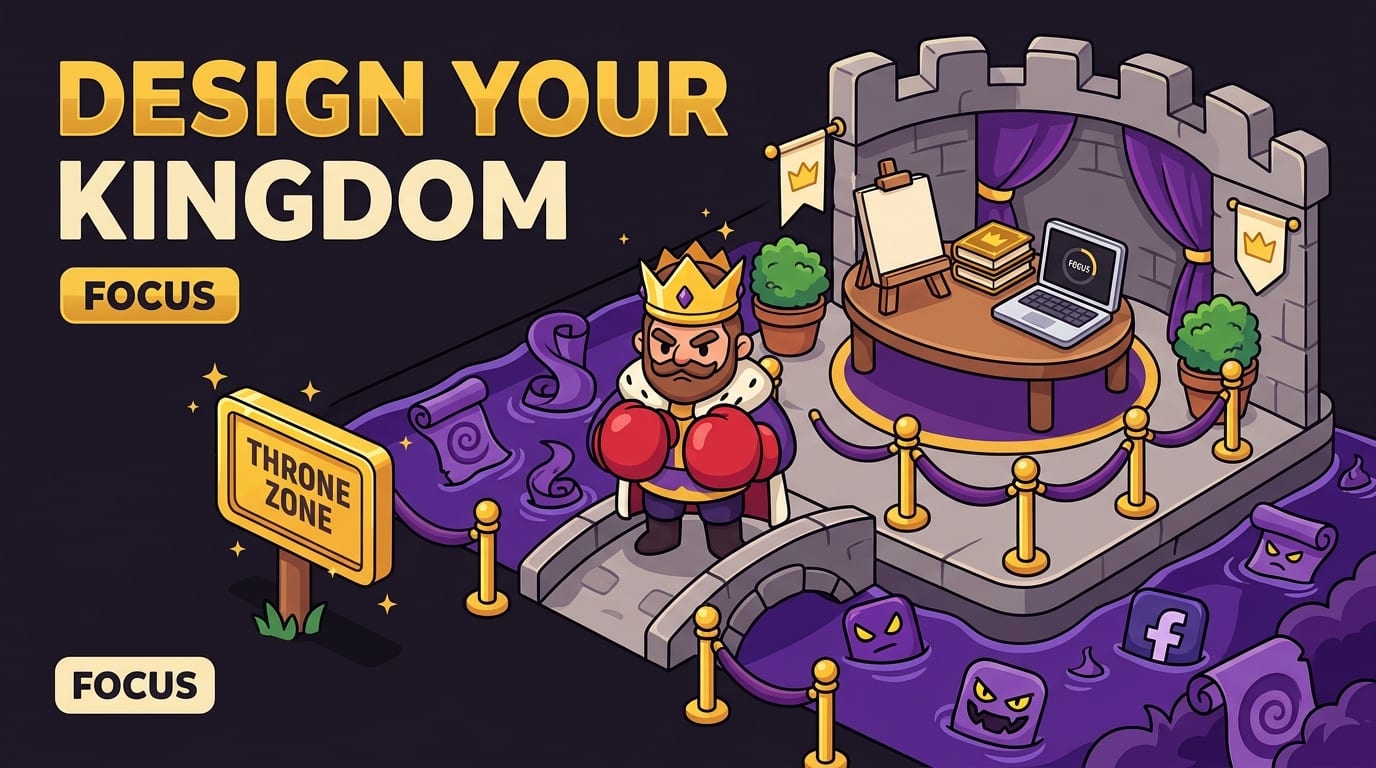
Design Your Environment Like a Tiny Focus Kingdom
Your environment is not neutral. It either helps your focus or quietly sabotages it while pretending to be furniture. When you are finding focus for creative projects, the goal is to reduce decision fatigue and remove obvious triggers before your willpower has to wrestle them.
Think of your workspace as a little kingdom. You are the monarch of attention. The project is the royal decree. The phone is a jester with dark powers. Treat accordingly.
Physical environment tweaks that actually help
- Put your phone out of arm’s reach: Not face down. Not “silent but nearby.” Across the room, in another room, or inside a drawer where it can think about what it did.
- Use one project surface: Keep only the materials for the current project visible. Visual clutter can become mental clutter.
- Control sound: Use noise-canceling headphones, ambient noise, instrumental music, or silence depending on what your brain tolerates.
- Keep a capture pad nearby: When unrelated ideas appear, write them down instead of chasing them. “Buy oat milk” does not need to derail your screenplay.
- Make starting easy: Leave the next step visible. Open the notebook to the next blank page. Save the file in an obvious place. Future you is not Sherlock Holmes.
Your digital environment matters even more. Most creative work happens on the same machine that contains your distractions. That is like trying to meditate inside a carnival dunk tank. You need digital boundaries.
This is where a tool like BlockChamp fits naturally. It is a gamified website blocker for Chrome that lets you block distracting sites, categories, and keywords. Instead of a sad gray “blocked” page, BlockChamp gives you The Stare-Down: a full-screen royal boxer mascot called The King judging your attempted escape. It is ridiculous. It is useful. It is basically having a tiny crown-wearing bouncer protect your draft from Reddit.
You can block social media, video platforms, news, shopping sites, gaming pages, and even AI distraction tools when they become procrastination machines instead of creative helpers. The point is not to become a productivity robot. The point is to stop making your creative brain fight the entire internet bare-knuckled.
Time-Block Creative Work Before the Day Eats It
If your creative project only gets “whatever time is left,” congratulations, it has been sentenced to the swamp. Days fill themselves. Work expands. Messages multiply. Errands spawn side quests. Suddenly it is 10:47 p.m., and your grand artistic contribution is opening the file and whispering, “Soon.”
Time-blocking gives your project a protected appointment. You decide in advance when creative work happens, what kind of work belongs there, and what distractions are not invited to the banquet.
Cal Newport popularized the idea of deep, focused work, and his writing on deep work and attention has influenced many creators, knowledge workers, and students who want more meaningful output in a noisy world. The principle is simple: your best work needs uninterrupted blocks, not confetti scraps of attention.
Three time-blocking formats for creators
1. The morning fortress: Work on the creative project for 60–120 minutes before email, social media, and messages. This is powerful because your attention is freshest and the world has not yet thrown pies at your calendar.
2. The lunch-hour sprint: Great for side projects. Use 45 minutes during lunch for one tiny deliverable. Keep the goal small: one sketch, one scene, one bug fix, one outreach draft.
3. The evening studio block: Useful if your day job owns your mornings. Create a repeatable wind-down routine, then work for 60–90 minutes. Avoid starting with entertainment, because “one episode” is the oldest lie in the kingdom.
For each block, define the mode of work. Creative projects usually involve different modes, and mixing them can make focus messy:
- Generate: Draft, sketch, brainstorm, record, improvise.
- Refine: Edit, arrange, polish, revise, cut.
- Research: Gather references, facts, examples, constraints.
- Admin: Export, upload, invoice, schedule, organize files.
Do not research during a drafting block unless research is truly required. “I need to look up one thing” is how many brave creators disappear into the Wikipedia fog and return aged by seven years.
If you are using BlockChamp Pro, recurring Focus Schedules can automatically turn blocks on during your creative hours. That means fewer heroic decisions. The King simply stands guard at 8 a.m. like, “Good morning, champ. The memes are closed.”
Use Constraints to Make Creativity Less Slippery
Creative freedom is wonderful. Unlimited freedom is chaos wearing a beret. When everything is possible, starting becomes harder. Constraints give your brain something to push against, and that friction often creates better work.
Finding focus for creative projects often means deciding what you will not do. You will not redesign the entire brand today. You will not rewrite chapter one again for the 400th time while chapter two starves in the corner. You will not test every font known to civilization.
Helpful constraints you can apply today
- Time constraint: “I will make a rough version in 45 minutes.”
- Quantity constraint: “I will generate 10 ideas, then choose one.”
- Tool constraint: “I will only use pencil and paper for the first draft.”
- Scope constraint: “This video will be under three minutes.”
- Audience constraint: “This piece is for beginner freelancers, not everyone with a pulse.”
- Quality constraint: “This pass is allowed to be ugly. The next pass can wear pants.”
Constraints reduce the number of decisions competing for your attention. They also protect you from perfectionism, which is procrastination wearing a velvet cape.
One useful approach is to separate messy creation from clean editing. During generation, your job is volume and movement. During refinement, your job is taste and judgment. If you try to do both at once, your inner critic grabs the steering wheel and drives into a ditch.
For writers and creators specifically, you might enjoy BlockChamp’s guide on finding focus to become a full-time writer. Even if you are not aiming for full-time writing, the principles apply to any creative practice where output depends on consistency rather than waiting for lightning to strike your forehead.
Fight Digital Distraction With Systems, Not Noble Suffering
Let us be honest: most creators do not need another inspirational quote about discipline. They need fewer trapdoors. The internet is designed to capture attention. Platforms optimize for engagement because engagement makes money. You are not weak because autoplay, infinite scroll, and algorithmic feeds work as intended. You are standing in front of a slot machine that learned graphic design.
The Pew Research Center’s social media usage data shows how deeply social platforms are woven into daily life. Meanwhile, DataReportal’s Digital 2024 Global Overview Report highlights the massive amount of time people spend online across devices and platforms. None of this means the internet is evil. It means your attention is valuable, and many companies would like to rent it permanently.
So stop relying on willpower alone. Willpower is useful, but it is not a security system. It is more like a tired guard named Gary who sometimes naps near the vending machine.
Create a distraction defense plan
- List your top five distraction sites: Be honest. If YouTube is your “research tool” but somehow all roads lead to hot wing interviews, write it down.
- Decide when those sites are allowed: Banning forever may not be realistic. Scheduling is stronger than vague guilt.
- Block during creative blocks: Use a website blocker so the decision is made before the craving hits.
- Remove shortcuts: Delete bookmarks, pinned tabs, and app icons that act like tiny temptation billboards.
- Track attempts: Notice when you reach for distractions. Boredom? Fear? Confusion? Fatigue? Each trigger needs a different response.
BlockChamp makes this more fun than the usual digital broccoli. Every focused minute earns XP. Every day with blocks active builds your reign. If you try to visit a blocked site, The King appears with The Stare-Down and gives you a royal “absolutely not.” Survive that moment, and you earn more XP. It turns restraint into a game loop, which is exactly the kind of nonsense our dopamine-goblin brains understand.
For tougher sessions, Champion users can use Hardcore Lockdown, which adds a cooldown timer or a boxing-riddle mini-game before turning focus off. That brief friction is often enough for the impulse to pass. Your future masterpiece may owe its existence to a cartoon king forcing you to repeat a glove combo. Art history is strange.
Protect the Messy Middle, Where Projects Go to Wrestle
Every creative project has a honeymoon phase. The idea is shiny. The possibilities sparkle. You tell a friend, “I’m really excited about this,” and for one glorious moment you believe you are unstoppable.
Then comes the messy middle. The draft is awkward. The design is almost good but somehow smells wrong. The song has a strong verse and a chorus that sounds like a chair falling down stairs. This is where focus gets hardest because the reward is delayed and the problems are real.
Most abandoned creative projects do not die at the beginning. They die in the middle, surrounded by half-named files like “final_v3_ACTUAL_final_new2.psd.”
How to stay focused when the project gets ugly
- Name the problem: “The pacing is slow,” “the hook is weak,” or “the color contrast is muddy” is easier to solve than “this is bad and I am a potato.”
- Switch from identity to process: Do not ask, “Am I talented?” Ask, “What is the next revision?”
- Use shorter sessions: When resistance spikes, try 25-minute sprints. Momentum beats melodrama.
- Make a punch list: Break the project into fixable items. Creative chaos becomes a checklist with better hair.
- Save versions: Knowing you can revert reduces fear and encourages experimentation.
It also helps to remember that focus does not mean feeling amazing. Sometimes focus feels like mild annoyance plus typing. Sometimes it feels like deleting 300 words and sighing like an old sea captain. That counts. The glamorous myth of creativity can make normal effort feel like failure. Do not fall for it.
If your creative work is tied to purpose, career change, or personal meaning, read BlockChamp’s piece on finding focus for meaningful work. It is a useful reminder that meaningful work is still work. The crown is earned in the unglamorous reps.
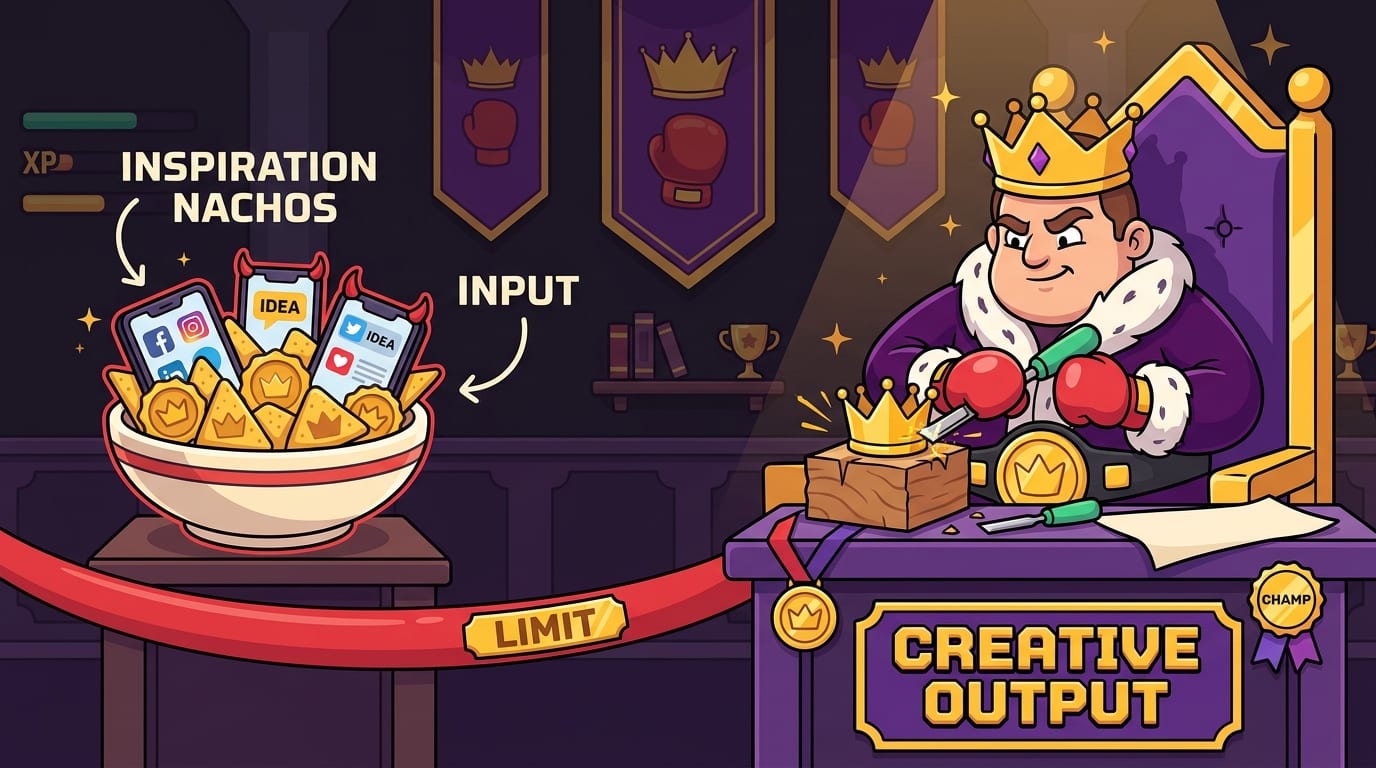
Balance Input and Output: Stop Eating Inspiration Nachos Forever
Creative people need input. You need books, films, music, conversations, research, examples, references, walks, galleries, tutorials, and occasionally staring at a wall like it has secret instructions. But input can become avoidance.
Consuming creative work feels productive because it is adjacent to your project. Watching another tutorial, reading another article, browsing another mood board, comparing another creator’s portfolio—it all feels like preparation. Sometimes it is. But preparation without output becomes inspiration nachos: tasty, endless, and not exactly dinner.
Use an input-output ratio
Try a simple rule: for every 30 minutes of creative input, do 60 minutes of output. If you watch a tutorial, immediately apply one technique. If you collect references, make a sketch. If you read an essay, write a paragraph. Do not let input sit in your brain like unopened mail.
For research-heavy projects, create a “research parking lot.” Put links, quotes, and references into one document. Then close the internet and work from your notes. This prevents research from constantly reopening the gates to distraction.
When you need the internet for legitimate creative reasons, use narrow windows:
- 15 minutes to collect visual references.
- 20 minutes to fact-check a section.
- 30 minutes to watch one specific tutorial.
- 10 minutes to download assets or examples.
Set a timer. Write the exact research question. Block unrelated categories if needed. “Research” should not mean giving the algorithm a blank permission slip to drag you through the village square.
This is where keyword blocking can be surprisingly useful. If certain topics or websites reliably derail you, BlockChamp Champion lets you block pages based on keywords. For example, if “news,” “meme,” or “crypto” routinely hijack your creative sessions, you can build a moat around those terms during focus time. Very regal. Very petty. Very effective.
Create Accountability Without Turning Your Life Into a Corporate Standup
Accountability helps because creative projects often lack external deadlines. Nobody is yelling if your poetry chapbook, indie game, or design portfolio slips another week. That freedom is beautiful. It is also dangerous. The project can quietly vanish beneath errands, client work, and the eternal swamp of “later.”
The trick is to create accountability that supports the work without suffocating it. You do not need a 14-person committee and a quarterly roadmap for your watercolor series. Please do not put your ukulele album in Jira unless you enjoy suffering.
Low-drama accountability options
- Weekly progress note: Send a friend one update every Friday: what you made, what is next, where you are stuck.
- Public streak: Share a simple daily or weekly creative streak, but keep the metric process-based, not applause-based.
- Creative coworking: Meet on video or in person, state your goal, work silently, report back.
- Deadline container: Join a challenge, submit to a contest, book a critique, schedule a release date.
- Progress tracker: Use a calendar, spreadsheet, habit app, or BlockChamp’s focus calendar to see your consistency.
BlockChamp’s gamification is useful here because it gives you visible progress even when the creative project itself is not finished yet. You earn XP for focus time, build a reign by keeping blocks active, unlock badges, and can climb the Hall of Champions leaderboard. This matters because big creative projects have long feedback loops. Gamified focus gives you smaller wins along the way.
If you are neurodivergent or struggle with attention regulation, accountability and environment design may be even more important. BlockChamp has an interview-style resource where an ADHD coach weighs in on finding freedom and focus with ADHD. Different brains need different systems, and that is not a flaw. That is just the operating manual being spicy.
Recover Like a Creator, Not a Burned-Out Goblin
Focus is not infinite. Creative work burns mental energy, especially when you are making decisions, solving problems, and wrestling ambiguity. If you push constantly without recovery, your brain will eventually rebel by making even simple tasks feel like assembling furniture in the dark.
Rest is not the enemy of creative focus. It is part of the cycle. The problem is that many people confuse restorative rest with numbing distraction. There is nothing morally wrong with scrolling or watching videos, but if your “break” leaves you foggier, more restless, and vaguely annoyed at humanity, it may not be recovery. It may be digital quicksand in a party hat.
Better breaks for creative momentum
- Walk without headphones: Let ideas recombine. Boredom is not a bug; it is a compost bin for thoughts.
- Do a body reset: Stretch, breathe, hydrate, or step outside. Your brain is attached to meat. Maintain the meat.
- Use analog play: Doodle, cook, tidy, play an instrument, or read on paper.
- Take a deliberate entertainment break: If you want YouTube or games, schedule it after the session, not in the middle.
- Sleep like it matters: Because it does. Tired brains make terrible kings.
Recovery also means reviewing your process without drama. At the end of the week, ask:
- When did I focus best?
- What distracted me most?
- Which environment helped?
- What kind of work did I avoid?
- What is one adjustment for next week?
Keep the tone curious, not courtroom. You are not prosecuting yourself. You are tuning the system.
A Step-by-Step Focus Plan for Your Next Creative Session
Let us turn all this into a practical plan you can use today. Not someday. Not after you buy the perfect notebook, desk lamp, mechanical keyboard, and artisanal thinking cardigan. Today.
- Choose one project: Not three. One. Put the others in a parking lot.
- Define the session outcome: Write one specific deliverable you can complete or move forward.
- Pick a time block: Start with 45 minutes if you are rusty. Go longer only when you have momentum.
- Prepare your environment: Clear the desk, open the right file, put your phone away, gather materials.
- Block digital traps: Use BlockChamp or another blocker to shut down your usual escape routes.
- Set a timer: During the timer, your only job is the project. If a side thought appears, capture it and return.
- Begin badly: Make the first version rough on purpose. Bad starts are the toll road to good work.
- End with a next step: Before stopping, write exactly where to resume. Future you deserves breadcrumbs.
- Reward completion: Take a real break. Celebrate the rep. The crown likes consistency.
The magic is not in one heroic session. It is in repeating a sane system until creative focus becomes easier to enter. You are building trust with yourself. Every kept appointment teaches your brain, “This is what we do.” Every finished session adds evidence. Eventually, your project stops feeling like a haunted mansion and starts feeling like a workshop.
Conclusion: Defend the Throne, Make the Thing
Finding focus for creative projects is not about becoming a joyless productivity statue. It is about protecting the conditions that let your best ideas survive long enough to become real. Creative focus needs clarity, ritual, boundaries, time, constraints, accountability, and rest. It also needs a little humor, because if you cannot laugh when you catch yourself opening Instagram for the sixth time during a writing session, you may start yelling at a houseplant.
Start small. Pick one creative win. Block one major distraction. Schedule one serious focus block. Make one messy draft. Then do it again tomorrow. That is how projects get built: not through constant inspiration, but through repeated returns.
And if your distractions keep storming the castle, bring in backup. BlockChamp turns focus into a game, complete with XP, levels, badges, streaks, a focus calendar, and The King roasting your attempted escape routes with royal disappointment. It is a website blocker for Chrome, yes, but more importantly, it makes staying focused feel less like punishment and more like winning a tiny championship belt for your attention.
So defend the throne. Crush the scroll. Open the file. Make the thing. Long live your focus, champ.
Related posts

Finding Focus For Fiction Writing

Learning To Focus In A Digital World As A Creative

Finding Focus For Personal Growth
