
Dopamine Reset Focus Guide

Your brain is not broken. It is just being bribed by tiny rectangles, infinite feeds, autoplay goblins, notification confetti, and the occasional “quick” YouTube video that somehow becomes a three-hour documentary about medieval plumbing. This dopamine reset focus guide is here to help you reclaim your attention without moving to a cave, deleting electricity, or becoming the kind of person who says “I only use my phone for calls” with terrifying sincerity.
Let’s be clear: a dopamine reset is not magic. You are not “draining dopamine” like old bathwater. Dopamine is a vital brain chemical involved in motivation, learning, movement, reward, and anticipation. You need it. The goal is not to become a productivity monk with the emotional range of a stapler. The goal is to reduce high-stimulation habits that train your brain to demand novelty every 11 seconds, then rebuild your ability to focus on slower, more meaningful work.
In this dopamine reset focus guide, we’ll cover what dopamine actually does, why digital overload wrecks concentration, how to build a realistic reset plan, and what daily routines help your brain stop chasing shiny chaos. We’ll also talk about practical tools like BlockChamp, the gamified Chrome website blocker that lets you block distracting sites while earning XP, badges, streaks, and occasional royal judgment from The King. Because if your brain wants a game, fine. Let’s make focus the game.
Quick Answers
What a Dopamine Reset Actually Means, Minus the Internet Wizardry
The phrase “dopamine reset” gets tossed around like a protein shaker in a startup office. Some people call it dopamine fasting. Others call it a digital detox. Some describe it like your brain has a reward battery that needs to be unplugged overnight. Cute metaphor. Not quite science.
Dopamine is not simply the “pleasure chemical.” According to StatPearls’ overview of dopamine physiology, dopamine plays major roles in reward, motivation, movement, attention, and reinforcement learning. In plain human language: dopamine helps your brain notice what matters, pursue goals, and repeat behaviors that seem rewarding.
The modern problem is not dopamine itself. The problem is that many digital products are engineered to deliver frequent, unpredictable rewards: new posts, likes, messages, headlines, comments, memes, videos, deals, drama, and that one Reddit thread where everyone is somehow both wrong and fascinating. Variable rewards are powerful because your brain learns to keep checking. Maybe something good is there. Maybe not. Better check again, peasant.
A dopamine reset is really a stimulation reset. You temporarily reduce easy, high-intensity rewards so lower-stimulation activities can feel rewarding again. Reading a book, writing a report, studying flashcards, planning a project, or sitting with your own thoughts should not feel like chewing cardboard. If it does, your reward system may be overtrained on hyper-novelty.
For a deeper science-first explanation, BlockChamp has a related breakdown on what dopamine fasting gets right and wrong. Spoiler: you cannot fast from dopamine completely, but you can stop feeding the scroll monster every time it rings a little bell.
Why Your Focus Feels Like a Squirrel Wearing Roller Skates
Your attention is being attacked from multiple angles. Not politely. Not with a tiny sword and a bow. With siege weapons.
Research published in Nature Human Behaviour found evidence that the abundance of information may be linked to shorter collective attention spans across cultural products and online trends. Translation: everything is competing harder, faster, and louder for your eyeballs. The internet is basically a medieval marketplace where every stall owner is screaming, juggling fire, and offering you 10% off emotional damage.
Meanwhile, task switching carries a real cost. The American Psychological Association’s research summary on multitasking explains that switching between tasks can reduce efficiency because the brain has to reorient each time. That “quick check” of Instagram during work is not free. It leaves a little attention tax. Pay enough of those taxes and suddenly your afternoon is bankrupt.
Common signs your attention system needs a reset include:
- You open your browser to do one task and wake up 20 minutes later in a tab jungle.
- You feel bored within seconds of starting deep work.
- You keep checking your phone even when nothing happened.
- You cannot watch a lecture, read a chapter, or write a page without craving another tab.
- You procrastinate with “productive” distractions like tool research, desk setup videos, or reorganizing notes you will never read again.
- You feel mentally foggy after long scrolling sessions but keep doing them anyway. Classic goblin behavior.
If this sounds familiar, you do not need more guilt. Guilt is a terrible productivity system. You need structure, friction, recovery, and a better reward loop.
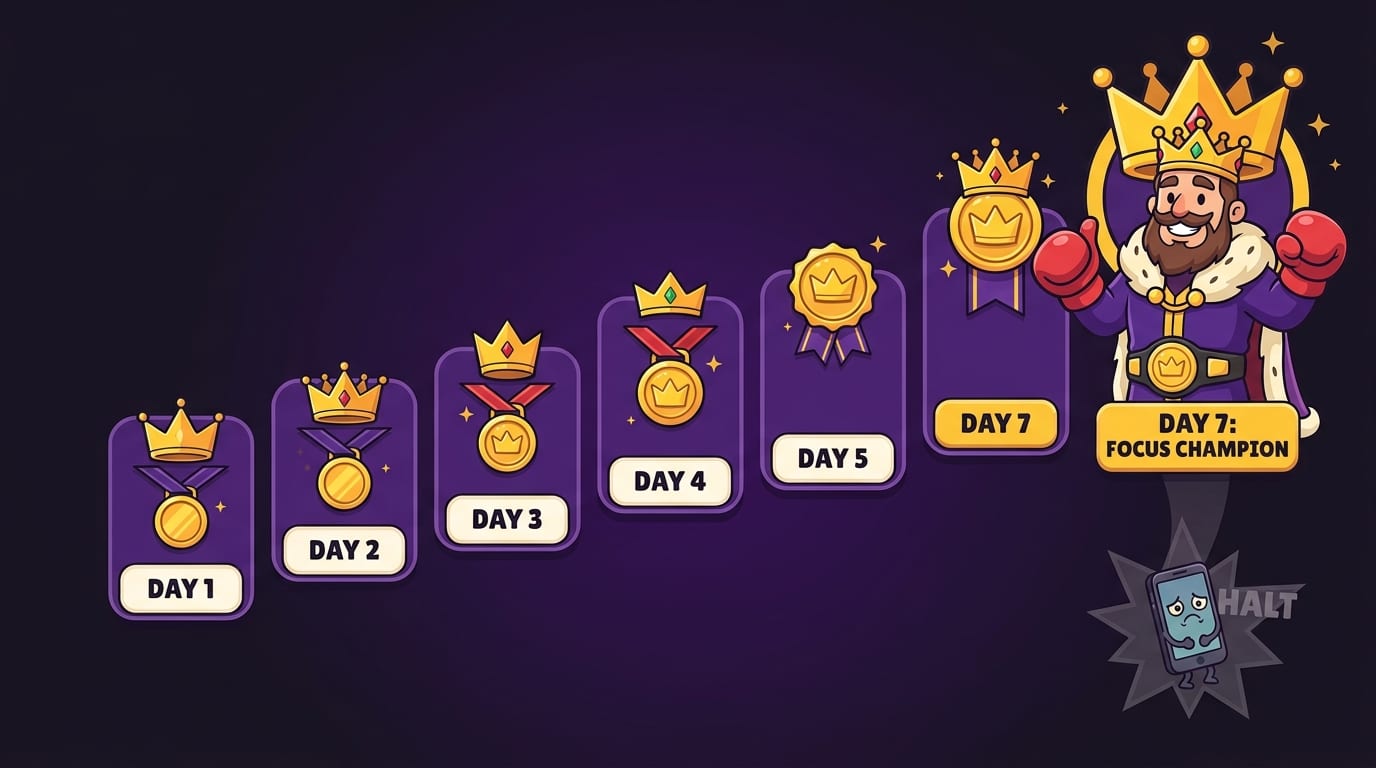
The 7-Day Dopamine Reset Focus Guide: A Practical Plan for Actual Humans
A 7-day reset is long enough to expose your distraction patterns but short enough that you will not fake your own disappearance and start a new life as a goat farmer. The goal is not perfection. The goal is to reduce the biggest attention hijackers, observe cravings without obeying them, and rebuild confidence in your ability to focus.
Day 1: Audit the Kingdom
Before changing anything, identify your top attention thieves. Look at your browser history, screen time reports, and honest memory. Be brave. The crown demands truth.
Write down:
- Your top 5 distracting websites or apps.
- Your most vulnerable times of day.
- Your emotional triggers: boredom, stress, loneliness, fatigue, avoidance, “just checking.”
- Your highest-value focus goals for the week.
This is where BlockChamp fits beautifully. In Chrome, you can block specific sites like YouTube, Reddit, TikTok, X/Twitter, or shopping sites. If you are not sure where the enemy lives, start with category blocks. Social Media and Video & Streaming are the usual suspects. They wear fake mustaches, but we know them.
Day 2: Remove the Easy Hits
Turn off nonessential notifications. Remove distracting bookmarks. Log out of sites you compulsively check. Put your phone in another room during deep work. Not face down. Not “I’ll be strong.” Another room. Preferably guarded by a dragon or at least a moderately judgmental houseplant.
If you work in a browser, install a website blocker and block your top distractions during focus hours. BlockChamp’s Master Focus Toggle makes this simple: one big switch to put the King “On Guard.” When you hit a blocked site, you get The Stare-Down instead of a bland error page. The King sees you. The King is unimpressed. Weirdly, this helps.
Day 3: Create Low-Dopamine Mornings
Your first hour sets the tone. If you start with feeds, your brain begins the day with novelty fireworks. Then your spreadsheet looks like a sad potato.
Try this morning sequence:
- Wake up without checking social media.
- Drink water. Revolutionary, yes.
- Get light exposure or take a short walk.
- Write your top 3 tasks on paper.
- Do one 25- to 50-minute focus block before entertainment, news, or messages.
For stress-related brain fog, you may also like BlockChamp’s cortisol level reset guide, because attention is not just a dopamine issue. If your nervous system is running around like a raccoon in a fireworks store, focus will suffer.
Day 4: Replace, Don’t Just Remove
If you remove scrolling but replace it with staring at the wall in existential horror, you will probably relapse by lunch. Your brain needs alternative rewards.
Good replacement activities include:
- Walking without headphones for 10 minutes.
- Reading fiction or nonfiction on paper.
- Stretching, mobility work, or a short workout.
- Cooking something simple.
- Calling a friend instead of silently consuming strangers’ opinions.
- Doing a small creative task: sketching, journaling, music, tinkering.
These activities may feel underwhelming at first. That is normal. Your brain has been dining at the buffet of instant novelty. A carrot stick will not seem thrilling on day one. Give it time.
Day 5: Train Deep Work Like a Muscle
Do not expect your focus to return instantly. Attention is trainable, but it does not respawn like a video game character. Start with manageable sessions.
Use this progression:
- Begin with 25 minutes of single-task work.
- Take a 5-minute break away from screens.
- Repeat 2-4 times.
- After a few days, increase to 45- or 60-minute blocks.
During the session, keep one task visible. One tab if possible. One document. One objective. Your brain may scream, “What if something happened?” Let it scream. It is being dramatic. Unless you are an emergency surgeon, most things can wait 25 minutes.
Day 6: Add Friction to Relapse
Willpower is cute. Friction is better. If your distraction is one click away, your tired brain will click it before your wise brain has finished putting on pants.
Add friction like this:
- Block distracting sites during work blocks.
- Use app limits or remove apps from your home screen.
- Keep your phone outside your bedroom.
- Make entertainment require a deliberate choice, not a reflex.
- Use scheduled focus hours so blocking happens automatically.
BlockChamp’s Champion features can help here with recurring focus schedules, unlimited blocked sites, keyword blocking, and Hardcore Lockdown. Hardcore Lockdown is especially useful if you are the kind of person who turns off blockers during a craving and then acts shocked. “Who did this?” You did, champ. The boxing riddle makes surrender annoying enough for the impulse to pass.
Day 7: Review, Adjust, and Crown Yourself Responsibly
At the end of the week, review what changed. Did mornings feel calmer? Did work feel less painful? Which sites pulled hardest? Which replacement habits actually helped?
Keep what worked. Loosen what was unrealistic. Tighten what still leaks attention like a cursed bucket. A dopamine reset is not a one-time cleanse. It is the start of a better attention environment.
Your Daily Dopamine Reset Routine: Morning, Workday, Evening
A reset works best when it becomes a routine. Not a giant heroic transformation montage. A routine. Tiny boring systems are how champions are built. The crown is mostly calendar management.
Morning: Protect the First Hour
Your morning routine should reduce chaos and create momentum. Do not start the day by letting 500 strangers, three brands, two news alerts, and one influencer with suspiciously white teeth decide your mental weather.
Try this:
- No social media, news, or short-form video for the first 60 minutes.
- Get sunlight or bright outdoor light if possible.
- Move your body for 5-20 minutes.
- Write your “must win” task for the day.
- Start one focus block before checking feeds.
The Sleep Foundation’s guide to circadian rhythms explains how light exposure helps regulate the sleep-wake cycle. Better sleep and better mornings are focus multipliers. Yes, sleep is productivity. No, scrolling in bed until your soul leaves your body does not count as “rest.”
Workday: Make Focus the Default
During work or study hours, your environment should make the right action easier than the wrong one. This is where many people fail. They try to “be disciplined” while keeping every dopamine slot machine open in the next tab. Brave. Also doomed.
Instead:
- Use time blocks for deep work, admin, messages, and breaks.
- Batch email and chat checks instead of grazing all day.
- Keep a distraction capture note for random urges and ideas.
- Block your worst sites before you begin, not after you already slipped.
- Reward completed focus blocks with offline breaks, not another algorithmic whirlpool.
If you are recovering from mental exhaustion rather than simple distraction, read BlockChamp’s guide on burnout and focus recovery. Burnout is not fixed by yelling “discipline!” at your frontal lobe. That is not leadership. That is workplace karaoke.
Evening: Lower the Volume
Evenings should help your brain downshift. If you spend the last two hours blasting your reward system with feeds, drama, shopping, and autoplay, sleep may suffer, and tomorrow’s focus starts with a limp.
Try a 60-minute digital sunset:
- Set a cutoff time for social media and work tabs.
- Charge your phone away from the bed.
- Prep tomorrow’s top task.
- Read, stretch, clean, journal, or do something tactile.
- Keep entertainment intentional: one episode, not “until Netflix asks if you are still alive.”
Tech-Free Habits That Rebuild Attention Without Making You Weird at Parties
You do not need to reject technology forever. You just need to practice being a person outside the feed. A shocking concept. Historians say people did this for thousands of years.
Tech-free habits are powerful because they remove infinite choice. They also give your brain slower rewards: movement, skill, reflection, connection, nature, and completion. These rewards may not scream like TikTok, but they stick.
Start with these:
- Single-task walks: Walk for 10-20 minutes without podcasts or music. Let your brain wander. It may produce thoughts. Some will be nonsense. That is allowed.
- Paper planning: Write your top tasks on a notebook. Physical writing slows you down in a good way.
- Analog breaks: During work breaks, avoid screens. Stretch, breathe, make tea, look outside, or tidy one small area.
- Book before phone: Read 5 pages before opening entertainment apps. Tiny rule, big impact.
- Boredom reps: Stand in line without checking your phone. Sit for two minutes without stimulation. Congratulations, you are now training attention like a tiny monk with better shoes.
The point is not to become anti-tech. The point is to restore choice. Technology should be a tool in your kingdom, not the jester secretly running the treasury.
How to Handle Cravings When Your Brain Demands the Scroll Throne
Cravings are not commands. They are suggestions from a dramatic committee inside your skull. You can hear them without obeying them.
When you feel the urge to check a blocked site or grab your phone, use the “pause and redirect” method:
- Name it: “This is an urge to avoid discomfort.”
- Delay it: Set a 10-minute timer before acting.
- Move: Stand up, stretch, or walk for one minute.
- Return: Do the next tiny step of your task.
- Reward: After completing the focus block, take an intentional break.
This works because urges rise and fall. They feel permanent, but they are more like waves than prison sentences. If you add even a little delay, the automatic loop weakens.
BlockChamp’s Stare-Down is basically an urge interruption with a crown and boxing gloves. You try to open a blocked site, The King appears, displays the site you attempted to enter, and reminds you not to lose your reign over nonsense. Every stare-down survived earns XP, which flips the script: resisting distraction becomes a win, not a miserable act of self-denial.
If you want more tactics for a mind that feels constantly pulled sideways, BlockChamp’s guide on how to focus with a distracted brain pairs nicely with this dopamine reset focus guide. Think of it as extra armor for the attention battlefield.
What to Avoid During a Dopamine Reset, Unless You Enjoy Self-Sabotage
A dopamine reset can fail when people make it too extreme, too vague, or too joyless. Do not declare, “I shall use no technology, eat only lentils, and become a productivity eagle by Friday.” That is not a plan. That is a villain origin story.
Avoid these common mistakes:
- Going nuclear: Deleting every app and banning all fun can trigger rebound bingeing. Reduce strategically instead.
- Keeping vague rules: “Use my phone less” is mushy. “No social media before noon” is usable.
- Replacing scrolling with nothing: Empty time needs a healthier default: walking, reading, cleaning, stretching, calling someone.
- Using work as a loophole: Research can become procrastination wearing a tiny academic hat. Set clear endpoints.
- Ignoring sleep: Sleep deprivation makes cravings stronger and focus weaker. The throne needs maintenance.
- Expecting instant bliss: The first few days may feel boring or restless. That does not mean it is failing. It means your brain is recalibrating.
Also, do not turn your reset into a moral purity contest. You are not better because you used fewer apps today. You are simply training your attention. Stay humble. The algorithm has humbled mightier warriors.
Using BlockChamp as Your Dopamine Reset Bodyguard
A good dopamine reset focus guide should not end with “just try harder.” Trying harder is what people do right before they open Reddit with the haunted expression of someone entering a cursed tavern.
You need a system that makes focus easier in the moment of temptation. BlockChamp helps by turning digital self-control into a game instead of a punishment dungeon. You can block distracting websites by site, keyword, or category. Free users can block up to 3 sites and enable 2 categories, which is enough to start punching the big distractions in the face. Champion users get unlimited sites, all 8 categories, keyword blocking, recurring schedules, sync, and Hardcore Lockdown.
Here is how to use BlockChamp during a dopamine reset:
- Pick your top 3 villains: Start with the sites that steal the most time: YouTube, Reddit, TikTok, X/Twitter, Instagram, shopping, gaming, news, or whatever your personal goblin prefers.
- Enable category blocking: During reset week, block Social Media and Video & Streaming first. Add News or Shopping if those are your traps.
- Turn on Master Focus: Keep blocks active during your most important hours. Your reign begins when you stop surrendering.
- Track stare-downs survived: Every blocked attempt is useful data. If you tried to open YouTube 9 times today, your brain has filed a formal complaint. Good to know.
- Use Hardcore Lockdown if needed: If you keep turning focus off, add a cooldown timer or boxing riddle. Make surrender deliberate, not impulsive.
- Celebrate XP and streaks: Motivation matters. Earn levels, badges, and reign milestones. Let focus feel like winning.
The best part is that BlockChamp does not rely on shame. When you slip, The King roasts you, sure. But it is playful. You survive the stare-down, earn XP, and return to work. That is the loop: interrupt, laugh, recover, continue. Long live your focus.
How to Measure Progress Without Becoming a Spreadsheet Goblin
You need feedback, but you do not need to turn your life into a dashboard that requires its own dashboard. Measure a few simple things.
Track these weekly:
- How many focused work blocks you completed.
- How many hours you spent in intentional focus.
- How often you checked your biggest distraction sites.
- Your average sleep time and energy level.
- Your mood and stress level.
- Which replacement habits worked best.
BlockChamp’s focus calendar, reign timer, XP, and leaderboard can make this visible without requiring manual accounting sorcery. You see which days stayed focused, how long your reign has lasted, and how many stare-downs you survived. That visibility matters because attention loss often feels invisible. One second you are checking one thing; next thing you know, your day has been pickpocketed by thumbnails.
For freelancers and remote workers, where nobody is physically hovering nearby with a clipboard of judgment, structure is even more important. BlockChamp’s article on how freelancers can reclaim focus for deep work gives additional strategies for building workdays that do not dissolve into tab soup.
The “Normal Life” Version: What Happens After the Reset?
After your 7-day reset, do not sprint back into old habits like a raccoon released into a donut shop. Reintroduce stimulation intentionally.
Use three categories:
- Green: Tools that support your goals, like calendars, notes, learning platforms, and work software.
- Yellow: Fun but limited tools, like streaming, social media, games, and news.
- Red: Tools that reliably cause binges, anxiety, procrastination, spending, or sleep destruction.
Green stays available. Yellow gets windows. Red gets blocked during vulnerable times, or removed entirely if it keeps body-slamming your attention.
A healthy post-reset routine might look like this:
- No feeds before your first focus block.
- Social media only after 5 p.m. or in two scheduled windows.
- Website blocking active during work or study hours.
- Phone outside the bedroom overnight.
- One tech-free evening per week.
- A weekly review of what helped and what hijacked you.
This is not about becoming perfect. Perfect people are suspicious and probably robots. This is about becoming harder to hijack.
Final Round: Reset Your Dopamine Environment, Reclaim Your Crown
A dopamine reset is not a punishment. It is not a vow of digital monkhood. It is a practical way to lower the volume of cheap stimulation so your brain can enjoy meaningful work again. You reduce the easy hits, protect your mornings, train deep work, add friction to distractions, and build healthier rewards that do not leave your attention lying face-down in a ditch.
The most important lesson in this dopamine reset focus guide is simple: do not rely on vibes. Build an environment where focus is the default and distraction has to fight its way through the castle gates.
If distracting websites are your biggest weakness, let BlockChamp stand guard. Block your worst sites, start your reign, earn XP for focused time, survive The King’s Stare-Down when temptation strikes, and climb from Peasant of Procrastination toward Block Champ glory. It is productivity, but with a crown, boxing gloves, and just enough roast to keep you honest.
Ready to defend the throne and crush the scroll? Try BlockChamp for Chrome and start your focus reign today. The King is waiting. He has gloves. He has opinions. And frankly, he saw that “quick” YouTube tab coming from three kingdoms away.
Related posts

Finding Focus For Fiction Writing

Learning To Focus In A Digital World As A Creative

Finding Focus For Personal Growth
