
Dopamine Fasting Science

Your brain is not a broken slot machine, but some days it sure behaves like one. You open TikTok “for two minutes,” blink, and suddenly you know seven ways to fold a burrito, the relationship status of a stranger’s ferret, and absolutely nothing about the task you were supposed to finish. This is where dopamine fasting science enters the chat — usually wearing a monk robe, holding a cold shower, and making suspicious claims about “resetting your dopamine.”
Let’s clean that up. Dopamine fasting is not about draining dopamine from your brain like old fryer oil. You need dopamine to move, learn, care, plan, and generally not become a decorative houseplant. The useful version of dopamine fasting is much less mystical: it is a structured break from high-stimulation, reward-heavy behaviors so your attention system can stop being dragged around by every glowing rectangle in the kingdom.
In this guide, we’ll unpack what dopamine fasting actually is, what the science says about reward pathways, how to set up a practical fast without becoming a joyless cave goblin, and how to measure whether it’s working. We’ll also talk about how tools like BlockChamp can help you defend the throne when your willpower tries to sneak out the back door wearing a fake mustache.
Quick Answers
Dopamine Fasting Science: What It Is, Minus the Wellness Fog Machine
The phrase “dopamine fasting” sounds like you’re putting your neurotransmitters on a juice cleanse. That is not how brains work. Dopamine is a neurotransmitter involved in motivation, reinforcement learning, movement, attention, and reward prediction. It is not simply the “pleasure chemical,” even though the internet keeps slapping that label on it like a discount sticker.
A more accurate way to understand dopamine is this: dopamine helps your brain decide what is worth pursuing. It spikes in relation to cues, novelty, anticipation, and reward prediction errors — basically, when your brain thinks, “Ooh, this might matter.” That is why social media feeds, notifications, short videos, gambling mechanics, online shopping, and infinite scroll are so sticky. They keep serving unpredictable little rewards. Your brain loves unpredictable rewards. Your to-do list does not.
The science behind dopamine fasting is closer to behavioral self-regulation than a biological “reset.” You temporarily reduce exposure to highly stimulating behaviors so you can weaken cue-triggered loops, lower compulsive checking, and make boring-but-important tasks feel less like chewing cardboard in a waiting room.
The original modern concept is often linked to “dopamine fasting 2.0,” a cognitive behavioral approach popularized by psychiatrist Dr. Cameron Sepah. His framing was not “avoid all pleasure.” It was more like: reduce impulsive behaviors that are reinforced by fast rewards, especially when they interfere with your goals. That’s much more useful than declaring war on music, sunlight, laughter, and sandwiches. Please do not fast from sandwiches unless medically advised. The kingdom needs morale.
If you want a deeper look at how brain habits and focus states interact, BlockChamp has a related breakdown on the neuroscience of procrastination, habits, and the flow state. Consider it your royal prequel.
Your Reward Pathways Are Not Evil — They’re Just Very Clickable
Reward pathways exist because humans had to learn what to seek and what to avoid. Food? Good. Social connection? Good. Avoiding a saber-toothed tiger? Also good, though admittedly less cozy. Dopamine helps reinforce behaviors that lead to outcomes your brain tags as important.
The problem is that modern apps and websites have become suspiciously good at hijacking this ancient system. Infinite scroll, autoplay, algorithmic feeds, notifications, streaks, likes, and personalized recommendations all lean on reward learning. They keep the next reward uncertain enough to be tempting. Will the next video be hilarious? Will the next post be dramatic? Will the next email be important? Probably not. But maybe. And “maybe” is the little goblin that keeps you scrolling.
Research on reward and habit formation shows that cues can trigger learned behaviors automatically, especially when rewards are immediate and variable. The National Institute on Drug Abuse explains that dopamine is deeply involved in reinforcing behaviors and teaching the brain to repeat actions associated with rewards, especially when those rewards are powerful or frequent. You can read their accessible overview of how dopamine and reward circuits influence repeated behavior.
Now, social media is not the same as a drug. Let’s not throw science into a moat. But many digital products do use reward mechanics that can build compulsive checking habits. A 2023 DataReportal report found that the average internet user spends a huge portion of the day online, with social media alone taking more than two hours daily for many users worldwide. Their Digital 2024 Global Overview Report is a useful snapshot of just how much of modern life now happens inside screens.
Dopamine fasting science matters because it gives us a better target. The enemy is not dopamine. The enemy is frictionless, high-frequency reward loops that train your attention to chase novelty instead of meaning. In royal terms: the court has been infiltrated by tiny jesters with push notifications.
What Dopamine Fasting Can Actually Do — and What It Can’t
Let’s be factual, champ. Dopamine fasting will not literally “reset your dopamine levels” in 24 hours. It will not make your brain pure. It will not turn you into a productivity monk who levitates above email. If someone promises that, check whether they are also selling a $97 PDF called “Neuro-Kingdom Secrets.”
What a well-designed dopamine fast can do is more practical:
- Reduce cue exposure: If you stop seeing the app, tab, notification, or shopping cart, you trigger fewer urges.
- Interrupt automatic loops: You create space between impulse and action, which is where self-control actually lives.
- Increase tolerance for boredom: Boredom stops feeling like a five-alarm emergency that must be extinguished with memes.
- Make rewards more intentional: You choose when to enjoy entertainment instead of being ambushed by it.
- Restore attention for deep work: Fewer interruptions mean your brain spends less time context-switching.
That last point matters. According to the American Psychological Association, switching between tasks can reduce efficiency because the brain has to reorient each time. Their summary on the costs of multitasking explains why bouncing between work and distractions makes you feel busy while quietly mugging your productivity in an alley.
Dopamine fasting also overlaps with digital fasting and digital detox strategies. If you want a broader lifestyle angle, read BlockChamp’s guide on why digital fasting is the new detox. The short version: sometimes your brain doesn’t need a new productivity hack. It needs fewer tiny slot machines in its pocket.
Step 1: Pick Your Dopamine Villains, Not All Joy Everywhere
The biggest mistake people make with dopamine fasting is going too broad. They announce, “Tomorrow I will avoid all stimulation.” Then by 11:14 a.m. they are emotionally bargaining with a toaster. Don’t do that.
Instead, identify the specific behaviors that are causing problems. A good dopamine fast targets compulsive, high-reward, low-value loops — not healthy pleasure. Reading a novel, taking a walk, eating a good meal, or laughing with friends does not need to be banished from the kingdom. The goal is not misery. The goal is sovereignty.
Start by listing your top distraction triggers. Common suspects include:
- Short-form video apps like TikTok, YouTube Shorts, and Instagram Reels
- Social feeds like Reddit, X/Twitter, Instagram, Facebook, Discord, or LinkedIn
- News doomscrolling, especially during work hours
- Streaming services that turn “one episode” into an archaeological era
- Online shopping tabs opened for “research” and ending in a cart full of ergonomic nonsense
- Gaming, gambling, adult content, or AI tools used as procrastination portals
Then ask three questions for each behavior:
- Do I use this more than I intend?
- Do I use this to avoid discomfort, boredom, stress, or work?
- Does it make my life better afterward, or just louder?
If the answer is “yes, yes, louder,” congratulations: you found a villain. Put it on the block list.
This is where BlockChamp fits naturally. Instead of relying on heroic willpower — a strategy with the structural integrity of wet cardboard — you can block specific sites, keywords, or entire categories. Social Media, Video & Streaming, News, Shopping, Gaming, Gambling, Adult, and AI Distractions can all be handled with category bundles. One tap, and The King stands guard. The peasants may scroll elsewhere.
Step 2: Choose the Right Fast Length Before You Go Full Medieval Monk
Dopamine fasting works best when the structure matches your life. If you’re a student during finals, your plan may look different from a freelancer trying to stop checking YouTube every 19 seconds. The right length is the one you can actually complete without turning into a haunted raccoon.
The 2-Hour Focus Fast
This is perfect for beginners. Choose one work block — maybe 9 a.m. to 11 a.m. — and remove your top digital temptations. No social feeds, no video, no shopping, no news. Keep useful tools available. If you need Google Docs, use Google Docs. This is dopamine fasting, not productivity cosplay with a quill.
Use this format when you need to study, write, code, plan, or finish a project. It trains your brain to tolerate one clean stretch of work without constant novelty. If urges pop up, write them down instead of acting on them. “Check Reddit” goes on paper. Reddit can survive without you for two hours. Brave, but true.
The Workday Fast
This fast blocks high-stimulation sites during business or school hours, usually Monday through Friday. It is especially useful if your main issue is not nighttime screen use but daytime derailment. You sit down to work, open a “quick” tab, and suddenly you’re watching a man restore a 1920s toaster. Fascinating? Yes. Relevant? Your manager says no.
BlockChamp’s Pro Focus Schedule is built for this: set recurring hours and let the King auto-activate your blocks. No morning negotiation. No “I’ll turn it on after coffee.” The throne opens at 9. Distractions get punched at 9:01.
The 24-Hour Reset
A full-day fast can help when you feel overstimulated, scattered, or compulsively checking everything. For 24 hours, remove the major reward loops: social media, streaming, online shopping, news feeds, and other personal traps. Replace them with lower-stimulation activities: walking, cooking, reading, journaling, cleaning, calling a friend, or doing the hobby you keep saying you’ll do once your “brain feels normal.” Plot twist: the hobby helps.
Do not make the day empty. Empty space is useful, but a totally barren schedule can backfire. Plan gentle activities so your brain has somewhere to land.
Step 3: Replace the Habit Loop, Don’t Just Leave a Smoking Crater
Every habit has a loop: cue, craving, response, reward. If you remove the response but ignore the cue and reward, your brain will stage a tiny rebellion. This is why “just stop scrolling” is about as helpful as telling a dragon to consider indoor manners.
For dopamine fasting science to become practical, you need substitutions. Not equally stimulating substitutions — that defeats the point — but satisfying alternatives that meet the underlying need.
Here are examples:
- If you open TikTok when bored, replace it with a 5-minute walk or a notebook “brain dump.”
- If you check news when anxious, replace it with one scheduled news window and a calming action like stretching.
- If you open YouTube when work feels hard, replace it with a 10-minute “ugly first draft” sprint.
- If you online shop for emotional comfort, replace it with a wishlist rule: save it for 48 hours before buying.
- If you use AI chatbots to avoid thinking, block AI distractions during deep work and write your rough ideas first.
The replacement should answer the same emotional need with less hijacking. Need rest? Rest. Need movement? Move. Need connection? Text a human. Need escape? Take a real break. Don’t let an algorithm decide what “break” means, because its answer is usually “stay here forever, my little revenue prince.”
If social media is your main loop, BlockChamp’s post on the science behind social media addiction and how to break free goes deeper into the mechanics of feeds, cues, and habit interruption.
Step 4: Add Friction Like a Responsible Tyrant
Willpower is useful, but it gets tired. Environmental design is more reliable. If a behavior is one click away, your tired brain will eventually click it. If it requires effort, delay, or embarrassment, the impulse often fades.
This is why friction is a core part of dopamine fasting science. You are not trying to become morally superior to Instagram. You are trying to make the bad choice less convenient and the good choice more automatic.
Practical friction tactics include:
- Log out of distracting accounts after each use.
- Remove bookmarks from your browser bar.
- Turn off nonessential notifications.
- Keep your phone outside the room during focus blocks.
- Use grayscale mode if visual app candy keeps pulling you in.
- Block distracting websites during planned fasts.
BlockChamp adds friction with a wink instead of a lecture. When you hit a blocked site, you get The Stare-Down: a full-screen royal judgment scene where The King catches you trying to enter the distraction dungeon. Sometimes he roasts you out loud. Every stare-down survived earns XP, because resisting temptation should feel less like shame and more like landing a clean uppercut.
For people who need stronger guardrails, BlockChamp Champion includes Hardcore Lockdown. Trying to turn focus off can trigger a cooldown timer or a boxing-riddle mini-game before surrender. That 30 to 60 seconds of friction is powerful because urges are often brief. Give the impulse time to pass, and suddenly “I need Reddit” becomes “Wow, that was a weird little brain sneeze.”
Step 5: Measure Results Without Becoming a Spreadsheet Goblin
If you don’t measure anything, you won’t know whether your dopamine fast helped or just made you feel temporarily noble. But you also don’t need a 19-tab spreadsheet with conditional formatting and a dashboard named “Project Dopamine Dragon.” Keep it simple.
Track three categories: behavior, attention, and wellbeing.
Behavior Metrics
These show whether the fast changed what you actually did.
- How many times did you attempt to visit blocked sites?
- How many minutes or hours did you stay off your target apps?
- How many focus blocks did you complete?
- How many times did you break the fast?
BlockChamp makes this visible with focus hours, stare-downs survived, reigns, XP, and a color-coded calendar. That matters because attention leaks are often invisible. You don’t notice the 37 tiny distractions; you just notice that the day somehow evaporated like a wizard stole it.
Attention Metrics
These show whether you can concentrate better.
- How long did it take to settle into work?
- How many times did you context-switch?
- Did boring tasks feel more tolerable by the end of the fast?
- Could you complete deeper work without needing constant stimulation?
The goal is not perfect focus. The goal is fewer mental escape hatches. If you normally check YouTube 14 times during a study session and today you tried twice, that is progress. The King allows incremental victories. He is stern, not unreasonable.
Wellbeing Metrics
These show whether your fast improved your day, not just your productivity trophy shelf.
- Mood from 1–10
- Stress from 1–10
- Sleep quality
- Energy level
- Sense of control over time
Screen behavior can affect wellbeing in different ways depending on content, timing, and personal vulnerability. The Sleep Foundation notes that evening screen use and blue light exposure can interfere with sleep timing and quality; their guide to how electronics affect sleep is a helpful evidence-based overview. If your dopamine fast includes a nighttime screen curfew, sleep may be one of the first places you notice improvement.
Common Dopamine Fasting Mistakes: Please Don’t Fight the Wrong Dragon
Dopamine fasting becomes silly when people turn it into punishment. The point is not to prove you can suffer. The point is to retrain attention and reduce compulsive loops. If your plan makes you miserable, isolated, and smug, congratulations, you invented a worse internet.
Here are the big mistakes to avoid:
- Going too extreme: Cutting all pleasure can backfire and make bingeing more likely later.
- Confusing dopamine with happiness: Dopamine is involved in motivation and learning, not just pleasure.
- Not planning replacements: Removing scrolling without adding meaningful alternatives leaves a vacuum.
- Using fasting as procrastination: Researching dopamine fasting for six hours is, tragically, still avoidance.
- Expecting instant transformation: You are changing learned behavior, not installing a new brain update.
- Ignoring emotional triggers: Stress, loneliness, anxiety, and fatigue often drive compulsive digital behavior.
A good dopamine fast should feel challenging but sane. You might feel restless at first. That’s normal. Your brain is used to quick novelty snacks. When you stop feeding it glitter cereal every five minutes, it complains. Let it complain. Give it water. Give it a walk. Give it one meaningful task and a timer.
Also, be careful if you have mental health conditions, addiction concerns, or severe compulsive behaviors. Digital habits exist on a spectrum. Self-guided fasting can help many people, but professional support is appropriate if your behavior feels out of control or causes serious harm.
A Practical 7-Day Dopamine Fast Plan for Normal Humans With Wi-Fi
Ready for a realistic plan? Here is a 7-day dopamine fast structure that uses the science without requiring you to move into a cave and befriend a philosophical goat.
Day 1: Audit the Kingdom
Track your biggest digital distractions for one day. Don’t judge. Just observe. Write down when you reach for social media, streaming, shopping, news, gaming, or other high-stimulation loops. Note the trigger: boredom, stress, fatigue, avoidance, loneliness, or pure “my hand opened the tab before I approved this message.”
Day 2: Choose Three Targets
Pick the three behaviors causing the most damage. For many people, this is social media, short-form video, and news. Use BlockChamp to block the exact sites or enable category blocks. Free users can block up to three sites and two categories, which is plenty for a starter fast. Champion users can go full royal arsenal with unlimited sites, all categories, keyword blocking, schedules, and Hardcore Lockdown.
Day 3: Run a 2-Hour Fast
Complete one clean two-hour focus block. Put your phone away. Block your targets. Choose one task. If you get an urge, write it down and keep going. Afterward, record how many times you wanted to switch, how much you finished, and how your brain felt.
Day 4: Add a Replacement Ritual
Pick one replacement for your most common urge. If you scroll when stuck, use a “next tiny action” ritual: write the next absurdly small step. Open document. Write title. Draft ugly sentence. Bow to the ugly sentence. Continue.
Day 5: Extend to Half a Workday
Block your targets for four hours. This is where friction matters. Your brain may try negotiation: “What if we check just one thing?” No. The King has reviewed the petition and denied it with dramatic glove gestures.
Day 6: Try a Low-Stimulation Evening
After dinner, avoid your top digital rewards. Choose reading, walking, cooking, stretching, journaling, or a real conversation. This is especially useful if your evenings dissolve into passive screen time. For more on why passive screen habits deserve attention, see BlockChamp’s post on passive screen time and dementia risk.
Day 7: Review and Adjust
Look at your metrics. Did you complete more work? Were urges weaker? Did you sleep better? Which blocks helped most? Which time of day was hardest? Keep what worked, shrink what didn’t, and set your next fast. This is not a one-time cleanse. It is training.
How to Make Dopamine Fasting Stick After the First Motivational Thunderclap
Motivation is loud at the beginning and suspiciously quiet later. That’s why the best dopamine fasting plan becomes a system. You want defaults that protect attention even when you’re tired, stressed, or one mildly annoying email away from opening YouTube like it owes you money.
Use recurring rules. For example:
- No social media before 11 a.m.
- No short-form video during workdays.
- News only at 12:30 p.m. and 6 p.m.
- Streaming only after the day’s key task is done.
- Phone outside the bedroom after 10 p.m.
- Deep work blocks protected by website blocking.
Mornings are especially valuable because they set your attentional tone. If you start the day by feeding your brain outrage, novelty, and 11 notifications, your focus enters work already wearing clown shoes. BlockChamp has a practical guide on protecting your mornings from email distraction if your inbox keeps storming the castle before breakfast.
Finally, make progress visible. One reason games are addictive is that they show advancement: points, levels, streaks, badges, ranks. BlockChamp uses that same motivational machinery for good. Every minute of focus earns XP. Every focused day builds your reign. Every blocked-site attempt survived becomes a tiny victory instead of a shame spiral. You’re not merely “avoiding distractions.” You’re leveling up into a Knight of the Block, Duke of Discipline, and eventually — if the crown fits — BLOCK CHAMP, King of Your Time.
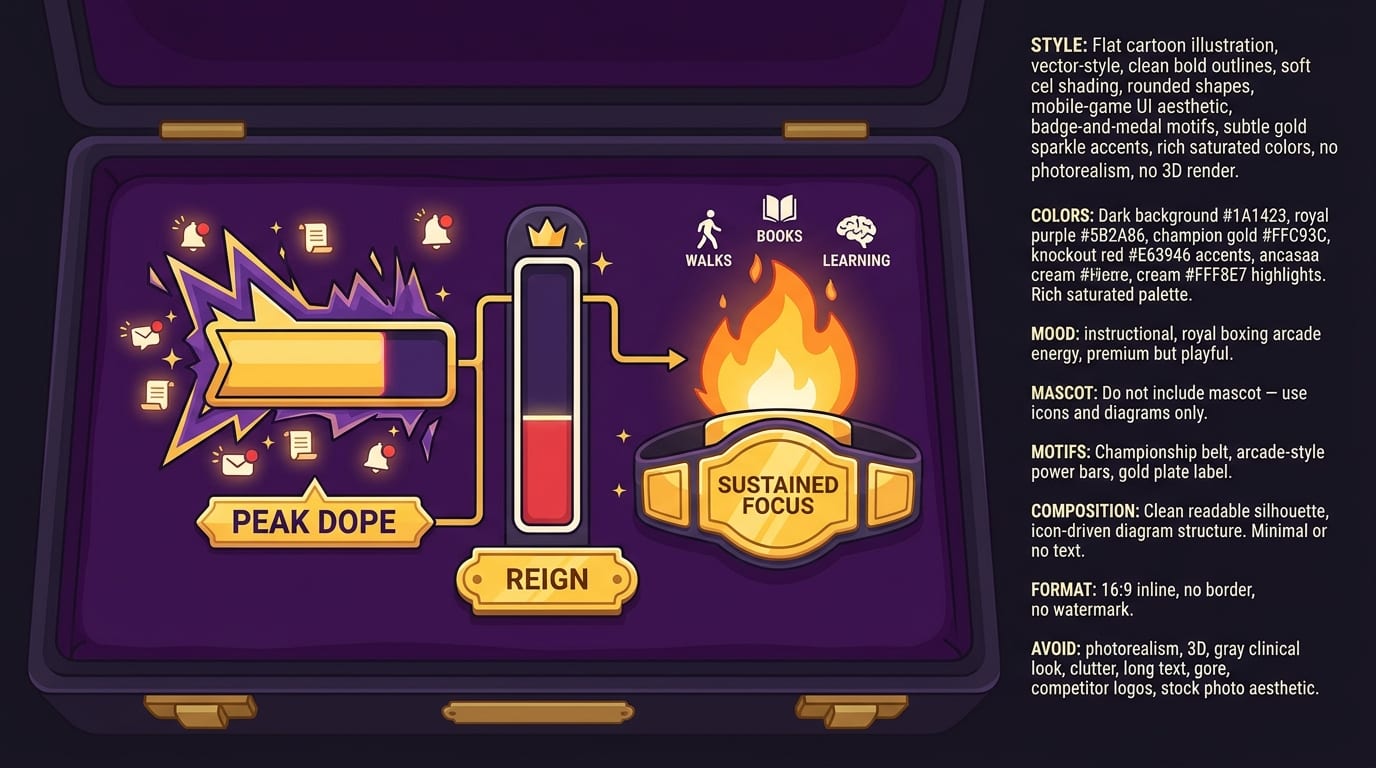
The Bottom Line: Don’t Fast From Dopamine. Fast From Digital Chaos.
Dopamine fasting science is useful when you strip away the nonsense. You are not emptying dopamine from your brain. You are reducing the cues and reward loops that train you to chase fast stimulation at the expense of focus, sleep, creativity, and actual life.
The winning formula is simple: identify your biggest digital triggers, set a realistic fast, replace the habit loop, add friction, and measure results. Start with two hours. Build to workday blocks. Try a 24-hour reset when needed. Keep the parts that make your attention feel less like a squirrel in a fireworks factory.
And if your distractions keep breaching the castle walls, bring backup. BlockChamp lets you block distracting sites, categories, and keywords in Chrome while turning focus into a game — XP, badges, reigns, leaderboards, and The King’s glorious stare-down included. It’s evidence-based behavior design wearing boxing gloves and a crown. Which, frankly, is how productivity should have dressed all along.
So pick your first fast. Block the villains. Defend the throne. Long live your focus, champ.
Related posts

How To Write 50000 Words With Focus

Finding Focus To Pursue Big Goals

Writing Sprint Tips For Focused Output
