
Writing Sprint Tips For Focused Output

Your writing sprint starts at 9:00. By 9:07, you have checked the weather, opened three tabs about desk chairs, and somehow ended up watching a raccoon steal cat food. The draft remains a blank page, judging you with the quiet intensity of a royal portrait.
Good writing sprint tips for focused output can help you turn that blank page into a manageable stretch of work. The trick is not to bully yourself into writing for hours. It is to set a specific goal, work for a short, planned interval, reduce interruptions, and leave yourself a clear next step. Think less “summon genius from the void” and more “put the phone away and write the next paragraph.”
Whether you are drafting a report, studying, working on a novel, or trying to get that email finished before it grows sentient, a writing sprint gives your attention a target. Here is how to plan one, keep it focused, and finish with useful progress instead of 47 open tabs and a vague sense of betrayal.
Quick Answers
What Is a Writing Sprint, Anyway?
A writing sprint is a short, timed period in which you focus on producing written work. You choose a duration, define what you will work on, and write until the timer ends. The goal is to make progress, not to create polished, publication-ready prose in one heroic sitting.
That distinction matters. Editing every sentence while drafting can turn a sprint into a tiny courtroom where each word must defend its existence. For most writing sprints, your job is to move forward: add new words, outline a section, develop an argument, or work through a specific revision task. You can polish later.
Sprints work especially well when a task feels too large to start. “Write my thesis chapter” is a cloud of doom. “Draft the section explaining the method for 25 minutes” is a task with edges. A timer also gives the work a finish line, which can make it easier to begin when motivation is still looking for parking.
There is no universally correct sprint length. Some writers like 10-minute bursts; others prefer 25, 40, or 50 minutes. Choose an interval that feels long enough to settle in but short enough that you can imagine finishing it. If you are new to the routine, start at 15 or 20 minutes and adjust based on experience.
Writing Sprint Tips for Focused Output Start With a Clear Target
Before you press start, decide what “done” means for this sprint. A vague goal like “work on my article” leaves your brain free to wander into anything that looks easier. A specific goal tells it where to go.
Good sprint goals are concrete and achievable within the time available. For example:
- Draft the opening 300 words of a blog post.
- Write one rough paragraph for each of three outline points.
- Revise the introduction for clarity without touching the rest of the draft.
- Answer five questions in a study guide using complete sentences.
- List examples and evidence for the next report section.
Notice that these goals can focus on a result or a process. A word-count goal can be motivating, but it is not the only useful measure. Research, outlining, or restructuring may produce fewer new words while still moving the project forward. Pick a target that fits the actual work instead of forcing every session to become a typing contest.
It can also help to define what is not part of the sprint. If you are drafting, do not start a full fact-check of every sentence unless accuracy research is the task. If you are editing, do not rebuild the whole outline because one paragraph feels awkward. Put those tempting side quests on a parking-lot list. The kingdom can survive without you pursuing every thought immediately.
Writers who find it difficult to settle into a session may benefit from a small pre-writing routine. The guide to finding focus for uninterrupted writing offers another angle on creating the conditions for a steadier writing session.
Choose a Timer That Helps, Not One That Starts a Coup
A timer gives your sprint boundaries. It says, “For this window, I’m working on this task,” and it also promises that a break is coming. That can make it easier to resist checking messages, getting a snack, or investigating whether that mysterious browser tab is still open.
Try a 25-minute sprint followed by a five-minute break if you want a familiar starting point. You could also work for 15 minutes with a three-minute reset, or use a 45-minute block with a longer break. The right interval depends on the task, your energy, and how quickly your attention tends to wander. Treat the first few sessions as experiments, not a referendum on your character.
Set the timer once and keep the clock out of your direct line of sight if watching every second makes you restless. When it rings, finish the sentence or jot down where you stopped. Then step away briefly: stretch, get water, look out a window, or walk a lap. A break is for recovering attention, not for falling into a social feed that has the gripping power of a sinkhole.
Research on multitasking suggests that switching between tasks can come with a cost. The American Psychological Association explains that shifting attention between complex tasks can reduce efficiency, especially when people repeatedly move back and forth. Read its overview on multitasking and task switching for context. In a sprint, the practical lesson is simple: fewer switches usually mean more room to stay with the work.
If a timer makes you anxious, use a gentle version. Set a minimum work window rather than demanding uninterrupted perfection. The aim is to create a dependable container for writing, not to turn your desk into a tiny productivity prison.

Defend Your Attention Before You Begin
Distractions are easier to manage before the sprint than in the middle of it. Take one minute to set up your workspace. Close unrelated tabs, silence nonessential notifications, put your phone out of reach, and open only the materials needed for the task. If you are writing online, consider keeping research separate from the document so a quick search does not become a grand tour of the internet.
Make the next action obvious. Open the draft at the right section. Add a temporary heading if you need one. Keep your outline or source notes nearby. The fewer decisions you need to make once the timer starts, the less chance your attention will wander off to negotiate with the refrigerator.
For browser-based work, website blocking can add a helpful boundary. BlockChamp is a Google Chrome website blocker that lets you block individual sites and, depending on your plan, categories or keywords. Its focus mode can make social media, video, news, or shopping less available during a writing window. When a blocked distraction calls, its Stare-Down page gives you a humorous reminder to return to the draft rather than a bland “nope” screen.
For people who benefit from visible progress, BlockChamp also uses XP, levels, badges, and reigns to reward focused time. That gamified approach will not write the paragraph for you—tragic, we know—but it can make consistency feel more satisfying. Explore BlockChamp if a playful website-blocking tool would help protect your writing sessions.
Do not block tools you genuinely need for the task. A researcher may need a browser; a marketer may need social media for a scheduled work purpose. Block the specific distractions that tend to hijack your time, and keep essential work resources accessible. The goal is to defend the throne, not accidentally lock yourself out of the kingdom.
Use a Sprint Plan That Fits the Work
Not every writing task benefits from the same sprint structure. A first draft, a revision pass, and a literature review have different demands. Match the session to the stage of work so you are not trying to edit, research, outline, and draft at once.
For a first draft
Start with a small outline or a short list of points you want to cover. During the sprint, write forward without fussing over every sentence. If you get stuck, leave a note such as “[add example here]” and move on. Rough but complete beats perfect and nonexistent.
For editing
Choose one editing lens for the session: structure, clarity, evidence, or grammar. Reading for all four at once can feel like trying to watch four different films on one screen. During a structure pass, focus on whether ideas are in a useful order. During a clarity pass, look for vague wording and confusing transitions. Save the tiny punctuation patrol for a later round.
For research-heavy writing
Define the question you need to answer and what would count as enough information to continue drafting. Keep a source log with the title, link, and one-sentence note about why each source matters. This helps prevent “one quick search” from expanding into a sprawling collection of tabs, each containing a slightly different opinion about the same thing.
For creative projects, momentum can be especially delicate. If your sprint gets tangled in self-doubt, try the practical ideas in overcoming creative fear and staying focused. And if your project is fiction, finding focus for fiction writing offers advice tailored to storytelling sessions.
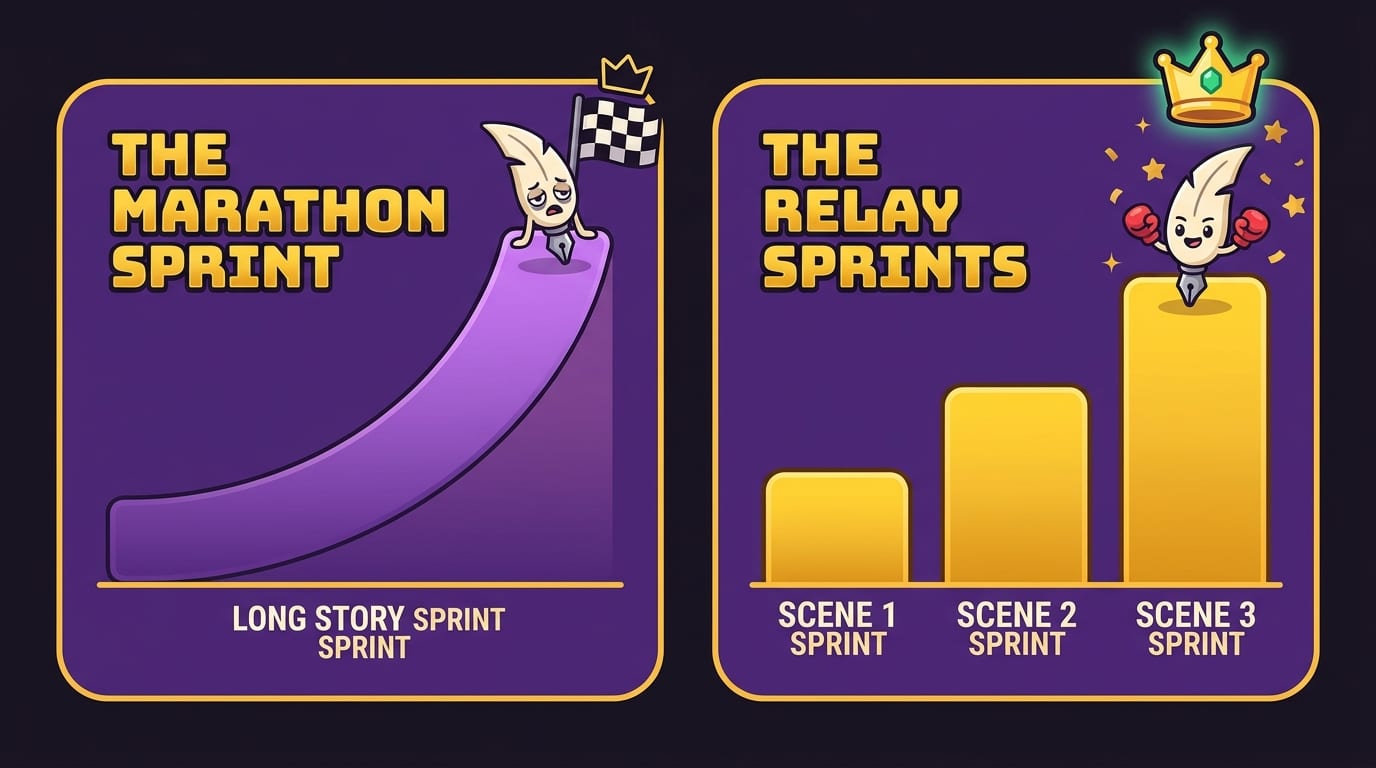
When Your Brain Wanders, Give It a Parking Spot
Even a well-planned sprint will attract stray thoughts. You may remember a bill, think of a better title, or suddenly decide that the desk needs reorganizing with military precision. Do not waste the session trying to prevent every thought from appearing. Instead, acknowledge it and return to the task.
Keep a scrap document or a piece of paper beside you. When an unrelated thought shows up, write a brief reminder—“email Sam,” “check source for date,” “look up title idea”—and go back to writing. This is a parking lot, not a second to-do list that demands immediate action. You are saving the thought for later, not granting it royal authority.
If you keep reaching for a distraction automatically, add a little friction. Move your phone across the room. Sign out of an especially tempting site. Use a blocker during your planned writing period. A small barrier creates a pause between impulse and action, giving you time to remember the reason you started the sprint.
And if you do get distracted, do not declare the entire session ruined. Notice what happened and restart. One interruption is a moment, not a prophecy. A helpful writing habit is built by returning to the work, not by achieving a mythical state in which no thought ever wanders.
End Each Sprint With a Quick Progress Review
When the timer ends, take a minute to record what happened. Note the task, the time spent, and what you completed. If you are tracking words, record the approximate count; if you were revising or researching, write down the section or decision you advanced.
Then leave yourself a restart note. Write one sentence describing the next action: “Add the example about the student survey,” or “Rewrite the second paragraph to explain the result.” This small step can make the next session much easier to begin, because you will not have to reconstruct your entire train of thought from the wreckage of yesterday’s browser tabs.
Use the review to improve your process, not judge your worth. Ask:
- Was the goal clear enough?
- Was the sprint length a good fit?
- What interrupted me, and can I reduce that next time?
- What is the smallest useful next step?
If you use BlockChamp, its focus tracking, XP, reigns, and calendar can make consistency more visible. Treat those signals as feedback, not a grade. A shorter session that got you past a stubborn section is a win, even if you did not produce a mountain of words.

Build a Sprint Routine You Can Repeat
One productive sprint is useful. A repeatable routine is better. Choose a reliable cue, such as making tea, closing your email, or starting a focus block at the beginning of your work period. Keep the routine short enough to repeat on busy days. A complicated pre-writing ceremony involving seven candles and a ceremonial quill is charming, but perhaps not ideal on a Tuesday morning.
Plan the next sprint before ending your workday. Write down the first task, gather the materials you need, and decide when you will begin. If you have multiple writing projects, identify the one that matters most now. Too many simultaneous priorities can make it hard to choose a starting point, which is how people end up alphabetizing their desktop icons instead.
Make room for different kinds of sessions. Some days you may have the energy for a longer deep-work block; other days, a 10-minute sprint is the realistic choice. Regular, manageable sessions can keep a project moving without requiring every work period to feel spectacular. For help thinking about the role of collaboration and accountability, see finding focus through writing communities.
For more context on staying focused around modern digital tools, the BlockChamp article on generative AI and staying focused at work discusses boundaries that help keep technology useful rather than distracting. The principle applies whether the temptation is an AI chat, a social feed, or a video that begins with “just one quick tip” and ends 40 minutes later.
A Simple Writing Sprint Template to Try Today
If you want a straightforward starting plan, try this 30-minute session:
- Minutes 0–2: Write one specific goal, such as drafting two rough paragraphs or revising one section.
- Minutes 2–4: Close distracting tabs, silence notifications, open your notes, and get water.
- Minutes 4–24: Write or revise only the chosen task. Park unrelated thoughts and keep moving.
- Minutes 24–27: Review what you accomplished and add any unfinished thoughts to your notes.
- Minutes 27–30: Write the next action for your next session, then take a short break.
Adjust the timings as needed. If you are already in a good flow, you can continue after the timer ends. If you are exhausted, stop and return later. The purpose of a sprint is to create useful focus, not to make a timer the new monarch of your life.

Write the Next Sentence, Champ
The most effective writing sprint tips for focused output are refreshingly practical: choose a clear target, set a realistic timer, prepare your workspace, keep distractions at a distance, and review your progress before you stop. Start with an interval you can manage and build a routine that fits your actual work and energy.
Do not wait for the perfect mood, the perfect desk, or a visit from the Muse wearing a helpful name tag. Set a small goal and begin. If online distractions keep ambushing your writing time, a Chrome blocker such as BlockChamp can help you put up a boundary—and make defending your focus feel a little more like a victory lap.
Your draft does not need a coronation. It needs the next sentence. Set the timer, defend the throne, and get writing.
Related posts

Paper Or Digital Planner

Generative Ai And Staying Focused At Work

Overcoming Creative Fear And Staying Focused
