
Focus Distracted Brain

Your brain is not broken. It is not “lazy.” It has not been personally cursed by the tiny goblin who lives inside TikTok’s recommendation engine. But if you are trying to focus with a distracted brain, it can absolutely feel like your attention span has been replaced by a caffeinated squirrel wearing roller skates.
The good news: focus is trainable. Not in the dramatic “move to a cabin and write with a feather quill” way. In the practical, modern, browser-tab-infested way. A focus distracted brain needs fewer temptations, clearer starting rituals, better recovery habits, and a little less faith in raw willpower. Willpower is adorable. It also collapses the second YouTube whispers, “Just one video about medieval plumbing.”
In this guide, we’ll break down why attention gets hijacked, how to rebuild sustained concentration, and what to do when your brain keeps sprinting toward distractions like it’s competing for gold in the Doomscroll Olympics. We’ll cover environment tweaks, mental techniques, routines, and tools like BlockChamp that help you knock out distracting websites before they turn your work session into a digital pie-eating contest.
Quick Answers
Why Your Focus Distracted Brain Keeps Looking for Trouble
A distracted brain is not necessarily a weak brain. Often, it is a stimulated brain. Modern apps, feeds, notifications, and infinite-scroll platforms are designed to be frictionless, rewarding, and emotionally sticky. They offer novelty on demand. Your spreadsheet, sadly, does not.
Attention works best when your environment supports it. But most people try to concentrate in a digital casino: Slack dinging, phone glowing, 37 tabs open, inbox lurking like a raccoon in a trench coat, and a browser history that knows too much. Then they blame themselves for not achieving monk-like stillness. Champ, even monks would struggle if their monastery had push notifications.
Research on attention residue shows that when you switch tasks, part of your mind remains stuck on the previous task, reducing performance on the next one. The concept comes from work by Sophie Leroy, summarized in the American Psychological Association’s research on attention residue. Translation: every time you bounce from your essay to Instagram to email to “quickly checking the weather in Luxembourg for no reason,” your brain pays a toll.
There is also the problem of interruptions. The University of California, Irvine research on interrupted work found that people often take significant time to return to a task after being interrupted. Even when you “only check one thing,” the hidden cost is the time and mental effort needed to reload the original task back into your brain’s RAM.
So the goal is not to become a productivity robot with perfect posture and no feelings. The goal is to build systems that reduce attention leaks. Less “try harder.” More “stop letting the internet slap your concentration with a wet fish.”
Step 1: Identify Your Distraction Triggers Like a Tiny Detective With a Crown
Before you fix a focus distracted brain, you need to know what keeps pulling it off course. Most people vaguely say, “I get distracted by my phone” or “I waste time online.” That is true, but too fuzzy to fight. You cannot knockout a fog machine. You need names, patterns, and moments.
Start by tracking your distractions for two normal work or study days. Do not judge yourself. Just observe. Pretend you are a scientist studying a rare creature called Homo Procrastinatus, known for opening Reddit during tax paperwork.
Track these five details
- What distracted you: TikTok, YouTube, Reddit, email, news, shopping, messages, AI chatbots, games, random Googling.
- When it happened: first thing in the morning, after lunch, during hard tasks, late afternoon, after a meeting.
- What you felt before it: bored, stuck, anxious, tired, uncertain, hungry, mildly offended by your own to-do list.
- How long it lasted: two minutes, twenty minutes, “I have seen the birth and death of civilizations in this comment thread.”
- What task you avoided: writing, studying, planning, admin, coding, cleaning up inbox, starting anything with a deadline.
This gives you a distraction map. You might discover you do not actually have a “focus problem” all day. You have a “starting hard tasks” problem. Or a “3 p.m. energy crash” problem. Or a “YouTube while researching becomes YouTube while watching a man restore a 1912 toaster” problem.
Once you see the pattern, you can build targeted defenses. If Reddit is your weak spot during writing sessions, block Reddit while writing. If news sites eat your mornings, block news before noon. If AI tools become a shiny escape hatch instead of a work aid, block AI distractions during deep work unless you explicitly need them. This is where a browser blocker like BlockChamp helps because you can block specific sites, keywords, or whole categories instead of playing whack-a-mole with your own impulses.
Step 2: Make Your Environment Boring Enough to Win
Your environment should make focus the easiest option. Not the heroic option. Not the “I shall overcome temptation through noble suffering” option. The easiest option. The brain loves low-friction paths, so if distraction is one click away, your focus distracted brain will eventually click it. It is not personal. It is physics with memes.
Start with your physical workspace. Clear the immediate area around your keyboard. Put your phone out of arm’s reach. Not face down beside you. Not under a notebook like it is in witness protection. Put it across the room, in a drawer, or in another room entirely. If you use your phone for authentication, fine, but do not let it sit there glowing like a cursed jewel.
Then clean your digital workspace. Close extra tabs. Use one window for the task at hand. Hide bookmarks that lead to your favorite distractions. Turn off nonessential notifications. If your desktop looks like a digital garage sale, spend ten minutes tidying it. A cluttered screen creates tiny decision points, and tiny decision points become tiny trapdoors.
A simple focus environment checklist
- Phone away from your desk, ideally in another room.
- Only the tabs needed for the current task are open.
- Notifications off for email, messaging, social media, and news.
- Water nearby, because dehydration makes your brain act like a dusty raisin.
- A written task goal visible beside you.
- Distracting websites blocked before you begin.
For digital boundaries, BlockChamp’s category blocking is useful because you can block entire buckets like Social Media, Video & Streaming, News, Shopping, Gaming, Gambling, Adult, and AI Distractions. Free users can block up to three sites and enable two categories, which is plenty to begin your royal anti-scroll campaign. Champion users can go full castle-wall mode with unlimited sites, keyword blocking, all categories, schedules, and Hardcore Lockdown.
If you want a deeper look at designing work rules that protect attention, read BlockChamp’s guide on how to stay focused at work with an attention charter. It pairs beautifully with this step because your environment improves faster when your rules are written down instead of floating around in your head wearing a tiny invisibility cloak.
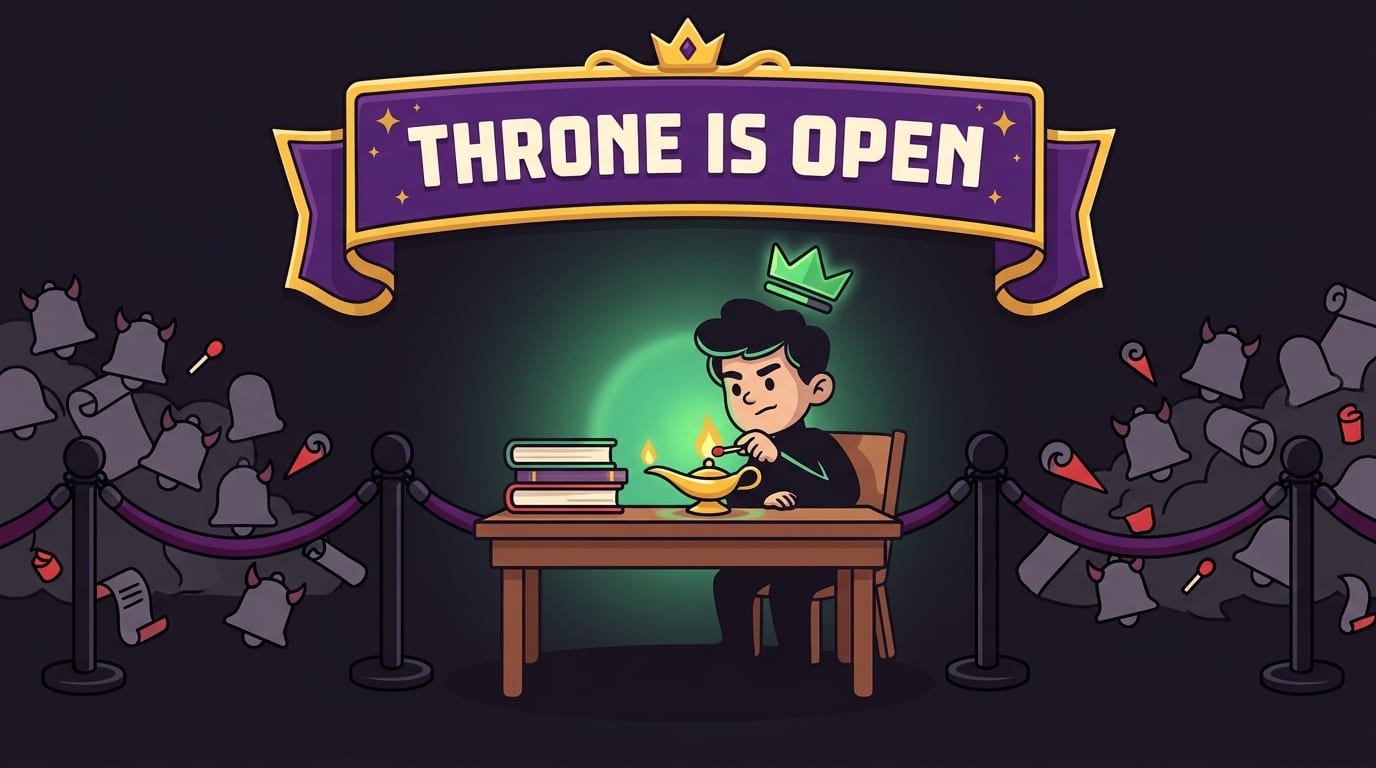
Step 3: Use a Start Ritual So Your Brain Knows the Throne Is Open
One reason people struggle to focus is that they wait to “feel ready.” Terrible plan. Feeling ready is a flaky little duke who rarely arrives on time. Instead, build a start ritual: a short, repeatable sequence that tells your brain, “We are entering focus mode now. Please stop shopping for imaginary kitchen gadgets.”
A good start ritual should take two to five minutes. It should be easy enough that you can do it even when motivation is hiding under the bed. The point is not magic; it is consistency. Your brain learns the sequence and starts transitioning into work mode more smoothly.
Try this 5-step focus ritual
- Name the mission: Write one sentence describing the outcome. Example: “Draft the introduction and first two sections of the report.”
- Set a timer: Choose 25, 45, or 60 minutes depending on task difficulty and energy.
- Remove escape routes: Close extra tabs and block known distraction sites.
- Prepare the first action: Open the exact document, problem set, design file, or code branch you need.
- Begin ugly: Start with a rough version. Bad first drafts are legal in the kingdom.
The “begin ugly” part matters. Perfectionism is often distraction wearing a fancy hat. If your brain thinks the work must be brilliant immediately, it will flee to something easier. Like checking if anyone has invented a silent leaf blower. Spoiler: probably not, and society suffers.
BlockChamp fits naturally into this ritual. Click the extension, turn Master Focus on, and let The King stand guard. The “On Guard” state makes the commitment visible. If you try to sneak into a blocked site, The Stare-Down page catches you with a royal “HALT” and sends you back to work. It is less shame spiral, more comedic boxing coach. We respect a roast with utility.
Step 4: Stop Multitasking, Because Your Brain Is Not a Juggling Octopus
Multitasking feels productive because you are busy. But busy and effective are not twins. They are distant cousins who avoid each other at weddings.
When you rapidly switch between tasks, your brain has to reorient again and again. This burns attention and increases mistakes. The American Psychological Association’s overview of multitasking research explains that task switching can reduce efficiency, especially when tasks are complex or unfamiliar. So if your work requires thinking, writing, learning, strategy, coding, or decision-making, multitasking is basically putting banana peels on your own mental floor.
Instead, practice singular focus. Pick one task. Define the finish line. Work until the timer ends or the defined outcome is complete. Then take a real break. Not a “break” where you check seven apps and return emotionally winded. A real break: stand, stretch, walk, breathe, refill water, stare at a tree like an underpaid philosopher.
For more on this, BlockChamp has a full breakdown on busting the multitasking myth and using singular focus. If your focus distracted brain loves juggling tabs, that post is your royal intervention.
The one-task rule
Before each focus block, write:
- “During this session, I am only working on ______.”
- “If I remember another task, I will write it down and return to ______.”
- “This session is successful if I complete ______.”
This prevents your brain from panic-switching every time a new thought appears. Random thoughts are not commands. They are brain confetti. Notice them, capture them, continue.
Step 5: Train Attention in Short Rounds, Then Build Up Like a Champ
If your concentration is currently fried, do not start with a four-hour deep work block and a heroic playlist called “Ascend.” That is how people burn out, quit, and end up reorganizing their sock drawer during work hours. Start smaller.
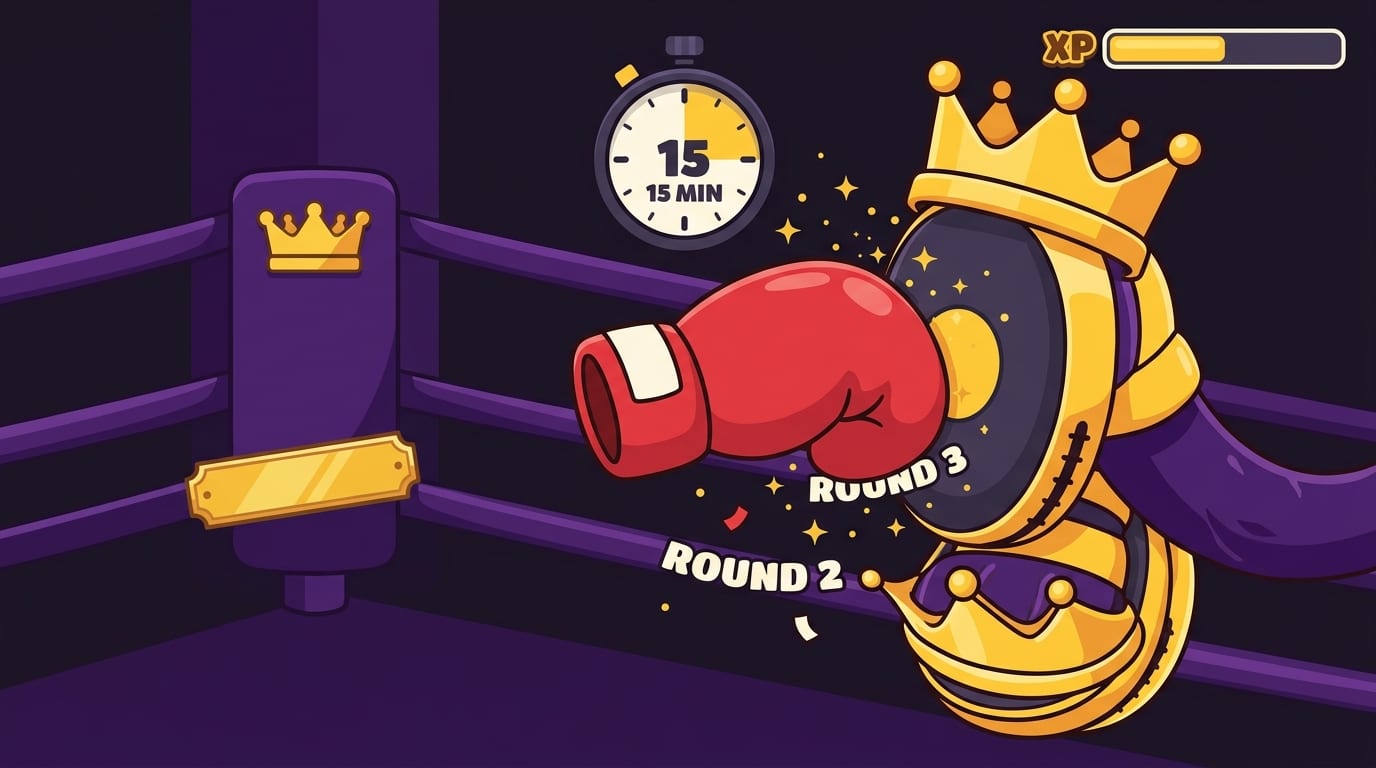
Attention is like fitness. If you have not trained it lately, short rounds work better than dramatic punishment. Begin with 20 to 25 minutes of focused work, followed by a five-minute break. Once that feels manageable, increase to 40 or 50 minutes. Eventually, you can work in 90-minute deep focus blocks, but nobody gets crowned on day one. First, survive the peasants of procrastination.
The Pomodoro Technique is popular because it reduces the intimidation of starting. A timer creates a small container: “I only have to focus until the bell.” That feels much less terrifying than “I must finish this entire project and become a better person by sunset.”
A progression plan for a focus distracted brain
- Week 1: Do two 25-minute focus sessions per day.
- Week 2: Do three 25-minute sessions or two 40-minute sessions.
- Week 3: Try one 60-minute session for your most important task.
- Week 4: Add one 90-minute deep work block on your best energy day.
Use BlockChamp’s XP and reign system to make this progression visible. Every minute of focus earns XP. Every day your blocks stay active contributes to your reign. Every blocked-site temptation you survive earns a little reward instead of becoming a failure parade. That matters because a distracted brain needs feedback. Games are sticky because they show progress. BlockChamp borrows that magic and points it at your work instead of your farm simulation empire.
Step 6: Use Mental Techniques When Distraction Hits Mid-Session
Even with a clean environment and blocked websites, your brain will still occasionally shout, “What if we checked something completely unrelated?” This is normal. Focus does not mean having zero distracting thoughts. Focus means not obeying every distracting thought like it is royal law.
When the urge appears, use a mental technique instead of immediately negotiating with yourself. Negotiating with a craving is like debating a raccoon over trash ownership. You will lose, and the raccoon has no shame.
The 10-second label
When you feel the urge to switch tasks, label it simply: “This is boredom,” “This is avoidance,” “This is uncertainty,” or “This is fatigue.” Labeling creates distance. You are no longer inside the urge; you are observing it.
The urge surf
Cravings usually rise, peak, and fall if you do not feed them. Set a timer for two minutes and keep working while noticing the urge. Most impulses lose strength when you do not instantly reward them.
The parking lot
Keep a note titled “Later.” When an unrelated thought appears, write it down there and return to the task. This reassures your brain that the thought is not lost. It is parked. Wearing a tiny helmet. Safe and ignored for now.
The next tiny action
If you want to escape because the task feels too big, shrink it. Ask: “What is the next physical action?” Examples: open the document, write the heading, solve question one, outline three bullets, reply to one email. Tiny actions bypass drama.
These techniques are simple, but they work best when combined with friction. If the distracting website is still open or accessible, you are making the mental technique fight a dragon with a pool noodle. Block the dragon. Then use the technique.
Step 7: Schedule Your Distractions Instead of Pretending You Are Above Them
You do not need to delete all fun from your life. That is how you become the person who says “I don’t watch TV” with unsettling intensity at parties. The goal is to control when distractions happen so they stop ambushing your best hours.
Scheduled distraction is powerful because it gives your brain a promise: “Not now, but later.” If your brain knows there is a planned break for entertainment, social media, or messages, it is less likely to panic-grab those rewards during work.
Try creating “distraction windows.” For example:
- Social media allowed from 12:30–12:45 p.m. and 6:00–6:30 p.m.
- YouTube allowed after the main task is complete.
- News checked once in the afternoon, not every time the world sneezes.
- Shopping sites only on weekends or during a planned errands block.
This pairs especially well with BlockChamp’s Champion Focus Schedule feature, which can automatically activate blocking during specific days and hours. If you work Monday through Friday from 9 to 5, schedule The King to stand guard during that window. No daily debate. No “I’ll turn it on after I check one thing.” The throne opens. The scroll gets crushed.
If your distractions are tied to social media specifically, you may like BlockChamp’s guide on quitting Twitter for focus and productivity. Even if you do not quit completely, the article is useful for designing healthier boundaries with feeds that behave like attention vacuum cleaners.
Step 8: Protect Your Energy, Because Tired Brains Love Chaos
Sometimes your focus distracted brain is not distracted because the internet is too tempting. Sometimes it is distracted because you are exhausted, hungry, dehydrated, sedentary, or running on sleep that can only be described as “legally suspicious.”
Attention depends on energy. You cannot hack your way around basic biology forever. You can install every productivity app in the kingdom, but if you slept four hours and ate a gas station pastry for lunch, your prefrontal cortex will file a complaint.
Sleep is especially important. The CDC’s sleep guidance notes that adults generally need at least seven hours of sleep per night for health and functioning. Poor sleep affects attention, decision-making, mood, and impulse control. In other words, a tired brain is much more likely to think, “Yes, watching 19 clips of raccoons stealing cat food is exactly what we need right now.”
Energy habits that support focus
- Sleep consistently: Keep wake time reasonably stable, even if bedtime varies.
- Move daily: A 10-minute walk can reset attention and reduce mental fog.
- Eat before deep work: Not a feast. Just enough fuel that your brain does not start chewing on its own motivation.
- Hydrate: Keep water at your desk. Become the hydrated monarch you were born to be.
- Take real breaks: Movement breaks beat feed breaks for recovery.
For freelancers, creators, and remote workers, energy management matters even more because your schedule is often self-directed. If that is you, check out five ways freelancers can reclaim focus and deep work. It covers practical ways to defend your time when nobody else is guarding the gates.
Step 9: Make Focus Measurable So Progress Stops Feeling Invisible
One sneaky reason focus habits fail is that progress is hard to see. You may spend three solid hours working, but your brain remembers the five minutes you slipped. Very rude. Very unhelpful. This is why measurement matters.
Tracking focus turns effort into evidence. Evidence builds confidence. Confidence makes you more likely to repeat the behavior. This is one reason habit trackers, streaks, and scoreboards work: they give your brain a visible reward for consistency.
You can track focus manually with a notebook or spreadsheet. Log:
- Start and end time of each focus session.
- Main task completed.
- Distractions resisted.
- Energy level before and after.
- One improvement for tomorrow.
Or you can use a tool that does it for you. BlockChamp tracks focus hours, reigns, XP, stare-downs survived, badges, calendar history, and leaderboard rankings. That means your focus is not just a vague feeling; it becomes a game board. Every focused day earns progress. Every avoided distraction becomes a mini-win. The King may judge your attempted YouTube escape, but he also rewards your comeback. Fair monarchy, honestly.
This kind of gamification works because it shifts identity. You are not “someone trying not to procrastinate.” You are becoming a Block Champ. That sounds silly, yes. It is also useful. Identity-based habits are sticky because people tend to act in ways that reinforce who they believe they are. If your system helps you see yourself as someone who protects focus, you are more likely to keep doing it.
A Practical 7-Day Plan to Reset a Focus Distracted Brain
Enough theory. Let’s put the crown on the calendar. Here is a simple seven-day reset plan for anyone whose attention has been dragged through the algorithmic mud.
Day 1: Audit the chaos
Track your distractions for one workday. Write down what pulled you away, when, and why. Do not fix yet. Just gather intel. The enemy has a name, and it is probably “just checking.”
Day 2: Block your top three distractions
Choose the three biggest websites or categories that sabotage your focus. Use BlockChamp or another blocker to remove them during work blocks. If you use BlockChamp, turn on Master Focus and let The King patrol the gates.
Day 3: Create your start ritual
Use the five-step ritual: name the mission, set a timer, remove escape routes, prepare the first action, begin ugly. Repeat it for at least two focus sessions.
Day 4: Practice one-task work
Pick one meaningful task and work on only that for 45 minutes. Keep a “Later” note for intrusive thoughts. If you switch tabs without purpose, gently return. No drama. No courtroom scene.
Day 5: Add scheduled distraction windows
Choose two times when you are allowed to check social media, news, or entertainment. Outside those windows, block or avoid them. Your brain gets treats. It just does not get to drive the carriage.
Day 6: Improve recovery
Take real breaks between focus sessions. Walk, stretch, breathe, hydrate. Notice how much better your attention feels when breaks do not involve diving face-first into a feed.
Day 7: Review and adjust
Look at what worked. Which block times helped? Which distractions still slipped through? Which tasks triggered avoidance? Add more blocks, adjust your schedule, and set a focus goal for the next week.
If you complete this seven-day reset, you will not become a perfect focus wizard. But you will have a working system. That is better. Wizards are unreliable. Systems show up on Tuesday.
Common Focus Mistakes That Keep Your Brain Distracted
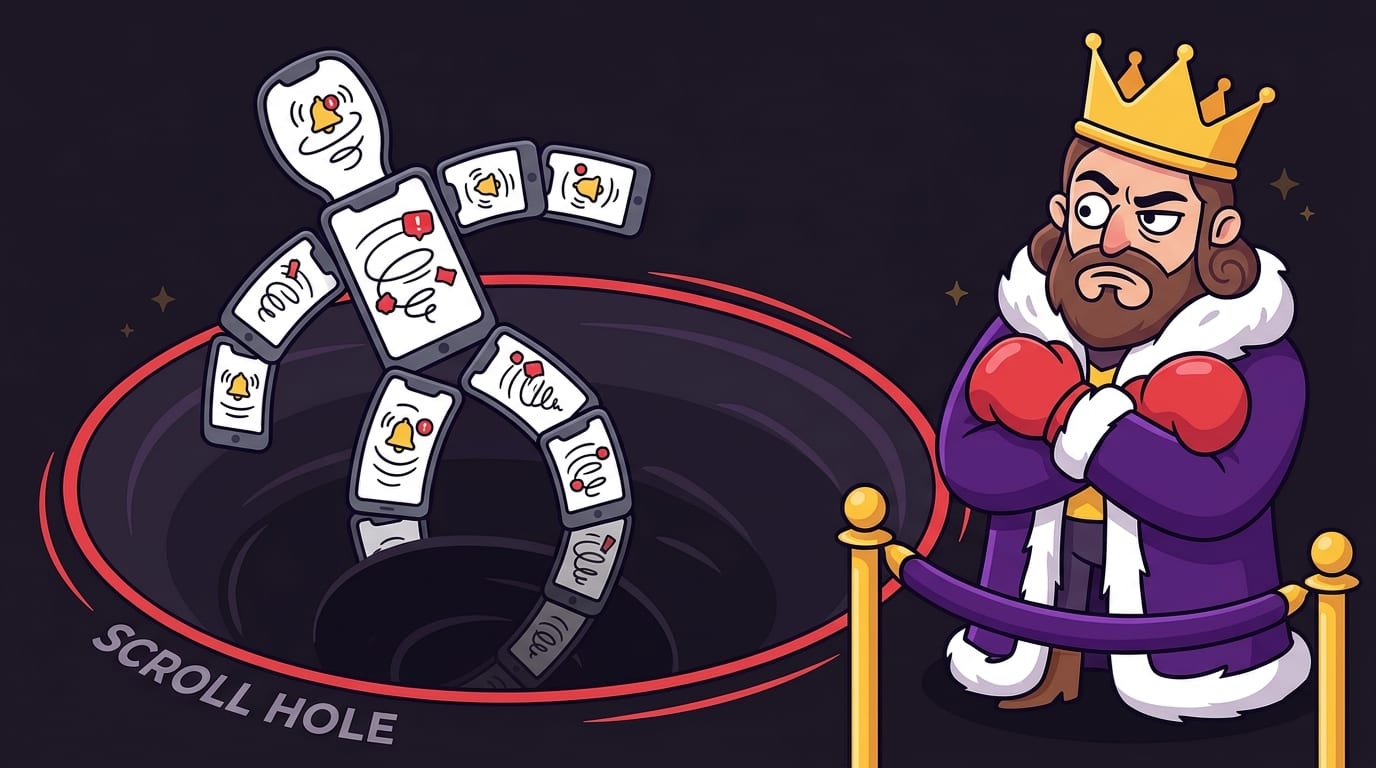
Even smart, motivated people sabotage focus by making the same mistakes repeatedly. Let’s call them out gently, like The King raising one disappointed eyebrow.
Mistake 1: Relying on motivation
Motivation is great when it appears, but it is not a strategy. Build routines and barriers that work even when motivation is wearing pajamas and refusing to cooperate.
Mistake 2: Keeping distractions “just in case”
If you do not need a site for the task, it should not be open. If it repeatedly sabotages you, block it. “Just in case” is how YouTube sneaks into your castle wearing a fake mustache.
Mistake 3: Taking digital breaks from digital work
If you have been staring at a screen for 60 minutes, scrolling on another screen is not recovery. It is screen lasagna. Take a physical break.
Mistake 4: Making the task too vague
“Work on project” is not a task. “Write the outline for section two” is a task. Specificity lowers resistance.
Mistake 5: Quitting after one slip
A distraction does not ruin the day. It is a rep. Notice it, adjust, and continue. BlockChamp’s approach is built around this idea: consistency beats perfection. Survive the stare-down, earn XP, return to the throne.
Final Round: Your Brain Can Focus Again, Champ
A focus distracted brain is not a life sentence. It is a system problem, a training problem, and sometimes a “why is my phone within grabbing distance like a shiny little goblin rectangle?” problem. Fix the system and focus becomes dramatically easier.
Start with the basics: identify your triggers, clean up your environment, build a start ritual, stop multitasking, train in short rounds, use mental techniques, schedule your distractions, protect your energy, and track progress. None of these require becoming a productivity monk. They require making focus less fragile.
And if your biggest battles happen in the browser, bring backup. BlockChamp turns website blocking into a game, complete with XP, levels, badges, reigns, a leaderboard, and The King’s merciless Stare-Down when you try to sneak into forbidden scroll territory. It is practical attention protection with a boxing glove and a crown. Honestly, productivity needed more theatrical royalty.
So here is your next step: pick one focus session today. Block your top distraction. Set a timer. Start ugly. Defend the throne for just 25 minutes. Then do it again tomorrow.
Long live your focus. Crush the scroll. Become king of your time.
Related posts

Writing Sprint Tips For Focused Output

Paper Or Digital Planner

Generative Ai And Staying Focused At Work
