
Cortisol Level Reset Guide

Your body is not a broken vending machine that needs a dramatic “detox.” But if you feel wired at midnight, foggy at 10 a.m., snacky at 3 p.m., and personally attacked by every notification, your stress system may be running the kingdom like a tiny caffeinated tyrant. This cortisol level reset guide gives you a practical, evidence-informed way to restore a healthier daily rhythm using sleep, light, movement, food, stress management, and digital boundaries — no swamp juice, no monk robes required.
Quick royal disclaimer before we mount the horse: cortisol is not “bad.” It is a vital hormone that helps regulate energy, inflammation, blood pressure, immune function, and your wake-sleep rhythm. The goal is not to crush cortisol into dust like a peasant rebellion. The goal is balance: higher in the morning, lower at night, responsive during real stress, and not constantly screaming because your brain thinks email, doomscrolling, and a group chat named “quick question” are all saber-toothed tigers.
If you suspect a medical issue — like Cushing’s syndrome, Addison’s disease, thyroid problems, severe anxiety, depression, or medication side effects — talk to a qualified clinician. Lifestyle changes help many people, but they are not a replacement for medical care. Now, let’s reset the royal stress thermostat.
Quick Answers
What Cortisol Actually Does: The Stress Hormone With a Day Job
Cortisol is produced by your adrenal glands and follows a daily rhythm called the circadian pattern. In a healthy rhythm, cortisol rises in the early morning to help you wake up, peaks shortly after waking, then gradually declines throughout the day so melatonin can roll in at night like a sleepy little wizard.
Problems happen when that rhythm gets flattened, shifted, or constantly poked by stressors. Chronic sleep loss, intense work pressure, irregular meals, too much caffeine, late-night screens, overtraining, alcohol, and relentless digital stimulation can all keep your nervous system on high alert. Your body may interpret “just checking TikTok for five minutes” as “attention threat detected, deploy the biochemical cavalry.” Rude, but evolution did not prepare us for infinite scroll.
According to the Cleveland Clinic’s overview of cortisol, cortisol affects many body systems, including metabolism, inflammation, blood pressure, and sleep-wake cycles. That is why chronic stress can feel so whole-body: tired but restless, hungry but unsatisfied, focused for 11 seconds, emotionally spicy, and suddenly convinced you need to reorganize your entire life at 1:17 a.m.
A cortisol reset is really a rhythm reset. You are training your body to understand: morning is for energy, daytime is for focused action, evening is for winding down, and midnight is not the appropriate hour to read 47 horrifying news headlines while lying horizontally like a stressed baguette.
Signs Your Cortisol Rhythm Might Be Out of Whack
You cannot diagnose cortisol problems from vibes alone, even if your vibes are wearing a tiny lab coat. But certain patterns can suggest your stress system needs support. Think of these as dashboard lights, not final verdicts from the throne.
- Feeling exhausted in the morning but alert at night
- Difficulty falling asleep or waking up around 2–4 a.m.
- Craving sugar, salty snacks, or caffeine when stressed
- Brain fog, low motivation, or difficulty concentrating
- Feeling easily overwhelmed by small tasks
- Getting irritated by normal human events, such as emails existing
- Digestive discomfort during busy or anxious periods
- Frequent headaches, tension, or jaw clenching
- Using scrolling, shopping, gaming, or snacking as a stress escape
Notice that last one. Digital habits matter. Your nervous system does not care whether the stressor is a boss yelling, a breaking-news alert, a comments-section cage fight, or 19 open tabs whispering “you forgot something.” To your brain, unresolved input can feel like threat. That is why your cortisol level reset guide needs more than sleep tips. It needs boundaries around attention.
If your main stress loop is online — doomscrolling, comparison spirals, late-night YouTube, Reddit rabbit holes, “research” that mysteriously becomes sneaker shopping — a website blocker can be a surprisingly powerful nervous-system tool. BlockChamp was built for exactly this modern boss fight: it helps you block distracting websites in Chrome, then turns focus into a game with XP, streaks, badges, and The King, a cartoon royal boxer who roasts you when you try to sneak into blocked sites. Is it scientifically necessary for a tiny king to judge your YouTube attempt? No. Is it effective because shame-free humor interrupts the impulse? Very possibly, champ.
Step 1: Anchor Your Morning Like a Responsible Little Sunflower
The fastest place to begin resetting cortisol is the morning. Your body’s internal clock uses light, movement, food timing, and routine to decide what time it is. If your morning starts in darkness, phone-in-face panic, and iced coffee before water, your circadian rhythm may be filing a formal complaint.
Start with outdoor light within 30–60 minutes of waking. Morning light helps regulate circadian timing and supports the natural cortisol awakening response. You do not need to stare at the sun like a confused sunflower villain. Just get outside or sit near bright natural light for 5–20 minutes, depending on weather and brightness.
The CDC’s sleep hygiene guidance emphasizes consistent sleep and wake times, light exposure, and habits that support better sleep. Morning light is one of those boring-but-mighty habits. It is not glamorous. It will not get a Netflix documentary. It works anyway.
Try this simple morning cortisol reset sequence:
- Wake at roughly the same time most days, even on weekends if possible.
- Drink water before caffeine. Your adrenal glands are not asking for a caramel lightning potion immediately.
- Get outdoor light for 5–20 minutes.
- Move gently: walk, stretch, mobility work, or a few bodyweight squats.
- Eat a protein-forward breakfast if you feel better with morning food.
- Delay phone chaos for at least 20–30 minutes.
If mornings are your weak spot, pair this with a simple checklist. BlockChamp readers may also like this practical morning routine checklist guide, which helps you build a sane start to the day instead of waking up and immediately letting the internet throw tomatoes at your nervous system.
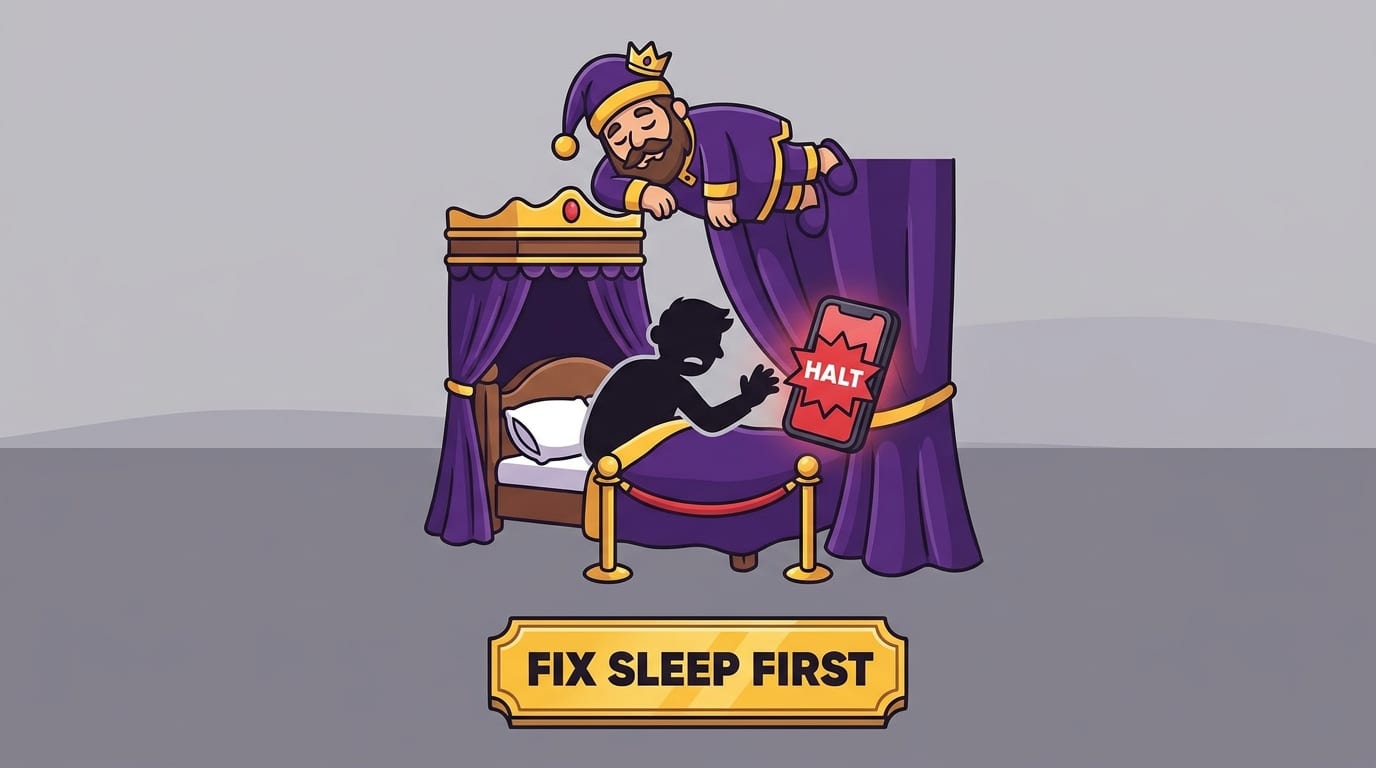
Step 2: Fix Sleep First, Because Cortisol Loves a Bedtime Villain Arc
If your sleep is chaotic, your cortisol will probably be chaotic too. Sleep deprivation can increase stress reactivity, disrupt appetite hormones, impair glucose regulation, and make you emotionally fragile enough to argue with a printer. Not your finest duel.
The basic sleep reset is not fancy, but it is powerful: consistent wake time, dimmer evenings, lower stimulation before bed, and a wind-down routine that tells your body the war council has adjourned.
Use these sleep-focused cortisol reset tactics:
- Set a caffeine cutoff. For many people, 8–10 hours before bed is a sensible range. If you are sensitive, go earlier.
- Dim lights at night. Bright light late in the evening can delay melatonin and make your brain think it is party o’clock.
- Stop working near bedtime. Your inbox is not a lullaby. It is a tiny stress piñata.
- Create a repeatable wind-down. Shower, stretch, read paper books, journal, prep tomorrow’s clothes.
- Keep your room cool and dark. Sleep likes cave energy. Luxurious cave energy, ideally.
- Don’t use bed as a stress theater. If you cannot sleep after a while, get up briefly and do something calm in low light.
Late-night scrolling deserves special attention because it is a triple jab: blue-enriched light, emotional stimulation, and endless novelty. One minute you are checking a message; 45 minutes later you are watching a raccoon steal cat food while your cortisol rhythm quietly packs its bags.
This is where environmental design beats willpower. If you know you open distracting sites at night, block them during your wind-down window. BlockChamp’s category blocking can shut down Social Media, Video & Streaming, News, Shopping, Gaming, and AI Distractions with simple toggles. Champion users can also use Focus Schedule to automatically activate blocks at specific hours. Translation: bedtime you does not need to negotiate with goblin-you. The King stands guard.
Step 3: Eat to Stabilize Energy, Not to Win a Sad Desk Salad Trophy
Nutrition affects cortisol indirectly through blood sugar, inflammation, caffeine intake, and overall energy availability. Extreme dieting, skipping meals when stressed, living on coffee until 2 p.m., or eating mostly ultra-processed snack confetti can all make your body feel less safe. A stressed body tends to become a loud body.
The goal is not perfection. The goal is stable inputs. Think protein, fiber, healthy fats, complex carbs, and regular hydration. Your adrenal glands do not require a 17-ingredient smoothie blessed by a wellness goblin. They appreciate consistency.
Build meals around this simple plate:
- A protein source: eggs, Greek yogurt, tofu, fish, chicken, beans, lentils, tempeh, lean meat
- High-fiber carbs: oats, potatoes, rice, quinoa, fruit, whole grains, beans
- Colorful plants: leafy greens, berries, peppers, carrots, cruciferous vegetables
- Healthy fats: olive oil, avocado, nuts, seeds, fatty fish
- Fluids: water, herbal tea, mineral water, or electrolyte support if needed
Be careful with the caffeine-cortisol tango. Caffeine is not evil. It is a tool. But if you use it as a substitute for sleep, food, sunlight, emotional regulation, and having one single boundary, it becomes less “productivity nectar” and more “legal anxiety juice.” Try delaying caffeine 60–90 minutes after waking if you get morning jitters, and avoid caffeine late in the day.
Alcohol is another sneaky stress-rhythm disruptor. It may make you feel sleepy, but it can reduce sleep quality and increase nighttime awakenings. If your cortisol reset plan includes better sleep, reducing alcohol — especially close to bedtime — is a strong move.
For a deeper performance-focused approach, read BlockChamp’s cortisol detox plan for high performers. It pairs nicely with this guide if your calendar looks like it was assembled by a caffeinated octopus.
Step 4: Move Your Body, But Don’t Turn Every Workout Into a Gladiator Trial
Exercise is one of the best long-term stress regulators. It improves sleep quality, mood, insulin sensitivity, cardiovascular health, and resilience. But there is a catch: intensity matters. A brutal workout can temporarily raise cortisol, which is normal and not bad. The problem is stacking intense training on top of poor sleep, under-eating, work stress, and late-night screen chaos. Then your body is not adapting; it is surviving.
A cortisol-friendly movement plan includes a mix of gentle daily activity, strength training, and moderate cardio. Walking is wildly underrated. It lowers stress, supports blood sugar regulation after meals, improves mood, and gives your brain a break from the glowing rectangle circus.
Use this weekly movement template:
- Daily: 20–40 minutes of walking, ideally outdoors
- 2–4 times per week: strength training with manageable effort
- 1–3 times per week: moderate cardio, cycling, swimming, jogging, or sports
- Several times per week: mobility, stretching, yoga, or breath-led movement
- Optional: high-intensity intervals only when sleep and recovery are solid
The World Health Organization’s physical activity guidance recommends regular aerobic and muscle-strengthening activity for health. You do not need to become a superhero. You need enough movement that your body remembers it is an animal, not a stressed office chair with opinions.
If you work on a computer all day, take movement snacks: 3–5 minutes every hour. Stand, walk, stretch your hip flexors, roll your shoulders, or do slow squats. These tiny resets interrupt stress accumulation. Bonus: they reduce the temptation to open a new tab and spiritually disappear into the algorithm.

Step 5: Use Stress Skills That Work in Real Life, Not Just in Candle Commercials
Stress management does not require becoming a serene forest wizard. You need tools you will actually use when your calendar is snarling. The best tools are short, repeatable, and easy enough to do while wearing normal pants.
Try these evidence-informed nervous system resets:
Physiological sigh
Take a deep inhale through the nose, then a second small inhale to top it off, then a long slow exhale. Repeat 2–5 times. It is quick, discreet, and excellent for acute tension. You may look like you just remembered taxes, but it works.
Box breathing
Inhale for 4, hold for 4, exhale for 4, hold for 4. Repeat for 2–5 minutes. This gives your attention a simple structure and can reduce the feeling of mental chaos.
Progressive muscle relaxation
Tense and release muscle groups from feet to face. It teaches your body the difference between “ready for battle” and “please stop clenching your jaw like a medieval gate.”
Journaling the threat
Write down what is stressing you out, what you can control, what you cannot control, and the next physical action. Stress loves vagueness. Specificity punches it in the hat.
The American Psychological Association’s stress resources explain how chronic stress can affect the body and why healthy coping strategies matter. The keyword is coping, not escaping. Scrolling may numb stress temporarily, but it usually does not resolve the problem. It just wraps the stress in memes and hands it back later.
For an excellent complement to this section, read The Power of Pause. A deliberate pause is the tiny drawbridge between impulse and action. Very royal. Very useful. Slightly less dramatic than throwing your phone into a lake.
Step 6: Reset Your Digital Environment Before It Resets You
A modern cortisol level reset guide must include digital stress because your phone and browser are basically tiny slot machines with weather apps. News alerts, social feeds, videos, notifications, shopping recommendations, AI chats, and endless tabs all compete for attention. Even when the content is “fun,” the constant switching can keep your brain in a scanning state.
Research from the American Psychological Association’s Stress in America report on technology and social media has highlighted links between constant technology use and stress. Meanwhile, workplace research from Microsoft WorkLab’s Work Trend Index has repeatedly pointed to digital overload, meetings, and communication volume as major productivity and wellbeing challenges. Translation: your stress is not imaginary. The internet is a buffet, and the buffet has knives.
Here is how to make your digital environment cortisol-friendlier:
- Turn off nonessential notifications. If everything is urgent, nothing is. Except maybe fire. Fire gets a notification.
- Create focus blocks during your best work hours.
- Keep your phone out of reach during deep work.
- Use website blocking for your personal danger zones.
- Batch news and social media into specific windows.
- Stop checking stressful apps first thing in the morning or last thing at night.
- Remove apps or bookmarks that trigger autopilot behavior.
BlockChamp is especially useful here because it turns boundaries into a game instead of a grim productivity prison. You can block specific sites like YouTube, Reddit, X/Twitter, or Instagram; use category bundles for Social Media, Video, News, Shopping, Gaming, Gambling, Adult, and AI Distractions; and build a focus reign that grows as you stay on guard. Every focused day earns XP. Every blocked-site attempt becomes a Stare-Down, where The King catches you trying to enter the distraction kingdom and sends you back to work. It is silly. It is memorable. That is the point.
If Chrome is your main battleground, this guide on how to block a website on Chrome walks through the practical side. Less “I should focus.” More “Reddit is now behind a royal drawbridge.”
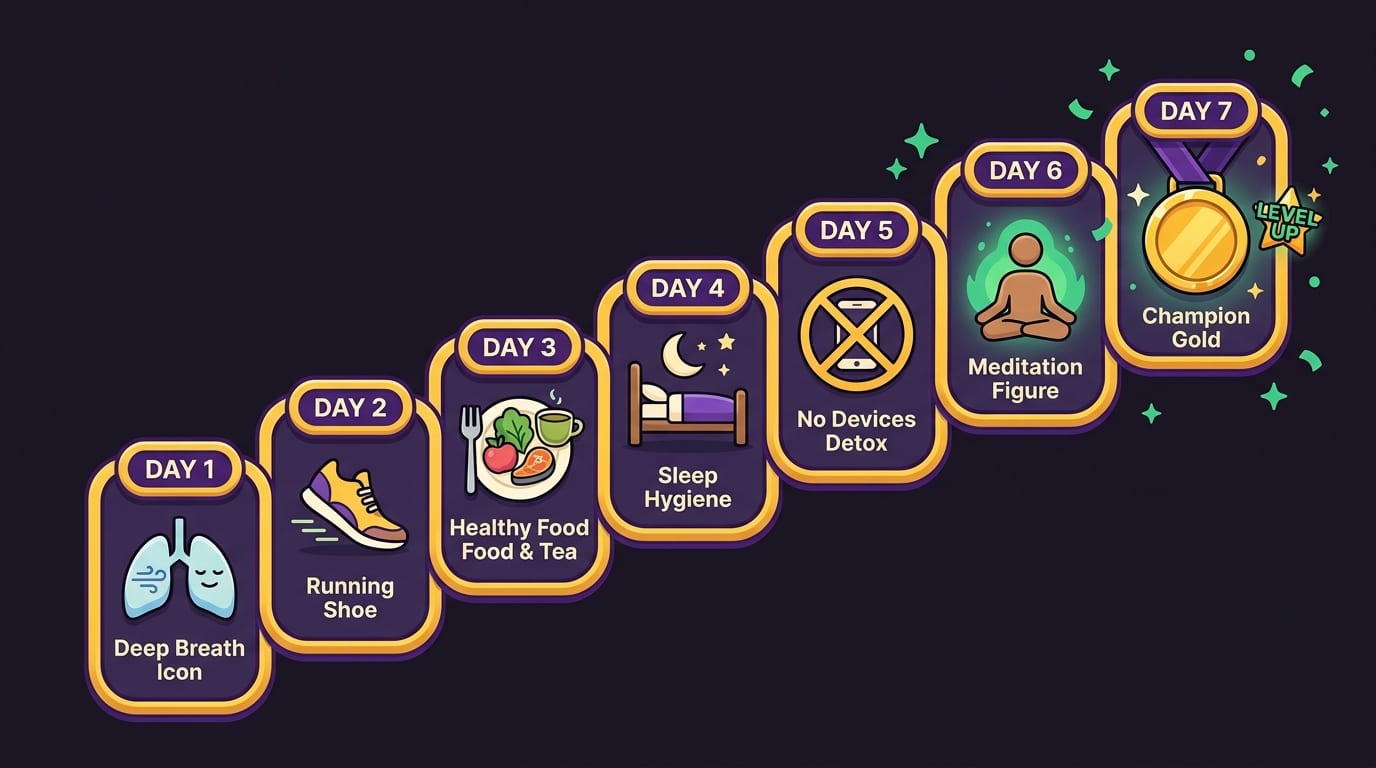
Step 7: Build a 7-Day Cortisol Level Reset Plan
You do not need to overhaul your entire life by Tuesday. In fact, please do not. Grand reinventions often collapse because they require you to become a new species. A better approach is a 7-day reset that stacks small wins. Small wins are the loyal knights of behavior change.
Day 1: Audit your stress triggers
Write down your top five stress inputs: sleep loss, caffeine timing, work overload, late-night phone use, social media, skipping meals, family stress, financial worry, overtraining, or messy mornings. Pick the top two. Do not fight every dragon at once. That is how you become dragon lunch.
Day 2: Lock in your wake time and morning light
Choose a consistent wake time and get outdoor light after waking. Add water and 5–10 minutes of movement. Keep the phone away for the first 20 minutes if possible. Your brain deserves a sunrise before it gets a comment section.
Day 3: Stabilize meals and caffeine
Eat protein at breakfast or your first meal. Add fiber and hydration. Set a caffeine cutoff. Notice your energy dips. If you crash hard in the afternoon, look at lunch quality, sleep debt, and caffeine timing before blaming your entire personality.
Day 4: Add movement snacks
Take a short walk after one meal. Add 3-minute movement breaks during work. If you are using BlockChamp, schedule blocks during deep work and use breaks for actual recovery — not “accidentally” opening a dopamine casino with thumbnails.
Day 5: Create an evening shutdown ritual
Pick a time to stop work. Write tomorrow’s top three priorities. Dim lights. Reduce screens. Block your biggest night-time distractions. If your hands try to type “youtube.com,” The King can lovingly shame them back into dignity.
Day 6: Practice one stress tool repeatedly
Choose box breathing, physiological sighs, or journaling. Do it three times during the day, before you are panicking. Skills work better when practiced before the dragon is chewing the curtains.
Day 7: Review and refine
Ask: What improved? What felt hard? What caused the biggest stress spike? What boundary helped most? Keep the practices that gave you the most relief. Drop the ones that felt like decorative suffering.
This seven-day cortisol reset is not magic. It is a controlled experiment. You are gathering data from your own life, which is more useful than copying a billionaire’s 4:12 a.m. elk-yoga routine.
Common Cortisol Reset Mistakes: Please Don’t Crown the Chaos
Even smart people make stress-reset mistakes because the wellness internet is a carnival with supplements. Let’s avoid the classics.
- Trying to do everything at once. Changing sleep, diet, exercise, caffeine, meditation, and screen habits in one week sounds heroic. It is usually a trap wearing a cape.
- Over-exercising. More intensity is not always better. Recovery is part of training, not a moral weakness.
- Using supplements as the main strategy. Some may help some people, but sleep, light, food, movement, and stress boundaries are the foundation.
- Ignoring medical symptoms. Rapid weight changes, severe fatigue, high blood pressure, mood changes, menstrual changes, or unusual weakness deserve professional attention.
- Keeping the same digital chaos. You cannot “mindset” your way out of an environment designed to hijack you.
- Expecting instant calm. Your nervous system learned patterns over time. Give it repetition, not one heroic Tuesday.
Another mistake: treating rest like something you earn only after maximum productivity. Rest is not a trophy. It is maintenance. Even The King must occasionally sit on the throne and stop shadowboxing notifications.
When to Consider Testing or Professional Help
Most everyday stress issues do not require cortisol testing. Cortisol naturally changes throughout the day, and interpreting results can be tricky. But if symptoms are severe, persistent, or unusual, talk to a healthcare professional. They may evaluate sleep disorders, thyroid function, mental health, blood pressure, medications, hormone conditions, or other underlying issues.
Seek medical guidance if you experience symptoms such as unexplained weight gain around the trunk, easy bruising, muscle weakness, very high blood pressure, severe fatigue, dizziness, fainting, major mood changes, or symptoms that interfere with daily life. Again: lifestyle is powerful, but it is not a substitute for diagnosis when something deeper is going on.
For general stress reduction, the National Center for Complementary and Integrative Health’s stress overview provides useful information on stress, relaxation techniques, and health considerations. Use reputable sources. Avoid anyone promising to “flush cortisol” with a $79 powder named after a moon animal.

Your Cortisol Reset Checklist: The Royal Quick Version
If you want the short version of this cortisol level reset guide, here is your practical checklist. Screenshot it. Print it. Tattoo it on a responsible notebook. Your call.
- Wake at a consistent time most days.
- Get outdoor light within 30–60 minutes of waking.
- Hydrate before caffeine.
- Eat enough protein, fiber, and whole-food carbs to stabilize energy.
- Set a caffeine cutoff 8–10 hours before bed if sleep is fragile.
- Walk daily and add strength training 2–4 times per week.
- Take movement breaks during computer work.
- Practice a quick stress tool: breathing, journaling, or muscle relaxation.
- Create an evening shutdown ritual.
- Block stressful or addictive sites during focus and wind-down windows.
- Keep your bedroom cool, dark, and boring in the best possible way.
- Review weekly and adjust one habit at a time.
The big idea: cortisol balance comes from repeated safety signals. Morning light tells your body the day has begun. Food tells your body resources are available. Movement tells your body stress can be discharged. Sleep tells your body repair is happening. Digital boundaries tell your brain the circus is closed, please exit through the gift shop.
Final Bell: Reset the Rhythm, Defend the Throne
A good cortisol level reset guide is not about fearing cortisol. It is about rebuilding rhythm. Your body wants predictable mornings, active days, calmer evenings, enough nourishment, real recovery, and fewer surprise attacks from glowing rectangles. Give it those signals consistently and your stress system can become less “panic goblin with a megaphone” and more “competent royal advisor with a clipboard.”
Start small. Pick one morning habit, one sleep habit, one food habit, one movement habit, and one digital boundary. Run the 7-day experiment. Track how you feel. Adjust like a scientist, not a perfectionist with a sword.
And if your biggest cortisol trigger is the endless internet buffet, let BlockChamp help you defend the throne. Use it to block the sites that hijack your focus, build a reign, earn XP, survive Stare-Downs, and let The King roast you back to work when your fingers betray the kingdom. You can try it at BlockChamp and start knocking out distractions like the crowned little focus menace you were born to be.
Long live your focus. May your evenings be calm, your mornings be bright, and your tabs be fewer than your ambitions.
Related posts

Writing Sprint Tips For Focused Output

Paper Or Digital Planner

Generative Ai And Staying Focused At Work
