
Tiny Habits For Productivity

If your productivity plan requires a new personality, a monk robe, a $400 planner, and waking up at 4:17 a.m. to journal under moonlight, congratulations: you have built a motivational haunted house. Let’s do something saner. Tiny habits for productivity are small, repeatable actions that make focus easier without demanding a full royal transformation by breakfast. They are the one-push-up, one-tab-closed, one-minute-start version of getting your life together.
The magic is not that tiny habits are impressive. They are not. That is the point. A tiny habit is so small your brain can’t summon its usual committee of excuses. “Write one sentence” is harder to argue with than “finish the entire report and become a respected adult.” “Open the study document” is less terrifying than “master organic chemistry and stop crying into flashcards.” Tiny habits sneak past resistance wearing a fake mustache.
In this guide, we’ll break down how to build tiny productivity habits that actually stick: micro-steps, habit stacking, friction removal, tracking, troubleshooting, and how to protect your focus from the glowing goblin cave known as the internet. We’ll also show where a tool like BlockChamp fits in—not as a magic wand, but as a very loud royal bouncer for your browser.
Quick Answers
Tiny Habits for Productivity: Why Small Beats Dramatic
Most people try to improve productivity by swinging a giant motivational sword. New routine. New app. New identity. New notebook. New caffeine arrangement. Then three days later, the sword is on the floor and they’re watching a 42-minute video about how medieval peasants brushed their teeth. Fascinating? Yes. Useful at 2:13 p.m. on a workday? The King says no.
Tiny habits work because they reduce the activation energy required to begin. Starting is usually the hardest part of productive work. Once you are moving, momentum often takes over. Research from BJ Fogg’s behavior model at Stanford emphasizes that behavior happens when motivation, ability, and a prompt converge; making the behavior easier increases the odds you’ll actually do it. You can explore the model through BJ Fogg’s Behavior Model, which is basically the science version of “make the thing so easy you trip into doing it.”
There is also evidence that habits form through repetition in stable contexts, not through one heroic burst of inspiration. A widely cited study published in the European Journal of Social Psychology found that automaticity develops gradually and can take much longer than the mythical “21 days.” Translation: your habit is not broken because it didn’t become effortless by Tuesday. Calm down, champ. Keep repeating.
The productivity benefit is simple: tiny habits create reliable entry points into focused work. They lower resistance, build confidence, and make consistency less dependent on mood. And mood, as we know, is a suspicious little raccoon.
The Tiny Habit Formula: Make It Ridiculously Easy
A good tiny habit has three parts: a specific trigger, a very small behavior, and an immediate reward or acknowledgment. Not a parade. Not a dramatic trumpet solo. Just a small “nice, I did it” moment that tells your brain the behavior matters.
Here is the basic formula:
- After I… existing routine or cue
- I will… tiny productive action
- Then I’ll… celebrate or reinforce it
For example:
- After I open my laptop, I will close one distracting tab.
- After I pour coffee, I will write one sentence in my draft.
- After I sit at my desk, I will start a 5-minute focus timer.
- After lunch, I will review my top task for 30 seconds.
- After I finish a meeting, I will write the next action in one line.
The secret is to make the behavior almost laughably small. If your tiny habit is “write for one hour,” that is not tiny. That is a full productivity dragon. Tiny means “open the draft.” Tiny means “write one ugly sentence.” Tiny means “put phone across the room.” Tiny means your brain goes, “Fine, whatever,” and then accidentally becomes productive.
Once the tiny version becomes automatic, you can naturally expand it. One sentence becomes a paragraph. Five minutes becomes twenty. Closing one distracting tab becomes blocking the whole cursed category of social media during work hours. The habit grows because the starting point is stable.
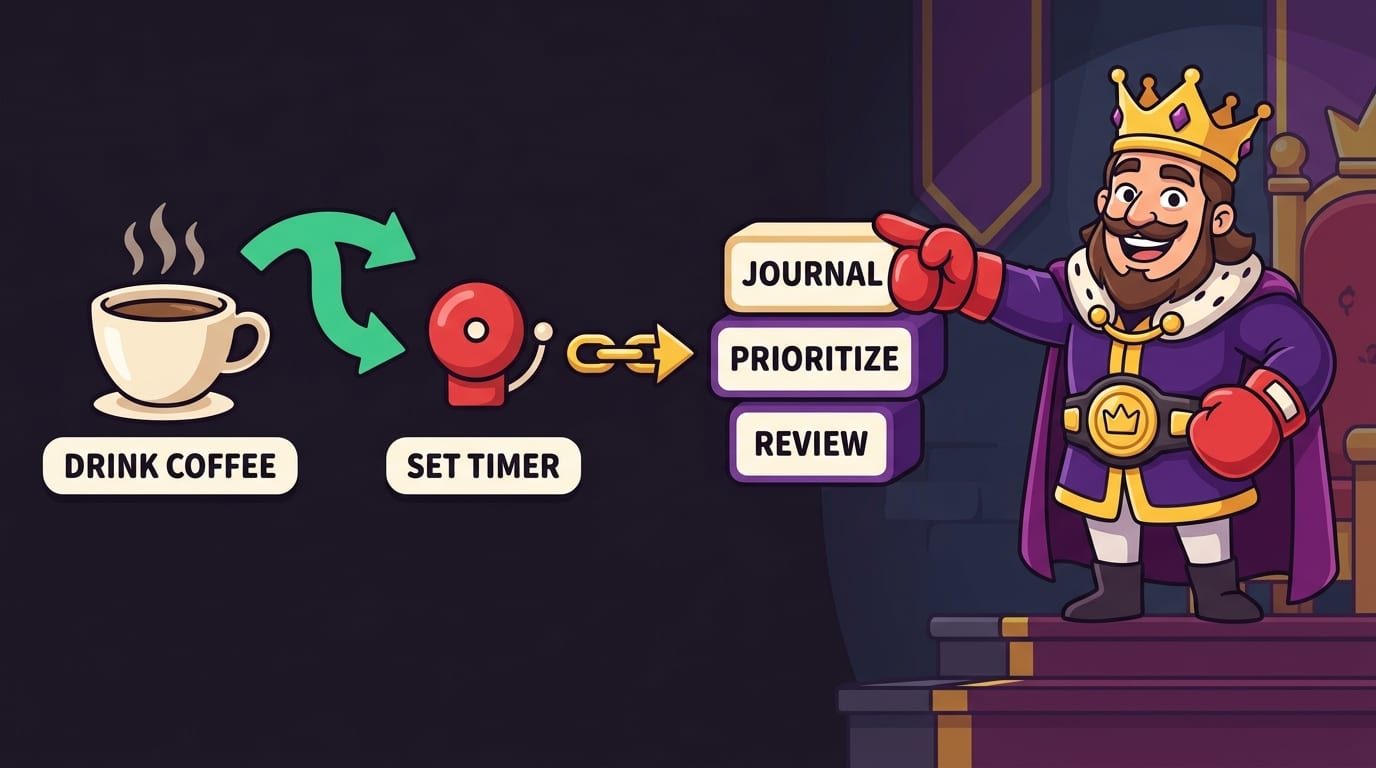
Habit Stacking: Attach Productivity to Something You Already Do
Habit stacking means attaching a new tiny habit to an existing habit. Your current routines become hooks for better behavior. This works because you don’t need to create an entirely new reminder system. You borrow one that already exists.
Think about the things you already do every day without needing a motivational podcast to yell at you:
- Wake up
- Brush your teeth
- Make coffee or tea
- Open your laptop
- Check your calendar
- Sit down after lunch
- Plug in your phone
- Close your laptop at the end of the day
Each one is a potential launchpad. If you want better work focus, stack a micro-action on the moment you start work. If you want better planning, stack it onto opening your calendar. If you want fewer digital distractions, stack your website blocker activation onto opening your browser.
Examples:
- After I open Chrome, I will turn on BlockChamp’s Master Focus Toggle.
- After I check my calendar, I will choose one “crown task” for the day.
- After I send an email, I will close my inbox for 10 minutes.
- After I finish a Pomodoro, I will stand up and stretch for 20 seconds.
- After I type a task into my to-do list, I will add the next physical action.
This is also why “fresh start” moments can be powerful. A new week, semester, month, job, or project gives your brain a clean narrative: new reign, new rules. If you like that reset energy, read our post on fresh start habits for more ways to use new beginnings without turning them into motivational fireworks that explode and vanish.
Micro-Starts: The Anti-Procrastination Uppercut
Procrastination often thrives on vague tasks. “Work on project” is a fog machine. “Make presentation” is a haunted castle. “Study biology” is a swamp with Wi-Fi. Your brain sees ambiguity and politely runs to TikTok for safety.
A micro-start turns a vague task into a concrete first move. The goal is not to finish. The goal is to begin in a way that removes uncertainty.
Use these micro-starts when your task feels enormous:
- Open the document.
- Write the title.
- Create three bullet points.
- Find one source.
- Rename the file.
- Set a 3-minute timer.
- Read one paragraph.
- Reply to one sentence of the email.
- Put the first number into the spreadsheet.
The micro-start is a tiny habit for productivity because it trains you to begin before you feel ready. That matters because “feeling ready” is unreliable. Sometimes you feel ready after a perfect sleep, balanced breakfast, and sunrise walk. Sometimes you feel ready only after rearranging your desk, researching ergonomic chairs, and discovering a forum argument from 2017. Dangerous kingdom.
Try this rule: when you catch yourself avoiding a task, ask, “What is the smallest visible action?” Not the smartest action. Not the most impressive action. The smallest visible action. Do that. Then decide whether to continue.
Design Your Environment So Your Brain Has Fewer Dumb Choices
Willpower is useful, but it is not a sturdy chair. Sit on it too long and someone ends up on the floor. Environment design is stronger because it changes what is easy, visible, and available.
According to the American Psychological Association’s overview of willpower, self-control can be affected by stress, fatigue, and competing demands. In normal human terms: if your day is chaotic, your brain will absolutely choose the shiny button. So stop leaving shiny buttons everywhere like a raccoon interior decorator.
Use tiny environmental tweaks:
- Put your phone outside arm’s reach before starting deep work.
- Keep only the tabs needed for the current task open.
- Use a separate browser profile for work or study.
- Place a notebook beside your keyboard for random thoughts.
- Turn off non-essential notifications during focus sessions.
- Block your top distraction sites before you begin.
This is where BlockChamp is especially useful. Instead of relying on “I simply won’t open Reddit” — adorable, truly — you can block specific sites, keywords, or entire categories like Social Media, Video & Streaming, Shopping, Gaming, News, Gambling, Adult, and AI Distractions. Free users can block up to 3 sites and enable 2 categories, which is plenty to begin your tiny reign. Champion users can go full royal fortress with unlimited sites, all categories, keyword blocking, recurring schedules, and Hardcore Lockdown.
The tiny habit version is this: before starting work, turn on your blocker. One click. “On Guard.” The King stands at the gate. You work. If you try to wander into YouTube, you get The Stare-Down instead of a dopamine buffet. Is it ridiculous? Yes. Does ridiculous sometimes work better than another grayscale dashboard? Also yes.
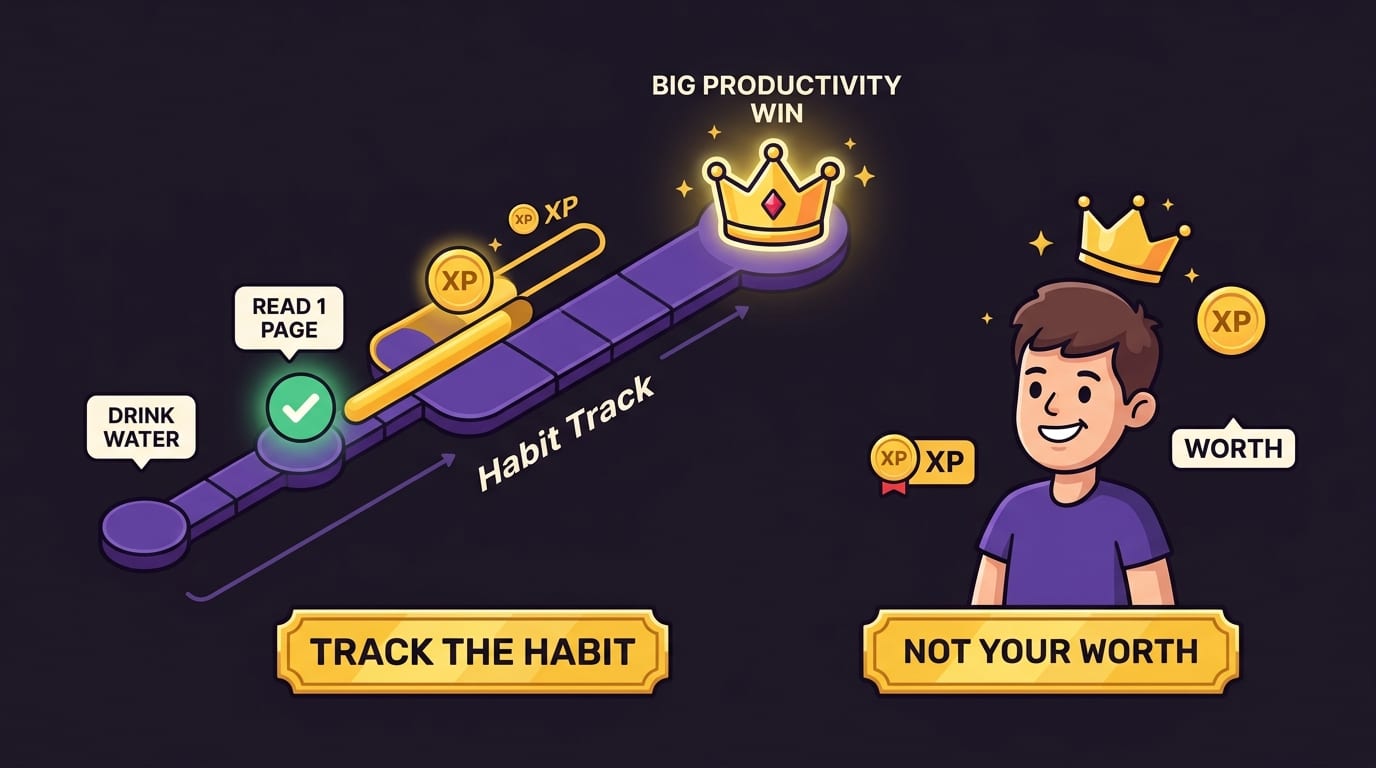
Track the Habit, Not Your Entire Worth as a Human
Tracking is powerful, but it can become weirdly dramatic. Miss one day and suddenly your habit tracker looks like a betrayal document. The point of tracking is feedback, not self-roasting. The King may roast your tab choices, but your spreadsheet does not need to call you a disgrace.
Track tiny productivity habits in a way that makes consistency visible:
- Use a checkbox for each day you completed the tiny habit.
- Track minutes focused, not just tasks finished.
- Use a simple color code: green for done, yellow for partial, blank for skipped.
- Write one sentence about what helped or hurt your focus.
- Review weekly instead of obsessing hourly like a productivity goblin.
BlockChamp’s gamification system does this automatically for focus habits. You earn XP for focus time, each day blocks stay active, and every stare-down you survive. Your reign tracks how long you’ve kept Master Focus on without surrendering. Your calendar turns focus history into something visible, so you can see your kingdom getting less chaotic over time.
This works because progress feels real. Tiny habits are small, so the payoff can feel invisible at first. A progress bar, streak, badge, or calendar gives your brain evidence: “Ah yes, I am becoming the kind of person who protects focus.” That identity shift matters. For more on learning and behavior through examples, check out our article on observational learning and habits.
Build a Tiny Productivity Routine You Can Actually Repeat
Let’s turn theory into a practical routine. Not a 19-step morning ceremony involving lemon water, breathwork, and communicating with your future self via fountain pen. A real routine. One you can do when you are busy, tired, and mildly suspicious of your own calendar.
The 5-Minute “Defend the Throne” Startup
Use this at the beginning of a work or study session:
- Minute 1: Clear your workspace enough to begin. Not perfect. Just not “archaeological dig site.”
- Minute 2: Choose one crown task. This is the task that matters most today.
- Minute 3: Open only what you need for that task.
- Minute 4: Turn on BlockChamp or block your known distraction sites.
- Minute 5: Start with one tiny action: one sentence, one calculation, one slide, one paragraph.
That’s it. Five minutes. If you continue, fantastic. If not, you still reinforced the startup habit. The routine trains your brain that work begins with clarity, boundaries, and action—not with checking six platforms to “get settled.” That phrase has committed crimes.
The 2-Minute Shutdown
Ending well makes starting tomorrow easier. Try this:
- Write the next step for your main task.
- Close unrelated tabs.
- Leave the correct document open or bookmarked.
- Set one reminder for tomorrow’s first focus block.
This reduces morning friction. Future You arrives to a clear runway instead of a browser battlefield. Remote workers especially benefit from these boundaries, because home and work can blend into one endless soup. For more on that modern chaos, read what remote work taught us about productivity.
Use Rewards Like a Game Designer, Not a Gremlin
Rewards help habits stick, but not all rewards are created equal. If your reward for 10 minutes of writing is 90 minutes of doomscrolling, your habit has been mugged in an alley. Choose rewards that reinforce the identity you want without unleashing the distraction kraken.
Good tiny rewards include:
- Checking off a box
- Watching your focus timer complete
- Standing up and stretching
- Getting a coffee refill
- Playing one song
- Adding XP or points to a tracker
- Sending a “done” message to an accountability buddy
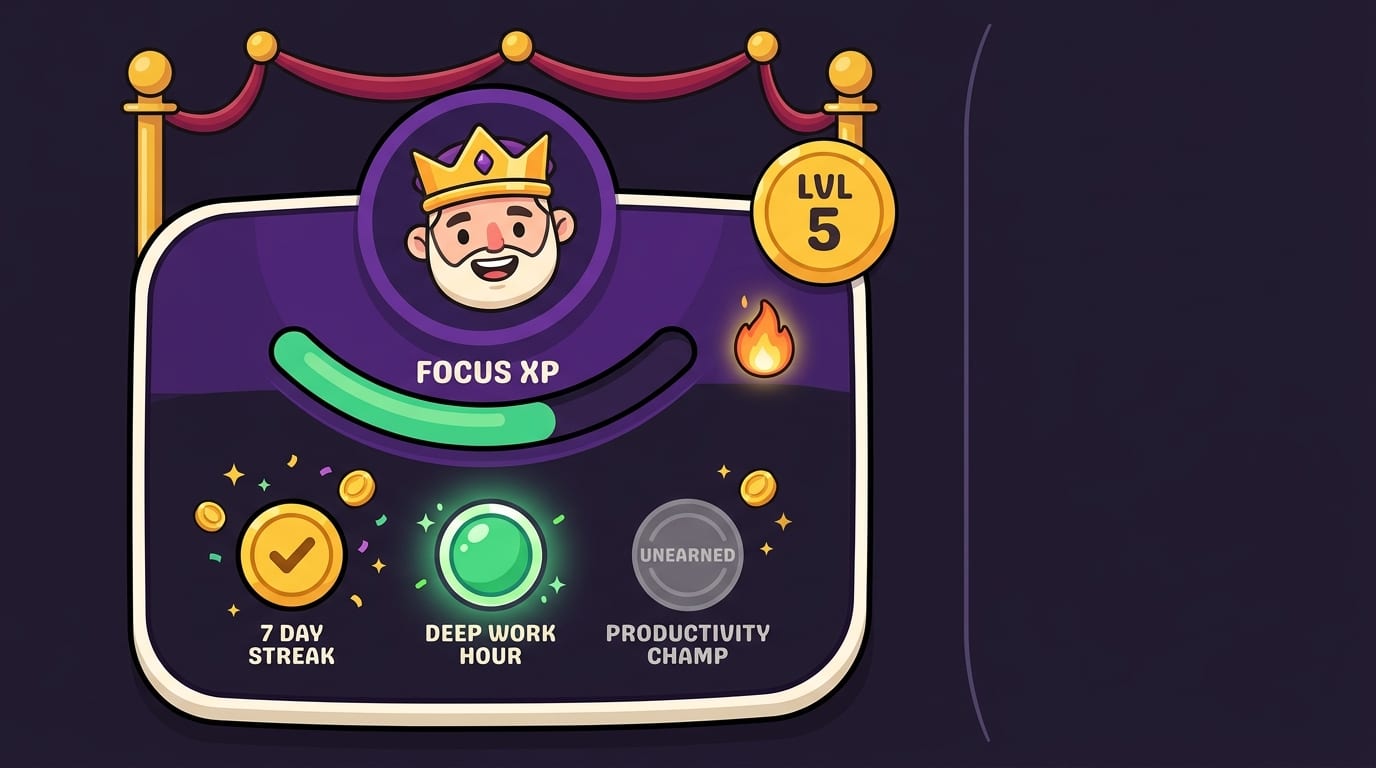
Games are excellent at this. They give immediate feedback, clear progress, and satisfying milestones. That’s one reason gamified productivity can feel more motivating than stern adult software that looks like it was designed inside a printer menu. Research on motivation often distinguishes between extrinsic rewards and intrinsic motivation, and the best systems support a sense of progress, competence, and autonomy. The Self-Determination Theory overview is a useful resource if you enjoy your psychology with fewer boxing gloves.
BlockChamp leans into game-like feedback: XP, levels, badges, a Trophy Room, leaderboards, and rank titles from Peasant of Procrastination to BLOCK CHAMP — King of Your Time. It rewards consistency, not perfection. If you try to visit a blocked site and survive the Stare-Down, you still earn XP. That reframes a near-slip as a win. The King saw you. You backed away. Crown retained.
Troubleshooting: When Tiny Habits Still Fall Apart
Even tiny habits can fail. This does not mean you are broken. It usually means the habit is too big, too vague, badly timed, unrewarded, or being ambushed by your environment like a cartoon villain.
Problem: “I keep forgetting.”
Your cue is weak. Attach the habit to something more reliable. “After lunch” is better than “sometime in the afternoon.” “After I open my laptop” is better than “when I feel productive,” because feelings are soup.
Problem: “I don’t feel motivated.”
Make it smaller. If “write one paragraph” feels hard, write one sentence. If one sentence feels hard, open the document. If opening the document feels hard, put the document shortcut on your desktop. This is not cheating. This is strategy.
Problem: “I start, then get distracted.”
Add friction to the distractions before you begin. Turn on Do Not Disturb. Put your phone away. Use BlockChamp to block your top sites or categories. If you are a Champion user, use Focus Schedule so blocking turns on automatically during work hours. If your future self cannot be trusted, and let’s be honest, that little gremlin has priors, Hardcore Lockdown adds a cooldown timer or boxing-riddle mini-game before you can turn focus off.
Problem: “I missed a day, so I quit.”
Use a recovery rule. For example: “Never miss twice.” Or: “If I skip, I do the 30-second version the next day.” Missing one day is a pothole. Quitting is driving into the moat.
Sometimes productivity struggles also have emotional roots: stress, boredom, fear, resentment, burnout, or the delightful little panic goblin who appears before big deadlines. If motivation feels unusually heavy, our post on the emotional aspects of productivity may help you troubleshoot beyond surface-level hacks.
Examples of Tiny Habits for Students, Creators, and Remote Workers
Different kingdoms, different dragons. Here are practical tiny habits for productivity based on your daily battlefield.
For students
- After opening your notes, write one question you need to answer.
- After sitting down to study, block YouTube, TikTok, Reddit, and streaming sites.
- After finishing a lecture, make three flashcards immediately.
- After reading one page, summarize it in one sentence.
- After a study session, write tomorrow’s first topic on a sticky note.
Students often lose time during transitions: before studying, after class, between assignments. Tiny habits protect those moments. The goal is to stop the “quick break” from becoming a documentary-length scroll expedition.
For creators
- After making coffee, write one bad headline.
- After opening your editing tool, organize one asset.
- After publishing, capture one improvement idea for next time.
- After checking analytics, close the tab and start one creative task.
- After getting stuck, set a 5-minute “ugly draft” timer.
Creators face a sneaky problem: the tools of creation live beside the tools of distraction. You open YouTube for research and wake up in a video essay about abandoned malls. BlockChamp’s keyword and category blocking can help separate “research mode” from “brain buffet mode.”
For remote workers
- After your morning standup, choose one deep work block.
- After opening Slack, set your status before starting focus time.
- After each meeting, write the next action before checking messages.
- After lunch, spend two minutes resetting your desk.
- After work, close work tabs to mark the day’s boundary.
Remote work gives flexibility, which is wonderful, and also enough rope to knit a procrastination hammock. Tiny rituals create structure without turning your home into a corporate cubicle shrine.
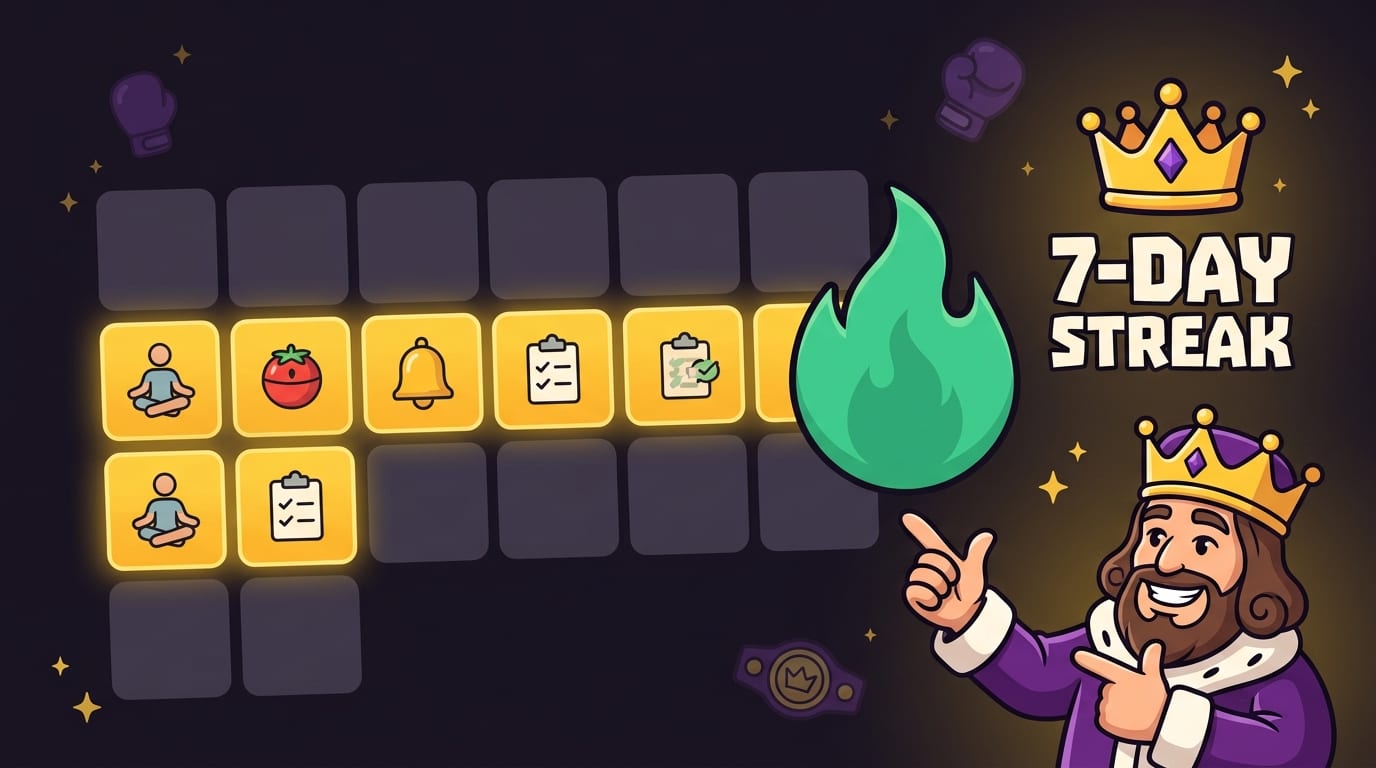
The 7-Day Tiny Productivity Challenge
Ready to test this without redesigning your entire existence? Try this seven-day challenge. It is small on purpose. No heroics. No productivity cosplay. Just repeatable moves.
- Day 1: Pick one crown task and write the smallest first action.
- Day 2: Stack that first action onto an existing cue, like opening your laptop.
- Day 3: Remove one distraction from your environment before starting.
- Day 4: Track completion with one checkbox. That’s all. Do not build a spreadsheet cathedral.
- Day 5: Add a tiny reward after the action, like a stretch or victory note.
- Day 6: Use a recovery rule if you miss or delay the habit.
- Day 7: Review what worked and make the habit slightly easier or more automatic.
If you want to add BlockChamp to the challenge, make your tiny habit: “After I open Chrome for work, I turn on Master Focus.” Then pick your top enemies. Social media? Video? Shopping? News? Choose your opponents. Let The King handle the knockouts. Each focused day earns progress, and each resisted distraction becomes part of your reign instead of another “where did the afternoon go?” mystery.
Final Round: Small Habits, Big Crown
Tiny habits for productivity are not glamorous. They will not make you levitate above your inbox. They will not transform you into a laser-eyed efficiency wizard by Thursday. But they will help you start more often, recover faster, and build a focus routine that survives real life.
The formula is simple: make the habit tiny, attach it to something you already do, reduce friction, track lightly, reward immediately, and troubleshoot without declaring yourself a fallen peasant. Productivity is not about being perfect. It is about defending your attention one small decision at a time.
And because the internet is a circus with excellent targeting algorithms, give your tiny habits a bodyguard. If your focus keeps getting ambushed by YouTube, Reddit, TikTok, shopping tabs, news spirals, or “research” that somehow becomes meme archaeology, try BlockChamp. It is a gamified website blocker for Chrome that turns staying focused into XP, levels, badges, reigns, and occasional royal judgment from The King. Ridiculous? Absolutely. Effective? That’s the crown we’re chasing.
Start tiny today: choose one task, take one micro-step, and block one distraction. Long live your focus, champ.
Related posts

Writing Sprint Tips For Focused Output

Paper Or Digital Planner

Generative Ai And Staying Focused At Work
