
Fresh Start Habits

Fresh start habits are the tiny, repeatable moves that make your brain go, “Ah yes, new chapter, new me, fewer 2 a.m. snack decisions.” They are not magical. They will not turn you into a linen-shirt productivity monk who journals at sunrise while birds braid your hair. But they can help you reset your focus, rebuild momentum, and stop treating every Monday, birthday, semester, or random Tuesday as a dramatic reboot you abandon by lunch.
The trick is to make your fresh start small enough to survive real life. A fresh start is not “I shall become perfect forever.” That is how motivation puts on a cape, flies directly into a ceiling fan, and disappears. A better plan is: create a few simple routines, remove obvious distractions, stack new behaviors onto existing ones, and track progress in a way that feels rewarding instead of like a courtroom transcript.
That is where fresh start habits shine. They give you a reset button without requiring you to burn your entire life down and move to a cabin named Serenity Hut. Let’s build a practical system you can use after a bad week, before a new semester, at the start of a month, or anytime your attention span has been kidnapped by YouTube thumbnails with unnecessarily shocked faces.
Quick Answers
What Are Fresh Start Habits, Really?
Fresh start habits are routines and rituals tied to moments that feel like a new beginning: mornings, Mondays, new months, birthdays, school terms, new jobs, post-vacation resets, or even “I just cleaned my desk and found three fossilized receipts.” These moments create a psychological dividing line between old behavior and new behavior.
Researchers call this the “fresh start effect.” In a well-known paper published in Management Science on the fresh start effect, researchers found that people are more likely to pursue goals after temporal landmarks like the start of a week, month, year, or birthday. In plain English: your brain loves a clean slate. It sees a boundary and thinks, “Excellent. The previous goblin era is over.”
But the clean slate alone is not enough. You still need behaviors that are specific, repeatable, and easy to restart when you inevitably miss a day. Because you will miss a day. You are a human, not a productivity toaster.
Strong fresh start habits usually have four ingredients:
- A cue: the moment that triggers the habit, like waking up, opening your laptop, or finishing breakfast.
- A tiny action: a behavior so small it is almost embarrassing, like writing one sentence or blocking distractions for 25 minutes.
- A reward: something that makes your brain want to repeat it, such as checking off a box, earning XP, drinking good coffee, or feeling smug in a morally acceptable way.
- A recovery plan: a rule for getting back on track without spiraling into “I failed, therefore I must become a couch.”
If you want deeper student-focused habit ideas, especially for exams and coursework, BlockChamp has a helpful guide on study habits for academic success. It pairs nicely with the fresh start approach because school terms are basically giant neon “reset” signs.
Start With a Reset Ritual: The Crown Goes Back On
Before you build new habits, mark the beginning. This sounds slightly ceremonial, like we are about to knight your planner with a spoon, but rituals work because they tell your brain, “We are shifting modes now.” A reset ritual does not have to be fancy. It has to be repeatable.
Try a 10-minute fresh start ritual whenever you need to reboot your week, day, or focus session:
- Clear one physical surface: desk, kitchen table, backpack, or that chair where laundry becomes a mountain kingdom.
- Write down the top three things currently stealing your attention.
- Choose one priority for the next 60 minutes.
- Remove one obvious distraction: close tabs, silence notifications, put your phone across the room, or block the sites you keep “accidentally” visiting.
- Say, out loud if possible: “New round. I’m back on guard.” Yes, you may feel ridiculous. That is part of the charm.
This ritual works because it combines environment design, prioritization, and identity. You are not just “trying harder.” You are stepping into a role. You are the person who resets quickly. You are the champ who gets back in the ring after a sloppy round. Very cinematic. Mildly sweaty. Effective.
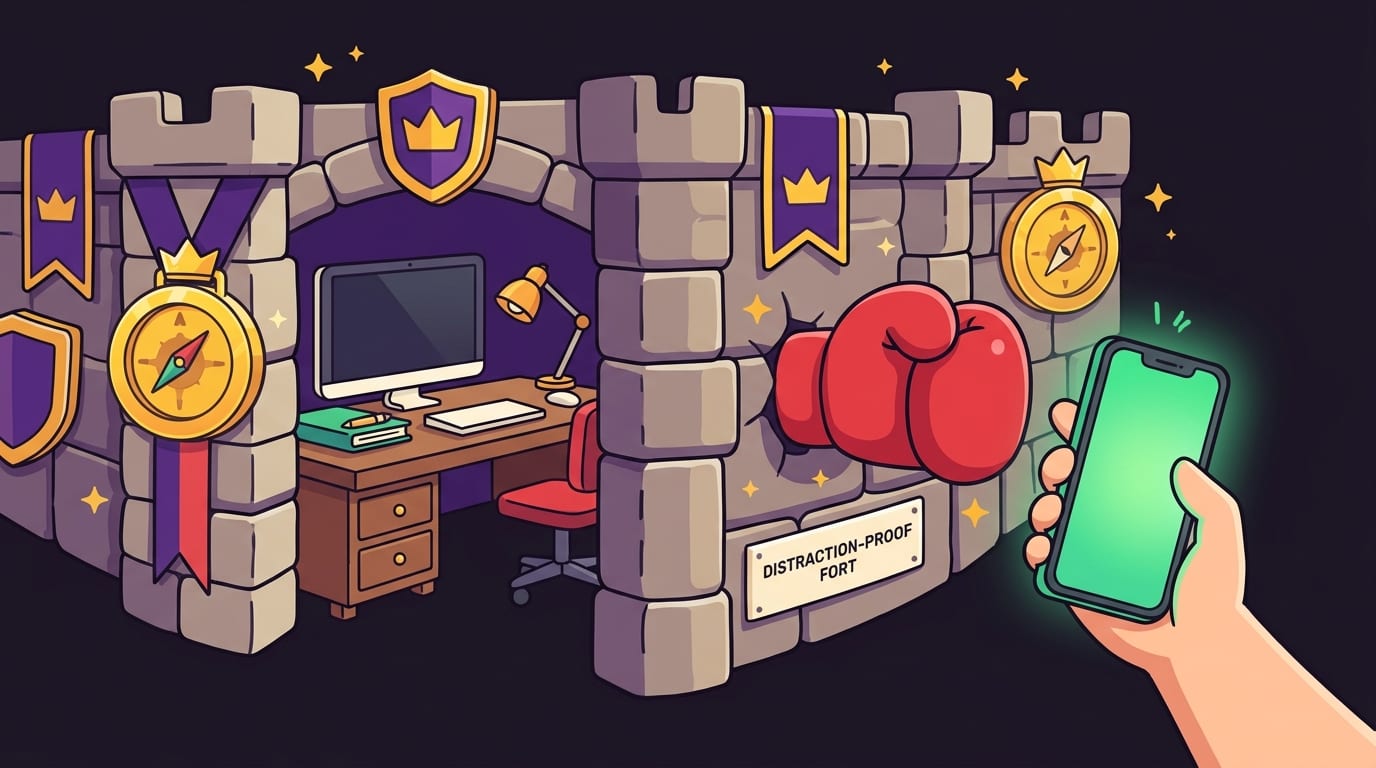
If distracting websites are part of your problem, and let’s be honest, they usually are wearing a tiny villain cape, use a tool like BlockChamp to make the reset real. BlockChamp lets you block specific sites, keywords, or whole categories like Social Media, Video, News, Shopping, Gaming, Gambling, Adult, and AI Distractions. Then, when you try to wander into a blocked site, The King gives you a full-screen stare-down instead of a boring error page. It is productivity with royal judgment. Finally, a monarchy with practical benefits.
Design a Morning Routine That Does Not Require Angelic Discipline
Morning routines are the classic fresh start habit because every morning is a mini New Year’s Day, except with less confetti and more toothpaste. But most morning routines fail because people design them for their fantasy self: the person who wakes at 5:00 a.m., drinks lemon water, reads philosophy, meditates, lifts weights, meal-preps quinoa, and somehow has perfect hair. Suspicious.
Your real morning routine should be short, flexible, and focused on momentum. The goal is not to win Instagram. The goal is to reduce friction and start the day with one useful action before the internet starts throwing digital pies at your face.
The 15-Minute Fresh Start Morning
Here is a simple morning routine that works for students, remote workers, freelancers, and anyone whose phone has become a glowing rectangle of doom:
- Minute 0-2: Drink water and avoid opening social apps. Hydrate the royal machinery.
- Minute 2-5: Make your bed or clear your desk. One quick environmental win.
- Minute 5-8: Write your “one must-win” task for the day.
- Minute 8-10: Turn on your focus blocker or set your first work timer.
- Minute 10-15: Begin the smallest possible version of your priority task.
The key move is starting the priority task before consuming input. No news. No TikTok. No “just checking” Reddit, which is historically how civilizations fall. According to the American Psychological Association, stress can affect attention, decision-making, and daily functioning. Starting your day by dumping global chaos into your brain is not exactly a spa treatment for your nervous system.
If your mornings currently begin with phone scrolling, do not attempt a total personality transplant overnight. Start with a 10-minute delay. Keep your phone out of reach until you complete your first tiny win. After a week, make it 20 minutes. Then 30. Build the throne one brick at a time, champ.

Use Goal-Setting That Survives Contact With Real Life
Fresh start energy often makes us overpromise. We write goals like “become a completely different person by Thursday.” Charming. Delusional. A little spicy. Better goal-setting turns vague ambition into repeatable action.
Use the “Fresh Start Goal Ladder”:
- Identity goal: Who are you becoming?
- Outcome goal: What result do you want?
- Process goal: What will you do repeatedly?
- Minimum goal: What counts on a low-energy day?
For example, instead of “I want to be productive,” try this:
- Identity: “I am becoming someone who protects my focus.”
- Outcome: “I will finish my project draft by Friday.”
- Process: “I will do two 45-minute deep work sessions each weekday.”
- Minimum: “On chaotic days, I will do one 10-minute session.”
That minimum goal is not a loophole. It is a recovery bridge. It stops one bad day from becoming a full-blown “welp, see you next month” collapse.
For students, a process goal might be “review notes for 20 minutes after class” rather than “get straight A’s through sheer vibes.” If you want more examples, the BlockChamp guide to smart study habits that set you up for success is packed with practical routines you can turn into fresh start habits.
One more useful move: define what you will not do. A focus goal gets stronger when it has boundaries. “I will write for 45 minutes” is good. “I will write for 45 minutes with YouTube, Reddit, TikTok, and news blocked” is much better. The first relies on willpower. The second builds a moat around the castle.
Habit Stacking: Attach the New Thing to the Thing You Already Do
Habit stacking is one of the easiest ways to build fresh start habits because it avoids the “remembering to remember” problem. Instead of creating a habit out of thin air, you attach it to something already baked into your day.
The formula is simple:
After I [current habit], I will [new tiny habit].
Examples:
- After I pour coffee, I will write my top three tasks.
- After I sit at my desk, I will turn on BlockChamp’s Master Focus Toggle.
- After lunch, I will take a five-minute walk before checking messages.
- After class, I will summarize the lecture in three bullet points.
- After brushing my teeth at night, I will put my phone outside the bedroom.
Habit stacking works because it uses existing context. You are not asking your brain to create a new pathway in the wilderness while wolves of distraction howl nearby. You are putting a new signpost on a road you already travel.
According to research summarized by the National Library of Medicine on habit formation, repetition in stable contexts helps behaviors become more automatic. Translation: if you do the same thing after the same cue enough times, your brain eventually stops acting like it has been asked to solve a riddle from a bridge troll.
Start with one stack. Not seven. Seven is how your fresh start turns into a circus where every clown has a clipboard. Pick one high-impact moment. For many people, the best stack is: “After I open my laptop, I will block distractions and start my first focus session.” That single stack can save hours because it protects the moment when your attention is most vulnerable.
Build a Distraction-Proof Environment Before Motivation Wanders Off
Motivation is adorable, but it has the reliability of a raccoon with a fake ID. Environment is stronger. If fresh start habits are going to stick, your surroundings need to make good behavior easier and bad behavior mildly annoying.
This is especially important online. Apps and websites are built to keep you engaged. Infinite scroll, autoplay, notifications, recommendation feeds, outrage headlines, and “because you watched one video about pasta, here are 900 more pasta universes” are not accidents. The Pew Research Center’s social media fact sheet shows how widely social platforms are used across age groups, which helps explain why “just ignore it” is not a serious strategy. The attention economy is a professional boxing league. Your willpower is wearing flip-flops.
Here are practical ways to make your environment support your fresh start:
- Remove your top three distraction bookmarks from the browser bar.
- Log out of apps that you check compulsively.
- Turn off nonessential notifications on desktop and phone.
- Use separate browser profiles for work and fun.
- Keep your phone out of arm’s reach during focus blocks.
- Block tempting sites during your planned work hours.
BlockChamp fits beautifully here because it makes the better choice the default. You can add specific troublemakers like YouTube, Reddit, X/Twitter, Instagram, or online shopping sites. Champion users can go further with unlimited sites, keyword blocking, recurring schedules, and Hardcore Lockdown. Hardcore Lockdown is especially useful when your future self says, “Please protect me,” and your present self says, “But memes.” With cooldown timers or a boxing-riddle mini-game before turning focus off, surrender becomes deliberate instead of impulsive.
And when you do try to visit a blocked site? The Stare-Down appears. The King sees you. The crown does not approve. You close the tab. You earn XP. Weirdly motivating? Yes. Better than shame? Also yes.
Turn Fresh Starts Into Streaks, XP, and Visible Progress
One reason fresh start habits fade is that progress feels invisible. You do the boring useful thing for three days and your brain says, “Where parade?” No parade arrives. So you quit and go find dopamine in a comment section full of strangers arguing about soup.
Visible progress matters. Research from behavioral science frequently shows that immediate feedback and rewards can support habit formation. A helpful overview from BehavioralEconomics.com on gamification explains how game mechanics like points, badges, and leaderboards can encourage engagement when used thoughtfully.
This is why tracking can be powerful. But tracking should be motivating, not a guilt spreadsheet wearing tiny glasses. Use one of these low-friction tracking methods:
- Calendar chain: mark every day you complete the habit.
- Focus hours: track time spent on deep work, studying, writing, or training.
- Streak count: count consecutive days you kept the habit alive.
- Session score: rate your focus from 1-5 after each work block.
- Reward milestones: celebrate 3, 7, 14, and 30 days.
BlockChamp turns this into a game automatically. Every focused minute earns XP. Every day your blocks stay active earns a daily bonus. Every Stare-Down survived earns XP too, because resisting temptation deserves a tiny trophy. Your “reign” keeps climbing as long as Master Focus stays on, and your calendar shows focus history in glorious gold. It is not about being perfect. It is about seeing proof that you are defending your time.
The identity shift is the secret sauce. “I’m trying not to procrastinate” feels fragile. “I’m building a 7-day reign” feels like a quest. Quests beat vague guilt. Always.
Create a Midday Reset for When the Morning Goes Face-First Into Chaos
Fresh starts are not only for mornings. This is crucial. If your day goes sideways at 9:17 a.m., you do not have to wait until tomorrow to become a functioning citizen again. You can use a midday reset.
Try the “3-2-1 Reset”:
- 3 minutes: clear your workspace and close unnecessary tabs.
- 2 minutes: breathe, stretch, or walk. Let your nervous system stop juggling flaming raccoons.
- 1 task: choose the next smallest useful action.
Then start a short focus sprint: 10, 15, or 25 minutes. Not because short sessions are magical, but because starting is the hard part. Once you begin, momentum often follows. If it does not, you still completed a useful sprint instead of doomscrolling yourself into a foggy little swamp creature.
Midday resets are especially helpful for remote workers and students because your environment may not have natural boundaries. There is no school bell, commute, or boss walking past your desk with eyebrow-based accountability. You have to create transitions yourself.
If you are a student or parent helping teens build better routines, you might like this guide to study habits and tools for teens. Teen attention is under siege from approximately 8,000 glowing portals, so practical resets and digital boundaries matter.

Use “Never Miss Twice” Instead of All-or-Nothing Drama
The fastest way to ruin fresh start habits is to believe one missed day means failure. This is nonsense. One missed workout, one distracted study session, one accidental trip into the algorithmic swamp does not erase your progress. It just means you are alive and the internet is annoyingly good at its job.
Use the “never miss twice” rule. If you miss once, your only job is to return at the next opportunity. No guilt ceremony. No dramatic monologue. No “I guess I’ll restart next month when Mercury wears a nicer hat.” Just return.
Make a recovery plan before you need it:
- If I oversleep, I will do the 5-minute version of my morning routine.
- If I get distracted, I will close all tabs and do one 10-minute focus sprint.
- If I skip studying, I will review one page before bed.
- If I turn off my blocker, I will turn it back on after my planned break.
- If I lose my streak, I will start a new reign immediately.
This is where BlockChamp’s approach is healthier than guilt-heavy productivity tools. It rewards consistency, not perfection. If you hit a blocked site, you get roasted by The King, yes. But you also get a chance to return to work and earn XP. The mistake becomes feedback, not a personal identity crisis. The crown may wobble. It does not have to fall into a sewer.
Fresh Start Habits for Different Life Moments
Different fresh starts need different routines. A Monday reset is not the same as a new semester reset, and a post-vacation reset is its own special goblin rodeo. Here are practical templates for common situations.
Monday Fresh Start
- Plan your top three outcomes for the week.
- Block your biggest weekday distractions during work or study hours.
- Schedule two deep work sessions before Wednesday.
- Clean your digital workspace: tabs, downloads folder, inbox triage.
New Month Fresh Start
- Review what worked last month and what repeatedly punched you in the ankle.
- Choose one habit to build and one distraction to reduce.
- Set a 30-day milestone, like 20 focus sessions or 10 distraction-free mornings.
- Pick a reward that does not sabotage the habit. A nice meal? Great. A 14-hour scroll bender? Your Majesty, no.
New Semester Fresh Start
- Create a weekly study schedule before assignments pile up like academic lasagna.
- Block social/video sites during study blocks.
- Review notes within 24 hours of each class.
- Use office hours early, not only when the final exam is breathing fire.
Post-Vacation Fresh Start
- Do a gentle re-entry day if possible.
- Clear inboxes in batches rather than marinating in email panic.
- Choose one work priority and one life admin task.
- Restart your morning routine at half-size for two days.
If your fresh start is about improving your relationship with technology, not just squeezing more tasks into the day, read BlockChamp’s post on healthy technology habits for connection. The goal is not to become a joyless productivity statue. It is to use tech on purpose instead of being dragged behind it like a shopping cart with one broken wheel.
Your 7-Day Fresh Start Habit Plan
Ready for a practical plan? Good. Stretch your metaphorical boxing gloves.
- Day 1: Pick your reset cue. Choose a daily moment: waking up, opening your laptop, after breakfast, after class, or after lunch. Attach your habit there.
- Day 2: Choose one tiny habit. Make it almost too easy: write one paragraph, study for 10 minutes, walk for five minutes, block distractions for one work sprint.
- Day 3: Remove one distraction. Delete one app from your home screen, log out of a site, or use BlockChamp to block your top temptation.
- Day 4: Track visible progress. Use a calendar, checklist, habit app, or BlockChamp’s XP and reign system.
- Day 5: Add a recovery rule. Write your “if I miss, then I return by…” plan.
- Day 6: Stack a second support habit. Example: after your first focus sprint, take a five-minute walk instead of opening social media.
- Day 7: Review and adjust. Keep what worked. Shrink what felt too big. Celebrate like a tiny parade is legally required.
The point of this plan is not to overhaul your entire existence in a week. It is to prove to yourself that you can reset, act, recover, and continue. That is the real fresh start skill. Not perfection. Continuation.

Conclusion: Your Fresh Start Does Not Need Drama, Just a Doorway
Fresh start habits work because they give your brain a doorway: old pattern on one side, new action on the other. The doorway might be Monday morning, a clean desk, a new semester, or the moment The King catches you trying to open YouTube during work. The magic is not in the date. It is in what you do next.
Start small. Stack habits onto cues you already have. Design your environment so focus is easier than distraction. Track progress in a way that makes you want to continue. And when you miss a day, do the most champion-level thing possible: come back without turning it into a courtroom drama.
If distracting websites keep ambushing your fresh starts, give BlockChamp a try in Chrome. Block your biggest time-wasters, earn XP for focused minutes, build your reign, and let The King stare down your worst impulses with the theatrical disappointment they deserve.
Fresh start habits are not about becoming perfect. They are about becoming harder to derail. Put the crown back on, champ. Your next round starts now.
Related posts

Writing Sprint Tips For Focused Output

Paper Or Digital Planner

Generative Ai And Staying Focused At Work
