
Staying Focused And Motivated While Studying

Staying focused and motivated while studying sounds simple until your brain remembers there are 47 tabs open, your phone exists, and one tiny YouTube “study break” can somehow become a documentary about raccoons stealing cat food. Magnificent. Terrible. Very human.
The good news: focus is not a magical personality trait reserved for people who own color-coded highlighters and wake up at 5 a.m. smiling like productivity goblins. Focus is a system. Motivation is a system. Studying well is mostly about building a routine that makes the right thing easier and the distracting thing slightly more annoying than wrestling a goose in a library.
In this guide, we’ll break down practical strategies for staying focused and motivated while studying: how to set goals that don’t make your soul leave your body, how to use time blocks, how to control distractions, how to make studying feel rewarding, and how tools like BlockChamp can help you defend the throne when TikTok, Reddit, YouTube, and “quickly checking something” come charging at the castle gates.
Quick Answers
1. Start With a Study Goal So Clear It Could Wear a Name Tag
Most study sessions fail before they begin because the goal is too vague. “Study biology” is not a plan. It is a fog cloud wearing a backpack. Your brain looks at it, panics, and immediately suggests checking Instagram for emotional support.
A better goal is specific, measurable, and small enough to start without dramatic background music. Instead of “study chemistry,” try: “Complete 20 practice problems on acid-base reactions and review every mistake.” Instead of “work on essay,” try: “Write the introduction and outline three body paragraphs.”
This works because your brain loves completion. Research on goal-setting has long shown that specific and challenging goals tend to improve performance more than vague intentions. The classic work by Locke and Latham, summarized by the American Psychological Association, found that clear goals help direct attention, effort, and persistence. Translation: “Read chapter 6 and make 15 flashcards” beats “become a genius by dinner.”
Use the “one session, one win” rule
Before each study block, write down one main outcome. Not twelve. Not a royal scroll of impossible academic conquest. One win.
- Bad: “Study for exam.”
- Better: “Memorize the key terms from lecture 4.”
- Best: “Make and test myself on 25 flashcards from lecture 4 until I score 80%.”
When your session has a finish line, motivation gets easier because progress becomes visible. You are no longer wandering around the kingdom poking textbooks with a stick. You are completing quests. Tiny quests, yes. But quests nonetheless.
If you want more study-specific focus tactics, BlockChamp has a related guide on how to stay focused while studying that pairs nicely with this goal-setting approach.
2. Build a Time-Block Routine Instead of Hoping Your Brain Behaves
Hope is not a study strategy. Hope is what you use when your laptop battery is at 2% and your charger is across campus. For studying, you need structure.
Time blocking means assigning a specific task to a specific chunk of time. It removes the constant decision-making that drains your brain before the real work even starts. You don’t ask, “What should I do now?” every twelve minutes like a confused academic squirrel. You already know.
A simple study time block might look like this:
- 10 minutes: Review notes from yesterday.
- 35 minutes: Work through practice problems.
- 10 minutes: Break and move around.
- 35 minutes: Correct mistakes and write explanations.
- 10 minutes: Quick self-test.
You can use the Pomodoro Technique if you like shorter sprints: 25 minutes of focus followed by a 5-minute break. For tougher subjects, longer blocks like 45/10 or 50/10 may work better. The exact number matters less than the rhythm. Focus, pause, reset, repeat. Like boxing rounds, except your opponent is calculus and it refuses to stay down.
Research also supports taking breaks strategically. The American Psychological Association notes that breaks can help reduce stress and improve performance, especially when they involve detaching from the task. That does not mean “break” equals “open TikTok and return three eras later.” Choose breaks that actually refresh you: stretching, water, a short walk, breathing, snacks that are not just caffeine wearing a trench coat.
Try this weekly study schedule
If you are juggling classes, exams, assignments, and the mysterious black hole known as “group projects,” try this structure:
- Sunday: Plan the week. Identify deadlines, exams, and your top three academic priorities.
- Monday to Thursday: Two focused study blocks per day for active work: practice, writing, problem-solving, recall.
- Friday: Review mistakes and clean up notes.
- Saturday: Lighter catch-up or exam review. Also: be a person. Touch grass. The King permits it.
BlockChamp’s Focus Schedule feature, available for Champion users, is handy here because it can automatically activate your blocks during recurring study hours. If your planned study block is Monday to Thursday from 7 p.m. to 9 p.m., The King can stand guard while you work. No ceremony. No negotiation. No “just checking Discord.” The throne is defended.
3. Remove Distractions Before They Put on a Tiny Crown and Rule You
Distraction control is not about having heroic willpower. Willpower is unreliable. It gets tired, hungry, bored, and weirdly interested in watching someone restore a rusty toaster for 28 minutes.
The smarter move is to design your environment so distractions have fewer chances to ambush you. This is especially important online, where platforms are built to keep you clicking. The Pew Research Center reports that YouTube, Facebook, Instagram, TikTok, and other platforms remain deeply embedded in daily life for many people. Translation: your distractions are not random. They are professional attention goblins with analytics dashboards.
Start with the obvious enemies:
- Put your phone in another room, not face down beside you like a sleeping dragon.
- Close tabs you do not need for the session.
- Use full-screen mode when reading, writing, or problem-solving.
- Keep only your study materials on the desk.
- Tell friends when you are unavailable, especially during exam season.
- Block websites that repeatedly hijack your attention.
This is where a website blocker becomes less of a “nice idea” and more of an academic helmet. BlockChamp lets you block specific sites like YouTube, Reddit, X/Twitter, Instagram, or whatever digital swamp keeps stealing your study time. You can also use category blocking for Social Media, Video & Streaming, News, Shopping, Gaming, Gambling, Adult, and AI Distractions.
The best part is that BlockChamp does not just slap you with a boring gray page. If you try to visit a blocked site, you get The Stare-Down: a full-screen royal judgment scene where The King catches you trying to abandon your kingdom for memes. It is funny, slightly humiliating, and weirdly effective. Like being caught by a gym teacher, but with a crown and boxing gloves.
For more on reducing digital chaos, check out BlockChamp’s guide to studying without distractions.
4. Use Active Recall, Because Rereading Is Often a Fancy Nap
If your study method is mostly rereading notes and highlighting entire pages until they look like a neon crime scene, we need to talk. Rereading feels productive because your eyes are moving. But learning requires retrieval: pulling information out of your brain, not just pushing it in again and again like stuffing socks into an overpacked drawer.
Active recall is one of the most effective study techniques because it forces your brain to practice remembering. Instead of reading the answer, you try to produce it. This strengthens memory and reveals what you actually know versus what merely looks familiar.
A major review published in Psychological Science in the Public Interest found that practice testing and distributed practice are among the most effective learning techniques. In regular human language: test yourself and spread your studying out over time. Your brain likes repetition with effort. It does not like panic-cramming at 1:13 a.m. while whispering, “I am become flashcard.”
Active recall methods that actually work
- Blank page method: Close your notes and write everything you remember about a topic. Then compare and fill gaps.
- Flashcards: Use them for definitions, formulas, concepts, dates, processes, and examples.
- Practice questions: Especially for math, science, coding, languages, and exam prep.
- Teach it out loud: Explain the topic as if teaching a confused roommate, pet, or emotionally supportive houseplant.
- Self-quizzing: Turn headings into questions and answer without looking.
Pair active recall with your time blocks. For example, in a 50-minute session, spend 10 minutes reviewing, 30 minutes testing yourself, and 10 minutes correcting mistakes. The correction phase matters. Mistakes are not proof you are doomed. They are tiny academic treasure maps pointing to where your brain needs work.

5. Make Motivation Less Dramatic and More Mechanical
Motivation is lovely when it appears. So is a rainbow. But you would not build your entire exam plan around the possibility of a rainbow showing up with index cards.
The secret to staying motivated while studying is to stop waiting for motivation to arrive before you act. Action often creates motivation. Once you start, your brain gets traction. The first five minutes are usually the hardest because they involve switching from comfort to effort. After that, momentum can carry you further than your original mood suggested.
Try the “five-minute entry fee” rule: commit to studying for just five minutes. No pressure to finish the whole chapter. Just open the material, set the timer, and begin. Most of the time, once you start, you continue. If you still feel awful after five minutes, adjust the task. Make it smaller. Do one problem. Review one page. Create five flashcards. Keep the crown on, even if it is crooked.
Reward progress like a tiny video game
Rewards help because the brain responds to feedback. That is why games are sticky: points, levels, streaks, badges, progress bars. Studying usually has delayed rewards, which is cruel. You work today, maybe get results weeks later, and in the meantime your textbook does not even applaud. Rude.
So create faster feedback loops:
- Track focused minutes.
- Mark completed study blocks on a calendar.
- Use a checklist for tasks.
- Give yourself a small reward after two or three deep work blocks.
- Celebrate consistency, not perfection.
This is exactly why BlockChamp uses XP, levels, badges, reigns, and a leaderboard. Every focused minute earns progress. Every blocked-site temptation you resist earns XP. Every day you keep your blocks active builds your reign. Instead of “I studied and nothing happened,” you see yourself leveling up from Peasant of Procrastination toward King of Your Time. Dramatic? Yes. Effective? Also yes.
If you enjoy the psychology of focus systems, you may also like this related post on how to stay focused when studying.
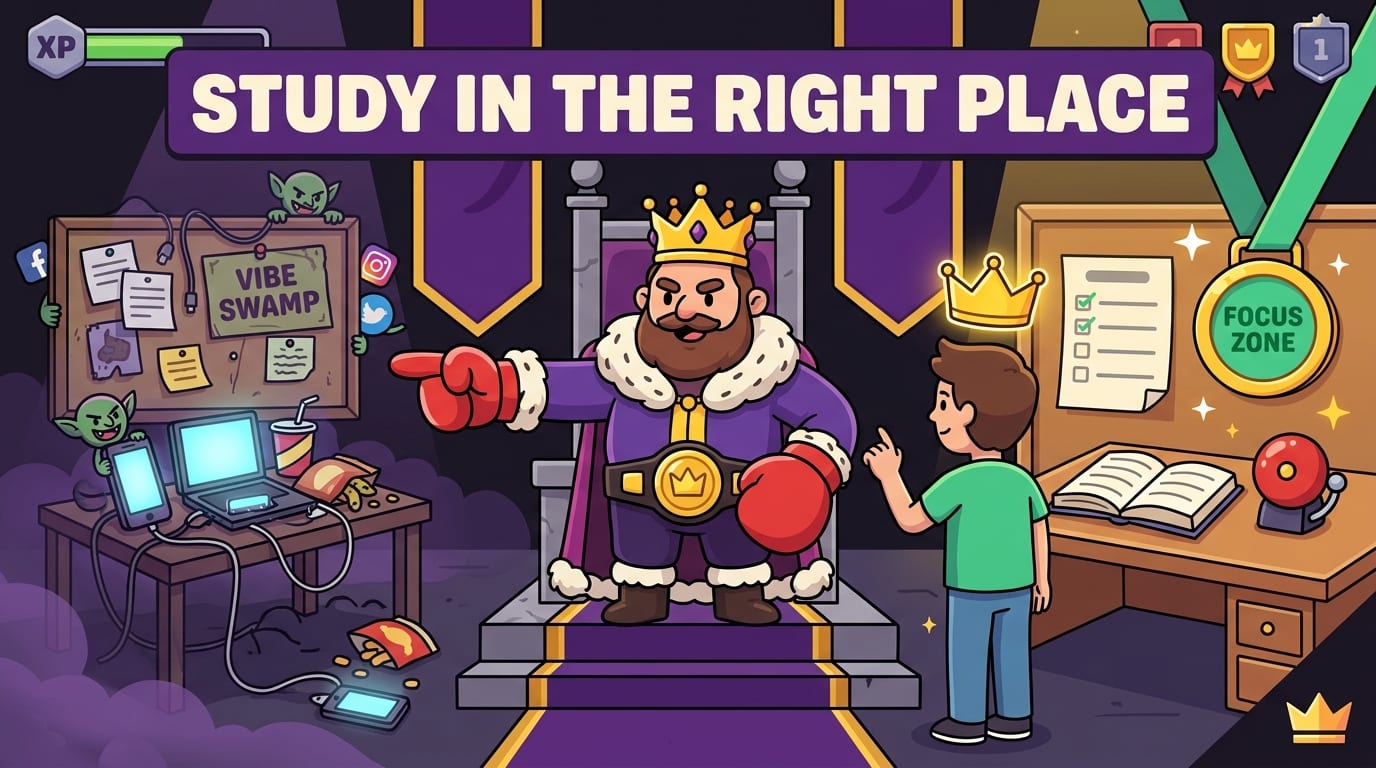
6. Study in the Right Place, Not the Vibe Swamp
Your environment tells your brain what kind of behavior belongs there. If you study in bed, your brain receives mixed instructions: “Memorize economics” and “become burrito.” Burrito usually wins.
You do not need a perfect study room with mahogany shelves and the scent of scholarly ambition. You need a consistent location that reduces friction. A desk, library table, quiet corner, or campus study room can all work. What matters is that the space is associated with focus.
Build a “study launchpad”
Set up your study space before you begin. Your launchpad should include:
- Laptop or tablet, charged.
- Notebook, pens, calculator, textbook, or required materials.
- Water bottle.
- Headphones or earplugs if needed.
- A written plan for the session.
- A distraction blocker armed and ready.
Remove anything that invites derailment. If your gaming controller is within arm’s reach, your brain knows. If your phone is buzzing under a notebook, your brain knows. If your browser has twelve tempting tabs open, The Algorithm knows, and it is already oiling itself up for battle.
Some students do well with background music, especially instrumental tracks, lo-fi, or white noise. Others need silence. Experiment. But avoid content with lyrics if you are reading or writing, because language competes with language. Your essay does not need a surprise verse from your breakup playlist.
7. Manage Energy Like a Champion, Not a Sleep-Deprived Goblin
Focus is physical. Your brain is attached to a body, despite what exam week tries to make you believe. Sleep, food, movement, and stress all affect concentration.
Sleep is the big one. According to the Sleep Foundation, sleep plays an essential role in learning, memory consolidation, mood, and cognitive performance. Pulling all-nighters may feel heroic, but it often turns your brain into soup with Wi-Fi.
Basic energy rules for better studying:
- Sleep 7–9 hours when possible, especially before exams.
- Study difficult material when your energy is highest.
- Eat something with protein and complex carbs before long sessions.
- Hydrate. Your brain is not a cactus.
- Move during breaks: walk, stretch, do squats, fight the invisible procrastination dragon.
- Avoid using caffeine as a substitute for having a functioning life.
You should also match study tasks to energy levels. High-energy blocks are for problem-solving, writing, coding, practice tests, and active recall. Lower-energy blocks are for organizing notes, reviewing flashcards, planning, or watching assigned lectures at a reasonable speed. Not 2.5x speed while your eyes plead for mercy.
8. Use Breaks Without Letting Them Become a Portal to the Meme Realm
Breaks are necessary. Breaks are healthy. Breaks are also dangerous if you spend them inside apps designed by extremely smart people whose job is to make you forget time exists.
The best study breaks have three qualities: they are timed, refreshing, and easy to stop. Scrolling fails all three. It has no natural endpoint, it often leaves you more mentally cluttered, and stopping feels like pulling gum off a carpet.
Better break options include:
- Walk around the room or outside for five minutes.
- Stretch your neck, shoulders, wrists, and back.
- Refill water or make tea.
- Do a quick breathing exercise.
- Look out a window to rest your eyes.
- Tidy your desk for two minutes.
- Eat a snack that is not just “three panic cookies.”
If you really want entertainment during breaks, make it deliberate. Set a timer. Choose one video, not “let the recommendation engine decide my fate.” Better yet, keep entertainment blocked until your full study session is done. With BlockChamp’s Master Focus Toggle, you can keep blocks active during breaks so you do not accidentally sacrifice a 90-minute study plan to a comment-section argument about pineapple pizza.
Champion users can also use Hardcore Lockdown. If you try to turn focus off, BlockChamp can force a cooldown timer or a three-round boxing riddle before surrender. It sounds ridiculous because it is. But that little delay is powerful: impulses fade when they cannot be instantly obeyed. The King makes you earn your escape, and sometimes that is enough to keep you on guard.
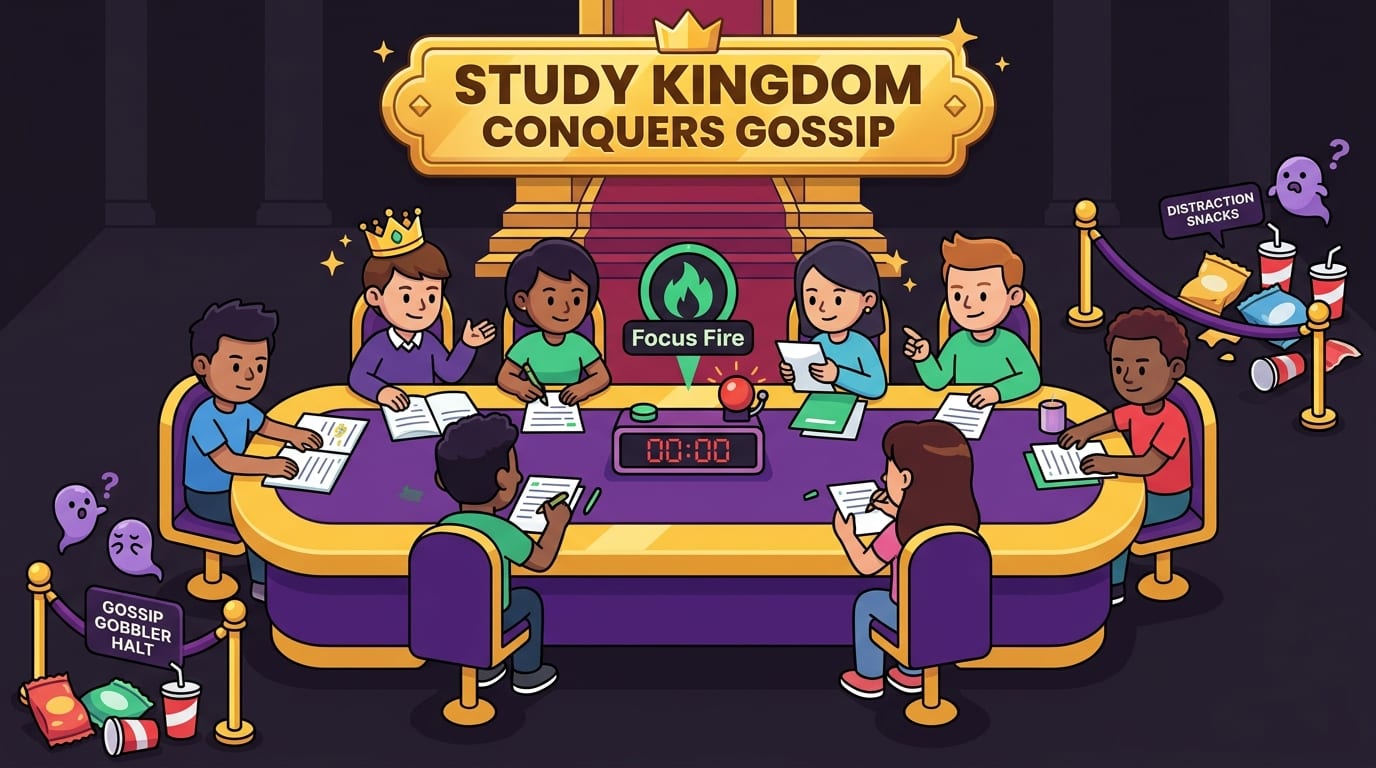
9. Make Studying Social Without Turning It Into a Snack-Based Gossip Festival
Studying with other people can help motivation, especially when everyone is serious. It creates accountability. It also makes it slightly harder to abandon your notes for a two-hour scroll because someone can see you betraying the kingdom.
But group study can go wrong fast. One minute you are reviewing anatomy. The next you are discussing cafeteria fries, someone’s dating situation, and whether your professor owns more than one sweater. Fascinating, yes. Exam-relevant, tragically no.
How to run a useful study group
- Set a clear agenda before starting.
- Assign each person a topic to explain.
- Use timed rounds: 30 minutes work, 10 minutes discussion.
- Quiz each other instead of passively comparing notes.
- Keep phones away from the table.
- End by listing what each person will study next.
You can also do virtual accountability sessions: hop on a call, state your goal, mute, work for 45 minutes, then report back. Very simple. Very effective. Slightly awkward in a wholesome way.
If your biggest challenge is balancing schoolwork with job tasks or remote work, BlockChamp also has a useful guide on staying focused while studying and working.
10. Track Your Progress So Your Brain Gets Proof You Are Winning
Motivation thrives on evidence. If you cannot see your progress, studying can feel endless. That is when the brain starts bargaining: “Maybe I am simply not a studying person. Maybe I should reorganize my desktop icons for clarity.” No, champ. We are not falling for that.
Track a few simple metrics:
- How many focused study blocks you completed.
- What topics you covered.
- Your scores on practice questions.
- Flashcards mastered versus still shaky.
- Hours studied per week.
- Distractions resisted.
Keep the tracking lightweight. A notebook, spreadsheet, calendar, or habit app can work. The point is not to become an administrative raccoon buried in dashboards. The point is to see patterns. If you always lose focus after 8 p.m., study earlier. If you score poorly on practice tests after passive reading, switch to active recall. If Reddit keeps appearing like a cursed wizard, block it.
BlockChamp’s calendar view is built for this kind of visibility. You can see focus hours, XP earned, stare-downs survived, and reign status. A fully gold calendar becomes a little trophy wall for your attention. Does it make studying magically effortless? No. But it makes consistency more satisfying, and satisfaction is rocket fuel for habits.
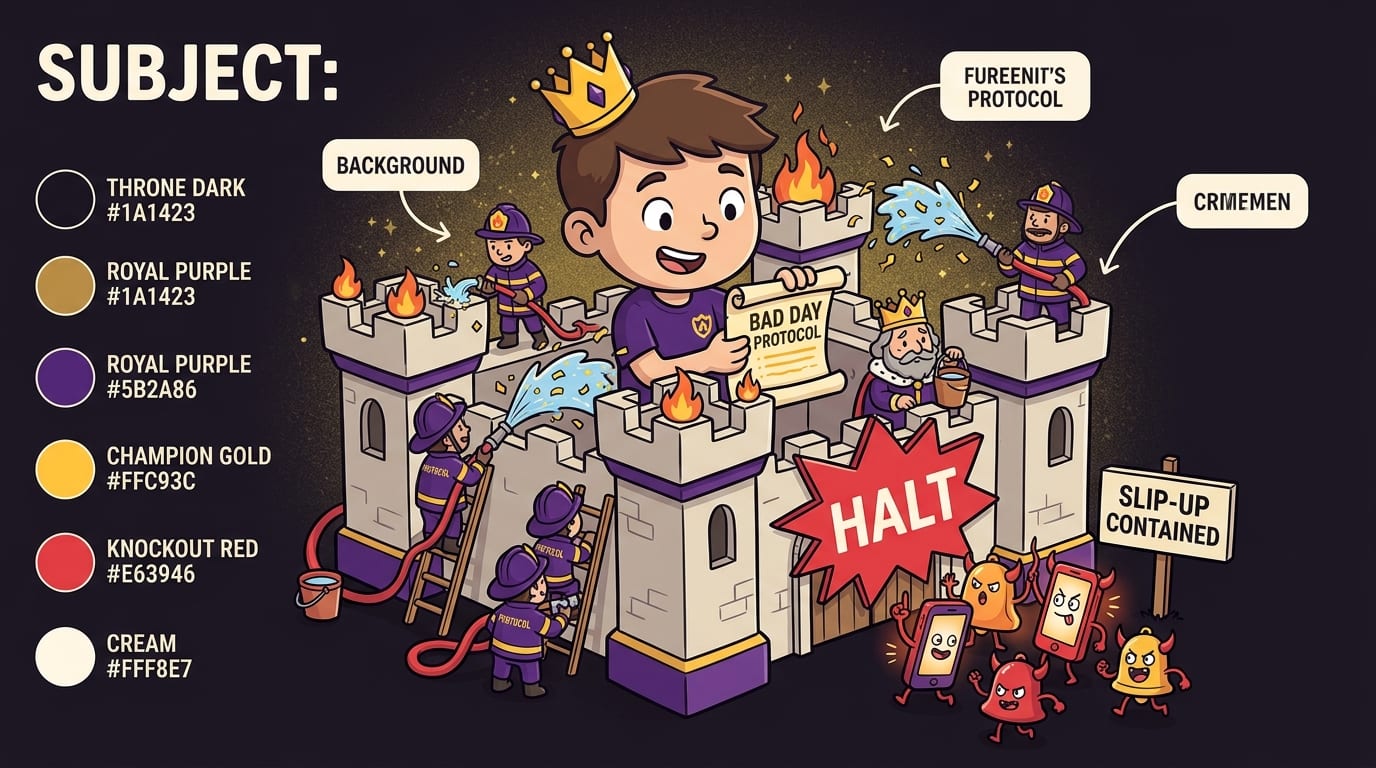
11. Have a “Bad Day Protocol” So One Slip Does Not Burn Down the Castle
You will have bad study days. Everyone does. Even the people with perfect notes and terrifying pencil cases. The goal is not perfection; the goal is recovery.
A bad day protocol is a small plan for getting back on track when motivation evaporates, focus collapses, or you accidentally spend 40 minutes learning about ancient shipwrecks instead of statistics. Again: human. Weirdly educational. Still not statistics.
Use this reset plan
- Name the problem: “I am tired,” “I am overwhelmed,” “I do not understand this,” or “My phone has become my ruler.”
- Make the task smaller: Reduce the next step until it feels doable.
- Set a 10-minute timer: Work only until it rings.
- Remove one distraction: Phone away, tabs closed, blocker on.
- End with a win: Complete one problem, one paragraph, or one flashcard set.
The magic is in not spiraling. Missing one study block does not mean the day is ruined. Getting distracted once does not mean you are doomed. You are allowed to adjust and continue. The crown may wobble. It does not have to fall off.
This is also why BlockChamp rewards consistency, not perfection. If you hit a blocked site and get roasted by The King, that is not failure. That is a successful interception. You tried to wander off. The guard caught you. Back to work. Five XP for surviving the stare-down. Long live the comeback.
12. A Simple Study Focus Routine You Can Steal Today
Here is a practical routine for staying focused and motivated while studying. No incense, no productivity monastery, no 4 a.m. ice bath required.
Before studying: 5 minutes
- Choose one specific outcome for the session.
- Gather materials.
- Close unrelated tabs.
- Put your phone away.
- Turn on BlockChamp or your preferred blocker.
- Set a timer for your first focus block.
During studying: 45–60 minutes
- Start with a quick review.
- Use active recall or practice problems.
- Write down confusing points instead of stopping to wander online.
- If you feel the urge to check something unrelated, note it on a “later list.”
- Finish by summarizing what you learned.
Break: 5–10 minutes
- Stand up.
- Move your body.
- Drink water.
- Avoid infinite-scroll apps.
- Return when the timer ends, not when the internet releases you from its swampy little hands.
After studying: 3 minutes
- Record what you completed.
- Mark your progress.
- Pick the next task for tomorrow.
- Reward yourself with something intentional.
This routine works because it reduces decisions, protects attention, creates visible progress, and gives your brain a reward loop. You are not relying on vibes. You are building a tiny academic fortress.
Conclusion: Defend the Throne, Crush the Scroll, Pass the Exam
Staying focused and motivated while studying is not about becoming a flawless productivity machine. Please do not become a machine. Machines do not enjoy snacks, and that is tragic. It is about setting clear goals, using time blocks, removing distractions, studying actively, managing your energy, and building a system that helps you recover when your focus faceplants into the carpet.
Start small. Pick one study block today. Define one clear win. Put your phone away. Block your biggest distraction. Test yourself instead of rereading for the eighth time. Track the result. Then do it again tomorrow.
And if your distractions keep breaking through the castle walls, let BlockChamp stand guard. It blocks distracting websites, rewards your focus with XP and badges, tracks your reign, and sends The King to roast you when you try to sneak off to YouTube mid-study. Is it slightly ridiculous? Absolutely. But if ridiculous helps you study, then ridiculous wears the crown.
Long live your focus, champ. Now close the tab that does not belong, open the notes that do, and go win the next round.
Related posts

Finding Focus For Fiction Writing

Learning To Focus In A Digital World As A Creative

Finding Focus For Personal Growth
