
Studying And Work

Balancing studying and work is a little like juggling flaming textbooks while your boss emails you “quick question” and your laundry evolves into a sentient kingdom in the corner. It is possible. It is also extremely easy to mess up if your plan is “I’ll just be disciplined” and your browser has seventeen tabs open, three of which are YouTube, one is a shopping cart, and one is a mysterious PDF titled “final_final_REAL_FINAL_v6.”
The good news: you do not need a perfect personality transplant to manage school and a job. You need systems. Boring word, magical results. When your time, energy, priorities, and distractions are managed on purpose, studying and work stop fighting like raccoons in a dumpster and start acting like two demanding but manageable roommates.
This guide breaks down practical strategies for balancing studying and work: time-blocking, prioritization, focus habits, burnout prevention, and distraction control. We’ll keep it realistic, because nobody with a part-time job, assignments, bills, group projects, and a human body is living like a productivity monk 24/7. But with a few smart moves, you can defend the throne, crush the scroll, and actually get your life back.
Quick Answers
Why Studying and Work Feels So Hard: Your Brain Is Not Broken, Champ
If studying and work feels harder than it “should,” congratulations: you are experiencing the very normal collision of cognitive load, context switching, deadlines, and modern distraction machines wearing tiny algorithmic boxing gloves.
Work and study both require attention, but they pull from the same mental battery. After a shift full of customers, meetings, spreadsheets, childcare, or physical labor, your brain may not be thrilled when you ask it to read 40 pages on macroeconomics. It may instead suggest a highly intellectual alternative: “What if we watched seven videos about raccoons stealing cat food?” Treacherous little goblin.
Research consistently shows that interruptions and task switching hurt performance. The American Psychological Association explains that multitasking often reduces productivity because switching between tasks creates mental costs. That means trying to answer work messages while studying for an exam is not “being efficient.” It is paying an attention tax. And the tax collector is wearing clown shoes.
There is also the time pressure. Students who work may have fewer flexible hours, less recovery time, and more decision fatigue. According to the National Center for Education Statistics, many college students are employed while enrolled, which means millions of people are trying to handle exactly this balancing act. You are not lazy. You are operating in a genuinely demanding setup.
The key is not to “try harder” in a vague motivational-poster way. The key is to reduce friction, make decisions ahead of time, and protect your focused hours like a tiny royal dragon sitting on a pile of gold.
Start With a Weekly Reality Check, Not a Fantasy Calendar
The first rule of balancing studying and work: stop planning as if you are a productivity cyborg who never gets tired, hungry, sick, sad, distracted, invited somewhere, or attacked by a surprise group project.
A good schedule starts with reality. Before you design the perfect week, map the week you actually have. Write down your fixed commitments first:
- Work shifts or office hours
- Classes, labs, lectures, seminars, or online sessions
- Commute time
- Sleep, meals, exercise, and basic maintenance of your human meat-suit
- Family responsibilities, caregiving, errands, appointments
- Assignment deadlines, quizzes, exams, and project milestones
Once the non-negotiables are visible, look for usable study blocks. A usable block is not just “empty time.” It is time when you have enough energy to do the kind of studying required. Thirty minutes after a brutal shift may be great for flashcards, reviewing notes, or organizing tomorrow’s tasks. It may be terrible for writing a 2,000-word research paper unless caffeine and divine intervention are both present.
Think in energy zones:
- High-energy time: Use for deep studying, writing, problem sets, coding, exam practice, or complex reading.
- Medium-energy time: Use for reviewing notes, outlining essays, watching lecture replays, or working through easier tasks.
- Low-energy time: Use for admin, formatting citations, uploading files, checking rubrics, or planning tomorrow.
This matters because one of the biggest mistakes people make when combining work and study is assigning hard tasks to dead-brain hours. Then they fail, feel guilty, and declare themselves “bad at discipline.” No, champ. You tried to do calculus after an eight-hour shift and a sad vending machine dinner. That is not a moral failure. That is poor task placement.
If building a schedule has historically felt like trying to assemble IKEA furniture during an earthquake, check out BlockChamp’s guide on how to create a schedule that works for you. The goal is not to create a museum-quality calendar. The goal is to build a schedule that survives contact with real life.
Time-Blocking: Put Your Hours in Little Focus Castles
Time-blocking is one of the most useful strategies for studying and work because it gives each responsibility a defined place to live. Instead of maintaining a giant mental soup of “I need to study, work, email, read, revise, buy toothpaste, and become a better person,” you put tasks into blocks.
A simple time-blocking system looks like this:
- List your major tasks for the week.
- Estimate how long each task will take.
- Assign tasks to specific calendar blocks.
- Add buffer time because humans are wildly bad at estimates.
- Review and adjust daily.
For example, if you work Monday, Wednesday, and Friday from 9 a.m. to 3 p.m., your study plan might look like:
- Monday 4:30–5:15 p.m.: Review lecture notes and make flashcards
- Tuesday 8:30–10:30 a.m.: Deep study for biology exam
- Tuesday 2:00–3:00 p.m.: Draft essay outline
- Wednesday 4:00–4:30 p.m.: Low-energy admin and assignment uploads
- Thursday 9:00–11:00 a.m.: Practice problems and quiz prep
- Saturday 10:00 a.m.–12:00 p.m.: Essay writing sprint
Notice that not every block is huge. When people imagine “studying,” they often picture a four-hour candlelit academic monastery session. Lovely. Rare. Usually interrupted by a Slack message, a roommate, or your own sudden need to reorganize all your socks. Shorter blocks can be powerful when they are specific.
Use labels that tell you exactly what to do. “Study chemistry” is vague. “Complete 20 equilibrium practice problems and mark confusing ones” is useful. Your future self should be able to open the calendar and begin without negotiating with the chaos gremlin.
One advanced move: pair time-blocking with website blocking. If your Tuesday 8:30 a.m. block is for exam prep, use BlockChamp to block Social Media, Video & Streaming, News, Shopping, Gaming, and any specific sites that tend to swallow you whole. On Champion, you can set recurring Focus Schedules so blocks automatically activate during your planned study and work hours. The King stands guard; you stop “accidentally” researching memes for 43 minutes. Royal efficiency.
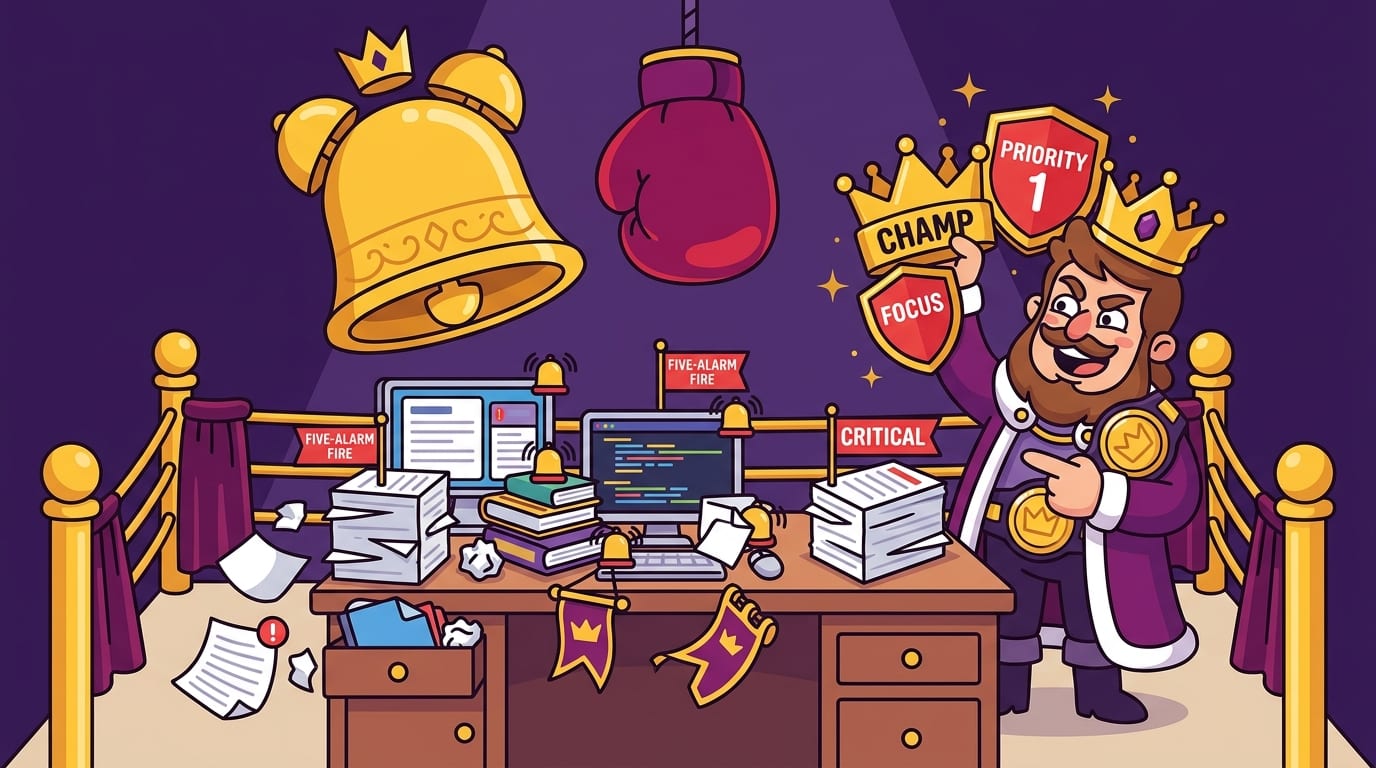
Prioritization: Because Not Everything Is a Five-Alarm Academic Fire
When studying and work collide, everything can feel urgent. Your boss needs a shift covered. Your professor posted a quiz. Your group project partner has contributed one sad thumbs-up emoji and vanished into the mist. Your inbox is blinking. Your brain screams, “Do everything!” Then you do nothing, because panic is famously bad project management.
Prioritization is how you choose what gets the crown today.
Try this simple weekly sorting method:
1. Identify deadlines
Write down everything due this week and next week. Include work-related deadlines too, such as shift requests, reports, training modules, or client deliverables. If it has consequences, it belongs on the list.
2. Rank by impact
Ask: “What happens if this is late, rushed, or ignored?” A final exam worth 35% of your grade outranks a discussion post worth 2%, even if the discussion post is louder in your inbox. Loud does not mean important. Toddlers and leaf blowers also know this.
3. Break big tasks into next actions
“Write paper” is a swamp. “Find three sources,” “create outline,” “draft introduction,” and “edit citations” are stepping stones. Smaller next actions reduce resistance because your brain can actually understand them without needing a ceremonial sword.
4. Pick your daily top three
Each day, choose three important tasks. Not twelve. Not “the entire semester.” Three. If you complete those, the day is a win. You can do bonus tasks if time allows, but the top three protect you from spending all day on tiny chores while the important dragon grows larger in the cave.
For a student with a job, a realistic daily top three might be:
- Attend work shift from 10 a.m. to 2 p.m.
- Complete statistics problem set questions 1–12
- Review 25 flashcards for Friday’s exam
This keeps the day grounded. It also helps you avoid “productive procrastination,” where you clean your desk, color-code your notes, make a new Notion dashboard, and somehow do not touch the assignment that is due tomorrow. Beautiful dashboard, though. Truly regal nonsense.
Build Focus Rituals So Your Brain Knows It’s Go Time
Focus is not just willpower. It is context. Your brain learns cues. If you always study in the same place, with the same playlist, same drink, same browser setup, and same start routine, your brain begins to associate that pattern with work mode. Basically, you train your brain like a very fancy, anxious golden retriever.
Create a short pre-focus ritual that takes less than five minutes:
- Clear your desk or study area.
- Open only the tabs and materials needed for the session.
- Put your phone out of reach or on Do Not Disturb.
- Turn on BlockChamp’s Master Focus Toggle.
- Write the exact goal for the session on paper or in your notes.
- Start a timer for 25, 45, or 60 minutes.
The point is to remove negotiation. When the ritual starts, the kingdom knows: we are not scrolling. We are not browsing “quickly.” We are not checking if one celebrity still has a weird kitchen. We are doing the task.
For deep work, longer uninterrupted blocks can be especially valuable. Cal Newport popularized the concept of deep work as focused, distraction-free effort on cognitively demanding tasks, and the idea has become central to modern productivity. If you want a practical dive into that approach, read BlockChamp’s post on deep work and disconnecting from distractions.
You do not need to do deep work all day. In fact, you probably cannot. But one or two protected focus sessions can outperform six hours of half-working, half-checking messages, and half-being spiritually trapped inside Reddit. Yes, that is three halves. Distraction math is cursed.
Manage Digital Distractions Before They Manage You
Let’s be honest: the internet is not a neutral library of knowledge. It is a glitter cannon aimed at your weakest impulses. Social apps, video platforms, news feeds, shopping sites, and AI tools can all be useful. They can also turn “I’ll check one thing” into “Why is it dark outside?”
The average person spends a huge amount of time online, and social platforms are a major part of that. DataReportal’s Digital 2024 Global Overview Report shows that people worldwide spend significant daily time using the internet and social media. That time is not automatically bad. But when you are trying to balance studying and work, uncontrolled digital habits can quietly eat the exact hours you needed for assignments, sleep, and not feeling like a haunted raccoon.
Here is the practical approach: do not rely on resisting temptation after it appears. Block temptation before the session starts.
Common distraction-control moves include:
- Logging out of social media during study blocks
- Removing bookmarks for time-wasting sites
- Keeping your phone in another room
- Using full-screen mode for writing or reading
- Blocking distracting websites during work and study hours
- Creating separate browser profiles for school/work and leisure
This is where BlockChamp fits naturally. It is a gamified website blocker for Chrome built for people who know they waste time but do not want a joyless productivity prison. You can block specific sites like YouTube, Reddit, TikTok, X/Twitter, or shopping sites. You can also block whole categories, such as Social Media, Video & Streaming, News, Gaming, Shopping, Gambling, Adult, and AI Distractions.
And when you try to sneak into a blocked site, you do not get a boring error screen. You get The Stare-Down: The King, a royal boxer mascot, judging your life choices with theatrical disappointment. Sometimes he roasts you out loud. It is funny. It is mildly humiliating. It works because it interrupts the impulse and gives you a second to choose better.
If your main battle is studying without falling into browser quicksand, start with this guide on how to block websites for studying. Your future grades may send a thank-you note. Your procrastination goblin will not.
Use Work Breaks and Micro-Sessions Like a Sneaky Productivity Goblin
When you are studying and working, you may not always have luxurious two-hour blocks. That does not mean you are doomed. Micro-sessions can carry a surprising amount of weight, especially for review-heavy subjects.
A micro-session is a focused study burst of 5 to 20 minutes. It is not ideal for everything, but it is excellent for:
- Flashcards
- Vocabulary review
- Formula memorization
- Reading one short article
- Reviewing lecture notes
- Creating a quick outline
- Planning the next study block
- Listening to a lecture recap during a commute
For example, if you have a 15-minute break at work, you might review flashcards instead of opening Instagram. Not every break should become a study session, because rest is real and you are not a productivity toaster. But a few intentional micro-sessions per week can reduce pressure on your bigger study blocks.
The trick is to prepare micro-tasks in advance. Keep a list called “Tiny Study Wins” with tasks that take less than 20 minutes. When you have a small pocket of time, you do not waste half of it deciding what to do.
Examples:
- Review 10 anatomy terms
- Summarize one paragraph from the reading
- Brainstorm three essay arguments
- Watch one assigned lecture segment
- Make five practice quiz questions
Micro-sessions are not a replacement for deep work, but they are excellent support troops. Think of them as tiny knights running around the kingdom handling annoying little tasks before they become dragons.

Protect Sleep and Recovery Like They Are Part of the Assignment
Here is a rude truth: if your studying and work plan depends on chronic sleep deprivation, the plan is garbage wearing a fake mustache.
Sleep is not optional decoration. It affects memory, concentration, mood, decision-making, and learning. The Sleep Foundation explains that sleep supports learning, memory, and overall health. So if you are studying until 2 a.m. every night and then dragging yourself to work at 7 a.m., you may be spending more hours “studying” while getting less actual learning.
Burnout often sneaks in when every hour is assigned a job. Work hours. Class hours. Study hours. Commute hours. Chore hours. Then your only “free time” becomes revenge bedtime procrastination, where you stay up scrolling because it is the only moment that feels like yours. Understandable? Yes. Sustainable? Absolutely not, your majesty.
Build recovery into your weekly plan:
- Choose a realistic bedtime for most nights, not an imaginary saint schedule.
- Leave at least one block per week intentionally unplanned.
- Use meals as real breaks when possible, not sad laptop-adjacent chewing.
- Take short walks to reset your nervous system between work and studying.
- Schedule lighter study tasks after demanding work shifts.
- Give yourself a shutdown routine so your brain knows the day is over.
Also, consider whether your work hours are sustainable. Sometimes the issue is not your time management; it is that your total workload is too heavy. If you are consistently failing despite a solid system, you may need to reduce hours, talk to an advisor, adjust your course load, or ask your manager for a more predictable schedule. There is no productivity hack that magically creates 30 hours in a day. If someone claims there is, they are probably selling powdered broccoli to CEOs.
For a broader look at sustainable output, BlockChamp has a helpful post on shorter work days and sustainable productivity. The big idea: more hours are not always better hours.
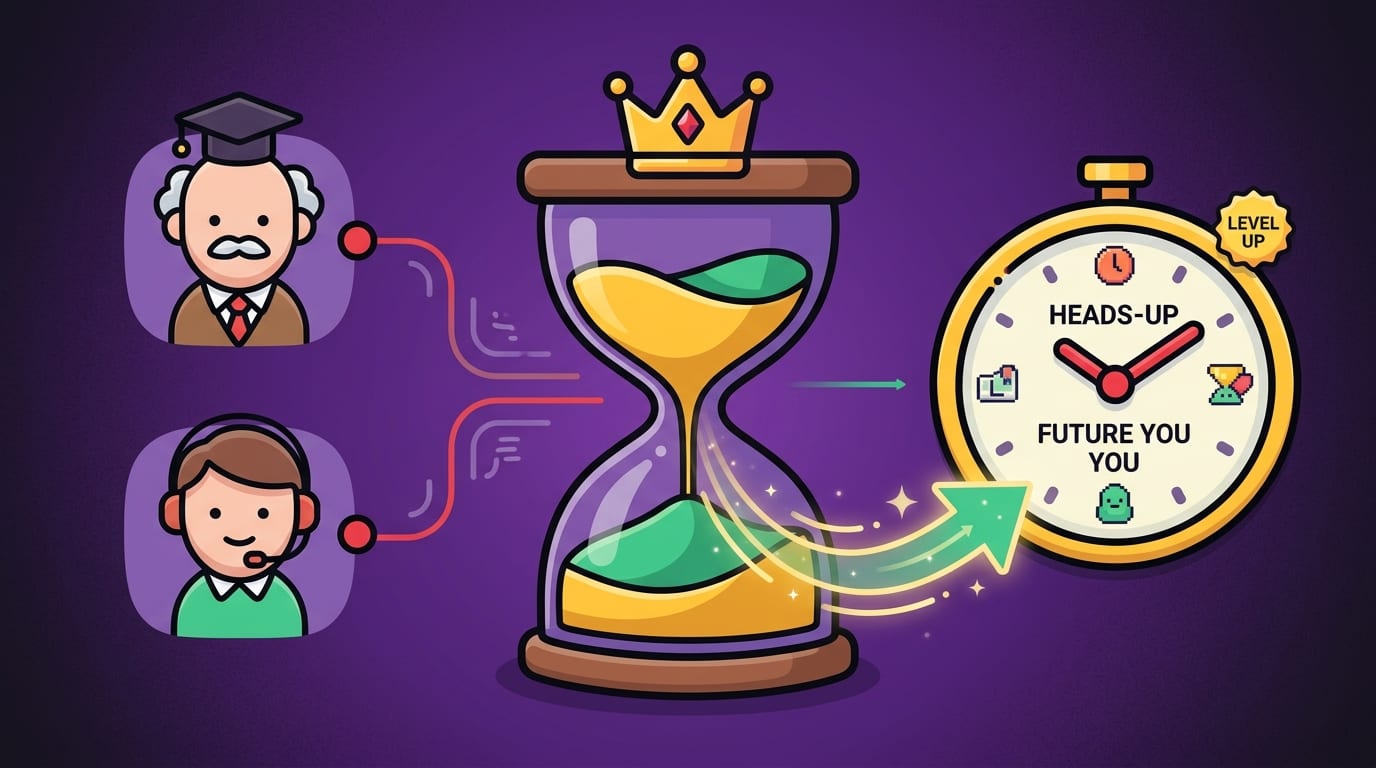
Communicate Early: Professors, Managers, and Future You Deserve a Heads-Up
Balancing studying and work gets much easier when you communicate before things explode. Waiting until the night before a deadline to announce that your schedule is overloaded is like telling the castle guard about the dragon after it has eaten the drawbridge.
At school, communicate with professors, teaching assistants, advisors, or group members when you see a conflict coming. You do not need to overshare your entire life story. Keep it clear and professional:
“Hi Professor, I’m working evening shifts this week and have two exams close together. I’m planning ahead and wanted to ask if there is any flexibility on the discussion post deadline, or if you recommend prioritizing specific material for the exam review.”
At work, be equally proactive. If your exam week is approaching, tell your manager early. Ask about shift swaps or reduced hours before the schedule is locked. If you have recurring class commitments, make them visible. Most managers prefer early planning over last-minute chaos confetti.
Also communicate with future you. That means writing things down. Use a calendar, planner, task manager, sticky notes, carrier pigeon, whatever works. Your brain is not a reliable storage unit when it is juggling work stress and academic deadlines. It will remember the lyrics to a commercial from 2009 but forget the quiz due at midnight. Classic betrayal.
A strong weekly review can prevent disasters:
- Check upcoming school deadlines.
- Check work shifts and obligations.
- Identify conflicts or heavy days.
- Move study blocks before the week gets crowded.
- Email or message anyone who needs advance notice.
This 20-minute habit can save hours of panic. It is not glamorous. No confetti cannon fires. But it is the kind of boring magic that keeps your kingdom from collapsing.
Create Separate Modes for Student Brain and Work Brain
One underrated challenge of studying and work is identity switching. At work, you may need to be fast, responsive, social, service-oriented, or deadline-driven. In study mode, you may need to be reflective, patient, analytical, or creative. Switching between those modes is not automatic.
Create transition rituals to help your brain shift gears.
After work, before studying:
- Change clothes or at least shoes to signal a mode shift.
- Eat something with actual nutritional value. Chips alone are not a study strategy, despite their crunchy confidence.
- Take a 10-minute walk or shower.
- Write down any work thoughts so they stop bouncing around your skull.
- Start with a low-friction study task for five minutes.
Before work, after studying:
- Write a quick “next study step” note so you can restart later easily.
- Close school tabs and documents.
- Check your work schedule and key responsibilities.
- Give yourself a few minutes of mental buffer before clocking in.
This sounds simple because it is. But simple rituals reduce context-switching friction. You stop expecting your brain to instantly transform from “customer service warrior” to “academic philosopher” in one breath. Even superheroes need costume changes. Yours may involve sweatpants and a suspiciously large coffee.
Make Progress Visible So Motivation Has Something to Chew On
When you are busy, progress can become invisible. You work, study, sleep, repeat, and still feel behind. That is demoralizing. Humans need feedback. We like seeing streaks, checkmarks, progress bars, and proof that effort is adding up. This is why games are addictive and why crossing something off a to-do list feels like defeating a tiny paperwork monster.
Use visible tracking for studying and work:
- Track study hours by subject.
- Mark completed assignments on a calendar.
- Use a checklist for each course.
- Keep a “done list” of completed tasks, not just a to-do list.
- Review your weekly wins every Sunday.
BlockChamp leans hard into this because motivation is easier when focus feels like leveling up. Every focused minute earns XP. Every blocked-site temptation you survive earns more XP. Keeping your blocks active builds your reign. You can unlock badges, climb levels from Peasant of Procrastination to Block Champ, and see your focus history on a calendar. It turns “I didn’t waste my study block on TikTok” into an actual win you can see.
This matters because consistency beats heroic bursts. A single eight-hour panic session before an exam is less reliable than steady focused work over several days. A gamified system gives your brain little rewards along the way, which helps you keep showing up even when motivation is wearing a bathrobe and refusing to participate.
If you are a freelancer, remote worker, or student with flexible hours, the same principle applies. Protect the hours, track the wins, reduce the distractions. BlockChamp’s guide for freelancers on reclaiming focus with deep work has useful ideas that apply beyond freelancing too.
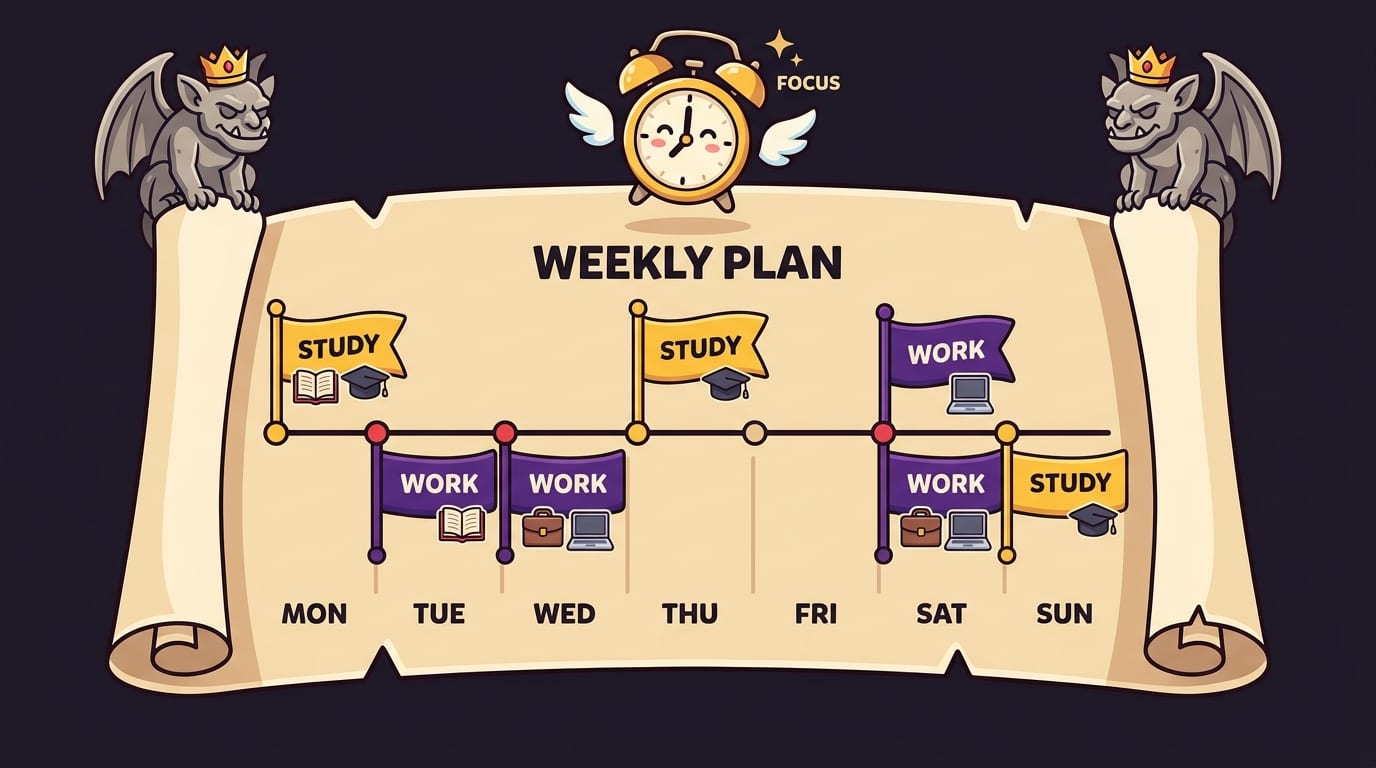
A Sample Weekly Plan for Balancing Studying and Work
Let’s make this practical. Suppose you work 20 hours per week and take four classes. Your week might include three work shifts, two heavy lecture days, and assignments due Friday and Sunday. Here is a realistic structure:
Sunday: Plan the kingdom
- Review deadlines for the next two weeks.
- Block study sessions on your calendar.
- Choose daily top three tasks.
- Prepare meals, laundry, or supplies if possible.
- Set BlockChamp schedules for study blocks and work focus periods.
Monday: Work plus light review
- Work shift: 9 a.m.–3 p.m.
- Recovery break: 3:30–4:15 p.m.
- Study: 4:30–5:15 p.m. flashcards and lecture review.
- Shutdown: write tomorrow’s first task.
Tuesday: Deep study day
- Study block: 8:30–10:30 a.m. exam practice.
- Class or lecture: midday.
- Study block: 2:00–3:00 p.m. essay outline.
- Evening: rest or light admin.
Wednesday: Work plus micro-session
- Work shift: 10 a.m.–4 p.m.
- Micro-session during break: review 15 flashcards.
- Evening: no heavy studying unless truly necessary.
Thursday: Assignment push
- Study block: 9:00–11:00 a.m. finish problem set.
- Study block: 1:00–2:30 p.m. draft essay sections.
- Admin: upload completed work and check rubrics.
Friday and Saturday: Flexible buffer
Use one block for catch-up and one for review. Keep at least one real recovery block. If your entire weekend becomes a punishment zone, Monday will arrive riding a horse named Regret.
The exact schedule will vary, but the pattern is the point: fixed commitments first, high-energy tasks in high-energy blocks, lighter tasks after work, buffers for chaos, and distractions blocked before they invade.
Common Mistakes That Make Studying and Work More Painful
Even smart, motivated people fall into traps when balancing studying and work. Here are the big ones to avoid:
- Planning every minute: A schedule with no buffer is a glass castle. Pretty, doomed.
- Studying only when you feel motivated: Motivation is flaky. Systems show up.
- Leaving distractions available: If TikTok is one click away, your willpower has to win every time. Bad odds.
- Ignoring sleep: Tired studying often produces tired results.
- Doing easy tasks first forever: Warm-ups are fine. Hiding from the hard thing is not.
- Not asking for help: Professors, advisors, managers, classmates, and tutors exist. Use the kingdom’s allies.
- Confusing busyness with progress: Being busy is not the same as moving important work forward.
One more mistake: assuming one bad day means the plan failed. It does not. A good system bends. If you miss a study block, reschedule it. If you fall into a scroll hole, block the site and continue. If your work shift changes, adjust the week. You are building consistency, not auditioning for a documentary called Perfect Person Never Makes Mistakes.
Final Bell: Balance Is Built, Not Discovered
Balancing studying and work is not about finding one magical hack that transforms you into an unstoppable academic gladiator with perfect hair. It is about building a set of small, repeatable systems: realistic weekly planning, time-blocking, prioritization, focus rituals, distraction blocking, recovery, communication, and visible progress.
Start simple. This week, do three things:
- Map your fixed work and school commitments.
- Schedule three specific study blocks based on your real energy levels.
- Block your biggest digital distractions during those blocks.
If Chrome is where your good intentions go to get mugged by YouTube, Reddit, TikTok, news, shopping, or “just one quick search,” give BlockChamp a try. It helps you block distracting websites, build focus streaks, earn XP, unlock badges, and get roasted by The King when you try to betray your own schedule. Is it ridiculous? A little. Is ridiculous sometimes exactly what makes a habit stick? Absolutely.
Long live your focus. Defend the throne. Crush the scroll. And remember: your degree, paycheck, sanity, and sleep can all exist in the same kingdom. They just need a ruler with a plan. That’s you, champ.
Related posts

Finding Focus For Fiction Writing

Learning To Focus In A Digital World As A Creative

Finding Focus For Personal Growth
