
Stay Focused When Studying

If you’re trying to stay focused when studying and your brain keeps opening TikTok like it’s a sacred academic resource, congratulations: you are a modern student. Your textbook is open, your notes are ready, your highlighter is uncapped like a tiny fluorescent sword… and somehow you’re watching a raccoon steal cat food on YouTube. Again.
The problem isn’t that you’re lazy, broken, or secretly destined to become the Duke of Doomscrolling. The problem is that studying requires sustained attention, and almost every app, tab, notification, and algorithm around you is built to hijack that attention with the subtlety of a marching band in a library.
The good news: focus is not a personality trait. It’s a system. You can design your study routine, environment, schedule, and digital boundaries so concentration becomes easier, less dramatic, and less dependent on heroic willpower. In this guide, we’ll walk through practical ways to stay focused when studying, from time-blocking and study rituals to distraction blockers, energy management, and tiny habit tweaks that actually stick.
Quick Answers
Why Studying Feels So Hard Now: Your Brain vs. The Distraction Goblin
Before we crown you Champion of Concentration, let’s talk about why studying feels like wrestling a caffeinated octopus. Your brain is wired to notice novelty. That was useful when novelty meant “rustling bush, possible tiger.” Less useful when novelty means “17 unread Discord messages and a sale on shoes you do not need.”
Research on attention and task switching shows that interruptions carry a real cognitive cost. The American Psychological Association explains that switching between tasks can reduce efficiency because your brain needs time to reorient each time you change focus. In plain student language: every time you “just check one thing,” your brain has to reload the study mission like an old game console with emotional damage. You can read more in the APA’s overview of multitasking and task switching.
Then there’s the phone. The mere presence of your phone can reduce available cognitive capacity, according to a well-known study published in the Journal of the Association for Consumer Research. Even if it’s face down. Even if you’re “being good.” Even if it’s sitting there like a tiny rectangular goblin whispering, “What if someone liked your post?”
So if your attention feels fragile, don’t take it personally. You’re studying inside a casino of notifications, feeds, autoplay, shopping recommendations, news alerts, group chats, and AI rabbit holes. The goal is not to become a monk who lives under a desk lamp and eats flashcards. The goal is to build a study system that protects your brain from ambush.
Start With a Study Plan That Doesn’t Require Wizard Powers
A lot of students sit down to study with a plan that sounds like this: “I will study biology.” This is not a plan. This is a fog machine wearing a backpack.
To stay focused when studying, you need a clear target. Your brain likes specific instructions. “Study biology” is vague and enormous, so your brain panics and looks for comfort in Instagram reels. “Review chapter 6 notes, make 20 flashcards, and complete practice questions 1–10” is much easier to start.
Use the 3-part study target
Before every study session, write down three things:
- What subject? Example: Chemistry.
- What exact task? Example: Balance 15 chemical equations.
- What finish line? Example: Score at least 12/15 correct without notes.
This turns studying from “wander through the swamp of academic doom” into “complete this one quest.” Much better. More crown. Less swamp.
If you want a deeper dive into creating a distraction-free study setup, BlockChamp has a related guide on studying without distractions that pairs nicely with this approach. Think of it as your royal pre-battle briefing.
Break big assignments into tiny, non-scary chunks
Big tasks breed avoidance. “Write research paper” feels like being asked to build a cathedral with a spoon. Instead, break it down:
- Choose topic.
- Find five sources.
- Write thesis draft.
- Create outline.
- Write introduction.
- Write body section one.
- Add citations.
- Revise for clarity.
Now you have smaller targets you can finish in a single study block. Each completed chunk gives your brain a little win, and little wins are focus fuel. Not quite dragon-fire, but close enough for finals week.
Build a Study Environment That Doesn’t Betray You
Your environment is either helping you focus or quietly pickpocketing your attention. If your desk has three snack wrappers, an open gaming tab, laundry judging you from the corner, and your phone glowing like a cursed artifact, your brain is not the villain. The room is.
Start by making your study space boring in the best possible way. Not prison boring. More like “nothing here is more interesting than the thing I came to do” boring.
The minimum viable focus zone
You don’t need a perfect aesthetic desk with a $900 chair and a plant named Professor Leafington. You need a repeatable setup:
- Clear workspace with only the materials needed for the current task.
- Phone out of reach, ideally in another room or inside a bag.
- One browser window for school-related tabs only.
- Water nearby so you don’t leave and accidentally reorganize your entire kitchen.
- Headphones or earplugs if your environment is noisy.
- A visible timer so your brain knows there is an end point.
If you study in a shared space, use a visual signal. Headphones, a sticky note, or a tiny “do not disturb unless on fire” sign can reduce interruptions. If people still interrupt you to ask where the cereal is, consider replying in Latin. Results may vary.
Use light, sound, and seating like a focus nerd
Lighting matters. Dim rooms tell your brain, “Nap? Perhaps?” Bright, comfortable lighting helps keep you alert. Natural light is great if you can get it, but a decent desk lamp also works. For sound, choose either quiet, instrumental music, brown noise, or ambient background noise. Lyrics can compete with reading and writing, because your brain starts processing words from the song while trying to process words from your textbook. Suddenly you’re annotating Shakespeare to a breakup anthem. Chaos.
Also: don’t study in bed unless you are studying the ancient art of becoming horizontal. Beds are for sleep. Your brain knows this. Respect the mattress kingdom.
Time-Blocking: Give Your Focus a Calendar Throne
If you want to stay focused when studying, don’t rely on “I’ll do it later.” Later is where productivity goes to get eaten by Netflix.
Time-blocking means assigning specific tasks to specific times. It works because it removes the constant decision-making of “What should I do now?” and replaces it with “At 4:00, I review calculus.” Less debating. More doing.
A simple study time-blocking formula
Try this structure:
- 5 minutes: Set up materials and write your study target.
- 25–50 minutes: Focused work block.
- 5–10 minutes: Break.
- 25–50 minutes: Second focused work block.
- 10 minutes: Review what you completed and plan next step.
The famous Pomodoro Technique uses 25-minute focus sessions and short breaks. Many students love it because it makes studying feel less endless. Others prefer 45- or 50-minute blocks, especially for reading, essays, or problem sets. There is no sacred tomato law. Choose the block length that fits the task and your energy.
The key is to decide before you begin. “I’ll study until I feel done” usually ends when you feel mildly uncomfortable, which may be after seven minutes and one dramatic sigh. A timer helps you push through the initial resistance without turning the session into a punishment parade.
Match task type to time of day
Not all study tasks require the same mental horsepower. Use your best energy for the hardest work:
- High-energy tasks: practice problems, essay drafting, active recall, exam simulations.
- Medium-energy tasks: summarizing notes, reviewing lecture slides, making flashcards.
- Low-energy tasks: organizing files, formatting citations, cleaning up your study plan.
If you’re sharpest in the morning, don’t spend that golden brain juice color-coding your notes like a medieval manuscript. Use it for the work that actually improves performance. Save the pretty headings for when your brain has become soup with ambitions.
For more workplace-style planning that can also apply to school, check out BlockChamp’s post on creating an attention charter to stay focused. Students can adapt the same idea into a “study charter” that defines when, where, and how distractions get banished from the kingdom.

Use Active Study Methods, Because Re-Reading Is a Sneaky Little Fraud
One reason students lose focus is that their study method is passive. Re-reading notes feels productive because your eyes are moving and your highlighter is having a wonderful time. But passive review often creates familiarity, not mastery. You recognize the material, but you can’t produce it under exam pressure. That’s how tests ambush you in broad daylight.
To improve concentration and memory, use active study techniques that force your brain to retrieve, apply, and explain information.
Better ways to study without zoning out
- Active recall: Close your notes and answer questions from memory.
- Practice testing: Use past papers, quiz banks, or self-made questions.
- Teach-back method: Explain the concept out loud like you’re teaching a confused squirrel.
- Blurting: Write everything you remember about a topic, then check gaps.
- Interleaving: Mix related problem types instead of doing one type repeatedly.
- Spaced repetition: Review material over multiple days instead of panic-cramming at midnight.
The science backs this up. Research summarized by the American Psychological Association on learning and memory highlights the power of retrieval practice and spacing. Translation: your brain remembers better when it has to work a little. Annoying? Yes. Effective? Also yes. The brain is a dramatic employee, but it can be trained.
Turn study sessions into mini challenges
Gamify the task. Set a challenge like:
- “Can I solve 10 algebra problems in 30 minutes with 80% accuracy?”
- “Can I explain this history topic in under two minutes without notes?”
- “Can I get through 25 flashcards with no more than five misses?”
This creates a clear goal, adds urgency, and gives you feedback. It also makes studying feel less like trudging through mud in academic boots. BlockChamp uses the same principle in its focus system: XP, levels, badges, reigns, and leaderboard progress make concentration feel like leveling up instead of sitting in a beige productivity dungeon.
Block Digital Distractions Before They Throw the First Punch
Let’s be honest: most study plans collapse not because the student doesn’t care, but because the internet is a buffet of forbidden snacks. You sit down to review biology, search one term on YouTube, and suddenly the algorithm is spoon-feeding you “Top 10 Deep Sea Creatures That Should Pay Rent.”
If you want to stay focused when studying, block the obvious traps before your session starts. Don’t wait until you’re tired, bored, or emotionally vulnerable because your calculus homework looked at you funny.
Make a distraction hit list
Write down the websites and apps that usually derail you. Common villains include:
- TikTok, Instagram, Reddit, X/Twitter, Snapchat, Discord, and other social platforms.
- YouTube, Twitch, Netflix, and streaming sites.
- News sites, especially if you enjoy refreshing the apocalypse.
- Shopping sites like Amazon, Temu, Etsy, and eBay.
- Gaming sites, forums, and wikis.
- AI chat tools when they become procrastination machines instead of study assistants.
Then block them during study sessions. This is where BlockChamp is built for the job. It’s a gamified website blocker for Chrome that lets you block specific sites, keywords, or whole categories like Social Media, Video & Streaming, News, Shopping, Gaming, Gambling, Adult, and AI Distractions. Instead of relying on heroic self-control, you put The King on guard and let him defend the throne.
And when you try to sneak into a blocked site? You don’t get a boring gray error page. You get The Stare-Down: BlockChamp’s full-screen royal block page where The King judges you, shows the site you tried to enter, and sends you back to work. Every survived stare-down earns XP. It’s accountability with a crown and boxing gloves. Productivity, but make it mildly theatrical.
If your main goal is exam prep or homework, this guide on how to block websites for studying walks through the practical side of setting up digital boundaries so your study time doesn’t get drop-kicked by the scroll.

Create a Pre-Study Ritual So Your Brain Knows It’s Go Time
Your brain loves cues. If you repeat the same small routine before studying, your brain starts associating that routine with focus. This is basic habit design, not magic. Though if you want to wear a wizard hat while doing it, the kingdom will not object.
A pre-study ritual should be short, repeatable, and boringly effective. The goal is to reduce friction and signal, “We are entering focus mode now. Please keep all memes outside the castle walls.”
A 5-minute focus ritual
- Clear your desk of anything unrelated to the session.
- Put your phone away or turn on Do Not Disturb.
- Open only the tabs and materials you need.
- Turn on your website blocker or study focus tool.
- Write one clear study target.
- Start a timer.
Do this every time. Not just when you feel motivated. Especially not just when Mercury is emotionally supportive. Rituals work because they reduce the number of decisions between “I should study” and “I am studying.”
Use an opening question
Start each session by asking: “What would make this study block a win?”
The answer should be concrete. “Understand physics” is not concrete. “Complete 12 projectile motion problems and mark the ones I miss” is concrete. Your brain can execute concrete. It cannot execute fog.
At the end of the session, ask: “What is my next move?” Write down the first task for your next study block. This makes it easier to restart later because you won’t waste 15 minutes performing the ancient student ritual of shuffling papers and looking concerned.
Take Breaks Like a Strategic Genius, Not a Chaos Gremlin
Breaks are not the enemy. Bad breaks are the enemy. A good break refreshes you. A bad break eats your afternoon and leaves you wondering how you became emotionally invested in a comment war between strangers.
The best breaks are short, physical, and low-dopamine. That means they don’t involve opening an infinite feed designed by attention warlocks.
Good study break ideas
- Stand up and stretch.
- Walk around the room or outside for five minutes.
- Refill water.
- Do 10 squats, push-ups, or jumping jacks if you want to alarm your furniture.
- Look out a window to rest your eyes.
- Do a quick breathing exercise.
- Tidy your desk for two minutes.
Avoid breaks that involve “just checking” social media. The phrase “just checking” has ruined more study sessions than bad lighting and group projects combined. Platforms are designed to keep you engaged. Reports from sources like DataReportal’s Digital 2024 Global Overview Report show how deeply embedded social media and online platforms are in daily life worldwide. In other words, these apps are not casual little distractions. They are professional attention wrestlers.
If you do want a fun break, make it finite. Watch one short video only if you can stop after one. If you cannot stop after one, congratulations, you have discovered why blockers exist. Put The King back on guard.
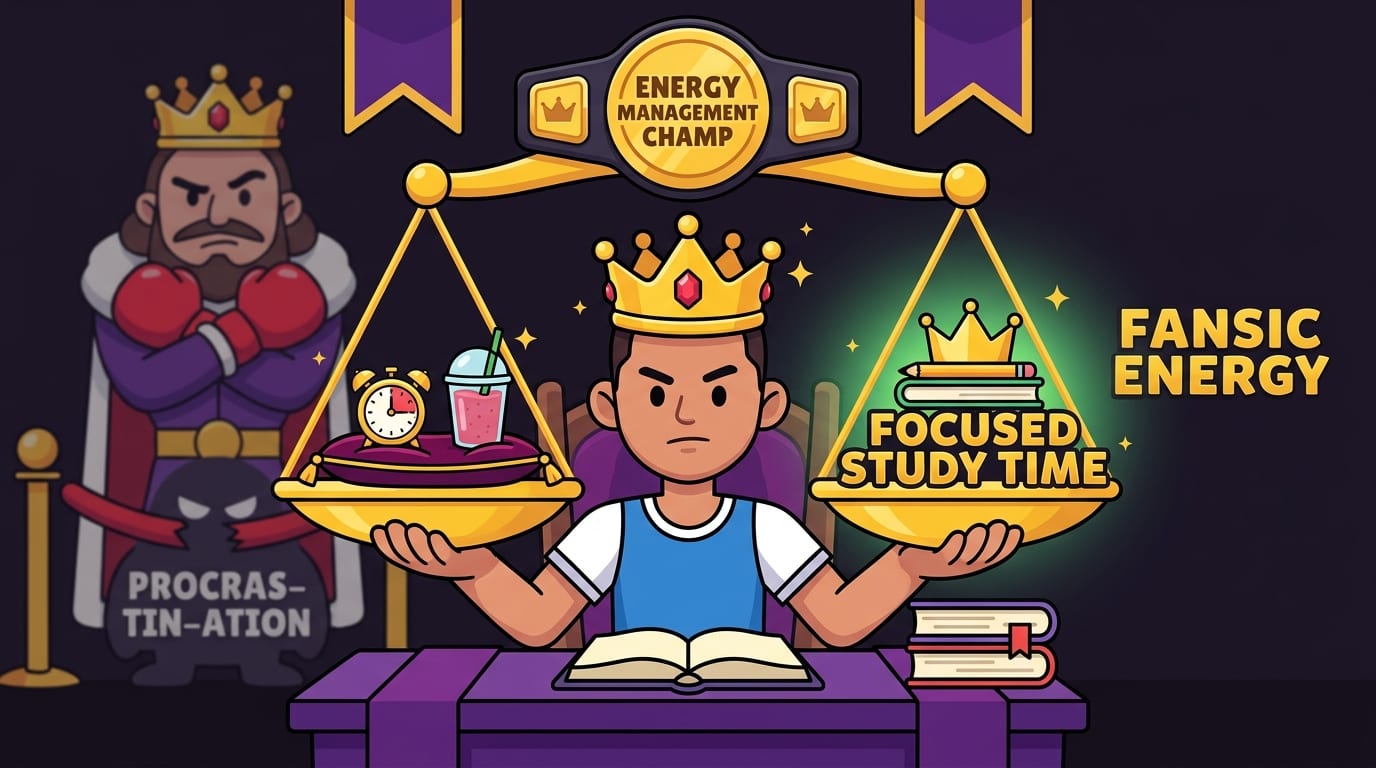
Manage Energy, Because Focus Is Not Just “Try Harder, Peasant”
Focus depends on energy. If you slept four hours, skipped breakfast, drank enough caffeine to communicate with satellites, and then expect yourself to calmly analyze literature, your brain may file a formal complaint.
To stay focused when studying, treat your body like part of the study system. Because it is. Your brain is not floating in a jar wearing tiny glasses. It lives in your body, and your body has opinions.
Sleep is the undefeated study hack
Sleep affects memory, attention, mood, and learning. The CDC’s sleep guidelines recommend that teenagers and adults get consistent, adequate sleep for health and functioning. Pulling an all-nighter may feel heroic, but it often leaves you slower, foggier, and more likely to make mistakes. Basically, your brain becomes a browser with 47 tabs open and one of them is playing music.
Protect sleep during exam season. Review earlier. Use spaced repetition. Stop pretending Future You enjoys being ambushed at 1:13 a.m. Future You is tired and holding a granola bar like a cry for help.
Food, hydration, and movement matter
You do not need a perfect nutrition plan. But studying for hours on only iced coffee and spite is not a long-term strategy. Try:
- Eating a real meal before long study blocks.
- Keeping water nearby.
- Choosing snacks with protein or fiber to avoid sugar crashes.
- Moving your body between sessions to reset energy.
Also, schedule demanding work when you are naturally most alert. Some people are morning hawks. Others are night goblins with excellent vocabulary. Work with your rhythm where possible.
Use Accountability Without Turning Your Life Into a Courtroom Drama
Accountability helps because it makes your intentions visible. But it should support you, not make you feel like you’re on trial for crimes against algebra.
Start small. Tell a friend, roommate, or classmate what you plan to study and when. Better yet, study together in a quiet “body doubling” session, where you each work on your own tasks while sharing the same focus window. No chatting every three minutes. No “quick break” that turns into ranking every snack in the vending machine. Just parallel work.
Try a study scoreboard
Track simple metrics:
- Number of focused study blocks completed.
- Practice questions attempted.
- Flashcards reviewed.
- Pages written.
- Distraction attempts resisted.
Tracking helps because it turns invisible effort into visible progress. This is one reason BlockChamp’s XP and reign system works so well for students. You earn XP for focus time, daily active blocking, and surviving blocked-site attempts. You can see your streak, your focus hours, your calendar, and your progress toward the next level. Suddenly, “I studied” becomes “I defended a 7-day reign and earned my crown.” Same work. Better story.
If you’re juggling school and a job, you may also like BlockChamp’s guide on balancing studying and work, which covers practical ways to protect your attention when your schedule is already doing circus tricks.
What to Do When You Still Get Distracted
You will get distracted sometimes. This does not mean the system failed. It means you are a human being with a nervous system, not a marble statue holding a textbook.
The key is to recover quickly. Don’t turn one distraction into a shame spiral. Shame is terrible fuel. It burns dirty and smells like regret.
Use the “notice, reset, resume” method
- Notice: “I’m distracted.” No drama. No self-roasting required. The King has that covered.
- Reset: Close the tab, put the phone away, stand up, take one breath.
- Resume: Return to the smallest next action: one question, one paragraph, one flashcard.
Do not restart the whole session. Do not wait for perfect motivation to return wearing a cape. Just resume. Momentum is built by returning, not by never slipping.
Make distractions harder next time
After a session, ask: “What pulled me away?” Then add a barrier:
- If YouTube got you, block YouTube during study hours.
- If your phone got you, move it farther away.
- If hunger got you, eat before studying.
- If the task felt overwhelming, break it smaller.
- If you kept turning focus mode off, use a stricter blocker setting.
BlockChamp’s Champion features are useful here because you can set recurring focus schedules and use Hardcore Lockdown. That means if you try to turn focus off during a weak moment, you may have to wait through a cooldown or complete The King’s boxing-riddle mini-game before surrendering. It’s funny, slightly ridiculous, and surprisingly effective because it creates just enough friction for the impulse to pass.

A Sample 2-Hour Study Routine You Can Steal Like a Noble Bandit
Here’s a practical routine you can use tonight. Adjust the times as needed, but keep the structure. Your kingdom, your crown, your slightly terrifying syllabus.
- 0:00–0:05 — Setup: Clear desk, put phone away, open materials, turn on BlockChamp, write your study target.
- 0:05–0:35 — Focus block 1: Active recall or practice problems. No passive rereading unless paired with questions.
- 0:35–0:40 — Break: Stand, stretch, drink water. Do not open the scroll portal.
- 0:40–1:10 — Focus block 2: Continue practice or teach-back. Mark weak spots.
- 1:10–1:20 — Longer break: Walk, snack, breathe, look at something that is not pixels.
- 1:20–1:50 — Focus block 3: Review mistakes and redo missed questions.
- 1:50–2:00 — Wrap-up: Summarize what you learned, write the next study target, celebrate one concrete win.
This routine works because it combines clear goals, focused intervals, active learning, breaks, and digital boundaries. It does not require you to become a different person. It just gives your current person better guardrails. Very royal. Very practical. Minimal goblin activity.
Final Crown Check: Focus Is a System, Not a Mood
To stay focused when studying, stop waiting to “feel focused.” Feelings are unreliable little weather balloons. Build a system instead.
Set a specific study target. Clean up your environment. Time-block your sessions. Use active recall and practice testing. Take breaks that actually refresh you. Protect your sleep and energy. Block the websites that keep stealing your attention like tiny digital raccoons. And when you slip, reset quickly instead of declaring the whole day ruined.
Most importantly, make focus easier than distraction. That’s the whole game. If Reddit, YouTube, TikTok, shopping tabs, and random news spirals are always one click away, your willpower has to fight a heavyweight match every five minutes. Put some armor on it.
If you study in Chrome and want a focus tool that doesn’t feel like a beige punishment box, try BlockChamp. You can block distracting sites and categories, earn XP for focused time, build your reign, survive The King’s Stare-Down, and gradually become the champion of not getting emotionally defeated by a notification.
Defend the throne. Crush the scroll. Finish the chapter. Long live your focus, champ.
Related posts

Finding Focus For Fiction Writing

Learning To Focus In A Digital World As A Creative

Finding Focus For Personal Growth
