
Reduce Stress At Work

Want to reduce stress at work without quitting your job, moving to a lighthouse, and communicating only with seagulls? Good news: you do not need a dramatic life montage. Most work stress is not caused by one giant flaming meteor. It is usually death by a thousand tiny pings: surprise meetings, vague priorities, Slack ambushes, tab overload, doomscroll “breaks,” and that one email that simply says “Thoughts?” like a cursed riddle from a productivity goblin.
The trick is not to eliminate every stressful thing. That would require becoming a houseplant. The real goal is to build a workday that gives your brain fewer fires to put out, more control over your attention, and actual recovery between bouts of effort. Stress drops when your workload becomes visible, your time has borders, and your focus stops getting body-slammed by TikTok, news, shopping tabs, and “quick” YouTube spirals that somehow end with a 47-minute video about medieval cheese.
This guide gives you practical strategies to reduce stress at work: quick routines, time-management techniques, boundary-setting tips, distraction defenses, and mindset shifts that help you stay calm and productive. Crown on. Inbox down. Let’s defend the kingdom.
Quick Answers
1. First, Know What Kind of Work Stress Is Punching You
Before you can reduce stress at work, you need to know what flavor of chaos you are dealing with. Stress is not one thing. It is a suspicious buffet. Some stress comes from too much work. Some comes from unclear expectations. Some comes from constant interruptions. Some comes from pretending you are “taking a break” while feeding your nervous system 19 tabs of breaking news and one argument thread written by strangers with cartoon avatars.
The American Psychological Association notes that work is a major source of stress for many adults, and chronic stress can affect mood, sleep, concentration, and physical health. Their workplace stress resources are a useful reminder that stress is not just “being dramatic.” Your body and brain respond to sustained pressure like it is a real threat, because biologically, it kind of is. Your nervous system did not evolve to distinguish between “a tiger is chasing me” and “Kyle moved the deadline up and used the phrase ‘circle back.’”
Start by identifying your top stress triggers. Use a simple three-column note for three workdays:
- Trigger: What happened? Example: “Boss asked for urgent deck changes at 4:42 p.m.”
- Reaction: What did you feel or do? Example: “Chest tight, opened Reddit, avoided it for 20 minutes.”
- Pattern: What does this reveal? Example: “End-of-day surprises make me spiral.”
After a few days, you will see patterns. Maybe meetings are devouring your deep work. Maybe unclear priorities are making everything feel urgent. Maybe digital distractions are not the root cause, but they are the royal trapdoor you fall through whenever discomfort appears. That matters. You do not fix meeting overload with meditation alone, and you do not fix distraction loops with another motivational wallpaper that says “grind.” Please, the crown deserves better.
Once you know the type of stress, you can choose the right tool. Workload stress needs prioritization. Interruption stress needs boundaries. Emotional stress needs decompression. Distraction stress needs environmental design. BlockChamp helps with that last category by letting you block distracting sites and categories in Chrome so your “stress break” does not become a two-hour scroll goblin festival. More on that shortly, champ.
2. Build a Two-Minute “Calm Down, Your Majesty” Reset
When stress spikes, your brain wants relief now. Not in 2027. Now. That is why you need a short reset routine that is so easy you will actually do it when your calendar looks like a waffle iron. The goal is not to become a serene mountain monk who levitates above quarterly planning. The goal is to lower your physiological arousal enough to make a smarter next move.
Try this two-minute reset:
- Exhale longer than you inhale. Breathe in for four counts, out for six to eight counts. Repeat five times.
- Unclench the weird places. Jaw, shoulders, hands, forehead. Yes, your forehead. It has been doing pushups.
- Name the next action. Say or write: “The next physical action is…” Example: “Open the client doc and review comments.”
- Remove one distraction. Close one tab, silence one notification, or block one tempting website.
This works because stress often turns work into a giant fog monster. Naming the next action slices the monster into something punchable. Research from the National Institute for Occupational Safety and Health highlights that job stress is linked to factors like workload, lack of control, and unclear expectations; their workplace stress overview is worth reading if you want the non-goblin version of the science. A reset gives you a small sense of control, which is a major stress reducer.
Make this routine visible. Put it on a sticky note. Add it to your desktop wallpaper. Tattoo it on your coffee mug emotionally, if not legally. The best stress-reduction strategies are the ones you can use in the ugly moments: after a tense call, before a big presentation, or when you realize you have been staring at the same spreadsheet cell like it owes you money.
3. Time Block Like a Tiny, Sensible Dictator
One of the fastest ways to reduce stress at work is to stop treating your calendar like a junk drawer. If your day is just a loose pile of tasks, every task competes for attention at the same time. Your brain hates that. It starts screaming, “Everything is urgent!” and then you spend 30 minutes reorganizing your desktop icons because apparently that is “preparation.”
Time blocking means assigning specific work to specific blocks of time. It does not need to be fancy. You are not carving royal decrees into marble. You are giving your day a skeleton.
Here is a simple structure:
- Deep work blocks: 60–120 minutes for demanding work like writing, analysis, coding, studying, planning, or creative tasks.
- Admin blocks: 20–45 minutes for email, messages, scheduling, expenses, and tiny task confetti.
- Meeting buffers: 10–15 minutes after meetings to capture decisions and next steps.
- Recovery blocks: 5–15 minutes for walking, stretching, breathing, or staring out a window like a Victorian poet with Wi-Fi.
Do not make the rookie mistake of time blocking every minute. That creates a calendar so tight it squeaks. Leave white space. Stress increases when reality collides with fantasy scheduling. If a task usually takes 45 minutes, block 60. If a meeting might run over, protect a buffer. The point is not to win a productivity pageant; it is to build a day that can survive contact with humans.
If you work remotely or hybrid, time blocking becomes even more important because home and work boundaries blur into one suspicious soup. For more help staying steady outside a traditional office, check out these practical tips for staying motivated in hybrid work. Hybrid work is powerful, but without structure, your kitchen becomes your break room, conference room, snack kingdom, and existential crisis chamber.
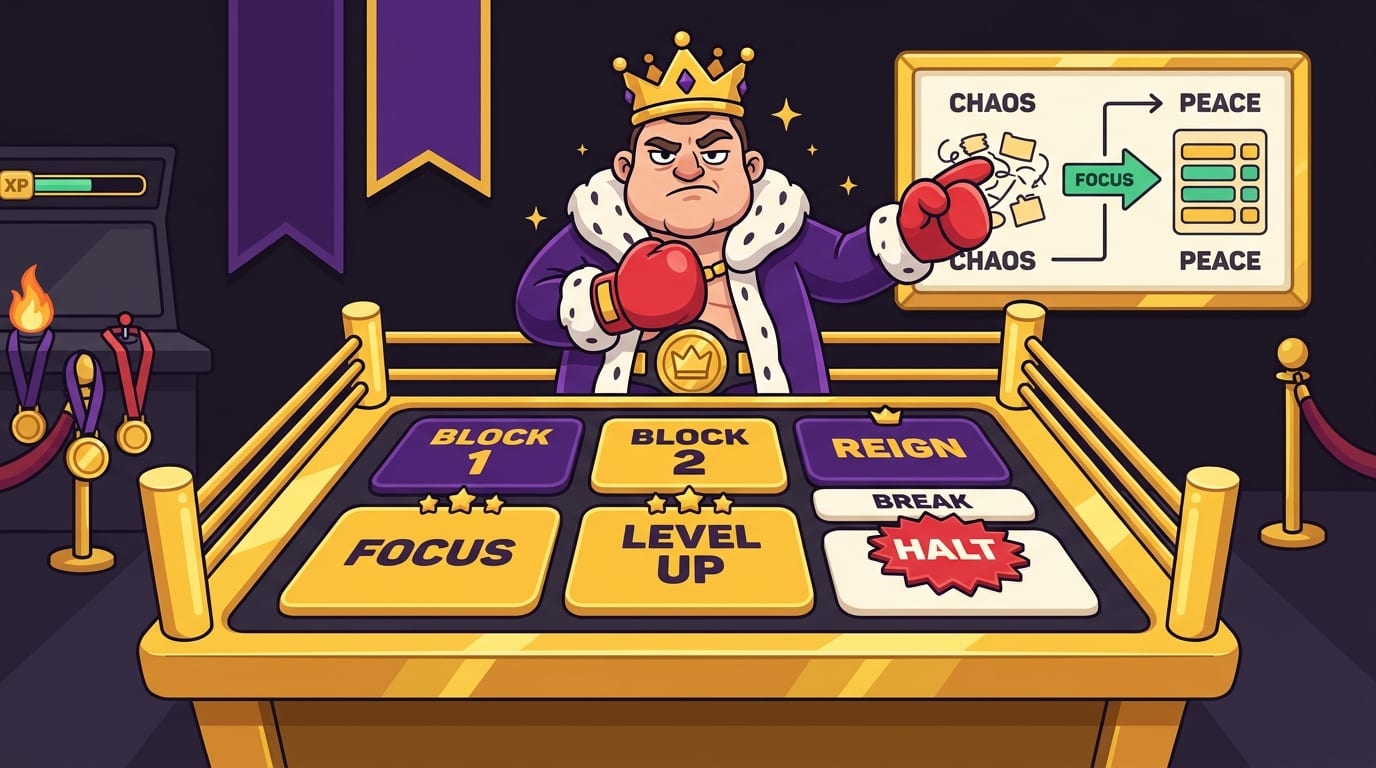
Pair your deep work blocks with distraction blocking. In BlockChamp, you can switch on the Master Focus Toggle so distracting sites are guarded while you work. Champion users can set a recurring Focus Schedule, such as Monday to Friday from 9 a.m. to noon, which means The King automatically stands guard during prime focus hours. Less decision-making. Fewer “just checking” detours. More calm. Long live the schedule.
4. Reduce Notification Stress Before It Becomes a Ping Circus
Notifications feel small, but they are tiny attention assassins wearing tap shoes. Every ping forces your brain to decide: “Is this important? Should I respond? What was I doing? Why am I now looking at a meme about raccoons?” Even if you do not reply, the interruption taxes your focus.
Microsoft’s research has shown that heavy digital communication and meeting overload can contribute to productivity strain; their Work Trend Index regularly explores how modern work patterns affect attention and wellbeing. Translation: your inbox is not “just part of the job.” It is a firehose, and someone put glitter in it.
Try a notification diet:
- Turn off non-essential desktop notifications.
- Check email at set times instead of constantly.
- Use “Do Not Disturb” during deep work blocks.
- Mute channels where you are not directly responsible.
- Create a visible status like “Focusing until 11:30; call if urgent.”
The magic phrase is response windows. Instead of being available every second, you choose windows for communication. Example: email at 10:30 a.m., 1:30 p.m., and 4:30 p.m. Messages after 5 p.m. wait unless truly urgent. This protects your nervous system from living in permanent “incoming threat” mode.
But be realistic. If your job requires quick responses, do not vanish like a productivity ninja in smoke. Start small: one 45-minute notification-free block per day. Tell your team. Deliver good work. Build trust. Boundaries work better when people see that you are not avoiding work; you are protecting the part of work that requires an actual brain.
Also block your own stress-trigger sites during focus windows. News, social media, shopping, and video platforms often pretend to be “breaks,” but many increase agitation. BlockChamp’s category blocking is useful here: Social Media, Video & Streaming, News, Shopping, Gaming, Gambling, Adult, and AI Distractions can be toggled as bundles. Instead of playing whack-a-tab with 30 websites, you can lock the whole distraction dungeon.
5. Use the “Top Three” Rule to Stop Drowning in Tasks
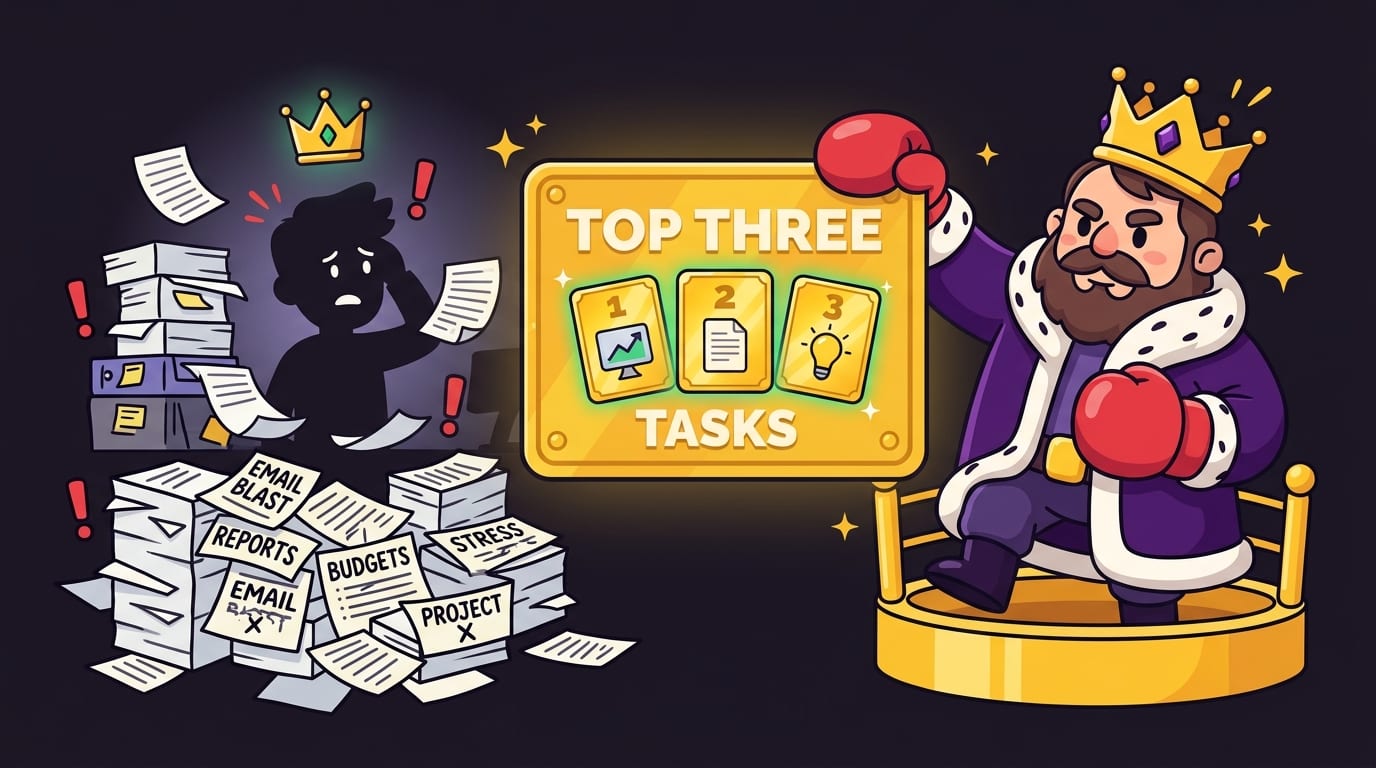
A giant to-do list can make even a normal workload feel like being attacked by paperwork bees. The brain sees 37 tasks and translates that into “we are doomed.” To reduce stress at work, shrink the battlefield. Pick your top three outcomes for the day.
Not 12. Not “everything.” Three.
Ask each morning:
- What three results would make today successful?
- Which task reduces the most future stress?
- Which deadline or dependency matters most?
- What can be delegated, delayed, deleted, or done at “good enough” quality?
The top three rule works because it separates important work from noisy work. A task can be loud without being valuable. Email is loud. Chat is loud. Random “quick questions” are loud. But the quiet task you keep avoiding may be the one that actually lowers stress: finishing the proposal, sending the decision memo, preparing the presentation, or clarifying the project scope before it becomes a flaming carriage pulled by panic horses.
Here is a simple daily planning template:
- Today’s top three: The three outcomes that matter most.
- One scary task: The task you are avoiding because it has teeth.
- One admin batch: A time window for small tasks.
- One recovery moment: A walk, lunch away from screen, or proper break.
If you are studying while working, juggling school, or generally attempting to be three adults in a trench coat, prioritization becomes survival gear. You may find this guide to balancing studying and work helpful for managing competing responsibilities without turning your brain into soup.
Bonus move: choose your top three before opening email. Email is where other people’s priorities dress up as emergencies and invade your throne room. Check your plan first. Then enter the inbox arena with your crown secured.
6. Take Real Breaks, Not Fake Breaks Wearing a Mustache
Fake breaks are sneaky. You tell yourself, “I need a break,” then open social media, absorb 15 opinions, compare your life to strangers, read bad news, and return to work somehow more tired. That is not recovery. That is feeding your brain a stress burrito.
Real breaks shift your state. They help your nervous system downshift, restore attention, or release tension. The World Health Organization recognizes burnout as an occupational phenomenon resulting from chronic workplace stress that has not been successfully managed; their burnout definition highlights exhaustion, mental distance from work, and reduced professional efficacy. Translation: if you never recover, your brain eventually files a formal complaint.
Better break options:
- Walk outside for five to ten minutes.
- Stretch your hips, neck, and wrists.
- Drink water without also reading email like a stressed raccoon.
- Do a short breathing routine.
- Look at something far away to relax your eyes.
- Chat with a coworker about something non-work, ideally not “the collapse of everything.”
A good rhythm is 50–90 minutes of focused work followed by 5–15 minutes of recovery. Pomodoro-style cycles can help, but do not treat the timer like a prison guard. If you are in deep flow, you can keep going. If you are fried, stop earlier. Productivity advice should serve your brain, not cosplay as a tiny tyrant.
If screen time itself is part of your stress, read how to reduce screen time without making it miserable. The key is not “never use the internet again.” The key is designing breaks that actually refresh you instead of dragging you into the algorithm swamp by the ankles.
BlockChamp can help make breaks cleaner by blocking the sites that turn five minutes into fifty. If YouTube, Reddit, X, TikTok, or news sites are your “break” traps, put them behind The King’s Stare-Down during work hours. When you try to wander in, The King catches you, displays the site you tried to visit, and politely-but-not-really sends you back to work. It is like having a bouncer for your attention, except shorter, royal, and wearing boxing gloves.
7. Set Boundaries Without Sounding Like a Corporate Fortress
Boundaries are one of the most effective ways to reduce stress at work, but people avoid them because they fear sounding rude, lazy, or difficult. Good news: boundaries do not need to be dramatic. You do not need to slam a goblet on the conference table and declare, “My kingdom rejects this request!” Though honestly, tempting.
A boundary is simply a clear expectation about time, availability, scope, or priority. The best boundaries are calm, specific, and paired with an alternative.
Use scripts like:
- “I can take this on, but I’ll need to move the report to tomorrow. Which is higher priority?”
- “I’m in focus time until 11:30. If it’s urgent, please call; otherwise I’ll respond after.”
- “To hit Friday’s deadline, I’ll need final feedback by Wednesday at noon.”
- “I’m at capacity this week. I can help for 30 minutes, or we can schedule more time next week.”
- “I don’t want to give you a rushed answer. I’ll review and reply by 3 p.m.”
Notice the pattern: you are not saying “no” like a slammed castle gate. You are clarifying tradeoffs. This is professional, not rebellious. In fact, managers often appreciate it because invisible overload becomes visible. If everything is priority one, nothing is priority one. That is not leadership; that is a smoothie made of panic.
Boundaries also apply to yourself. Stop letting future-you pay for present-you’s chaos. If you promise to stop work at 6 p.m., create a shutdown ritual at 5:45. If you keep checking messages at night, remove work apps from your phone or at least disable notifications. If you keep “just checking” distracting sites during hard tasks, block them before the task starts. Your willpower is not weak; your environment is just booby-trapped.
Remote workers may also benefit from social accountability. A virtual coworking session can make focus feel less lonely and reduce the stress of self-managing all day. If that sounds useful, here is a guide to using virtual co-working to stay focused without needing an office or a suspiciously expensive latte.
8. Make Your Workspace Less Like a Digital Junk Drawer
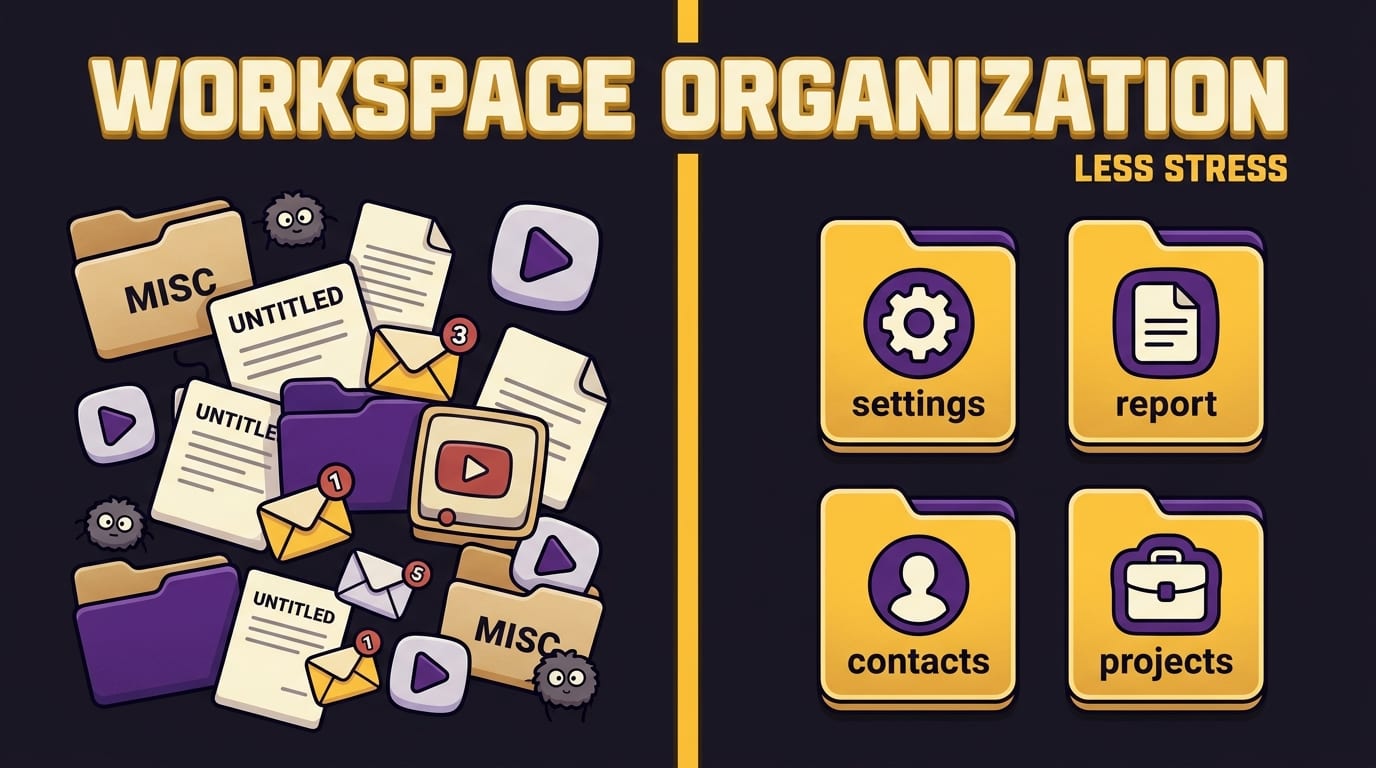
Your environment constantly tells your brain what to do. If your browser has 42 tabs open, your desk is covered in ancient receipts, and your phone is face-up glowing like a cursed jewel, your brain receives one message: “Panic buffet is open.”
To reduce workplace stress, lower visual and digital noise. You do not need a minimalist desk with one bonsai tree and a notebook made of artisanal moon paper. Just remove enough clutter that your attention has room to breathe.
Clean your physical zone
- Keep only the tools needed for the current task within reach.
- Put your phone out of sight during deep work.
- Use one notebook or capture app for stray thoughts.
- Reset your desk at the end of the day for two minutes.
Clean your digital zone
- Close tabs unrelated to the task.
- Use separate browser windows for different projects.
- Turn off badge counts where possible.
- Unsubscribe from newsletters you never read but emotionally carry.
- Block high-temptation sites during work blocks.
Browser clutter is especially dangerous because it looks like work. You can have a project doc, analytics dashboard, inbox, calendar, Slack, three articles, two shopping carts, and a video open “for later.” That is not a workspace; that is a carnival with spreadsheets.
This is where a tool like BlockChamp fits naturally. It is a gamified website blocker for Chrome that helps you defend your attention without making focus feel like punishment. You can block specific sites, use category bundles, and earn XP for staying focused. Every focused day builds your reign. Every blocked-site attempt becomes a Stare-Down from The King. It adds just enough friction and humor to interrupt the automatic habit loop. Instead of shame, you get a royal roast and a chance to choose better. Honestly, HR could never.
9. Change the Stress Story: From “I’m Behind” to “I’m Choosing the Next Move”
Mindset will not magically fix an overloaded workload. Let’s not sprinkle glitter on a dumpster and call it wellness. But the story you tell yourself during pressure does affect how much stress you feel and how effectively you respond.
Common stress stories include:
- “I’m so behind.”
- “I can’t handle this.”
- “Everything is urgent.”
- “If I don’t reply immediately, people will be mad.”
- “I need to finish everything today.”
These thoughts may feel true, but they are often too broad to be useful. Swap them for action-oriented versions:
- “I am choosing the next most important task.”
- “I can reduce this by one step.”
- “I need to clarify what is truly urgent.”
- “I can respond during my next communication window.”
- “I will finish the highest-impact work today and renegotiate the rest.”
This is not toxic positivity. It is tactical language. Your brain behaves differently when it sees a next move instead of a giant doom cloud. Cognitive reframing is a well-established stress-management technique, and organizations like the Mayo Clinic explain how shifting self-talk can influence stress and coping. Again, not magic. More like giving your brain a map instead of handing it a kazoo and hoping for the best.
Try ending each workday with a tiny “closure note”:
- What did I finish?
- What is the next step for tomorrow?
- What can wait?
- What am I officially releasing for the evening?
This helps prevent open loops from following you home and sitting on your couch like unpaid interns. The workday needs a closing ceremony. Not a coronation, necessarily. Though if you want to whisper “the throne rests,” we support your journey.
10. Create a Personal Anti-Stress Work System
Individual tips are helpful, but systems are what save you when motivation leaves town wearing sunglasses. Build a repeatable work system that reduces decisions, protects focus, and gives stress fewer entry points.
Here is a simple anti-stress work system you can start tomorrow:
- Morning setup: Choose your top three outcomes before opening email.
- Focus defense: Turn on Do Not Disturb and BlockChamp for your first deep work block.
- Communication windows: Check messages at planned times unless your role requires emergency availability.
- Break rhythm: Take real recovery breaks every 60–90 minutes.
- Boundary check: Clarify tradeoffs when new work appears.
- Shutdown ritual: Write tomorrow’s next action and close the workday deliberately.
Do this imperfectly. Seriously. The goal is consistency, not productivity cosplay. If you fall into a scroll hole, recover. If your day gets hijacked, reset. If The King catches you trying to open YouTube during spreadsheet time, accept the roast, close the tab, and return to the throne. Every recovered moment counts.
BlockChamp’s gamification helps here because progress becomes visible. You earn XP for focus time, gain levels, unlock badges, and build reigns. That matters because stress reduction can feel invisible. You may not notice “I avoided 12 distractions today,” but your dashboard can. Seeing progress gives your brain evidence that your system is working, which makes it easier to stick with the habits. The crown likes receipts.
Conclusion: Less Panic, More Crown
To reduce stress at work, you do not need to become a productivity robot with a laminated morning routine and suspiciously perfect handwriting. You need a calmer system: know your triggers, reset your body, time block your day, tame notifications, choose your top three, take real breaks, set clear boundaries, clean up your environment, and speak to yourself like a capable human instead of a panicked court jester.
Stress shrinks when your attention has protection and your work has shape. Start with one change today. Block one distraction. Schedule one focus block. Take one real break. Send one boundary-setting message. Tiny moves compound. That is how reigns are built.
And if the internet keeps tackling your focus in the hallway, bring in backup. BlockChamp helps you knock out distracting websites on Chrome with category blocking, XP, badges, streaks, and The King’s glorious Stare-Down when you try to betray your own calendar. It is focus protection with personality. Less gray guilt box. More royal boxing coach.
Defend the throne. Crush the scroll. Become king of your time, champ.
Related posts

Finding Focus For Fiction Writing

Learning To Focus In A Digital World As A Creative

Finding Focus For Personal Growth
