
Increase Productivity Studying

If you want to increase productivity studying, here is the uncomfortable truth: your problem probably is not that you are “bad at studying.” Your problem is that your brain is trying to learn calculus while TikTok is tap dancing on the table, YouTube is waving nachos, and your group chat is screaming like a medieval village under goose attack.
Studying productively is not about becoming a flawless academic monk who wakes at 4:12 a.m. and drinks plain air for breakfast. It is about building a system that makes the right thing easier and the wrong thing slightly annoying. That is the whole game. Protect your focus, use your energy wisely, review what matters, and stop letting the internet steal your crown one “quick check” at a time.
This guide gives you practical, proven ways to study smarter: time-blocking, focused study sessions, environment tweaks, habit-building, active recall, spaced repetition, distraction blocking, and a few tiny psychological tricks that make your future self less likely to betray you. Long live your focus. Let’s get the royal brain engine humming.
Quick Answers
1. Start With a Study Plan That Does Not Look Like a Fantasy Novel
A huge reason students struggle to increase productivity studying is that their plan is basically: “Study everything. Somehow. Before Friday. Panic included.” That is not a plan. That is a weather event.
A useful study plan tells you three things:
- What you will study
- When you will study it
- How you will know you are done
Vague goals like “study biology” are mushy little goblins. They sound responsible, but they do not guide your behavior. A stronger version is: “From 4:00 to 5:00, review Chapter 7 cell respiration notes, make 20 flashcards, and answer 10 practice questions.” Now your brain has marching orders. Tiny royal trumpets. Very official.
Before each week begins, create a simple study map. List every subject, exam, assignment, and deadline. Then rank tasks by urgency and difficulty. Your hardest or highest-stakes work should get your best energy, not the leftover fumes after you have watched 37 videos about raccoons stealing pizza.
Try this weekly planning flow:
- Write down all upcoming exams, quizzes, papers, labs, and readings.
- Break big tasks into smaller actions, such as “outline essay,” “review lecture 3,” or “do practice set 2.”
- Estimate how long each action will take, then add 25% because humans are bad at time math.
- Assign each task to a specific day and time block.
- Leave buffer space for surprises, confusion, and the occasional existential staring contest with your textbook.
If you want a deeper dive into staying on track while studying, BlockChamp already has a helpful guide on how to stay focused studying. Pair that with the planning method above and you will stop treating your study schedule like a haunted treasure map.
2. Use Time-Blocking: Put Your Study Sessions on the Throne
Time-blocking is one of the most effective ways to increase productivity studying because it removes daily decision fatigue. Instead of asking “Should I study now?” twelve times a day, you decide once in advance. Your calendar becomes the boss. A tiny rectangular monarch.
Time-blocking means assigning specific chunks of time to specific activities. Not just “study tonight,” but “7:00–7:45 p.m. chemistry practice problems” and “8:00–8:30 p.m. flashcard review.” The more specific the block, the less room your brain has to negotiate with the goblin council of procrastination.
According to Todoist’s guide to time-blocking, scheduling tasks into dedicated blocks can reduce context switching and make your day feel more intentional. That matters for students because switching between tasks, tabs, apps, and subjects can quietly drain your attention like a leaky brain faucet.
How to time-block for studying without becoming a calendar gremlin
Start with 2–4 study blocks per day, depending on your workload. Most students do better with focused blocks than giant “study all day” marathons. A three-hour block can work, but only if it has structure. Otherwise it becomes 30 minutes of work, 40 minutes of snack analysis, and 110 minutes of tab-based shame.
Here is a simple evening study schedule:
- 4:00–4:45: Math practice problems
- 4:45–5:00: Break
- 5:00–5:40: Biology active recall
- 5:40–6:10: Dinner, walk, reset
- 6:10–6:45: History essay outline
- 6:45–7:00: Review what you completed and plan tomorrow
The secret is to put breaks in the plan. Breaks are not failure. They are maintenance. Even race cars pit. Even kings nap. Even The King from BlockChamp occasionally stops roasting peasants to polish his crown.
If you use BlockChamp, this is where the magic gets satisfyingly bonk-shaped. You can turn on the Master Focus Toggle before your study block, block your biggest distraction sites, and let The King stand guard while you work. Pro users can even use Focus Schedule to automatically activate blocks during recurring study hours. When should the King stand guard? Ideally before your brain opens Reddit “for research.”
3. Study in Focused Sprints, Not Academic Mud Wrestling
Focused study sessions work because attention is not infinite. It is more like a battery, except the battery is dramatic and keeps asking for Instagram.
The Pomodoro Technique is the classic version: study for 25 minutes, take a 5-minute break, repeat. After four rounds, take a longer break. It is simple, which is why it works. You are not promising to be a productivity machine forever. You are promising to focus for one short sprint. Tiny commitment. Big payoff.
Research on attention and breaks suggests that brief diversions can help maintain performance over time. One study discussed by the American Psychological Association found that short breaks may help people stay focused on long tasks. Translation: breaks are not the enemy. Unplanned doomscrolling disguised as a break is the enemy. Different beast. Worse smell.
Pick the sprint length that matches the task
Not every subject needs the same session length. Use different focus blocks for different kinds of work:
- 25 minutes: flashcards, vocabulary, quick review, light reading
- 45 minutes: problem sets, essay drafting, lecture note review
- 60–90 minutes: deep work, past papers, complex writing, coding projects
During each sprint, define one target. Not five. One. “Finish 15 practice problems.” “Summarize two lecture sections.” “Write the introduction paragraph.” This gives your brain a finish line to punch through.
When the timer ends, take a real break. Stand up. Drink water. Stretch. Look at something farther away than your screen so your eyeballs stop filing complaints. Avoid opening apps designed to trap you, because a five-minute TikTok break is how time enters a wormhole and returns wearing sunglasses.
If you want more motivation tactics for long study sessions, check out BlockChamp’s post on staying focused and motivated while studying. Motivation is easier when your sessions are small enough to start and structured enough to finish.

4. Remove Digital Distractions Before They Put You in a Headlock
You cannot increase productivity studying while constantly fighting apps that are literally engineered to hijack your attention. That is not weakness. That is design. Social platforms, video sites, news feeds, shopping apps, and algorithmic content machines are built to keep you clicking. Your willpower is brave, but it is not a reinforced castle gate.
According to the American Psychological Association, chronic stress can affect concentration and memory. Constant digital interruptions pile onto that mental load. Even when you do not fully switch tasks, notifications can create a “what was that?” moment that fractures your focus.
Studies on multitasking also show that switching between tasks can hurt performance. The APA’s research summary on multitasking explains that task switching has cognitive costs, especially when tasks are complex or unfamiliar. Studying is usually both. Your brain does not need 14 browser tabs staging a circus.
Build a distraction defense system
Before each study block, do a two-minute distraction sweep:
- Put your phone across the room, in another room, or inside a drawer like a cursed artifact.
- Turn on Do Not Disturb.
- Close unrelated tabs.
- Log out of social media on your study browser.
- Use a website blocker to block your usual traps.
This is where BlockChamp becomes less “nice productivity tool” and more “royal bouncer with boxing gloves.” You can block specific sites like YouTube, Reddit, TikTok, X/Twitter, or Instagram. You can also use category blocking for Social Media, Video & Streaming, News, Shopping, Gaming, Gambling, Adult, and AI Distractions. Free users can block up to 3 sites and enable 2 categories, which is plenty to knock out the biggest villains in your study kingdom.
And when you try to visit a blocked site? You do not get a sad gray error page. You get The Stare-Down: The King judges you full-screen, shows the site you tried to enter, and sends you back to work. Every stare-down survived earns XP. It is productivity with a tiny roast. Honestly, academia needed this.
For students who keep turning blockers off “just for one second,” BlockChamp’s Champion plan includes Hardcore Lockdown. You can set a cooldown timer or use the boxing riddle, where you must repeat The King’s punch combos before surrendering focus. That 30–60 second delay is often enough for the impulse to pass. The scroll goblin hates friction. Good.
5. Fix Your Study Environment: Your Desk Is Either a Launchpad or a Swamp
Your environment quietly shapes your behavior. If your study space is cluttered, noisy, snack-sticky, and full of tempting devices, you are basically asking your brain to study inside a carnival cannon.
A productive study environment does not need to look like a minimalist influencer cave. It needs to reduce friction and support the type of work you are doing. You want fewer decisions, fewer distractions, and fewer reasons to wander off and reorganize your sock drawer “as a warm-up.”
The royal study setup checklist
- Clear your surface: Keep only the materials you need for the current session.
- Control noise: Use earplugs, noise-canceling headphones, instrumental music, or white noise.
- Improve lighting: Bright, comfortable lighting reduces eye strain and sleepiness.
- Keep water nearby: Hydration is boring advice because it works. Annoying, but true.
- Use a consistent spot: Studying in the same place can cue your brain that it is focus time.
The goal is to create a “study mode” that begins before you even open the book. Same desk. Same playlist. Same timer. Same browser blocker. Same notebook. These cues reduce the activation energy required to start.
If your home is chaotic, use environment rotation. Go to the library for reading-heavy tasks, a quiet café for outlining, and a campus study room for group review. Match the place to the work. Do not try to memorize anatomy while your roommate hosts a loud debate about whether cereal is soup. That battle is unwinnable.
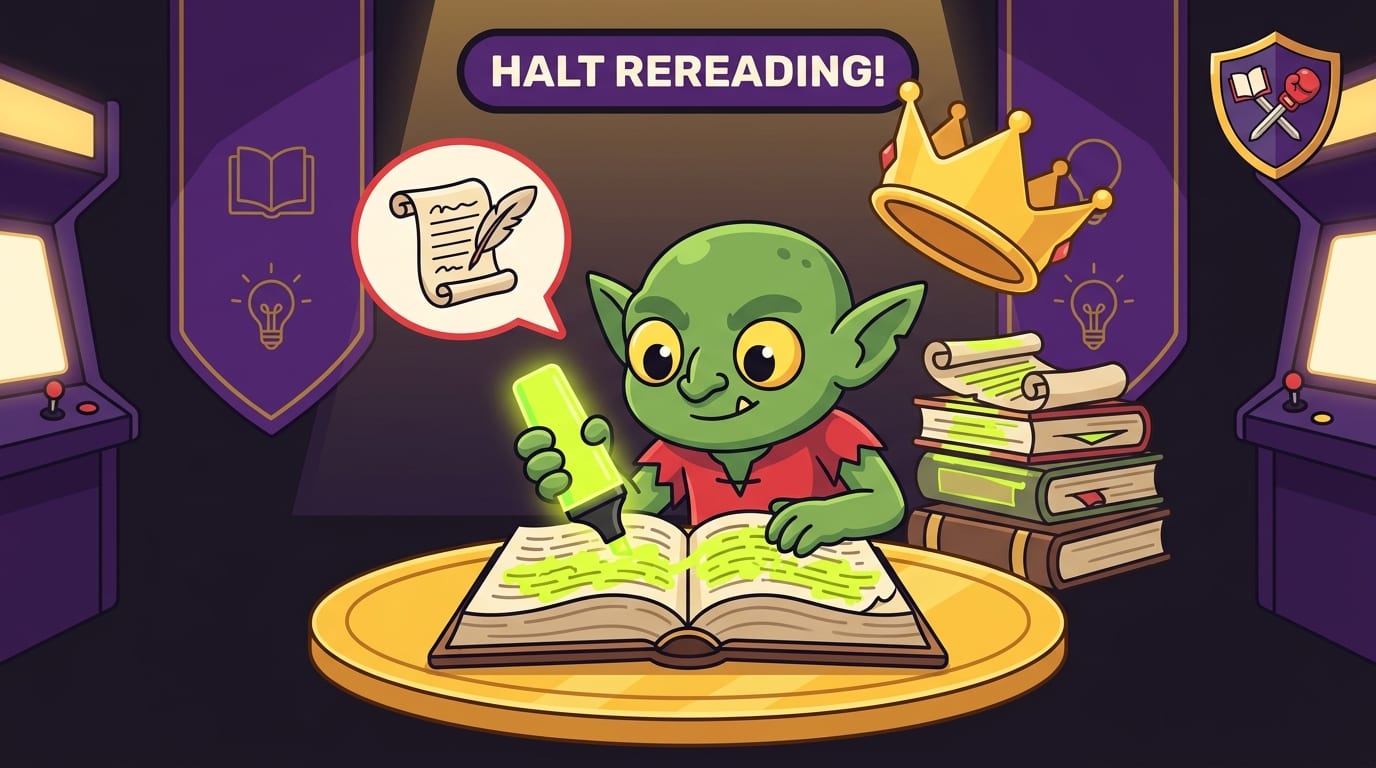
6. Use Active Recall: Stop Rereading Like a Fancy Highlighter Goblin
Rereading notes feels productive because your eyes are moving and the page looks familiar. But familiarity is sneaky. It can trick you into thinking you know the material when you only recognize it. Then the exam arrives, asks one slightly twisted question, and your brain leaves the kingdom.
Active recall is the practice of pulling information from memory without looking at the answer first. It is harder than rereading, but that difficulty is the point. You strengthen retrieval by practicing retrieval.
A major review published in Psychological Science in the Public Interest found that practice testing and distributed practice are among the most effective learning techniques. In normal human language: quiz yourself and spread study out over time. The crown approves.
Easy active recall methods
- Blank page method: Close your notes and write everything you remember about a topic. Then compare and fill gaps.
- Flashcards: Use question-answer cards, not giant paragraphs wearing flashcard costumes.
- Practice questions: Do textbook problems, past exam questions, or self-made quizzes.
- Teach it out loud: Explain the concept as if teaching a confused friend, rubber duck, or judgmental houseplant.
- Brain dumps: Before reviewing, list formulas, dates, definitions, or processes from memory.
For example, if you are studying psychology, do not just reread the definition of classical conditioning. Cover the page and ask: “What are the parts of classical conditioning? Can I create a real example? How is it different from operant conditioning?” The more ways you retrieve and use the concept, the stronger it becomes.
Active recall is not glamorous. It is not covered in glitter. But it works. Rereading says, “This looks familiar.” Active recall says, “Can you summon this knowledge in battle?” Exams are battle. Bring armor.
7. Use Spaced Repetition: Cramming Is a Gremlin With a Deadline
Cramming can sometimes help you survive tomorrow’s quiz, but it is terrible for long-term retention. It is the academic equivalent of duct-taping your car right before a road trip. Bold. Not wise.
Spaced repetition means reviewing information at increasing intervals over time. Instead of studying a topic once for three hours, you review it several times: today, tomorrow, three days later, a week later, and again before the exam. Each review strengthens memory right as it starts to fade.
The science behind this is called the spacing effect. A helpful overview from The Learning Scientists explains how spacing practice improves learning compared with massed practice. Basically, your brain remembers better when it has to retrieve information after a delay. Memory likes a challenge. Dramatic little organ.
A simple spaced repetition schedule
Use this review pattern for each new topic:
- Day 0: Learn the material and make recall questions.
- Day 1: Review using flashcards or practice questions.
- Day 3: Test yourself again and mark weak spots.
- Day 7: Do mixed review with older topics.
- Day 14: Complete practice questions under timed conditions.
You can use a flashcard app, spreadsheet, paper notebook, or calendar reminders. The tool matters less than the habit. Make every study session include two parts: new material and review. New material builds the castle. Review keeps invaders from walking through the front gate wearing a fake mustache.
If you track your study time, you can also identify which subjects need more spaced review. BlockChamp has posts about productivity tracking, including how using a time tracker can increase your productivity, which pairs nicely with studying because what gets measured stops hiding in the bushes.
8. Build Study Habits That Survive Low-Motivation Days
Motivation is lovely when it shows up, but it is a flaky little jester. If your study system depends on feeling inspired, your GPA is riding a unicycle across a moat.
Habits are stronger than motivation because they reduce the need for decision-making. The goal is to make studying feel like a normal part of your day rather than a dramatic personal negotiation every time.
Use habit stacking
Habit stacking means attaching a new habit to an existing one. For example:
- After I eat breakfast, I will review flashcards for 10 minutes.
- After my last class, I will go directly to the library for one study sprint.
- After dinner, I will plan tomorrow’s top three study tasks.
- After I open my laptop, I will turn on BlockChamp before opening any study materials.
The formula is simple: “After I do X, I will do Y.” This works because the existing habit becomes the trigger. No motivational thunderstorm required.
Make the starting line ridiculously easy
If you struggle to begin, lower the entry point. Promise yourself only five minutes. Open the document. Write one sentence. Do one flashcard. Solve one problem. Starting is often the hardest part because your brain imagines the entire mountain. Show it one pebble.
Once you start, momentum usually kicks in. If it does not, fine. You still kept the habit alive. Consistency beats heroic chaos. A 20-minute daily review session over two weeks usually beats one frantic six-hour cram session powered by fear and vending machine cookies.
BlockChamp helps here because it rewards consistency, not perfection. Every minute of focus earns XP. Every focused day builds your reign. Every blocked-site temptation resisted becomes a little victory. That matters because students do not just need discipline; they need feedback that says, “Yes, champ, this is working. Keep going.”
9. Review Like a Champion: Weekly Reset, Exam Prep, and Mistake Logs
Studying more is not always the answer. Studying better is. A strong review system helps you find weak areas before the exam finds them for you with a tiny villain mustache.
Set aside 30–45 minutes once a week for a study reset. This is not a full study session. It is a command meeting with your academic kingdom.
Your weekly review checklist
- What assignments are due next week?
- Which exams or quizzes are coming up?
- Which topics felt confusing this week?
- Which tasks did you avoid, and why?
- Which study methods actually worked?
- What will you time-block for next week?
For problem-based subjects like math, chemistry, economics, accounting, physics, or coding, create a mistake log. Every time you miss a question, record:
- The topic
- The question type
- What mistake you made
- The correct method
- A similar practice question to try later
This turns mistakes into data. No shame goblin. Just strategy. If you keep missing questions because you misread wording, your fix is different from someone who forgets formulas. If you keep running out of time, you need timed practice. If you understand concepts but blank on definitions, you need more retrieval practice.
For essay subjects, review feedback from teachers or professors. Look for patterns: unclear thesis, weak evidence, poor structure, grammar issues, shallow analysis. Then practice the exact skill. Do not just “write more.” Write smarter. The throne demands specificity.
10. Protect Energy: Sleep, Movement, Food, and the Non-Negotiable Human Stuff
You cannot productivity-hack your way out of being a biological creature. Rude, but true. Sleep, food, movement, and stress management directly affect learning. Your brain is not a laptop. You cannot plug it into panic and expect premium output.
The CDC recommends that teenagers and adults get adequate sleep, with most adults needing at least 7 hours per night and teens needing more. Sleep helps consolidate memory, regulate mood, and keep your attention from collapsing like a folding chair at a wrestling match.
Movement also helps. You do not need to become a gym goblin. A 10-minute walk between study blocks can refresh your attention, reduce stress, and stop your body from turning into desk-shaped furniture.
Energy rules for better studying
- Do your hardest studying when your energy is highest.
- Take short movement breaks between focus sessions.
- Eat something with protein and fiber before long sessions.
- Avoid starting intense work at midnight unless your deadline has a sword.
- Stop pretending four hours of sleep plus caffeine is a personality.
Productive studying is not just what happens during the study block. It is the system around it. Sleep gives memory a place to settle. Food gives your brain fuel. Movement clears mental fog. Breaks keep your focus from turning into soup.
11. A Practical 7-Day Plan to Increase Productivity Studying
Enough theory. Let’s put the crown on the calendar. Here is a simple 7-day plan you can start this week.
Day 1: Audit your distractions
Write down your top five study distractions. Be honest. YouTube? TikTok? Reddit? Group chats? “Research” that somehow becomes shopping for lamps? Add your biggest websites to BlockChamp and enable relevant categories like Social Media or Video & Streaming.
Day 2: Create your weekly study map
List all assignments, exams, and readings. Break them into specific tasks. Time-block your top priorities. Keep blocks realistic. You are a student, not a productivity forklift.
Day 3: Run three focused sprints
Pick three 25–45 minute study sprints. Define one clear outcome for each. Turn on your blocker, start your timer, and work until the bell. Take actual breaks. No doomscrolling in a fake mustache.
Day 4: Add active recall
Convert one chapter or lecture into questions. Quiz yourself before checking notes. Mark what you miss. Review mistakes immediately, then again tomorrow.
Day 5: Build your spaced repetition system
Create review dates for the topics you studied this week. Use flashcards, a notebook, or reminders. Make sure tomorrow’s plan includes both new work and review.
Day 6: Fix your environment
Clean your desk, choose a study playlist or silence setup, and create a “start ritual.” Example: water bottle, timer, BlockChamp on, phone away, notebook open. Five steps. Same order. Every time.
Day 7: Review and adjust
Look at what worked. Which blocks were too long? Which subjects need more review? When did distractions attack? Adjust next week’s schedule. Productivity is not a personality trait. It is a feedback loop with fewer goblins each round.

Final Round: Study Smarter, Defend the Throne
To increase productivity studying, stop relying on vibes, panic, and heroic last-minute suffering. Build a system. Time-block your sessions. Study in focused sprints. Use active recall. Review with spaced repetition. Protect your environment. Guard your energy. And for the love of the crown, stop giving distraction websites an open invitation to your brain banquet.
The best study system is not the one that looks impressive on paper. It is the one you actually use when you are tired, bored, mildly hungry, and one click away from watching a man restore a rusty spoon for 28 minutes.
If distracting sites keep body-slamming your study plans, let BlockChamp help you defend the throne. It is a fun, gamified website blocker for Chrome that lets you block sites, keywords, and categories, earn XP for focused time, build your reign, survive The King’s Stare-Down, and turn studying into something that feels a little more like leveling up and a little less like being trapped in a beige spreadsheet dungeon.
Try BlockChamp at blockchamp.app, set your study enemies, flip the Master Focus Toggle, and get back to work like the academic champion you are becoming. Distractions? Not in your kingdom, champ.
Related posts

Finding Focus For Fiction Writing

Learning To Focus In A Digital World As A Creative

Finding Focus For Personal Growth
