
Gamification For Productivity And Focus

Your to-do list is ready. Your browser has other plans. One “quick check” of social media becomes a tour of everyone’s lunch, a video about restoring a rusty toaster, and a sudden urge to buy a lamp you didn’t know existed. If this sounds familiar, gamification for productivity and focus can help turn good intentions into routines that are more engaging—and easier to repeat.
The idea isn’t to make work feel like a video game every second. It’s to borrow useful game mechanics—clear goals, visible progress, small rewards, and satisfying milestones—to make focused behavior easier to start and sustain. Used thoughtfully, gamification can help you build habits, reduce digital distractions, and see your effort adding up. Used badly, it can turn your life into a frantic badge hunt. Let’s aim for the crown, not the badge-hoarding goblin.
Quick Answers
What gamification for productivity and focus actually means
Gamification means applying selected features of games to activities that aren’t games. In a productivity system, that might mean setting a clear challenge, earning points for completing a work session, tracking a streak, or unlocking a milestone after a meaningful achievement. The task remains real: studying, writing, preparing a presentation, or finally sorting out the spreadsheet that has been haunting your dreams.
The important word is selected. A productive system doesn’t need fireworks after every email. It needs to make the next useful action clear and give you feedback that helps you continue. A simple progress bar can show that your study session is moving forward. A daily check mark can help you notice consistency. A small reward after a completed focus block can make it easier to begin the next one.
Games are good at breaking big goals into manageable steps. “Become excellent at mathematics” is huge and foggy. “Complete ten practice problems, review the mistakes, and earn a break” is specific. The second goal gives your brain a next move, which is rather more helpful than staring at a textbook and hoping wisdom descends from the ceiling.
For a practical foundation, pair game-like rewards with ordinary productivity methods. You can use a Pomodoro-style work-and-break rhythm, time blocking, or a short daily priority list. Our guide to building better focus and productivity habits explores how routines and personal accountability can support steady progress.
Why small goals beat heroic declarations
People often set goals at the scale of a dramatic movie montage: “I will study for six hours every night, never check social media, and become a new person by Thursday.” This is ambitious, but it gives you very little guidance when Tuesday arrives and your energy is about as powerful as a damp napkin.
Gamified productivity works better when the challenge is small enough to start and meaningful enough to matter. Instead of “finish my thesis,” set a 25-minute goal to draft one section. Instead of “get organized,” clear one surface or file one batch of documents. Then record the win. A visible series of small completions can make a large project feel less like a mountain and more like a staircase.
Try defining each focus session with three parts:
- One target: Name the specific task, such as writing 300 words or reviewing two lecture topics.
- A short time limit: Choose a realistic work block, perhaps 20, 25, or 45 minutes.
- A finish line: Decide what counts as complete before you start, so you don’t move the goalposts halfway through.
For example, a student preparing for an exam might set a 30-minute session to review one chapter and answer five questions without notes. A freelance designer might block 45 minutes to sketch three concepts before checking messages. Each task has a clear finish line, which makes progress easier to recognize—and makes “I worked on it for a while” less likely to masquerade as a plan.
Start with a goal you can repeat on an ordinary day, not just a day when you woke up inspired, hydrated, and mysteriously immune to notifications. If you consistently finish the small version, expand it gradually. Sustainable progress is less flashy than a productivity moonshot, but it tends to stick around after the motivational soundtrack ends.
Build a reward loop without bribing yourself into exhaustion
Rewards can reinforce a behavior, but they work best when they’re tied to effort you control. You can’t always control whether a difficult task produces a brilliant result. You can control whether you begin, stay with it for a chosen block, and make a reasonable effort to finish the next step.
That’s why a useful focus reward might be a check mark, a short walk, a cup of tea, or a few minutes of guilt-free downtime after completing a session. The reward should be pleasant, quick, and compatible with your goal. “Finish one focused block, then stretch” is a reliable loop. “Finish one focused block, then open a feed designed to keep me scrolling until dinner” is a suspiciously generous reward plan.
Make the reward proportional. A small session can earn a small reward; a major milestone can earn something more substantial. You might celebrate a week of consistent study sessions with a movie night or a favorite meal. You do not need to buy a gold-plated treadmill because you answered three emails. The kingdom’s budget is not infinite.
There’s also a useful distinction between progress rewards and outcome rewards. Progress rewards recognize actions—showing up, completing a work block, or resisting an interruption. Outcome rewards recognize results, such as submitting a project or finishing an exam revision plan. Use both, but give progress its share of the applause. Outcomes can depend on deadlines, other people, and plain old luck; routines are where you can build dependable momentum.

Streaks and levels: motivating, until they become tiny tyrants
Streaks make consistency visible. If you practice a language or read for 15 minutes each day, a streak can remind you that repeated effort is adding up. Levels can serve a similar purpose by showing growth across multiple sessions. Both can make a routine feel more rewarding, especially when progress would otherwise be hard to notice.
But streaks can become counterproductive if one missed day feels like proof that you have failed as a person. A streak is a record, not a moral verdict. Build flexibility into the rules: decide whether the goal is daily, five days a week, or simply a certain number of sessions per month. Plan for rest, illness, travel, and the occasional day when your brain behaves like a browser with 47 tabs open.
One helpful strategy is to track two things: your current streak and your recovery. If you miss a session, make the next step easy and return at the next planned opportunity. Don’t try to “make up” for a missed day by working until midnight. Punishment may create activity, but it rarely creates a routine you’ll be pleased to repeat.
Gamification should reward consistency without demanding perfection. That principle is useful well beyond an app. A calendar of completed focus sessions, a personal best for uninterrupted work, or a monthly tally of study hours can all show progress without turning one off day into a royal succession crisis.
Make focus measurable, but keep the scoreboard honest
Productivity is not the same as being busy, and a scoreboard can accidentally reward the wrong thing. Counting hours alone may encourage long sessions full of tab-hopping. Counting tasks may encourage you to complete easy, low-value items while the important project remains untouched, wearing a tiny disguise and pretending to be “just one more quick email.”
Choose measures that reflect the behavior you want. For deep work, track uninterrupted minutes or completed focus blocks. For studying, track practice questions attempted and topics reviewed. For writing, track sessions completed or rough drafts produced. These measures are useful because they show effort and support action, rather than promising that every hour will produce a masterpiece.
Use your records to learn, not to prosecute yourself. If your focus is strongest in the morning, schedule demanding tasks then. If you repeatedly lose time to video sites during writing sessions, add a barrier or change your workspace. If a goal keeps going unfinished, it may be too large or vague. The data is a coach, not a courtroom.
For a useful overview of habit formation, explore James Clear’s explanation of how habits work. Its emphasis on making behaviors obvious, attractive, easy, and satisfying offers a helpful way to design routines. You don’t need to gamify every part of your day; sometimes the best upgrade is simply making the desired action easier to begin.
Reduce distractions before asking willpower to box the internet
Gamification can encourage focus, but it cannot make a distracting website less distracting. If you’re trying to write while social feeds, shopping pages, news, and video recommendations are one click away, you’re asking willpower to fight an opponent that never gets tired and has excellent autoplay settings.
Start by identifying your most common digital detours. Is it one specific site? A category of sites? A search term that leads you into an hour-long side quest? Then add friction before your next work session: close extra tabs, silence nonessential notifications, put your phone out of reach, and block the sites that reliably pull you away. This is not weakness. It’s sensible arena design.
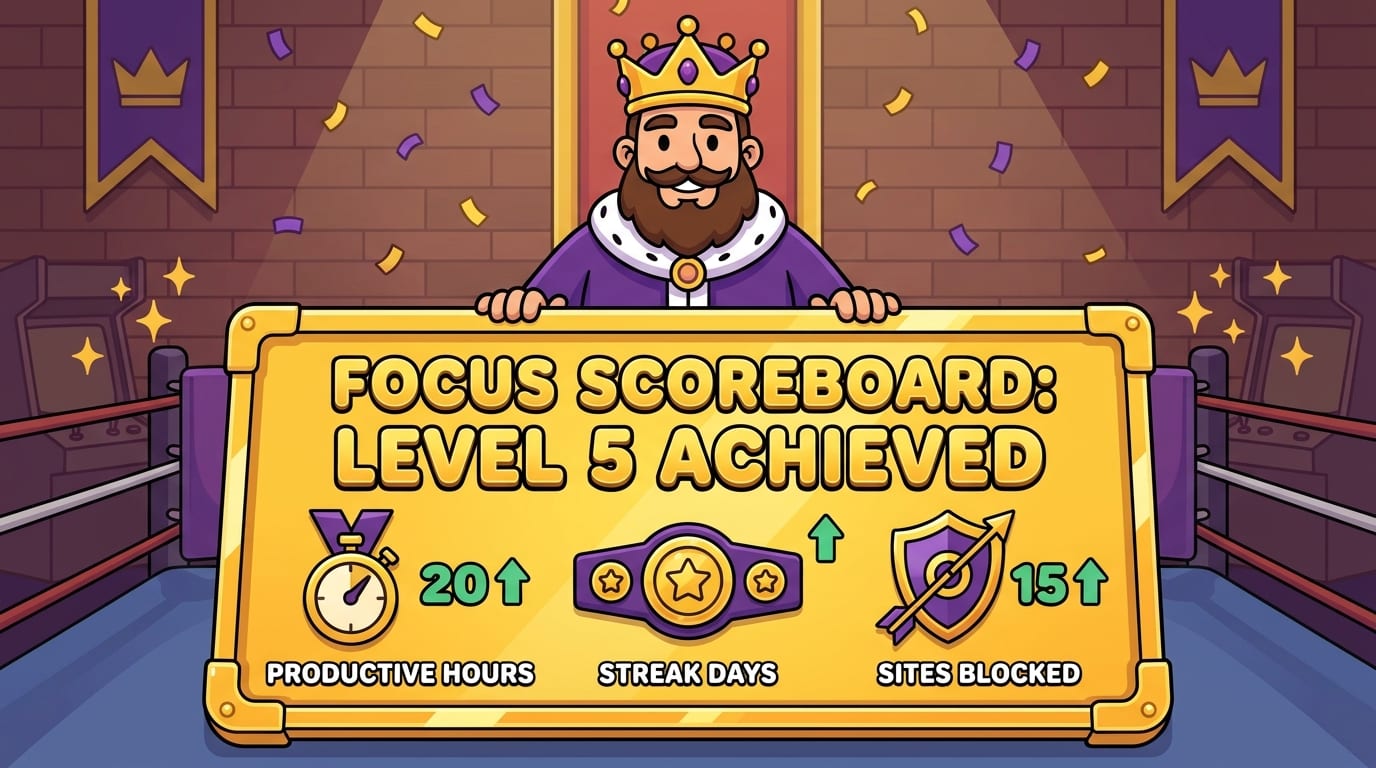
BlockChamp is a gamified website blocker for Google Chrome that combines those practical barriers with visible progress. You can block specific sites or switch on distraction categories, then earn XP for focused time, days with blocks active, and resisting blocked sites. The Stare-Down screen turns an attempted detour into a reminder to return to your task—with The King looking on like he has personally witnessed your browser history’s worst decisions.
BlockChamp also uses reigns, levels, badges, a focus calendar, and a leaderboard to make consistency more visible. If you want additional help resisting the “just one minute” impulse, its Champion plan includes Hardcore Lockdown options: a cooldown timer or a short boxing-riddle game before you can turn focus off. The point is not to trap you forever in a productivity dungeon. It’s to create a pause between an impulse and a decision, giving you a chance to remember what you planned to do.
For someone who prefers a quieter approach, any blocker can still be part of a simple routine: choose the sites that derail your work, activate blocks during your focus window, and leave necessary work tools available. BlockChamp’s free tier supports up to three blocked sites and two categories, so you can test the idea without building an elaborate digital fortress on day one.
Turn focus into a repeatable session, not a vague mood
“I’ll focus when I feel ready” is a plan with a very unreliable project manager. A repeatable session gives you cues and steps that work even when motivation is off getting snacks.
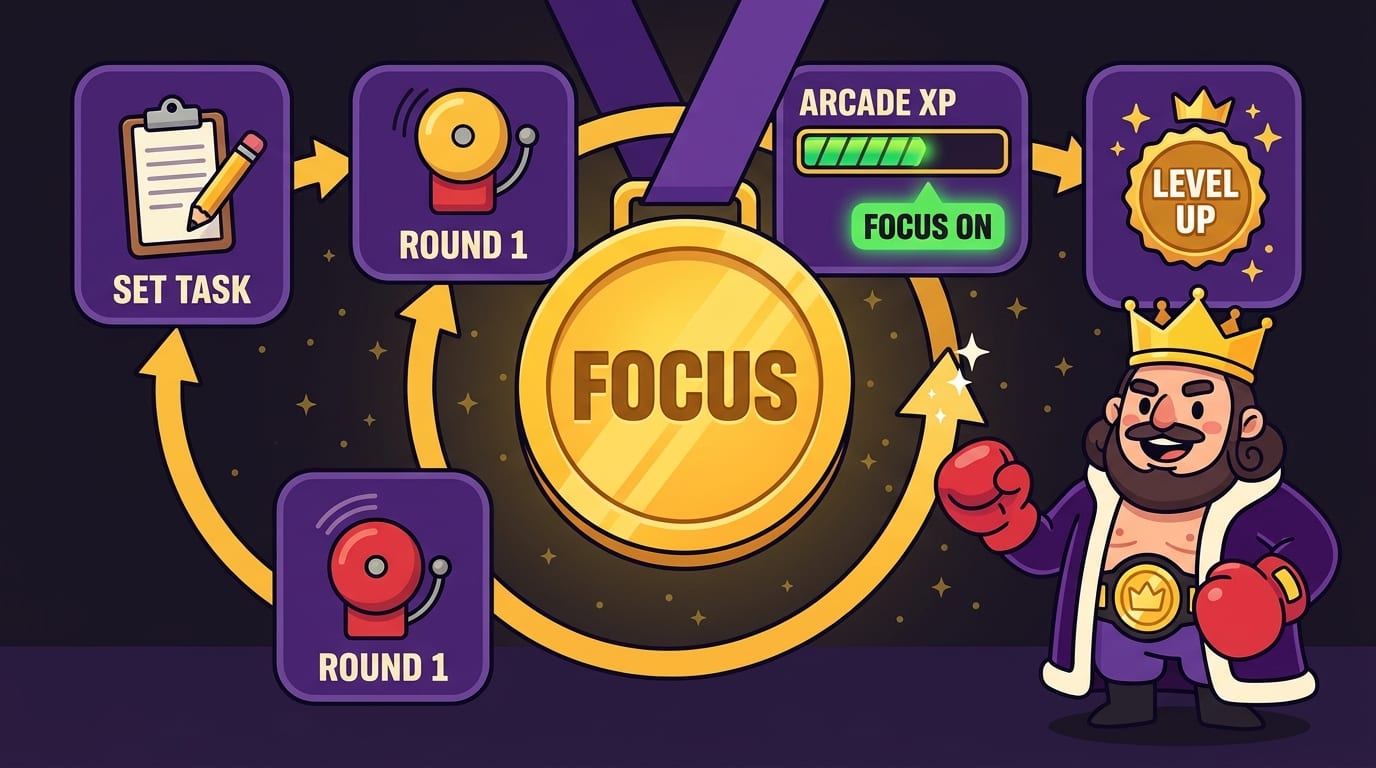
- Choose a task: Write down one outcome for the session, such as outlining a report or reviewing a lecture.
- Prepare the arena: Gather what you need, close unrelated tabs, and activate your website blocks.
- Set a timer: Pick a manageable work period and decide whether you’ll take a short break afterward.
- Record the win: Mark the session complete, note the time spent, or claim a small reward.
- Choose the next move: Continue, take a planned break, or write down the next step for later.
Keep your first session deliberately modest. If 25 minutes feels too long, begin with 10. If you can focus for an hour but struggle to restart after breaks, use shorter blocks and a clear restart cue. The best system is not the one with the most impressive settings; it’s the one you’ll actually use when your inbox is noisy and your motivation is wearing sweatpants.
Exercise can also support a productive routine by giving your day structure and a useful reset. Our article on how exercising can improve focus offers ideas for building movement into a work or study day. You can also read five practical ways to pair exercise with better productivity. A brisk walk between sessions may be more refreshing than trying to reset your brain by opening another app.
Common gamification mistakes: avoid these boss battles
Gamification can help, but adding points to a broken routine won’t magically fix it. Watch for these common traps:
- Too many rules: If you need a manual, a spreadsheet, and a ceremonial bell to start work, simplify the system.
- Rewarding clicks instead of progress: Don’t hand out points for activity that doesn’t support your goal. Track meaningful effort.
- Making rest feel like failure: Breaks are part of sustainable work. Protect them instead of treating them as a loophole.
- Comparing yourself to everyone: A leaderboard can motivate some people, but your most useful comparison is often with your own past routine.
- Overusing notifications: A reminder that interrupts your work to celebrate your work is a tiny productivity paradox. Keep alerts helpful and limited.
Competition is optional. Some people love a leaderboard; others focus better when the only opponent is yesterday’s distraction habit. If social comparison makes you tense, use personal records, private calendars, or milestones instead. The goal is to support your attention, not audition for a reality show called Who Can Do the Most Deep Work?
Likewise, don’t mistake gamification for a cure-all. If your workload is unreasonable, your task is unclear, or you’re exhausted, badges won’t solve the underlying problem. Adjust the work, ask for help, set boundaries, or rest as needed. A well-designed system supports good judgment; it does not replace it.
Design your own focus game in one afternoon
You can start without an app, a subscription, or a dramatic cape. Use a notebook, a calendar, or a simple checklist. The key is to make the rules clear enough that you don’t negotiate with yourself every time you’re supposed to begin.
Try this one-week setup:
- Pick one focus area: Choose studying, writing, admin work, or another task you want to do more consistently.
- Set a daily minimum: Choose a small amount you can manage on a typical day, such as one 20-minute session.
- Define your score: Give yourself one point for completing the session, not for being perfect or producing a flawless result.
- Add a helpful barrier: Silence notifications, move your phone, or block the websites you tend to open automatically.
- Choose a modest reward: Take a planned break, enjoy a snack, or do something relaxing after the session.
- Review the week: Notice what made focus easier or harder, then adjust one rule for the next week.
Keep the review curious. Did you skip sessions because the goal was too big? Were you more focused at a different time? Did a particular website keep drawing you in? Make one practical change and test it. A productivity system is an experiment, not a stone tablet delivered from Mount Spreadsheet.
If you’re interested in the relationship between attention, exercise, and creative work, you may also enjoy this article about procrastination and focus for creatives. Creative tasks can feel especially difficult to gamify because the result is uncertain. A process-based goal—show up, make a rough draft, test an idea—can keep the work moving without demanding inspiration on command.

Make your next focused hour a win
Gamification for productivity and focus works best when it makes the next useful action clear, gives you honest feedback, and rewards consistency without demanding perfection. Set small goals. Track effort that matters. Use streaks as encouragement, not a threat. Make distractions harder to reach, and build a routine that can survive an ordinary Tuesday.
If you want a playful way to pair website blocking with XP, levels, badges, and a running focus streak, take a look at BlockChamp. Block the distractions that keep stealing your attention, start a manageable focus session, and let the progress add up. Defend the throne, crush the scroll, and earn your next win—one focused block at a time.
Related posts

Blockchamp Vs Blocksite

Blockchamp Vs Cold Turkey Blocker

Blockchamp Vs Blocksite
