
Why Your Brain Needs Understimulation

Your brain is not a vending machine. You cannot keep smashing the “give me novelty” button and expect it to dispense focus, creativity, emotional stability, and a perfectly folded fitted sheet. At some point, the machine starts making sad refrigerator noises.
That is why your brain needs understimulation.
Not forever. Nobody is asking you to move into a cave, rename yourself Moss Wizard, and communicate exclusively with squirrels. Understimulation simply means giving your mind deliberate periods of low input: fewer tabs, fewer notifications, fewer videos autoplaying into your eyeballs, fewer “quick checks” that turn into a 47-minute scroll through strangers arguing about oat milk.
In a world where everything is designed to be louder, faster, brighter, and more emotionally spicy, boredom has become suspicious. Silence feels illegal. Waiting in line without checking your phone feels like an extreme sport. But the science is pretty clear: your brain needs quiet, empty, low-stimulation moments to reset attention, process information, spark creative ideas, and calm the nervous system.
So let’s talk about why your brain needs understimulation, what happens when it never gets any, and how to reclaim some mental white space without becoming a productivity goblin in linen pants. We’ll also cover practical ways to reduce digital noise, including how a focus tool like BlockChamp can help you knock out distractions before they storm the castle wearing TikTok armor.
Quick Answers
What Understimulation Actually Means: No, It’s Not Just Staring at a Wall Like a Haunted Victorian Child
Understimulation is a deliberate reduction in sensory, emotional, and informational input. It is not laziness. It is not failure. It is not “doing nothing” in the useless sense. It is a recovery state for a brain that spends most of the day getting pelted with content confetti.
Examples of understimulation include:
- Taking a walk without headphones
- Eating lunch without watching a video
- Sitting for five minutes before starting work instead of opening social media
- Doing chores without a podcast filling every second
- Leaving your phone in another room while you read, think, write, or plan
- Blocking distracting websites during focus sessions so your brain stops playing browser whack-a-mole
The key is that understimulation creates room. Room for thoughts to settle. Room for memory consolidation. Room for ideas to bump into each other like awkward guests at a royal banquet. Room for your nervous system to stop behaving like a squirrel with a caffeine sponsorship.
This matters because modern digital life constantly feeds the brain high-density stimulation. Social media gives novelty. News gives threat. Shopping sites give desire. Streaming platforms give endless “one more episode” temptation. AI tools give infinite answers, drafts, rewrites, rabbit holes, and “maybe I should ask one more question” loops. None of these things are evil by themselves. But together, all day, every day? Congratulations, your brain is now a browser with 93 tabs open and one of them is playing music.
If that sounds familiar, you may also like our deep dive on why you can’t focus and what to do about the distracted brain. Spoiler: your character flaws are probably not the main villain. The attention economy is wearing a tiny mustache and twirling it.
The Science: Your Brain Has a Limited Attention Budget, and It Keeps Getting Mugged
Attention is not infinite. It is a limited cognitive resource, and every ping, headline, message, and thumbnail asks for a slice. Some requests are tiny. Some are huge. All of them add up.
Researchers have long studied how task switching affects performance. The American Psychological Association explains that even brief mental switching can create measurable costs, especially when tasks are complex or unfamiliar. In other words, when you bounce between your work document, Slack, email, YouTube, a news headline, and a group chat named “Chaos Goblins,” your brain pays a toll each time. You can read more in the APA’s overview of the cognitive costs of multitasking.
Understimulation helps because it reduces the number of competing demands. Instead of forcing your attention to defend the throne against 800 peasants with push notifications, you give it a clean battlefield. Fewer inputs. Fewer decisions. Fewer temptations.
This also connects to cognitive load theory: your working memory can only hold so much at once. When the brain is overloaded, learning and problem-solving suffer. A classic paper by educational psychologist John Sweller describes how unnecessary cognitive load can impair learning and performance. If you want the scholarly version with fewer jokes about tab goblins, see Sweller’s work on cognitive load during problem solving.
Here is the practical translation: every extra stream of input makes your brain work harder just to maintain control. That means less energy for actual thinking. Less patience. Less creativity. Less ability to sit with difficult work long enough to make progress.
This is why “just focus harder” is often terrible advice. That is like telling someone to win a boxing match while allowing random spectators to run into the ring every nine seconds and slap them with coupons. Sometimes the answer is not more willpower. Sometimes the answer is fewer slaps.
Boredom Is Not the Enemy. Boredom Is the Weird Little Doorway
Boredom has terrible branding. It sounds like something your brain does when it has been abandoned in a dentist waiting room with only a 2009 golf magazine for entertainment. But boredom can be useful. It often appears when your brain is no longer being fed immediate novelty, which creates space for internal thought.
Research on mind-wandering suggests that periods of undirected thought can support planning, autobiographical memory, and creative problem-solving. A study published in Proceedings of the National Academy of Sciences found that mind-wandering is associated with activity in brain networks involved in internal thought and executive control. Translation: when your mind drifts, it is not necessarily “doing nothing.” Sometimes it is sorting the royal archives.
This is one reason creative ideas often arrive in the shower, on walks, while doing dishes, or during other low-input activities. Your brain finally has enough quiet to connect dots. It stops reacting and starts recombining.
We wrote more about this in Bored and Brilliant: why boredom boosts creativity, because boredom deserves a redemption arc. It has been treated like the court jester, but it may actually be the royal advisor.
The problem is that most of us never let boredom fully arrive. The instant a tiny gap appears, we fill it:
- Elevator? Phone.
- Microwave countdown? Phone.
- Computer loading? New tab.
- Awkward feeling? Scroll.
- One difficult sentence in an essay? Suddenly researching medieval soup recipes.
When every gap gets plugged with stimulation, your brain loses practice being alone with itself. That matters. Focus requires tolerance for a little discomfort. Creativity requires wandering. Emotional regulation requires noticing what you feel before you drown it in memes.
Overstimulation Trains Your Brain to Expect Fireworks Every 12 Seconds
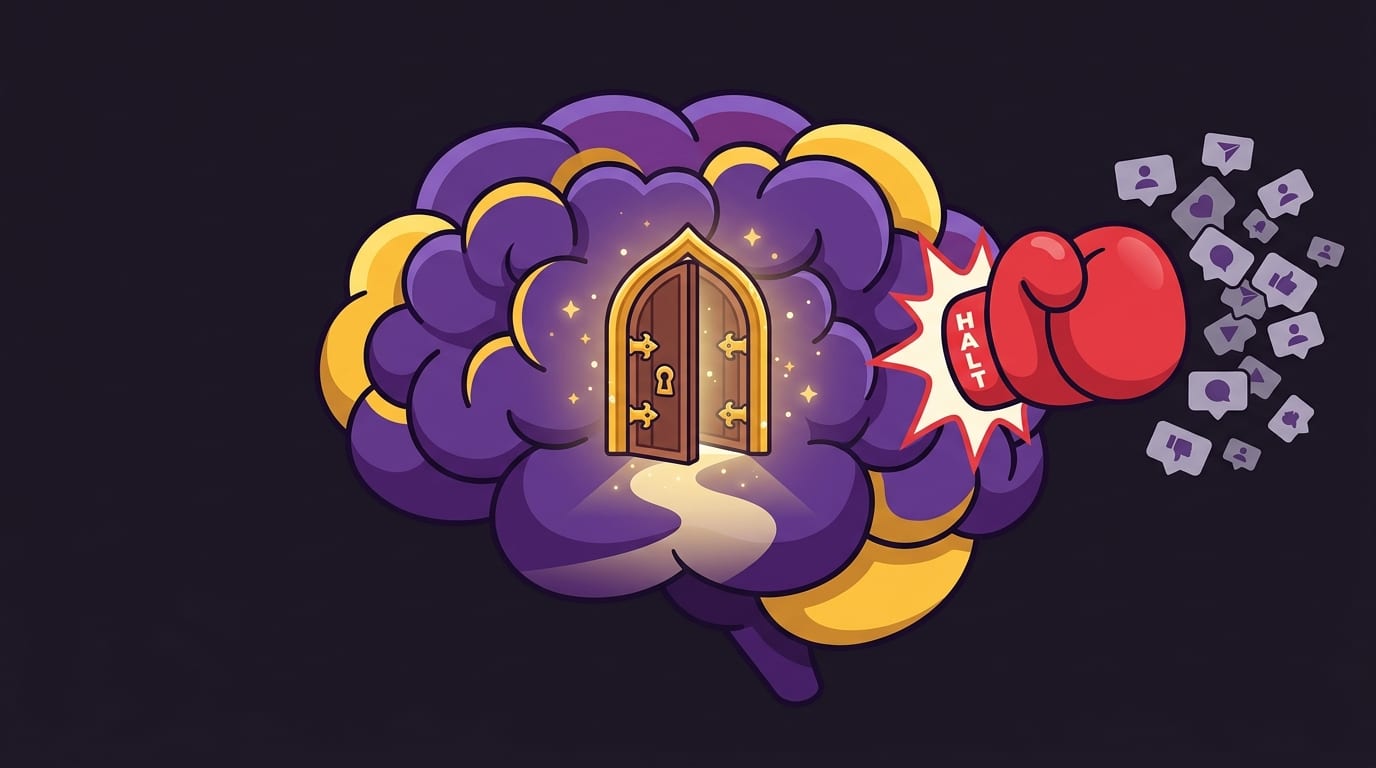
Digital platforms are very good at giving your brain exactly enough novelty to keep it nibbling. Infinite scroll, autoplay, algorithmic feeds, personalized recommendations, variable rewards, bright badges, breaking news alerts, and “people are typing…” indicators are not accidental. They are attention architecture.
According to DataReportal’s Digital 2024 Global Overview Report, internet users spend an average of more than six hours online per day globally. That is not automatically bad. The internet contains work, education, communication, art, and videos of raccoons being suspicious. Important civilization stuff. But when high-stimulation browsing fills every spare moment, your baseline shifts.
Your brain starts expecting constant novelty. Then normal tasks feel painfully dull by comparison:
- Reading a textbook feels slow.
- Writing an email feels unbearable.
- Planning a project feels like chewing cardboard.
- Studying without checking something every three minutes feels like exile.
This is not because you are weak. It is because your attention system adapts to what you repeatedly feed it. If every break becomes a dopamine buffet, deep work starts looking like plain oatmeal wearing a sad hat.
Understimulation helps recalibrate your expectations. It teaches your brain that not every moment needs fireworks. Sometimes a moment can be quiet. Sometimes work can be slow. Sometimes the kingdom can run without a jester cannon blasting content into the throne room.
That does not mean you must quit entertainment. Please enjoy your shows. Laugh at the memes. Send the raccoon video. The goal is not digital monkhood; it is rhythm. Stimulation and recovery. Input and quiet. Feasting and digestion. Your brain needs both, but many of us are all feast, no digestion, and now the mental banquet hall smells weird.
Understimulation Improves Focus Because It Removes the “Maybe Something Better” Trap
One of the sneakiest enemies of focus is not distraction itself. It is the possibility of distraction.
If you know that YouTube, Reddit, TikTok, X, Instagram, news sites, shopping tabs, and AI chatbots are all one click away, part of your brain remains aware of the escape hatch. The work gets slightly hard, and the little goblin inside whispers, “Perhaps we should check if anything has happened anywhere in the world.”
Something has always happened somewhere in the world. That is how the world gets you.
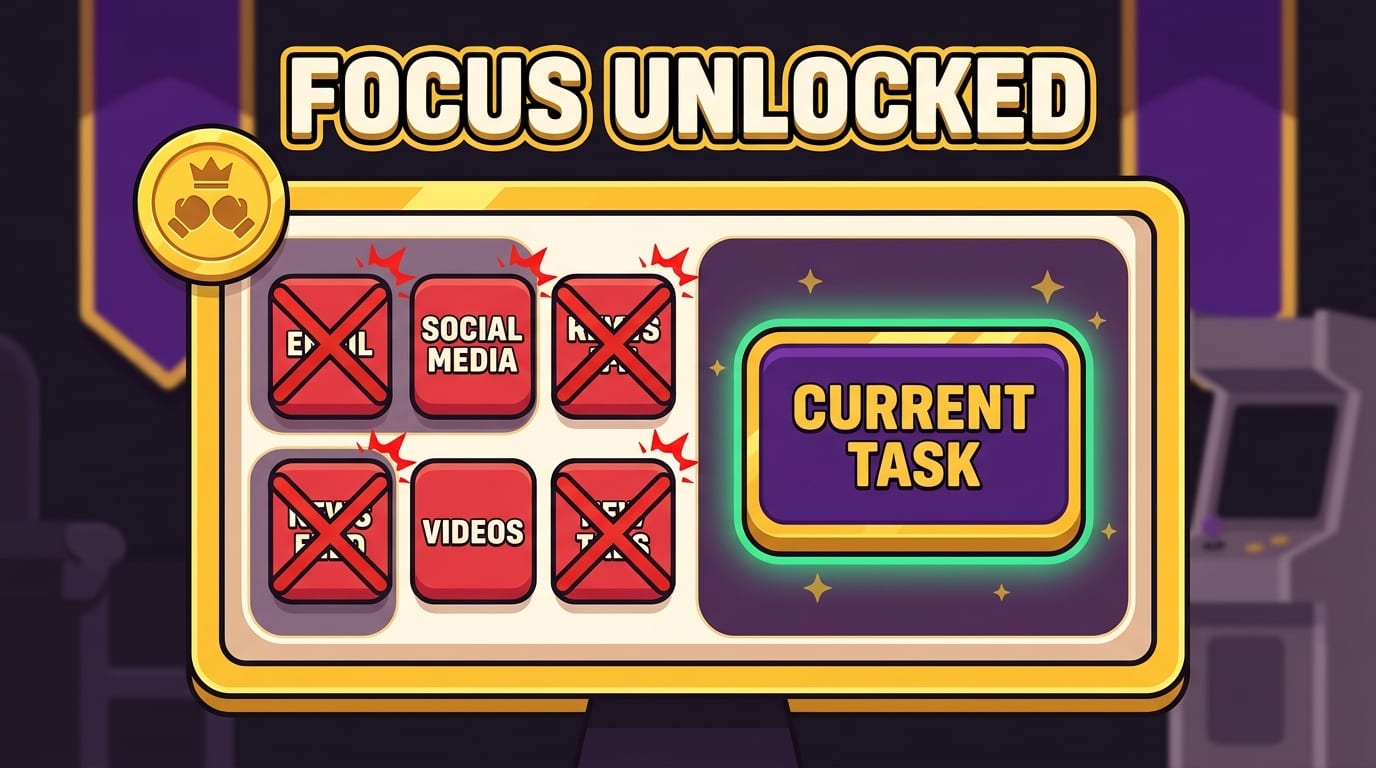
Understimulation works best when paired with friction. You need to make the stimulating option less available, especially during focus blocks. This is where a website blocker becomes less of a “productivity hack” and more of a moat around your attention castle.
BlockChamp was built for this exact problem. It is a gamified Chrome website blocker that lets you block specific sites, keywords, or entire categories like Social Media, Video & Streaming, News, Shopping, Gaming, Gambling, Adult, and AI Distractions. Instead of relying on raw willpower, you create a lower-stimulation environment on purpose.
And because BlockChamp has the personality of a tiny royal boxer with emotional range, it does not feel like being grounded by a spreadsheet. When you try to visit a blocked site, The King gives you a full-screen Stare-Down. The site you tried to enter appears on a gold plate like evidence in a medieval courtroom. Sometimes he roasts you out loud. It is ridiculous. It is useful. It is hard to keep pretending you “accidentally” opened YouTube when a cartoon monarch is judging your bloodline.
This matters because the best focus systems are not built on perfect self-control. They are built on environment design. If the distraction is blocked, your brain has fewer “maybe something better” loops to chase. The work in front of you becomes less optional. Your attention stops negotiating with 17 tabs and starts doing the thing.
If you want more training on resisting digital temptation, check out Mental Gymnastics: training your brain to resist digital distractions. Think of it as leg day for your prefrontal cortex. Sorry in advance.
The Nervous System Angle: Quiet Helps Your Brain Stop Wearing a Helmet Indoors
Overstimulation is not just an attention issue. It can also become a stress issue.
Your brain and body react to input. Notifications can create urgency. News can create threat. Social comparison can create insecurity. Email can create anticipatory stress. Even positive stimulation can keep your system revved up: fast videos, exciting games, intense debates, endless messages, dramatic headlines, and five apps politely screaming for your soul.
The nervous system is not meant to be in high-alert mode all day. Chronic stress is associated with a range of health and cognitive effects, and the National Institute of Mental Health offers a useful overview of how stress affects mental and physical health.
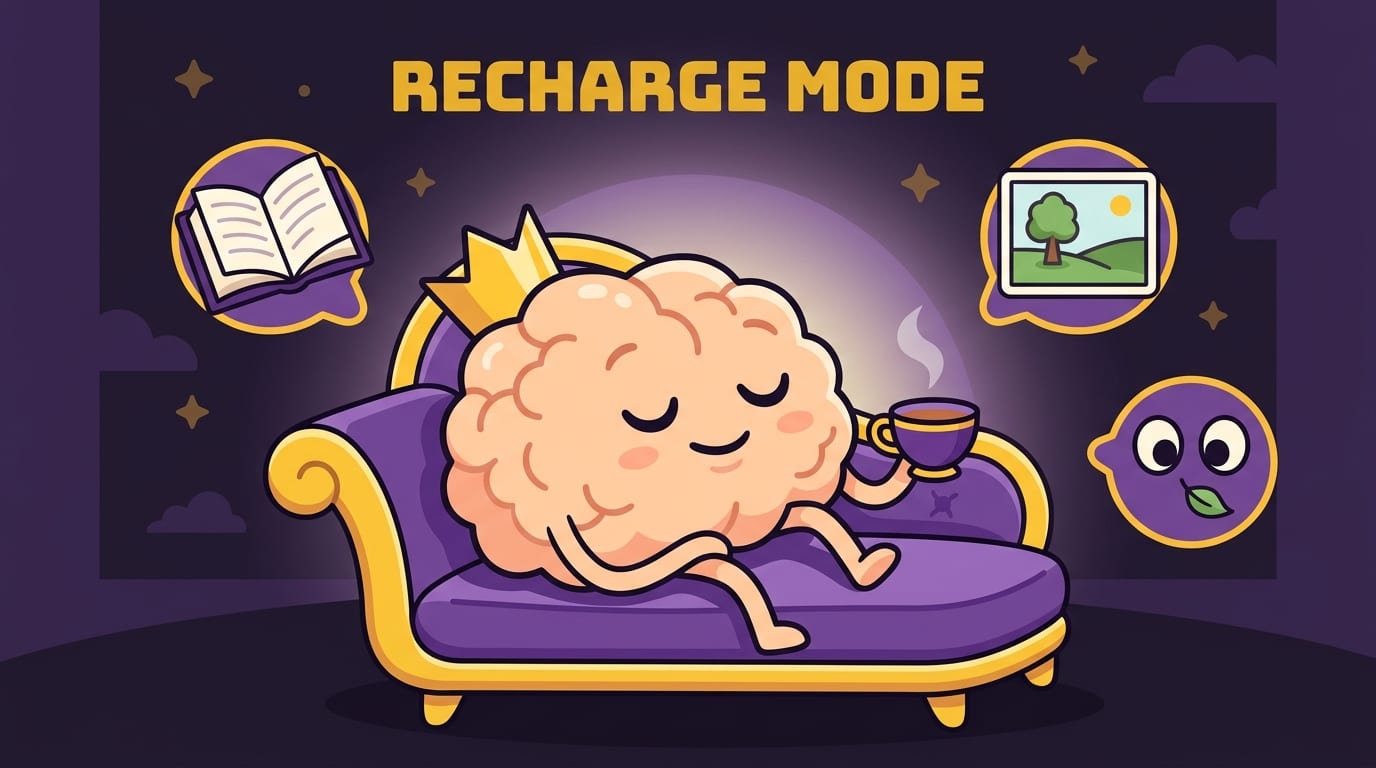
Understimulation gives the system a chance to downshift. Low-input moments can support calm because they remove sources of urgency. You are not reacting. You are not comparing. You are not bracing for the next ping. You are letting the mental guards unclench their tiny fists.
This is especially important if you work on a computer all day. Remote workers, students, creators, and freelancers often live inside a digital command center. Messages, tabs, tasks, research, entertainment, banking, shopping, social life, and existential dread all happen in the same glowing rectangle. Without boundaries, your brain never gets a clear signal that the fight is over.
Try creating “decompression buffers” between intense input and rest:
- Five minutes of quiet after meetings before checking messages
- A short walk after work before opening entertainment apps
- No social media in the first 20 minutes after waking
- No news or arguments right before bed, unless you enjoy sleeping like a startled meerkat
- A blocked-site focus schedule during work hours so entertainment stays outside the castle gates
These small buffers tell your nervous system, “We are safe. The kingdom is not currently under siege by a comments section.”
How to Practice Understimulation Without Losing Your Mind
If your brain is used to constant input, sudden silence may feel uncomfortable. That is normal. Do not start with a full weekend digital detox in the wilderness unless you are emotionally prepared to hear your own thoughts forming a committee.
Start small. Make understimulation boringly achievable. The crown is won through consistency, not one dramatic productivity montage.
1. Create one “empty pocket” per day
Pick a daily activity and remove extra input from it. Walking, showering, cooking, stretching, commuting, folding laundry, or waiting for coffee are all excellent candidates.
For 5 to 15 minutes, do only that thing. No podcast. No video. No feed. No “just checking.” Let your mind wander. At first, it may behave like a raccoon trapped in a pantry. Let it. Eventually, it settles.
2. Use a “low-stimulation start” before deep work
Before a study session or work block, avoid jumping straight from high-stimulation content into focus. Going from TikTok to tax forms is like asking a nightclub DJ to perform Gregorian chants.
Instead, try this:
- Close unnecessary tabs.
- Put your phone out of reach.
- Turn on your website blocker.
- Sit quietly for two minutes.
- Write down the next tiny action.
- Start.
Those two quiet minutes act like a mental airlock. You are leaving the chaos planet and entering the focus ship.
3. Block your personal “oops, I live here now” sites
You know the ones. The sites you open automatically when your brain gets mildly inconvenienced. Maybe it is YouTube. Maybe Reddit. Maybe shopping. Maybe news. Maybe an AI chatbot you ask one question and suddenly it is helping you design a fictional island nation.
Use BlockChamp to block your top offenders during specific focus windows. Free users can block up to 3 sites and enable 2 categories, which is plenty to start. Champion users can go full royal fortress with unlimited sites, all 8 categories, keyword blocking, schedules, and Hardcore Lockdown.
Hardcore Lockdown is especially useful if you are the type to disable your blocker during a weak moment. To surrender, you have to wait through a cooldown or beat The King’s boxing riddle. That short delay gives the impulse time to pass. Also, being defeated by a cartoon monarch’s glove combo is humbling in a way the soul remembers.
4. Make boredom visible, not accidental
Plan boredom like it matters. Put it on your calendar if needed. Call it “thinking time,” “walk,” “reset,” or “do not feed the algorithm.” Fancy name optional.
The goal is to stop treating empty time as a mistake. Empty time is where your brain digests. You do not call it “wasted time” when your body digests lunch. Your brain deserves the same courtesy, minus the burping.
A Simple 7-Day Understimulation Challenge for the Chronically Tab-Haunted
If you want a practical reset, try this seven-day plan. It is gentle, realistic, and does not require you to throw your phone into the sea like a dramatic pirate widow.
- Day 1: Take a 10-minute walk without headphones. Notice how often your hand reaches for your phone like it is a tiny emotional support brick.
- Day 2: Eat one meal without a screen. Taste your food. Remember chewing? Vintage technology.
- Day 3: Block your top 3 distracting websites for one 60-minute focus block using BlockChamp or your preferred tool.
- Day 4: Create a no-input morning buffer: no social media, news, or videos for the first 20 minutes after waking.
- Day 5: Do one chore in silence. Dishes, laundry, tidying, sweeping. Let your thoughts assemble their little parade.
- Day 6: Set a 90-minute deep work block with your phone away and distracting sites blocked. If The King catches you trying to sneak into Reddit, accept the roast and return to glory.
- Day 7: Take 15 minutes to reflect. Did you feel calmer? More focused? More creative? More aware of your automatic habits? Write down what changed.
For extra power, combine this with a review of your broader digital habits. Our guide, It’s time to take a look at your digital habits, can help you spot the patterns that quietly steal hours while wearing fake mustaches.
You can also build a “phone break” into the challenge. If your phone is the main chaos portal, read how to take a healthier break from your phone and start with short, repeatable boundaries instead of one heroic detox that collapses by lunchtime.
What Understimulation Feels Like at First: Spoiler, Sometimes Annoying
Let’s be honest: the first few attempts may not feel magical. You might not instantly become calm, brilliant, and capable of writing a novel in a sunbeam. You may feel restless. Irritated. Bored. Slightly itchy in the soul.
That discomfort is useful information. It shows how trained your brain has become to expect constant input. The goal is not to judge yourself. The goal is to rebuild tolerance.
Common early experiences include:
- Reaching for your phone automatically
- Feeling like silence is “wasting time”
- Noticing uncomfortable thoughts or emotions
- Feeling impatient during slow tasks
- Having sudden ideas pop up after a few quiet minutes
Stay with it in small doses. Understimulation is like stretching a stiff muscle. You do not yank it into a split and declare war on your hamstrings. You ease in, repeat, and let capacity grow.
Over time, low-input moments can become genuinely pleasant. Your brain remembers how to wander. Work feels less brutally dull. You may find yourself having better ideas, making calmer decisions, and noticing when you are reaching for stimulation as avoidance.
That last one is the crown jewel. Once you can notice the impulse, you can choose your response. You can say, “Ah, I am not actually interested in checking X. I am avoiding a difficult paragraph.” Then you can return to the paragraph and defeat it in honorable combat.
Why Your Brain Needs Understimulation More Than Ever
The modern attention environment is not neutral. It is competitive. Every platform wants your time, and many are optimized to keep you engaged as long as possible. That means your attention is constantly being auctioned, nudged, baited, and monetized. Fun!
Understimulation is a counter-move. It is not anti-technology. It is pro-agency.
When you reduce input on purpose, you reclaim the ability to decide what deserves your mind. You become less reactive. You stop treating every notification like a royal decree. You remember that your time belongs to you, not to whatever app has the brightest red badge.
This is especially important for students and knowledge workers because focus is now a competitive advantage. The ability to sit with hard problems, read deeply, write clearly, learn patiently, and think without constantly escaping is increasingly rare. It is also extremely valuable.
Understimulation supports that ability by making focus less alien. When your brain is not constantly marinated in novelty, slower work becomes tolerable again. Maybe even satisfying. Imagine that: doing one thing and not feeling like your skeleton is trying to leave. Royal behavior.
Tools help, too. A blocker like BlockChamp does not replace discipline, but it gives discipline a fighting chance. The Master Focus Toggle puts your blocks on guard. Category bundles remove entire kingdoms of distraction in one tap. XP, badges, reigns, calendars, and leaderboards turn consistency into a game. And The King’s Stare-Down transforms a slip-up into a funny reset instead of a shame spiral.
That is the sweet spot: not punishment, not perfection, but playful structure. Less chaos. More crown.
Conclusion: Give Your Brain Some Glorious Nothing
So, why your brain needs understimulation? Because attention needs recovery. Creativity needs emptiness. Calm needs fewer alarms. Focus needs an environment where every shiny object is not allowed to burst through the door yelling, “Look at me, champ!”
Understimulation is not about hating the internet or becoming a joyless monk with excellent posture. It is about giving your brain space to breathe. A walk without headphones. A meal without a screen. A focus block without social media lurking one click away. A few minutes of quiet before you charge into the day swinging.
Start tiny. Pick one empty pocket today. Block one distraction. Let boredom knock. Let your thoughts wander around the castle. They may find something useful in the basement.
And if your brain keeps sprinting toward YouTube, Reddit, TikTok, news, shopping, or whatever digital dragon keeps eating your afternoons, put The King on guard with BlockChamp. Block the sites, earn XP, build your reign, survive the Stare-Downs, and become king of your time.
Long live your focus. Crush the scroll. Give your brain a little glorious nothing.
Related posts

Finding Focus For Fiction Writing

Learning To Focus In A Digital World As A Creative

Finding Focus For Personal Growth
