
Break From Your Phone

Your phone is a tiny rectangular casino with weather updates. It pings, glows, vibrates, and whispers, “Just check me for one second,” like a needy wizard trapped in glass. If you’re trying to take a break from your phone, you are not weak, lazy, or secretly part raccoon. You are a human with a nervous system, and your phone is a professionally engineered attention magnet.
The good news: you do not need to flee to a cabin, throw your iPhone into a lake, or start saying “I don’t own technology” at dinner parties. A lasting phone break is less about dramatic detox theater and more about building friction, replacing habits, setting boundaries, and making focus feel rewarding enough that your brain stops staging tiny coups every 11 minutes.
This guide gives you practical, science-backed steps to take a real break from your phone: not just a heroic Sunday cleanse followed by a Monday doomscroll relapse, but a sustainable plan for reclaiming your focus, free time, and ability to watch a movie without also opening six apps like a caffeinated octopus.
Quick Answers
Why Taking a Break From Your Phone Is So Hard
Let’s start with the obvious: phones are useful. They help us navigate, bank, message friends, take photos, order tacos, check train times, and avoid talking to strangers in elevators. The problem is not the phone itself. The problem is the infinite buffet of apps fighting for your attention like seagulls over a french fry.
Research has repeatedly shown that smartphones can affect attention, sleep, mood, and productivity. The American Psychological Association has covered how constant digital connection can contribute to stress and distraction, especially when notifications keep pulling us back into “always on” mode. You can read more in the APA’s reporting on smartphone use and psychological wellbeing.
Meanwhile, a widely cited study from the University of Texas at Austin found that even having your phone nearby, face down and silent, can reduce available cognitive capacity. In other words, your phone does not even need to do anything. It can sit there like a little attention goblin and still tax your brain. The study is summarized in the university’s article on how the mere presence of a smartphone reduces brain power.
This is why “just use willpower” is terrible advice. Willpower is useful, but it gets tired. Your phone, on the other hand, does not get tired. It has push notifications, autoplay, infinite scroll, streaks, likes, badges, drama, novelty, and that one group chat that somehow contains 87 messages about absolutely nothing.
If you want a break that lasts, you need a system. Not vibes. Not “I’ll be better tomorrow.” A system.
First, Define What “Break From Your Phone” Actually Means
A phone break can mean different things depending on your life. For one person, it means no social media for 30 days. For another, it means no phone in bed. For a student, it might mean studying without TikTok ambushes. For a freelancer, it might mean not checking messages every time a client sends a “quick thought” that ruins an entire afternoon.
Before you start, define your version of success. Otherwise, your brain will negotiate with itself like a shady lawyer in a velvet tracksuit.
Pick your break type
- Micro-break: 30 to 90 minutes phone-free during work, study, meals, workouts, or family time.
- Daily boundary: No phone before breakfast, after 9 p.m., or during your first deep work block.
- App-specific break: No TikTok, Instagram, Reddit, YouTube Shorts, gambling apps, shopping apps, or news apps for a set period.
- Weekend reset: A Saturday or Sunday with only calls, maps, music, and essential messages.
- Full digital detox: 24 hours to 7 days with your phone limited to emergencies and practical tools.
If you are not sure which version fits, start smaller than your ego wants. The goal is not to become a monk by Tuesday. The goal is to build evidence that you can be away from your phone and survive, maybe even thrive, maybe even remember what clouds look like. Wild stuff.
For a deeper phone-specific reset, BlockChamp has a companion guide on how to break up with your phone without making it weird. Think of this article as your strategic war map; that one is the dramatic breakup speech.
The Science Bit: Your Phone Runs on Cues, Cravings, and Tiny Rewards
Most phone habits follow a simple loop: cue, craving, response, reward. You feel bored, stressed, lonely, uncertain, tired, or mildly allergic to effort. That feeling becomes the cue. You crave relief or novelty. You pick up the phone. The reward arrives: a message, a meme, a sale, a score update, a scandal, a video of a golden retriever wearing boots. Your brain says, “Excellent. Again.”
That loop gets stronger when rewards are unpredictable. Sometimes you open the app and nothing happens. Sometimes you open it and see the funniest thing on Earth or a message from your crush or breaking news that makes your eyebrows leave your face. Variable rewards are powerful because the maybe is addictive.
The Center for Humane Technology has written extensively about how persuasive design and attention-based business models shape digital behavior. Their resources on social media and the brain are useful if you want to understand why apps feel less like tools and more like tiny slot machines wearing UX perfume.
Here’s the key: you do not break phone habits by yelling at yourself. You break them by interrupting the loop.
- Change the cue: keep your phone out of sight.
- Change the response: replace checking with a different action.
- Change the reward: make focus rewarding, visible, and satisfying.
- Add friction: make the bad habit slightly annoying to do.
This is also why a website blocker can help even when your goal is a phone break. Many phone habits migrate to your laptop the second you put the phone down. “I’m off Instagram on my phone,” says the noble citizen, while opening Instagram in Chrome like a raccoon with a law degree. Tools like BlockChamp help protect your computer from becoming your phone’s evil understudy.
Step 1: Audit Your Phone Use Without Spiraling Into Shame Soup
Before you change anything, gather data. Not to shame yourself. Not to stare at your screen time report like it’s a cursed royal scroll. Just to learn what is actually happening.
Open your phone’s screen time settings and look for three things:
- Total daily screen time: How much time are you spending?
- Top apps: Which apps are eating the biggest chunks?
- Pickup patterns: When do you grab your phone most often?
You may discover that your problem is not “my phone” in general. It might be one app, one time of day, or one emotional trigger. Maybe you are disciplined all morning, then get absolutely suplexed by YouTube at 10:30 p.m. Maybe your “quick news check” after lunch turns into 40 minutes of refreshing headlines until your soul feels like wet cardboard.
According to DataReportal’s global digital reports, people around the world spend significant time online daily, with social platforms claiming a large share of attention. Their Digital 2024 Global Overview Report is a helpful source for understanding just how normal heavy digital use has become. Normal, however, does not always mean healthy. Eating cereal from a saucepan is also normal in some households. We adapt.
Ask yourself:
- Which apps do I open automatically?
- Which apps leave me feeling worse afterward?
- Which phone habit steals time from sleep, work, studying, fitness, or relationships?
- When do I most often say, “Wait, how did I end up here?”
If your results are alarming, breathe. You are not broken. You are simply looking at the scoreboard. And once you can see the score, you can start playing better.
If you want help spotting warning signs, read BlockChamp’s guide to the signs you’re spending too much time on your phone. It’s practical, direct, and mercifully free of monk robes.

Step 2: Remove the Triggers That Make You Reach for It
The fastest way to take a break from your phone is not to become a willpower superhero. It is to stop placing your phone in the center of your life like a tiny glowing emperor.
Your environment should make the good choice easier and the scroll choice mildly inconvenient. Not impossible. Just annoying enough that your impulse loses momentum.
Try these friction upgrades
- Charge your phone outside the bedroom. Buy an alarm clock if you need one. Yes, a separate alarm clock. Ancient technology. Still undefeated.
- Keep your phone in another room during deep work. If it is within arm’s reach, your brain will treat it like a snack bowl.
- Turn off non-essential notifications. Keep calls, calendar, rideshare, banking, and actual humans you care about. Mute the rest.
- Use grayscale mode. Removing color makes apps less visually rewarding. Your phone becomes a sad calculator with weather.
- Move addictive apps off your home screen. Put them in folders with boring names like “Tax Documents” or “Regret Portal.”
- Log out of problem apps. A login screen is a tiny speed bump, and tiny speed bumps work surprisingly well.
Friction matters because impulses are brief. If you can delay yourself by 10 to 60 seconds, you often give your better judgment time to put on pants and enter the room.
This is the same principle behind BlockChamp’s Hardcore Lockdown on Chrome. When you try to turn focus off, you can require a cooldown timer or a boxing-riddle mini-game before surrendering. The point is not punishment. The point is interruption. The King makes your impulse wait outside the throne room until it calms down and stops yelling about Reddit.
Step 3: Set Phone-Free Zones and Times Like a Reasonable Monarch
A lasting phone break works best when it has clear boundaries. “I should use my phone less” is not a rule. It is a cloud wearing a name tag. Your brain cannot follow it because it does not know what it means.
Instead, create phone-free zones and phone-free times. Make them specific, repeatable, and tied to real life.
Good phone-free zones
- Bedroom: Protect sleep like it owes you money.
- Dining table: Food deserves better than being eaten above a news feed.
- Bathroom: Be honest. We all know. The kingdom need not discuss it further.
- Desk during deep work: Your workspace should not be a notification arcade.
- Car: Safety first. No tiny screen goblin is worth it.
Good phone-free times
- The first 30 minutes after waking
- The last 60 minutes before bed
- During meals
- During study blocks or meetings
- During workouts
- During social time with friends, family, or anyone whose face is not backlit
If this feels intimidating, pick one zone and one time. For example: no phone in the bedroom, and no phone for the first 30 minutes after waking. That alone can change your day. Morning phone use often sets your brain into reactive mode: messages, news, notifications, tasks, everyone else’s agenda. Suddenly your mind is a crowded medieval market and someone is selling panic by the barrel.
Try replacing morning phone time with a tiny ritual: water, light stretching, coffee, journaling, reading one page, walking outside, or simply sitting there like a mysterious Victorian ghost. The ritual does not need to be impressive. It just needs to be yours.
Step 4: Replace the Habit, Don’t Just Delete It
One of the biggest mistakes people make during a digital detox is removing the phone without replacing the function it was serving. Your phone is not just entertainment. It may be comfort, escape, social connection, procrastination, background noise, or a way to avoid your own thoughts marching around with tiny drums.
If you take the phone away and leave a vacuum, the habit will crawl back in wearing sunglasses.
So ask: what job is my phone doing?
- If you use it for boredom, replace it with a book, puzzle, walk, sketchpad, or music.
- If you use it for anxiety, replace it with breathing, stretching, journaling, or a quick call with a real person.
- If you use it for procrastination, replace it with a 5-minute starter task.
- If you use it for loneliness, schedule actual connection instead of grazing on likes.
- If you use it for fatigue, take a nap, move your body, or stop pretending caffeine is a personality.
The replacement should be easy. Ridiculously easy. If your phone break plan says, “Every time I want TikTok, I will practice violin for 90 minutes and learn Mandarin,” congratulations, you have invented a fantasy trap. Keep replacements small and available.
Try a “phone break menu” on paper:
- Walk around the block
- Make tea
- Do 10 push-ups or stretch for 2 minutes
- Read 5 pages
- Clean one small surface
- Write down the next task
- Look out a window without becoming a philosopher
When the urge hits, choose from the menu. This prevents the classic “I don’t know what else to do, so I guess I’ll re-download the app and become mayor of Doomscroll Town again.”

Step 5: Use App Limits, Blocking Tools, and Focus Modes Without Apologizing
Some people act like using blockers or limits is “cheating.” This is nonsense. You wear a seatbelt, use a calendar, set alarms, and put snacks on high shelves so you don’t eat them all like a raccoon at a wedding. Tools are not weakness. Tools are how humans beat predictable human problems.
Start with your built-in settings:
- iPhone: Use Screen Time, Downtime, App Limits, Communication Limits, and Focus modes.
- Android: Use Digital Wellbeing, Focus Mode, Bedtime Mode, and app timers.
- Browsers: Use blockers to stop “I put my phone away but opened the same nonsense on my laptop.”
If you use an iPhone and want detailed steps, BlockChamp has a practical guide on how to block apps on an iPhone and keep yourself out. It’s especially useful if your thumbs have developed criminal instincts.
For your computer, BlockChamp is built for exactly this “I’m taking a break from my phone, but now Chrome is tempting me” problem. You can block specific sites like YouTube, Reddit, Instagram, X/Twitter, or shopping sites. You can also use category blocking for Social Media, Video & Streaming, News, Shopping, Gaming, Gambling, Adult, and AI Distractions. One master toggle puts The King on guard, and every focused minute earns XP.
What makes BlockChamp different from grim productivity tools is that it makes focus feel like a game instead of a punishment. Try to visit a blocked site and you get The Stare-Down: a full-screen royal judgment scene where The King catches you in the act. On every second stare-down, he may even roast you out loud with a voice line. Is it slightly ridiculous? Yes. Does ridiculous work? Also yes.
The free tier lets you block up to 3 sites, enable 2 categories, and use the full gamification system with XP, levels, badges, reigns, calendar, and leaderboard. If your phone break is part of a bigger “stop wasting time online” campaign, that kind of playful accountability can be the difference between a one-day detox and an actual reign.
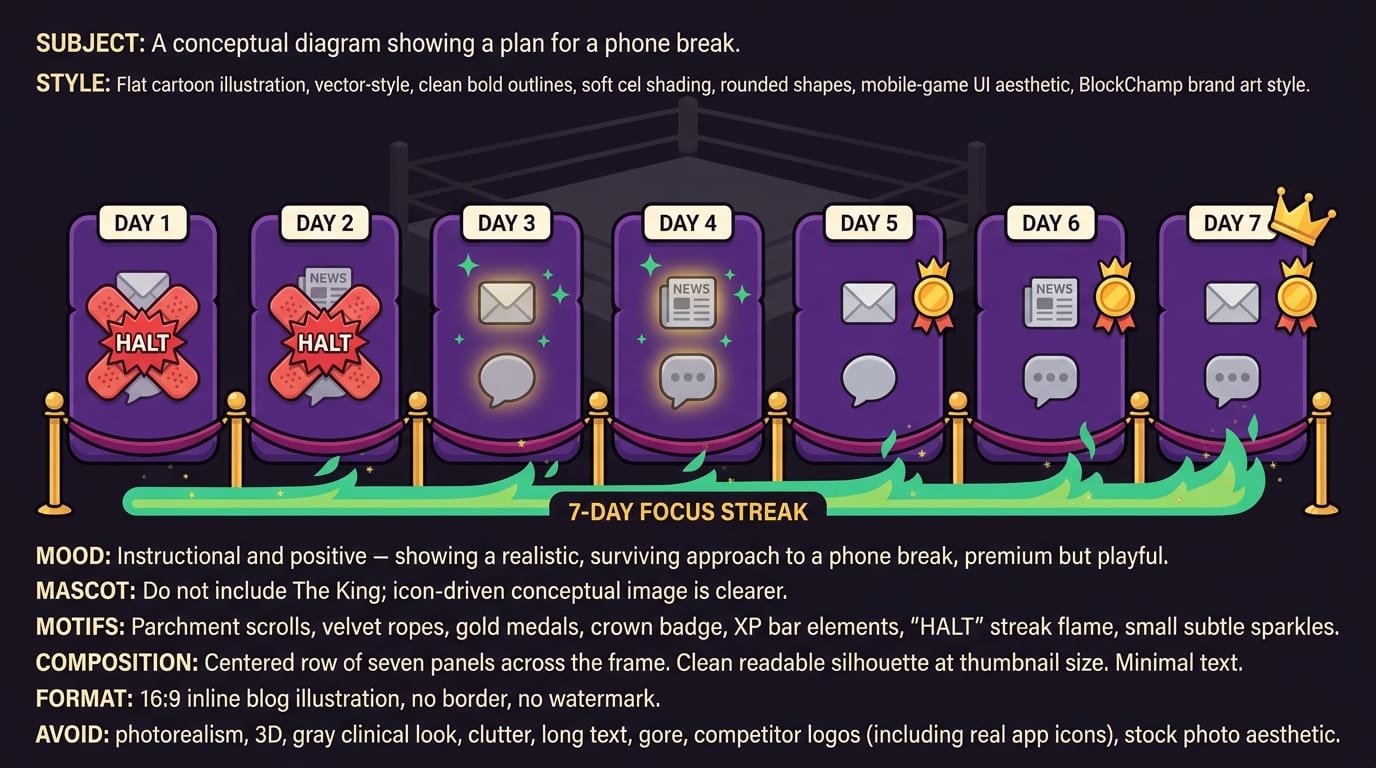
Step 6: Build a 7-Day Phone Break Plan You Can Actually Survive
You do not need to begin with a 30-day digital detox. In fact, please don’t if your current screen time looks like a part-time job. Start with seven days. Seven days is long enough to notice patterns but short enough that your brain won’t pack a tiny suitcase and flee.
Day 1: Measure and choose your target
Check your screen time. Pick one target: reduce total screen time by 25%, remove one problem app, or create one phone-free zone. Do not try to fix everything. A kingdom is not built in a day, unless you are playing a mobile game, which is exactly the problem.
Day 2: Notification purge
Turn off every notification that does not require timely action. Keep humans and essential services. Remove badges from social apps. Badge counts are tiny red panic cupcakes.
Day 3: Bedroom banishment
Charge your phone outside the bedroom. Use a real alarm clock. Put a book, journal, or glass of water where your phone used to sit. Replace the cue before your half-awake brain starts negotiating.
Day 4: App friction day
Delete or log out of the worst app. Move tempting apps off your home screen. Use grayscale. Add app limits. If you’re tempted to “just check on desktop,” set up BlockChamp and block the matching websites too. No loopholes for the peasants.
Day 5: Phone-free focus block
Do one 60 to 90 minute work or study block with your phone in another room. On your computer, block your usual distractions. Track how you feel afterward. Most people notice the first 10 minutes are itchy, then their brain stops doing cartwheels.
Day 6: Social reset
Replace passive scrolling with active connection. Text a friend to make plans. Call someone. Go outside. Sit at a café. Say hello to a dog, if permitted by the dog’s legal team.
Day 7: Review and adjust
Look at your screen time again. What improved? What broke? What was easier than expected? What caused the most cravings? Use the answers to design week two.
For more gentle, long-term habit building, read BlockChamp’s guide to mindful phone habits that don’t require becoming a hermit. The goal is not “never use your phone.” The goal is “use your phone on purpose.” Big difference. Crown-worthy difference.
Step 7: Protect Your Sleep Like It’s the Royal Treasury
If you only change one phone habit, start with sleep. Late-night scrolling is especially sneaky because it feels like rest, but it often delays actual rest. You get into bed tired, open one app, and suddenly it is 12:47 a.m. and you are watching a man restore a rusty waffle iron from 1912. Fascinating? Yes. Necessary? Your tomorrow-self is filing a complaint.
The Sleep Foundation explains that screens can affect sleep through blue light exposure, mental stimulation, and delayed bedtime routines. Their guide to how electronics affect sleep breaks down why devices before bed can make it harder to wind down.
Try this sleep-protection routine:
- Set a “phone sunset” 60 minutes before bed.
- Put your charger outside the bedroom.
- Use a boring bedtime replacement: paper book, stretching, shower, journaling, calm music.
- Keep a notepad nearby for thoughts instead of opening your notes app and accidentally checking everything.
- Use Do Not Disturb so only emergency contacts can reach you.
If 60 minutes feels impossible, start with 15. Then 30. Then 45. The point is not perfection. The point is building a ramp your brain can walk down instead of launching it off the TikTok cliff at midnight.
Step 8: Decide What “Healthy Phone Use” Looks Like After the Break
A break from your phone is not just about stopping. It is about returning differently. Otherwise, your detox ends and the apps throw a welcome-back parade with confetti made of your attention span.
Define your post-break rules before the break ends. This prevents the “I earned a scroll binge” trap. Yes, you deserve fun. No, you do not need to celebrate focus by feeding yourself to the algorithm like tribute.
Healthy phone rules that actually work
- Check messages at set times instead of constantly grazing.
- Keep social apps off the home screen permanently.
- Use app limits with passcodes or accountability if needed.
- Keep the bedroom phone-free even after the detox.
- Schedule entertainment instead of letting it colonize every spare second.
- Review screen time weekly like a scoreboard, not a moral trial.
Many experts recommend thinking in terms of intentional use rather than total abstinence. Pew Research Center’s work on mobile technology and digital life shows how deeply phones are woven into everyday routines, communication, and access to services. Their research on mobile technology and home broadband is a useful reminder that the goal is not to pretend phones are useless. The goal is to stop letting the most addictive parts drive the carriage.
If you are wondering what amount of phone time is “normal,” BlockChamp has a helpful breakdown of the right amount of time to spend on your phone. Spoiler: the answer depends less on the number and more on whether your phone use supports your life or quietly steals the crown jewels.
Common Phone Break Mistakes That Make People Relapse
Relapse is not a dramatic failure. It is data wearing a fake mustache. If your phone break falls apart, look for the weak point in the system.
Mistake 1: Going too extreme too fast
If you go from eight hours a day to “I shall only use my phone for maps and emergency carrier pigeons,” your brain may revolt. Start with one boundary and build.
Mistake 2: Keeping the same environment
If your phone is still next to your bed, on your desk, buzzing during meals, and glowing during movies, nothing has really changed. The throne room is still full of jesters.
Mistake 3: Not blocking desktop loopholes
Deleting apps from your phone does not help much if you open the same platforms in your browser. Pair phone limits with website blocking. If you are on Chrome, BlockChamp can block the desktop versions of your phone temptations and turn each resisted attempt into XP. Fancy? Yes. Effective? Also yes.
Mistake 4: Treating boredom as an emergency
Boredom is not a bug. It is where ideas, rest, and self-awareness often begin. You do not need to fill every elevator ride, grocery line, or 22-second pause with content. Let your brain idle. It has been trying to speak to you, but Instagram keeps interrupting with soup recipes and arguments about celebrities.
Mistake 5: Using shame as fuel
Shame may spark short-term change, but it is lousy long-term fuel. Curiosity works better. Ask, “What triggered me?” not “Why am I like this?” The first question builds a plan. The second question builds a cave where you fight imaginary goblins.

How to Make Your Phone Break Stick Long-Term
The best phone break is one that becomes part of your identity. Not “I am a person trying not to scroll,” but “I am a person who protects my attention.” That shift matters. You stop seeing boundaries as deprivation and start seeing them as self-respect with better posture.
Use visible wins to reinforce the identity. Track phone-free mornings. Mark calendar days when you kept your bedroom phone-free. Count deep work blocks completed. Celebrate streaks. Humans love progress bars because humans are basically houseplants with achievement systems.
This is exactly why BlockChamp uses XP, levels, badges, reigns, and a Hall of Champions leaderboard. Focus becomes something you build, not just something you endure. Every blocked site resisted is a tiny knockout. Every focused day strengthens your reign. Every time The King catches you trying to sneak into YouTube and sends you back to work, you get a funny little reminder: your time is worth defending.
Try pairing these long-term supports:
- A weekly screen time review
- A permanent no-phone bedroom rule
- Daily phone-free focus blocks
- Blocked desktop distractions during work hours
- A replacement hobby that gives real satisfaction
- Social accountability with a friend, partner, or study group
The secret is consistency, not purity. You will have messy days. You will check your phone too much sometimes. You may even open an app, forget why, and stare at it like a confused medieval guard. Fine. Reset. Re-arm your boundaries. Continue the reign.
Final Round: Take the Break, Keep the Crown
Taking a break from your phone is not about hating technology. It is about refusing to let your attention get mugged in broad daylight by apps with excellent color palettes. Your phone should be a tool, not a tiny glowing throne that rules your schedule, your sleep, and your mood.
Start simple. Audit your use. Pick one boundary. Remove triggers. Replace the habit. Protect sleep. Block loopholes. Review weekly. Make focus visible and rewarding. Do not wait until you feel perfectly motivated, because motivation is a flaky little court jester. Build the system first, and motivation can catch up wearing ridiculous shoes.
If your phone break keeps getting sabotaged by desktop distractions, let BlockChamp guard the gates on Chrome. Block the sites that drag you back in, earn XP for staying focused, survive The King’s stare-downs, and turn your attention span into a royal comeback story.
Long live your focus. Defend the throne. Crush the scroll. And for the love of all that is crowned and caffeinated, charge your phone outside the bedroom tonight.
Related posts

Finding Focus For Fiction Writing

Learning To Focus In A Digital World As A Creative

Finding Focus For Personal Growth
