
Screen Free Mornings

Your alarm goes off. You blink once. Suddenly you are 47 minutes deep in a stranger’s vacation photos, a breaking news thread, three weather apps, and a video of a raccoon stealing cat food like it pays rent. Congratulations: the tiny glowing rectangle has conquered the kingdom before breakfast.
That is why screen free mornings are having a moment. Not because screens are evil little demons with glass faces, but because the first hour of your day sets the tone for your attention, mood, energy, and decision-making. If your morning begins with notifications, algorithmic chaos, and “just checking one thing,” your brain starts the day in defense mode. You are not waking up. You are entering battle wearing pajamas.
The good news: creating screen free mornings does not require moving to a cabin, churning your own butter, or becoming the kind of person who says “I rise with the sun” unironically. It requires a plan, a few environment tweaks, and some clever friction between you and your digital temptations. Let’s build a practical, realistic morning routine that keeps your phone and laptop from body-slamming your focus before you have even located your socks.
Quick Answers
What Are Screen Free Mornings, Really?
Screen free mornings are intentional blocks of time after waking when you avoid phones, computers, tablets, TVs, gaming devices, and other attention-hijacking screens. For most people, this means the first 30 to 90 minutes of the day are reserved for offline activities: hygiene, breakfast, movement, journaling, reading, planning, or simply staring into the middle distance like a mysterious Victorian poet.
The goal is not perfection. The goal is to create a protected runway between sleep and the internet. Instead of letting email, TikTok, YouTube, Reddit, news alerts, Slack, Discord, or shopping apps decide your first thoughts, you decide. A radical concept, apparently.
Screen free mornings can look different depending on your life:
- Students: No phone until after shower, breakfast, and a 25-minute study review.
- Remote workers: No email, Slack, or news until after planning the day’s top three tasks.
- Parents: No scrolling until the kids are fed, dressed, and launched into the world like tiny cereal-powered rockets.
- Creators: No social media until after writing, sketching, filming, editing, or practicing.
- Everyone: No doomscrolling before coffee. That is not productivity. That is emotional dodgeball.
Think of a screen free morning as a boundary, not a punishment. You are not “depriving” yourself of your phone. You are giving your brain a few sacred minutes before the internet barges in wearing muddy boots.
Why Your First Scroll Hits So Hard
Mornings are vulnerable. Your brain is transitioning from sleep to wakefulness, your willpower is still stretching in the corner, and your attention has not yet chosen a direction. That makes the first input of the day especially powerful.
When you grab your phone immediately, you invite dozens of competing signals into your head: messages, likes, headlines, ads, calendar reminders, hot takes, cold takes, lukewarm takes, and one person from high school posting cryptic song lyrics. Your brain starts switching contexts before you have even brushed your teeth. Context switching is not free; it drains cognitive energy and makes it harder to settle into deep work later.
Research also suggests that heavy screen use can affect sleep, attention, and mental wellbeing. The Sleep Foundation explains how technology use can interfere with sleep, especially when screens creep into bedtime routines. And while morning screen use is not exactly the same as late-night blue light exposure, the pattern matters: if your phone is the last thing you see at night and the first thing you see in the morning, your day is basically a phone sandwich. Delicious? No. Disturbing? Yes.
There is also the design problem. Apps are built to keep you engaged. Infinite scroll, autoplay, notifications, streaks, and recommendation feeds are not there because someone in a hoodie whispered, “Let’s support human flourishing.” They are there because attention is valuable. According to DataReportal’s Digital 2024 Global Overview Report, people worldwide spend an average of several hours per day online, with social media taking a major slice of that attention pie. The pie is not gluten-free. It is made of your focus.
If you want your mornings back, you need to stop treating distraction like a character flaw and start treating it like a design challenge. The internet has a plan for your attention. Your morning needs one too.
The Screen Free Morning Rule: Start Small or Get Flattened
The fastest way to fail at screen free mornings is to declare, “From tomorrow onward, I shall never touch a device before noon.” Noble. Dramatic. Doomed.
Big lifestyle changes often collapse because they rely on heroic motivation. Motivation is great, but it has the structural integrity of a wet paper crown. Instead, start with a small, specific rule that is easy to repeat.
Try one of these beginner rules
- No phone for the first 15 minutes after waking.
- No social media until after breakfast.
- No email until after your first work block.
- No news before 10 a.m.
- No laptop until you have written your top three priorities for the day.
- No screens in bed, ever. The bed is for sleep, rest, and questioning why you said that weird thing in 2016.
Once your first rule feels normal, expand it. Fifteen minutes becomes thirty. No social media becomes no phone. No email until 9 becomes no email until after your most important task.
The secret is to make your morning boundary embarrassingly doable. If your current habit is waking up and immediately checking notifications, then a 10-minute delay is a win. Stack wins. Let the crown grow one tiny jewel at a time.
If you need more help setting digital limits without turning into a joyless productivity goblin, BlockChamp has a useful guide on creating screen time boundaries that actually stick. Boundaries work best when they are simple, visible, and supported by your environment.
Build a Screen Free Morning Routine That Does Not Feel Like Punishment
A common mistake is removing screens without replacing them. That leaves a vacuum. And what rushes into a vacuum? Dust, chaos, and your hand automatically reaching for your phone like it owes you money.
To make screen free mornings work, you need attractive alternatives. Not “sit silently and become enlightened by Thursday.” Real things. Useful things. Pleasant things. Things Future You will not hate.
A simple 60-minute screen free morning template
- Wake up with a non-phone alarm. Use an analog alarm clock or a sunrise alarm. Yes, they still exist. No, they are not illegal.
- Hydrate. Drink water before caffeine. Your brain has been offline all night, not marinating in espresso.
- Move for 5-15 minutes. Stretch, walk, do pushups, dance badly, salute the toaster. Just move.
- Get clean and dressed. This tells your brain, “We are a functioning citizen now.” Mostly.
- Eat something decent. Protein helps. A breakfast made entirely of vibes and panic is not ideal.
- Plan your day on paper. Write your top three priorities. Not twenty-seven. Three. We are building a kingdom, not a bureaucratic swamp.
- Do one offline focus activity. Read, journal, tidy, review notes, sketch, meditate, or prep for work.
You can compress this into 20 minutes or stretch it into 90. The structure matters more than the exact timing. Wake, reset your body, choose your priorities, then enter the digital world on purpose.
For people who want to understand the bigger upside of reducing screen time, check out BlockChamp’s deeper breakdown of the benefits of going screen free. Spoiler: your attention may stop feeling like a squirrel in a fireworks factory.

Put Your Phone in Exile: Environment Beats Willpower
If your phone sleeps next to your pillow, you are not practicing discipline. You are sleeping beside a casino with weather updates. The easiest way to create screen free mornings is to make screens physically inconvenient.
Your environment should make the right behavior easy and the wrong behavior annoying. Not impossible. Just annoying enough that your half-awake gremlin brain gives up.
Try these phone-proofing tactics
- Charge your phone outside the bedroom. Kitchen, hallway, desk drawer, tiny velvet throne room. Anywhere but arm’s reach.
- Use a real alarm clock. This removes the “I need my phone for my alarm” loophole, the sneakiest loophole in the kingdom.
- Put your phone in a box or drawer. Out of sight reduces automatic grabbing.
- Turn on Do Not Disturb overnight. Let only emergency contacts through if needed.
- Disable lock screen notifications. Notifications are tiny attention traps wearing badges.
- Keep a book, notebook, or water bottle where your phone used to be. Replace the cue with something better.
Behavioral science has long emphasized how cues shape habits. James Clear popularized this in Atomic Habits: make good habits obvious and easy, and make bad habits invisible or difficult. Your morning setup should do exactly that.
Do not rely on “I will simply not check my phone.” That is adorable. Put the phone somewhere inconvenient. Make the scroll walk across the room and explain itself.
Use Website Blocking for the Laptop Loophole
Phones get most of the blame, but laptops are sneaky little portals too. Maybe you successfully avoid your phone, open your computer “just to check the calendar,” and somehow land on YouTube watching a man restore a rusty wrench for 19 minutes. Beautiful craftsmanship. Terrible morning boundary.
This is where a website blocker becomes useful. If your screen free morning includes “no social media,” “no email,” “no news,” or “no video sites,” you can block those distractions before your willpower has to wrestle them barehanded.
BlockChamp is especially handy here because it is a gamified website blocker for Google Chrome that makes focus feel like leveling up instead of sitting in productivity detention. You can block specific sites like YouTube, Reddit, X/Twitter, Instagram, or news sites. You can also use category bundles to block entire groups such as Social Media, Video & Streaming, News, Shopping, Gaming, Gambling, Adult, and AI Distractions.
For screen free mornings, the practical setup might look like this:
- Block Social Media from wake-up until after your first focus block.
- Block News until mid-morning to avoid doomscrolling with cereal.
- Block Video & Streaming so “one quick clip” does not become a documentary about medieval plumbing.
- Use Pro scheduling to automatically activate morning blocks on weekdays.
- Turn on Hardcore Lockdown if you tend to disable blockers during weak moments.
BlockChamp’s Master Focus Toggle arms your blocks, and your “reign” continues as long as you do not surrender by turning focus off. If you try to visit a blocked site, The King gives you the Stare-Down: a full-screen royal judgment scene that basically says, “Nice try, peasant. Back to work.” It is funny, mildly humiliating, and weirdly effective.
The best part for morning routines: every focused minute earns XP. Every blocked-site temptation you survive earns XP. Every focused day builds your streak. Your morning boundary becomes a game, not a grim little spreadsheet of shame. Long live your focus.
The “No Input Before Output” Rule
One of the cleanest rules for screen free mornings is this: output before input.
Input is consuming: scrolling, reading the news, watching videos, checking email, browsing feeds. Output is creating or acting: writing, planning, exercising, cleaning, studying, making breakfast, sketching, practicing music, solving problems.
When you consume first, you give other people’s priorities first access to your attention. When you produce first, you begin the day with agency. That sounds fancy because it is. Put a crown on it.
Examples of output-before-input mornings
- Write 200 words before opening social media.
- Review flashcards for 20 minutes before checking messages.
- Plan your top three tasks before opening email.
- Walk around the block before reading news.
- Clean your desk before opening your laptop.
- Record one idea, riff, or sketch before consuming content.
This rule is powerful because it does not require you to reject screens forever. It simply says: earn your inputs by doing one meaningful thing first. The internet can wait. It has been yelling since 1997; it will manage another half hour.
If email is your biggest morning ambush, BlockChamp has a specific guide on protecting your mornings from email distraction. Email feels productive because it wears a little office costume, but it can still hijack your priorities before your day begins.

Design Habit Swaps That Are Actually Appealing
“Stop using your phone” is not a routine. It is a command. Commands fail when they do not give your brain a replacement reward. Your morning screen habit probably gives you novelty, stimulation, connection, escape, or a fake sense of preparedness. Your replacement should satisfy a similar need in a healthier way.
Here are common morning screen cravings and better swaps:
- If you crave stimulation: Try a brisk walk, upbeat music, stretching, or a cold splash of water. Less algorithm, more human.
- If you crave connection: Text one person intentionally after your screen-free window, or leave a handwritten note for someone at home.
- If you crave information: Write down what you need to know today, then check it later in a scheduled window.
- If you crave escape: Read fiction for 10 minutes, make good coffee, or sit outside. Escape does not have to come with autoplay.
- If you crave control: Plan your day on paper. Email can wait until you know what actually matters.
The trick is not to become less human. You are allowed to want novelty, comfort, and connection. The trick is to stop letting apps deliver those rewards in the most addictive format possible at the most fragile time of day.
The American Psychological Association’s advisory on social media use highlights how online platforms can influence attention, sleep, and wellbeing, particularly for younger users. Even if you are not a teen, the principle still applies: the design of your digital environment matters. Your morning brain deserves guardrails.
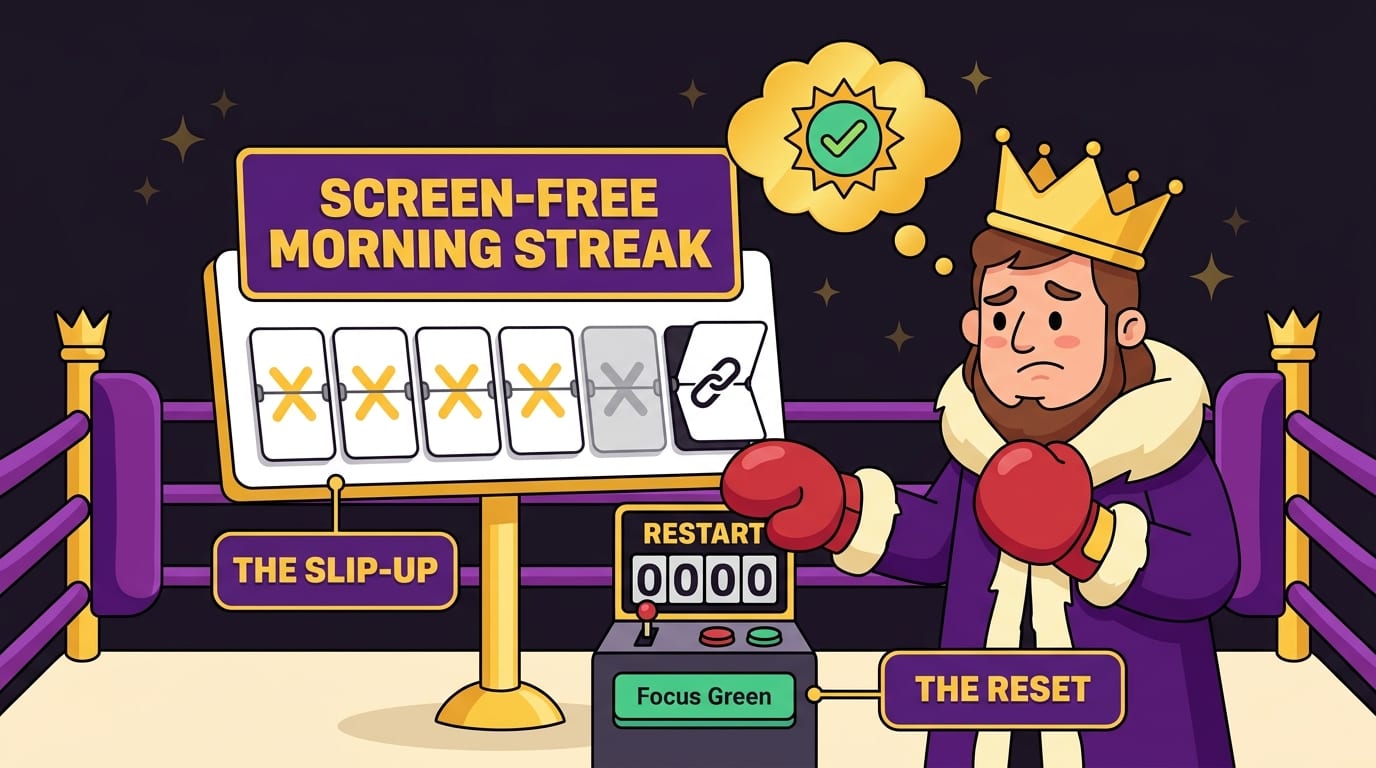
What to Do When You Break the Streak
You will mess up. You will check your phone. You will open a browser tab. You will tell yourself you are “just checking the weather” and then somehow learn the relationship status of a celebrity chef. This does not mean screen free mornings are impossible. It means you are a mammal with Wi-Fi.
The goal is consistency, not purity. If you slip, do a quick reset instead of declaring the whole day ruined. One scroll does not have to become a four-hour attention bonfire.
Use the 3-step morning reset
- Notice it. Say, “I’m scrolling.” No drama. No courtroom scene.
- Stop the next minute. Close the app, lock the phone, or shut the laptop.
- Do one physical action. Stand up, drink water, make the bed, step outside, or write your priorities.
This works because habits recover through action, not guilt. Guilt makes you feel like a tragic fallen knight. Action puts you back on the horse, even if the horse is just you walking to the kettle.
BlockChamp is built around this same idea. It rewards consistency, not perfection. If you hit a blocked site, you get the Stare-Down and a chance to go back to work. Survive the temptation, earn XP, protect your reign. The King may roast you, yes, but lovingly. Mostly.
A 7-Day Screen Free Morning Challenge
If you want to make this real, try a 7-day challenge. Not a vague “be better” challenge. A clear one. The crown likes clarity.
Day 1: Move the phone
Charge your phone outside the bedroom tonight. Set up a non-phone alarm if needed. Your mission is simply to not wake up with the phone in your hand like a cursed object.
Day 2: Choose your screen-free window
Pick 15, 30, 45, or 60 minutes. Write it down. “No screens until 7:30” is better than “less phone,” which is basically a fog machine pretending to be a goal.
Day 3: Create your replacement menu
List five offline morning activities you actually like. Examples: coffee on the balcony, stretching, reading, journaling, walking, making breakfast, reviewing notes, cleaning your desk, or sitting quietly like a wise potato.
Day 4: Block your biggest morning traps
If you use Chrome in the morning, set up BlockChamp to block your top distractions. Start with three sites on the free tier or use categories if your distractions travel in packs like digital wolves.
Day 5: Try output before input
Do one productive or creative thing before any digital consumption. Tiny counts. Ten pushups. One paragraph. Three priorities. One flashcard set. One cleaned surface. Momentum is momentum.
Day 6: Add a planning ritual
Write your top three priorities for the day on paper. This is your royal decree. Email and social media are not allowed to rewrite it before breakfast.
Day 7: Review and adjust
Ask three questions: What worked? What broke? What needs less drama? Adjust your routine so it fits your real life, not the imaginary version of you who wakes up glowing and drinks lemon water while journaling in calligraphy.
Want extra reinforcement? Pair this challenge with BlockChamp’s streaks, XP, and focus calendar. Your morning boundary becomes visible progress, which is far more motivating than quietly hoping your future self behaves.
Common Screen Free Morning Mistakes
Even smart people sabotage their screen free mornings with sneaky little mistakes. Let’s expose them in the town square.
Mistake 1: Keeping the phone nearby
If it is within reach, it will be reached. Put it elsewhere. Yes, even if you “only use it for the alarm.” That excuse has ruled long enough.
Mistake 2: Checking “useful” apps
Weather, calendar, email, banking, and messages can all become gateways. If you truly need one piece of information, get it intentionally and leave. Do not let “checking the temperature” become “watching seven reels about breakfast burritos.”
Mistake 3: Going too extreme
If you try to remove every screen for three hours when your current average is three seconds, you may rebound hard. Start smaller. Win daily.
Mistake 4: Forgetting work realities
Some people genuinely need to be reachable in the morning. Fine. Use Do Not Disturb exceptions, emergency contact settings, or a short check-in window. Screen free does not mean irresponsible. It means intentional.
Mistake 5: Treating one slip as failure
The moment after a slip is the real test. Reset quickly. Protect the rest of the morning. The throne is not lost because you glanced at one notification. It is lost when you shrug and let the scroll army through the gates.
How Screen Free Mornings Improve Focus, Calm, and Momentum
Screen free mornings help because they reduce reactive behavior. Instead of waking up and immediately responding to what everyone else wants, you create space to decide what matters. That can improve your sense of control, reduce anxiety, and make it easier to begin meaningful work.
There is also a compounding effect. A calmer morning often leads to better choices later: more focused work blocks, less compulsive checking, better meals, more movement, and fewer “where did the day go?” moments. Your morning is not everything, but it is a powerful first domino.
The concept also connects with digital wellbeing research. The Pew Research Center’s mobile technology research shows how deeply smartphones are woven into daily life. That is not automatically bad, but it does mean intentional boundaries matter. If a tool is always present, you need rules for when it is not invited.
For broader boundary ideas beyond the morning, BlockChamp also has a helpful post on practical screen time boundaries. Mornings are a great starting point, but the real win is building an attention system that supports your whole day.
Your Screen Free Morning Starter Kit
Here is the short version, because your brain deserves a tidy little battle plan:
- Move your phone out of the bedroom.
- Use a non-phone alarm.
- Pick a realistic screen-free window: 15 to 60 minutes.
- Choose replacement activities before tomorrow morning.
- Write your top three priorities on paper.
- Block laptop distractions like social media, news, and video sites.
- Use output before input: create, plan, move, or tidy before consuming.
- Recover quickly when you slip. No guilt parade required.
If you want a stronger system, use BlockChamp to block distracting websites during your morning window. Set your blocks, turn on Master Focus, and let The King stand guard while you become the kind of person who does not lose breakfast to a comment section. With XP, badges, reigns, and the occasional royal roast, it makes staying focused feel less like self-denial and more like winning a tiny daily championship.
Final Thought: Win the Morning, Don’t Worship It
Screen free mornings are not magic. They will not fold your laundry, heal your inbox, or make you suddenly enjoy cardio. Rude, but true. What they can do is give you a calmer, cleaner start. They help you choose your first thoughts, protect your attention, and stop the internet from declaring itself king before your feet hit the floor.
Start small. Move the phone. Block the traps. Replace the scroll with something useful or genuinely pleasant. Keep your routine human. If you slip, reset. If you improve by 10 minutes, that counts. If you make it a week, crown yourself dramatically. Confetti optional, but encouraged.
And if your laptop keeps trying to sneak YouTube, Reddit, email, or news into your sacred morning kingdom, let BlockChamp help you knock out your distractions. The King is ready. The throne is waiting. Your morning is yours to defend, champ.
Related posts

How To Stop Procrastinating When You Have Adhd

Why Do I Procrastinate 6 Ways To Stop Procrastinating Today

Where Theres A Will Theres A Way 5 Ways To Boost Your Willpower Self Control
