
How To Write A Phd With Focus

Learning how to write a PhD with focus is basically learning how to wrestle a giant academic octopus while it throws PDFs, supervisor comments, existential dread, and “quick” YouTube breaks at your face. Your thesis is not just a document. It is a multi-year boss fight with footnotes.
The good news? Focus is not a magical personality trait reserved for people who own linen notebooks and wake up at 5 a.m. smiling at oatmeal. Focus is a system. You can build it. You can protect it. You can train it like a tiny scholarly dragon. And yes, you can finish the beast without letting TikTok, email, Reddit, or “just one more article” eat your brain for lunch.
This guide breaks down practical, step-by-step strategies for writing a PhD with focus: goal-setting, research planning, time blocking, deep work routines, distraction control, revision habits, and sanity-preserving systems. We’ll also talk about how tools like BlockChamp can help you defend your writing throne by blocking digital temptations before they stage a coup.
Quick Answers
1. Define the Real PhD Goal: Not “Write a Thesis,” But “Finish a Defensible Argument”
One reason PhD writing feels so foggy is that “write my thesis” is a terrible goal. It is huge, vague, emotionally cursed, and about as actionable as “become a wise forest wizard.” To write a PhD with focus, you need a sharper target.
Your actual goal is to produce a defensible scholarly argument supported by evidence, positioned within existing research, and communicated clearly enough that your examiners do not need a treasure map and three espressos to understand it.
That means your focus should revolve around answering a few core questions:
- What is the central research question?
- What claim or contribution does the thesis make?
- What evidence supports that claim?
- How does each chapter serve the overall argument?
- What must be written now, and what can wait?
Notice that none of those questions are “How can I read 47 more papers to avoid drafting Chapter 3?” Sneaky academic procrastination wears a tweed jacket and calls itself preparation. Do not be fooled by Professor Procrastination.
Start by writing a one-page thesis map. Keep it ugly. In fact, ugliness is encouraged. A polished plan can become another procrastination shrine. Your thesis map should include your title or working title, your research question, your chapter list, and one sentence explaining the purpose of each chapter.
For example:
- Chapter 1: Introduces the problem, research question, contribution, and thesis structure.
- Chapter 2: Reviews the literature and identifies the gap.
- Chapter 3: Explains the methodology and why it fits the research question.
- Chapter 4: Presents findings from dataset/interviews/archives/experiments.
- Chapter 5: Interprets findings and connects them to the literature.
- Chapter 6: Concludes, states contribution, limitations, and future research.
This map becomes your compass. Every writing session should connect to it. If a task does not move one chapter forward, support your argument, or clarify your evidence, it may be a glittery distraction wearing academic shoes.
2. Build a Research Plan Before Your Brain Starts Collecting PDFs Like Pokémon
Research can be productive. Research can also become an endless swamp where “one more article” turns into three days of citation spelunking. If you want to write a PhD with focus, you need boundaries around reading and note-taking.
According to the American Psychological Association’s overview of learning and memory, effective learning depends heavily on organization, retrieval, and meaningful processing. Translation: your brain is not a junk drawer. Stop treating it like one.
Create a research plan with three levels:
- Core sources: The essential texts your thesis absolutely depends on.
- Supporting sources: Useful works that strengthen context, methods, or interpretation.
- Nice-to-have sources: Interesting but not mission-critical. The academic equivalent of decorative throw pillows.
For each chapter, decide how many sources you actually need before drafting. Not perfect. Not exhaustive. Enough. A focused PhD writer knows when reading is feeding the thesis and when it is feeding anxiety.
A good rule: if you have enough material to explain the debate, identify the gap, support your method, and position your argument, start writing. You can always add sources during revision. You cannot revise a blank page, even if that blank page is surrounded by 800 beautifully annotated PDFs.
Use a note template to keep research focused:
- Full citation
- Main argument
- Method or evidence used
- How it relates to your thesis
- One useful quote, if genuinely useful
- Chapter or section where it belongs
The final line is the magic one: “Where does this belong?” If you cannot answer that, the source may not deserve your attention right now. Send it to the “later dungeon.” It can think about what it did.
3. Turn the Thesis Into Tiny, Non-Terrifying Writing Targets
Focus loves specificity. Panic loves vagueness. “Work on thesis” is vague. “Draft 500 words explaining why semi-structured interviews fit my research question” is specific. One is a fog monster. The other is a punchable task.
Break your PhD into layers:
- Thesis
- Chapters
- Sections
- Subsections
- Paragraphs
- Sentences
Your daily writing target should live near the paragraph or subsection level. That is where focus becomes manageable. Do not sit down to “write methodology.” Sit down to write:
- 300 words on participant recruitment
- One paragraph defining your key concept
- A rough explanation of your coding process
- A transition between your literature review themes
- A bullet-point outline of findings section 4.2
Small targets reduce resistance because your brain can see the finish line. It may still complain, because brains are dramatic little goblins, but at least it knows what to do.
If you write for a living or want to build more consistent writing muscles, you may also like BlockChamp’s guide on finding focus to write for a living. Different writing battlefield, same enemy: distraction wearing a fake mustache.
4. Use Time Blocking Like a Scholar With a Sword
Time blocking is one of the most useful techniques for PhD writing because it removes the daily negotiation. You do not wake up and ask, “Should I write today?” You look at the calendar. The calendar says yes. The calendar is now your mildly bossy academic butler.
A focused PhD schedule should include different types of work blocks:
- Deep writing blocks: Drafting, argument-building, analysis, conceptual work.
- Light admin blocks: Email, forms, scheduling, file organization.
- Reading blocks: Focused source review with clear chapter relevance.
- Revision blocks: Editing structure, clarity, citations, and supervisor feedback.
- Recovery blocks: Walks, exercise, meals, sleep, and hobbies that remind you that you are not a bibliography in human form.
Research from the American Psychological Association on multitasking shows that switching tasks can reduce efficiency and increase cognitive load. For PhD students, this is huge. Every time you bounce from thesis writing to email to Slack to news to thesis again, your brain has to reload the mental universe. That loading screen costs you.
Try this weekly structure:
- Monday morning: planning and chapter priorities
- Tuesday to Thursday morning: deep writing blocks
- Afternoons: reading, analysis, citations, lighter revision
- Friday: review progress, supervisor tasks, next week setup
Your exact schedule will depend on teaching, lab work, fieldwork, family, jobs, health, and the mysterious university meetings that appear from nowhere like academic mushrooms. But the principle stays the same: protect your best brain hours for the hardest writing.
If mornings are your sharpest time, do not spend them formatting references unless a deadline is breathing fire. Use them for argument, analysis, and drafting. References can wait until your brain is slightly soupier.
5. Create a Deep Work Ritual So Your Brain Knows It’s Thesis Time
Deep work is sustained attention on cognitively demanding tasks. A PhD basically requires it. Unfortunately, modern internet life trains the opposite skill: shallow hopping between tabs like a caffeinated squirrel.
Cal Newport popularized the term deep work, and while you do not need to move to a cabin and communicate only by carrier pigeon, the idea matters. Focus improves when you make deep work repeatable. A ritual tells your brain, “We are entering the thesis cave now. Bring a torch.”
Here is a simple deep work ritual for PhD writing:
- Choose one writing target before the session starts.
- Open only the documents needed for that target.
- Put your phone out of reach or in another room.
- Turn on a website blocker for distracting sites.
- Set a timer for 45 to 90 minutes.
- Write badly, clearly, or messily. Just write.
- End by noting the next tiny step.
That last step is underrated. Ending a session with “Next: explain limitation of sample size” makes it far easier to restart tomorrow. Ending with “continue thesis” is how you summon the fog monster again.
This is where BlockChamp can genuinely help. During your deep work ritual, you can block social media, video, news, shopping, gaming, gambling, adult sites, and even AI distraction categories. If your thesis session does not require YouTube, Reddit, X/Twitter, TikTok, or “researching laptop stands for optimal scholar posture,” block them. The King will stand guard. If you try to sneak into a blocked site, you get The Stare-Down: a full-screen royal boxer judging your life choices. Honestly, some dissertations need exactly that energy.
For more writing-specific focus strategies, check out these focus tips for freelancers and writers. PhD writing has different stakes, but the attention mechanics are painfully similar.
6. Control Digital Distractions Before They Control Your Thesis
Let us speak plainly. Your willpower is not designed to defeat billion-dollar attention machines all day. Social platforms, streaming sites, news feeds, and recommendation engines are built to keep you clicking. The thesis document, tragic little rectangle that it is, cannot compete with an algorithm wearing glitter pants.
Data from DataReportal’s Digital 2024 Global Overview Report shows that people spend enormous amounts of time online each day, with social media taking a major slice of attention. Meanwhile, Pew Research Center’s social media fact sheet highlights just how widespread platform use has become across age groups. In other words: if you struggle to focus, you are not broken. You are living inside a casino with push notifications.
For PhD work, the danger is not only obvious procrastination. It is micro-distraction:
- Checking email “just in case.”
- Opening news during a difficult paragraph.
- Searching one term and falling into unrelated papers.
- Using AI tools for help, then wandering into prompt experiments for two hours.
- Watching one “methodology explanation” video and waking up in a cooking channel.
Set rules before the session starts. Do not decide mid-urge. Mid-urge you is a terrible prime minister.
Try this distraction defense plan:
- Block your known danger sites during writing hours.
- Use one browser window for thesis work only.
- Keep a “later list” for random thoughts instead of chasing them.
- Check email at fixed times, not whenever your anxiety rings the doorbell.
- Use full-screen mode when drafting.
- Disable nonessential notifications.
BlockChamp’s focus schedule is especially useful for PhD students who want recurring protection. You can set blocks to activate during your regular thesis hours, so the kingdom is guarded automatically. Champion users can also use Hardcore Lockdown, which makes turning focus off intentionally inconvenient through a cooldown timer or boxing-riddle mini-game. Because sometimes your future doctor self needs protection from your present “just five minutes of Reddit” self.
7. Write First, Polish Later: The Drafting Rule That Saves Souls
Many PhD students struggle because they try to write perfect sentences too early. This is like trying to decorate a castle before building the walls. Nice curtains, shame about the missing roof.
Drafting and editing are different cognitive tasks. Drafting is generation. Editing is refinement. If you mix them constantly, you slow both down.
During drafting, your job is to get the argument onto the page in a usable form. Not elegant. Not final. Usable. Think “clay,” not “statue.”
Use drafting phrases to keep moving:
- “What I am trying to argue here is…”
- “This matters because…”
- “The key point from this literature is…”
- “In relation to my research question…”
- “A possible limitation is…”
These phrases may not survive revision, and that is fine. They are scaffolding. Scaffolding is not supposed to be pretty. It is supposed to stop the building from collapsing on your academic head.
A strong PhD writing workflow often looks like this:
- Outline the section in bullets.
- Draft quickly using rough language.
- Leave gaps where citations or details are missing.
- Return later to add evidence and polish structure.
- Revise for clarity, argument, and flow.
If you get stuck, switch from prose to bullets. If bullets feel hard, talk out loud and transcribe the idea. If that still fails, write a deliberately bad paragraph. Bad paragraphs are not failure. They are raw material. Blank pages are the real villain.
8. Build a Revision System That Does Not Require Crying Into a Spreadsheet
Revision is where a PhD becomes a thesis instead of a pile of smart fragments wearing a trench coat. But revision can be overwhelming because everything seems important: structure, argument, theory, evidence, style, citations, formatting, supervisor comments, and that one paragraph you have hated since 2022.
To revise with focus, separate revision into passes. Do not try to fix everything at once. That way lies madness, snacks, and opening seventeen tabs about “how to quit academia and raise goats.”
Pass 1: Argument and Structure
Ask whether the chapter has a clear purpose. Does each section move the argument forward? Are there sections that repeat, wander, or show off knowledge that does not serve the thesis? Be ruthless but fair. The goal is not to display everything you know. The goal is to make the examiner understand why your argument works.
Pass 2: Evidence and Citations
Check whether claims are supported. Add citations where needed. Remove citation clutter where five sources are doing the job of one. Make sure key scholars are represented accurately. Examiners enjoy accuracy. Funny little habit of theirs.
Pass 3: Paragraph Flow
Each paragraph should usually have one main idea, evidence or explanation, and a link back to the section’s purpose. If a paragraph contains six ideas and a surprise theory detour, split it. No paragraph should need its own passport.
Pass 4: Style and Clarity
Shorten long sentences. Define terms. Remove filler. Replace vague phrases with precise ones. Academic writing does not need to be fancy to be smart. In fact, clear writing often demonstrates stronger command because readers can actually follow the thought without needing emergency biscuits.
Pass 5: Formatting and Final Checks
Only do formatting near the end. Formatting too early is procrastination wearing a tiny graduation hat. Save reference style, table numbering, margins, and consistency checks for late-stage revision blocks.
If you do writing-adjacent research, journalism, or reporting alongside your PhD, this piece on focus for writing and reporting offers useful crossover tactics for managing sources, deadlines, and attention.
9. Work With Your Supervisor Without Turning Feedback Into a Thunderstorm
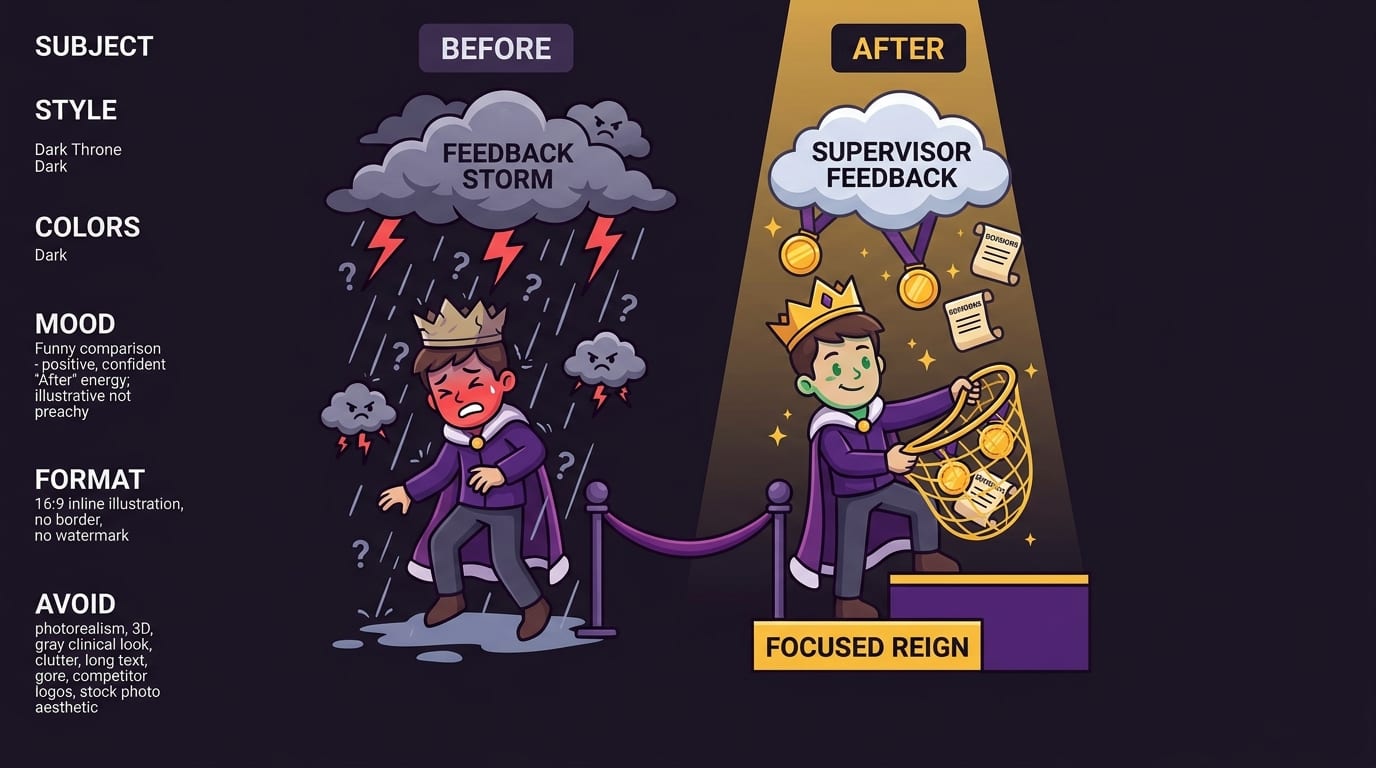
Supervisor feedback is essential, but it can also feel like someone took a red pen to your soul. The trick is to process feedback as data, not judgment. Easier said than done, obviously. We are scholars, not stone gargoyles.
When you receive comments, do not immediately rewrite everything in a panic. First, categorize the feedback:
- Major structure: Chapter order, missing sections, unclear argument.
- Conceptual issues: Theory, definitions, research contribution.
- Evidence issues: More support needed, weak examples, missing sources.
- Style issues: Clarity, repetition, sentence-level edits.
- Questions: Places where the supervisor did not understand your intention.
Then turn comments into tasks. “This section is unclear” becomes “Rewrite section opening to state the claim in one sentence.” “Engage more with X literature” becomes “Add 3 paragraphs comparing my approach with Author A and Author B.”
Focused PhD writing depends on converting emotional fog into concrete next actions. Feedback hurts less when it becomes a checklist. Still annoying, yes. But now it is an annoying checklist, and checklists can be defeated.
Before your next meeting, prepare three things:
- What you changed since last time
- What you are unsure about
- What decision you need from your supervisor
This keeps meetings focused and reduces the dreaded “interesting discussion” that lasts an hour but produces no next steps. Interesting is nice. Actionable is better.
10. Protect Your Energy: Focus Starts With Not Becoming a Crispy Academic Pancake
You cannot write a PhD with focus if you are permanently exhausted, underfed, isolated, and surviving on caffeine fumes and spite. Spite is powerful, but it is not a complete nutrition plan.
Sleep, movement, food, and breaks are not “extras.” They are part of the writing system. Cognitive work depends on physical capacity. The CDC notes that sleep affects thinking, mood, and overall health, which is deeply inconvenient but true. Your brain is the tool. Please stop treating it like a rental scooter.
Build recovery into your week:
- Take short breaks between writing blocks.
- Walk after intense sessions to process ideas.
- Keep at least one low-work evening if possible.
- Schedule social time before isolation starts whispering nonsense.
- Use exercise as a thinking tool, not just a health chore.
Digital rest matters too. If your breaks involve the same screen that just exhausted you, they may not be real breaks. Sometimes the most radical productivity move is standing outside like a confused medieval villager and letting your nervous system remember clouds exist.
For more on this, BlockChamp has a helpful post on why focus starts with self-care and unplugging. It is not fluffy wellness confetti. It is maintenance for the thesis machine.
11. A Practical Weekly System for Writing a PhD With Focus
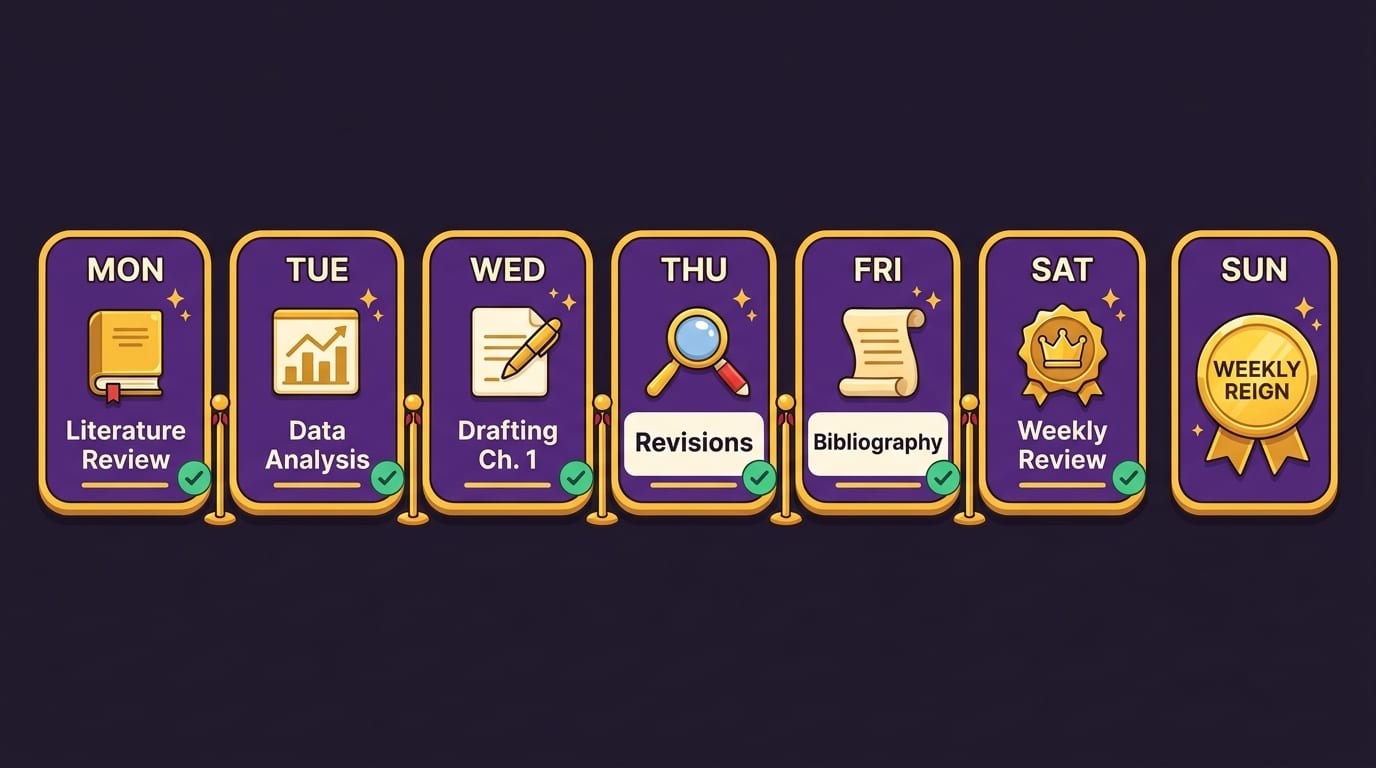
Let’s pull this together into a simple weekly workflow. Adjust it to your discipline, deadlines, and life responsibilities. The point is not perfection. The point is rhythm.
Monday: Command the Kingdom
Review your thesis map. Choose one primary chapter goal for the week. Break it into three to five writing tasks. Schedule deep work blocks. Activate your website blocker during those blocks. Tell The King where to stand guard.
Tuesday to Thursday: Draft Like a Determined Gremlin
Use your best energy for writing. Start each session with one tiny target. Keep a “later list” open for distractions, missing citations, and random ideas. Do not chase them during drafting. Let them sit there like peasants outside the castle gate.
Friday: Revise, Review, Reset
Read what you wrote. Clean up the worst bits. Note what needs evidence, restructuring, or supervisor input. Decide the first task for next week so Monday-you does not wander around the document like a lost raccoon.
Daily Minimum: Keep the Thread Alive
On bad days, do a 20-minute minimum: outline a paragraph, read one source, revise one page, or write 150 words. Momentum matters. A PhD is not built only in heroic 6-hour sessions. It is built in repeated returns.
BlockChamp’s gamified system fits nicely here because it rewards consistency. Every focused minute earns XP. Every focused day builds your reign. Every blocked-site attempt you survive becomes a tiny victory instead of a shame spiral. You are not just avoiding distractions; you are leveling up your academic discipline. Ridiculous? Slightly. Effective? That is the point.
12. Common Focus Traps PhD Students Fall Into
Even smart, disciplined researchers fall into predictable traps. Spotting them early helps you dodge them like an over-caffeinated academic ninja.
Trap 1: Waiting for a Full Free Day
A full free day sounds lovely. It also tends to evaporate into laundry, email, errands, and an accidental documentary about deep-sea creatures. Use smaller blocks. Ninety focused minutes can beat a chaotic eight-hour “writing day.”
Trap 2: Confusing Reading With Progress
Reading is progress only when it supports a defined writing goal. Otherwise, it can become intellectual hoarding. If your notes do not connect to a chapter, they may be clutter.
Trap 3: Editing While Drafting
This creates slow, painful writing sessions where one sentence gets polished into a tiny diamond while the chapter remains unwritten. Draft first. Polish later. The crown gets buffed after the battle.
Trap 4: Keeping Distractions “Available Just in Case”
If a site repeatedly derails you, block it during thesis hours. Do not keep the dragon in the living room and act surprised when it eats the sofa.
Trap 5: Measuring Only Word Count
Word count matters, but PhD progress also includes outlining, analysis, restructuring, reading strategically, and revising. Track meaningful outputs: sections drafted, arguments clarified, feedback addressed, sources integrated.
Conclusion: Defend the Thesis Throne, Champ
Learning how to write a PhD with focus is not about becoming a productivity robot with perfect posture and no feelings. It is about building a system that helps you return to the work again and again: clear goals, realistic research boundaries, tiny writing targets, protected deep work blocks, smart revision passes, and recovery that keeps your brain from turning into soup.
Your thesis does not need daily genius. It needs repeated attention. It needs you to stop letting distractions stroll into the kingdom and put their muddy boots on the literature review.
Start small today. Write your thesis map. Pick one section. Schedule one deep work block. Block your top distractions. Draft badly, then revise bravely. And if your browser tries to lure you into a doomscrolling swamp, let BlockChamp stand guard with a crown, boxing gloves, XP, streaks, and The King’s deeply unnecessary but highly motivating stare-down.
Long live your focus. Defend the throne. Finish the thesis.
Related posts

Finding Focus For Fiction Writing

Learning To Focus In A Digital World As A Creative

Finding Focus For Personal Growth
