
How To Focus On Homework

Learning how to focus on homework should not feel like preparing for battle against a thousand tiny goblins named TikTok, YouTube, “one quick snack,” and “I should reorganize my desk alphabetically.” But here we are. Homework requires your brain to sit still long enough to understand algebra, write paragraphs, memorize biology terms, or read 38 pages about a historical treaty everyone signed while wearing itchy pants.
The good news: focus is not a magical personality trait reserved for people who own color-coded highlighters and say things like “I just love getting ahead.” Focus is a skill. More importantly, it is a system. If your homework routine depends on willpower alone, you are basically sending a paper umbrella into a hurricane. Noble. Dramatic. Useless.
This guide gives you a practical, step-by-step system for how to focus on homework: setting up your environment, using time-blocking, managing digital distractions, building routines, training your attention, and recovering when your brain wanders off like an unsupervised raccoon. Let’s defend the study throne, champ.
Quick Answers
1. Start With the Real Problem: Your Brain Is Not Broken, It Is Overbooked
If you keep asking, “Why can’t I focus on homework?” the answer is probably not “because I am lazy.” Lazy is an insult your brain invented while avoiding Spanish verbs. The more accurate answer is that your attention is being pulled in too many directions.
Modern students are doing homework in a world where entertainment is instant, social updates never stop, and every app is competing to become your tiny pocket overlord. Research from the American Psychological Association on multitasking shows that switching between tasks can reduce efficiency because the brain pays a mental “switching cost.” Translation: every time you jump from math homework to messages to YouTube to math again, your brain has to reload the homework like an ancient computer wheezing awake.
This is why “just try harder” is terrible advice. If your environment is full of tempting tabs, buzzing notifications, and open loops, focusing on homework becomes unnecessarily difficult. You do not need more guilt. You need fewer traps.
Before you start any homework session, do a quick “attention audit.” Ask:
- What usually distracts me first?
- What sites or apps do I open automatically?
- What time of day do I focus best?
- Do I know exactly what homework task I am starting with?
- Is my workspace helping me focus, or is it a snack museum with a laptop?
If your main issue is digital distraction, use a tool built for that exact problem. BlockChamp is a gamified website blocker for Chrome that lets you block distracting sites, keywords, and categories like Social Media, Video, News, Gaming, Shopping, and AI Distractions. Instead of a boring “site blocked” page, The King gives you a full-screen Stare-Down and sends you back to work. Is it slightly ridiculous? Yes. Does ridiculous work when your brain wants Reddit? Also yes.
If you want a deeper dive into the distracted brain, read BlockChamp’s guide on why you can’t focus and what to do about it. It pairs nicely with this homework plan, like peanut butter and academic survival.
2. Make Homework Stupidly Clear Before You Begin
One of the biggest reasons students lose focus is that the task is too vague. “Do homework” is not a task. It is a foggy swamp. Your brain looks at it, sees no clear path, and immediately suggests checking Instagram as a “warm-up.” Sneaky little goblin.
To improve concentration, define the next action before you sit down. Not the whole mountain. Just the next climbable rock.
Bad homework goals:
- Study chemistry.
- Work on essay.
- Do math.
- Catch up.
Better homework goals:
- Complete chemistry worksheet questions 1–12.
- Write the introduction paragraph for my essay.
- Finish 20 algebra problems and check odd-numbered answers.
- Read pages 44–58 and write five bullet-point notes.
Specific tasks reduce decision fatigue. You are no longer negotiating with your brain about what to do. You are simply executing the next move. Very royal. Very efficient. The peasants are impressed.
Try this simple pre-homework planning method:
- Write down every homework assignment due soon.
- Circle the task with the nearest deadline or highest importance.
- Break that task into pieces that take 10–30 minutes.
- Choose the first piece only.
- Set a timer and begin.
For example, if you have a history essay due Friday, do not write “history essay” on your to-do list and expect your brain to salute. Break it into: choose thesis, find three sources, outline body paragraphs, write intro, draft paragraph one, draft paragraph two, revise, proofread. Suddenly the dragon is just a lizard with paperwork.
3. Build a Homework Routine That Trains Your Brain Like a Tiny Academic Boxer
Your brain loves cues. A routine tells it, “Ah yes, now we do the thing.” Without a routine, every homework session starts with a negotiation. And your brain is a terrible negotiator because it will trade your GPA for 14 minutes of “just one video.”
A strong homework routine does not need to be fancy. In fact, simple is better. The goal is to repeat the same sequence often enough that starting becomes automatic.
A simple homework start ritual
- Put your phone away or across the room.
- Open only the tabs you need.
- Turn on your website blocker or focus mode.
- Write the exact task you are starting.
- Set a timer for your first focus block.
- Begin before your brain files an appeal.
That last step matters. Do not wait until you “feel ready.” Motivation often arrives after action, not before it. You start the worksheet, your brain complains for five minutes, then it settles down because apparently we are doing this now. Excellent. The kingdom is secure.
Consistency also helps your body and brain predict study time. If possible, schedule homework at the same time each day: after school, after dinner, or during a dedicated evening block. According to UNC Learning Center’s study guidance, studying smarter involves planning, active learning, and avoiding marathon cram sessions. A routine makes those habits easier to repeat.
If you use BlockChamp, the Pro Focus Schedule can automatically turn blocks on during your homework hours. That means when 7:00 p.m. hits, The King stands guard. No ceremony. No debate. No “but maybe I need YouTube for research” followed by 27 minutes of raccoon videos. The throne has rules.

4. Use Time-Blocking So Homework Does Not Expand Like Cursed Dough
Homework has a weird magical property: if you give it the whole evening, it will eat the whole evening. This is why time-blocking is one of the best strategies for how to focus on homework effectively.
Time-blocking means assigning a specific task to a specific chunk of time. Instead of “I’ll do homework tonight,” you decide: “From 6:30 to 7:00, I’ll complete biology notes. From 7:10 to 7:40, I’ll do algebra problems.” This gives your brain boundaries. It also creates urgency without panic, which is the productivity sweet spot. Like coffee, but less likely to make you vibrate.
Try the 30/10 homework block
For many students, 30 minutes of work followed by 10 minutes of break is a good starting rhythm. It is long enough to make progress and short enough that your brain does not stage a coup.
- 30 minutes: focused homework on one task only.
- 10 minutes: stand up, stretch, drink water, use the bathroom, stare out a window like a Victorian poet.
- Repeat 2–4 times depending on workload.
If 30 minutes feels impossible, start with 15. If you are in a groove, stretch to 45 or 50. The perfect study block is the one you can actually repeat without becoming a burnt pancake.
You can also use the Pomodoro Technique, commonly structured as 25 minutes of work followed by 5 minutes of rest. The Todoist guide to the Pomodoro Technique explains how timed sessions can help reduce procrastination and make big tasks feel less intimidating.
A sample homework time-block plan
- 4:00–4:10 — Reset: snack, water, clear desk.
- 4:10–4:40 — Math worksheet problems 1–15.
- 4:40–4:50 — Break: walk around, no social apps.
- 4:50–5:20 — English reading pages 22–35.
- 5:20–5:30 — Break.
- 5:30–6:00 — Science notes and flashcards.
- 6:00–6:05 — Write tomorrow’s first task.
Notice the final step: write tomorrow’s first task. This prevents the dreaded “what was I doing again?” fog. Future-you deserves a map. Present-you can stop leaving future-you in the wilderness with a granola bar and vibes.
5. Block Digital Distractions Before They Challenge You to a Duel
If your homework happens on a computer, your biggest enemy is probably not the assignment. It is the tab one inch away from the assignment. The internet is an all-you-can-eat buffet of distraction, and your homework is sitting sadly next to the salad bar.
Attention is easier to protect before temptation appears. Once you are already on TikTok, YouTube, Reddit, Discord, Netflix, or a news site, you are negotiating from enemy territory. Better to close the gate before the invading army arrives wearing meme armor.
Here is a practical digital distraction checklist:
- Close all unnecessary browser tabs.
- Log out of social media on your homework device.
- Turn off notifications for messages, email, and apps.
- Use full-screen mode for writing or reading.
- Block your top distraction sites during homework hours.
- Keep your phone out of reach, not face-down beside you like a forbidden waffle.
BlockChamp is especially useful here because it lets you block by site, category, or keyword. Free users can block up to 3 sites and 2 categories, which is enough to knock out the usual suspects. Champion users can block unlimited sites, all 8 categories, and even keywords. If “NBA trade rumors,” “makeup haul,” “Minecraft,” or “celebrity drama” keeps derailing you, keyword blocking can help put those rabbit holes in the dungeon.
The best part is that BlockChamp turns staying focused into a game. You earn XP for focus time, daily active blocks, surviving Stare-Downs, and maintaining your reign. That matters because consistency feels better when you can see progress. Instead of “ugh, I’m restricting myself,” the feeling becomes “I am leveling up, peasants.” Different energy. Better cape.
For more on why digital temptation feels so sticky, read BlockChamp’s dopamine reset focus guide. It explains how reward loops can hijack your attention and how to make your brain slightly less obsessed with shiny internet confetti.
6. Use Active Study Methods So Your Brain Does Not Fall Asleep Standing Up
Sometimes students think they cannot focus when the real problem is that their study method is too passive. Re-reading notes for 45 minutes can feel productive, but your brain may be quietly napping behind its eyes. Rude, but understandable.
Active studying forces your brain to do something with the information. It improves concentration because you are engaging, recalling, solving, explaining, and applying. Basically, you make your brain pick up the academic dumbbells.
Try these active homework techniques
- Practice retrieval: close your notes and write down everything you remember.
- Teach it out loud: explain the concept as if teaching a confused squirrel. Bonus points if the squirrel passes.
- Use flashcards: especially for vocabulary, formulas, dates, and definitions.
- Do practice problems: do not just watch someone solve math; solve it yourself.
- Summarize each section: after reading, write a one-sentence summary in your own words.
- Make mini-quizzes: turn headings into questions and answer them later.
Research on learning consistently supports active recall and practice testing. The American Psychological Association’s overview of learning and memory strategies notes that retrieval practice is a powerful way to strengthen memory. In normal human language: trying to remember information helps you remember it better than just staring at it until your soul leaves your body.
Active methods also make homework less boring. Boredom is one of the fastest roads to distraction. If you want a whole royal sermon on why boredom matters for deep focus, BlockChamp has a great post on the lost art of boredom and deep focus. Spoiler: sometimes your brain needs fewer fireworks to do better work.

7. Design Your Study Space Like a Focus Arena, Not a Chaos Cave
Your environment gives your brain instructions. A messy bed with your phone, snacks, gaming controller, laundry pile, and open laptop says, “We might study, nap, scroll, eat crackers, or emotionally spiral.” Not ideal. A clean desk with one assignment, water, timer, and necessary materials says, “We are here to work.” Much better. The King approves.
You do not need a Pinterest-perfect study nook with plants named Oliver and sunlight angled like a productivity commercial. You need a space that reduces friction and distractions.
Set up your homework zone
- Keep only the materials you need for the current task on your desk.
- Use a comfortable chair, but not so comfortable that you become soup.
- Keep water nearby so thirst does not become a side quest.
- Use headphones or background noise if your home is loud.
- Put your phone in another room, backpack, drawer, or with a trusted human guard.
- Keep a “distraction note” nearby to write down random thoughts instead of acting on them.
The distraction note is underrated. When your brain says, “We should look up whether penguins have knees,” write “penguin knees” on the note and return to work. You are not suppressing the thought; you are postponing it. Later, during your break, you may discover penguin anatomy like a responsible scholar of weirdness.
If you cannot control your environment because you share a room, live in a noisy house, or study in a busy space, focus on controlling what you can: your browser, headphones, task list, timer, and phone location. Even small improvements stack up.
8. Take Better Breaks: Rest Without Falling Into the Scroll Swamp
Breaks are not the enemy. Bad breaks are the enemy. A good break refreshes you. A bad break throws you into a content pit where time disappears and suddenly it is tomorrow.
The most dangerous break is “I’ll just check my phone for five minutes.” This is how empires fall. Social feeds are designed for endless scrolling, and they do not politely say, “Dear student, your five-minute break has concluded.” They say, “Here is a raccoon stealing pizza. Also, your friend posted. Also, breaking news. Also, 900 comments from strangers arguing about soup.”
Use breaks that reset your body without hijacking your brain:
- Stand up and stretch.
- Walk around the room or outside.
- Drink water.
- Eat a simple snack.
- Do 10 squats or push-ups if you enjoy being dramatic.
- Look out a window and let your eyes rest.
- Tidy one small thing.
Avoid break activities that are hard to stop:
- Short-form video apps.
- Gaming “for one match.” Famous last words.
- Group chats that explode into chaos.
- News feeds.
- Shopping apps.
- Anything with autoplay.
If you do use BlockChamp, keep your distracting categories blocked during breaks. That way your break stays a break instead of becoming a full royal surrender. With Hardcore Lockdown on Champion, turning focus off requires either a cooldown timer or a boxing riddle. It is funny, but it also creates enough friction for the impulse to pass. Sometimes all your future needs is a cartoon king in boxing gloves saying, “Absolutely not, champ.”

9. Manage Energy, Not Just Time
You can schedule homework perfectly and still struggle if you are tired, hungry, stressed, or running on three hours of sleep and a suspicious energy drink. Focus depends on energy. Your brain is an organ, not a motivational poster.
Sleep is especially important. The CDC explains that sleep supports learning, memory, attention, and overall health. If you consistently do homework late at night when your brain is mush wearing headphones, focusing will be harder. Not impossible. Just harder than it needs to be.
Use your energy patterns wisely:
- Do difficult homework when you are most alert.
- Save easier tasks, like formatting or organizing notes, for lower-energy times.
- Eat before long homework sessions if hunger distracts you.
- Take movement breaks to wake up your body.
- Avoid starting with the easiest task every time if the hard task keeps getting pushed into midnight goblin hours.
If you are burned out, your focus problems may need a recovery plan, not another productivity hack taped to a sinking ship. BlockChamp’s guide on burnout and focus recovery is helpful if you feel mentally cooked, crispy, or lightly charred around the edges.
Also, be realistic with your workload. If you have four hours of assignments after a full school day, sports practice, chores, and family obligations, you are not weak for struggling. You are human. Build systems, ask for help when needed, and avoid pretending you can operate like a laser-powered homework robot. Those are not real. Yet.
10. Use the “Restart Rule” When You Lose Focus
You will get distracted sometimes. Everyone does. The difference between students who recover and students who spiral is not perfection. It is the restart.
The restart rule is simple: when you notice you are off task, return to the next tiny action without self-roasting for 20 minutes. A little roast is fine. A full courtroom drama is not productive.
Use this sequence:
- Notice the distraction: “I am off task.”
- Close or remove the distraction.
- Take one breath.
- Look at your written homework task.
- Do the next tiny action for two minutes.
Two minutes matters because starting again is usually the hardest part. Tell yourself, “I only have to work for two minutes.” Once you restart, momentum often returns. If it does not, you still made progress and protected the habit.
This is where BlockChamp’s Stare-Down is weirdly useful. If you try to open a blocked site, The King catches you, shows what you tried to visit, reminds you not to lose your reign, and gives you a clear button back to work. No vague guilt cloud. Just: “Caught. Back to the assignment.” It turns distraction into a checkpoint instead of a disaster.
Focus is not about never falling. It is about falling less often, recovering faster, and eventually becoming the kind of person who sees a distraction and thinks, “Not today, peasant website.”
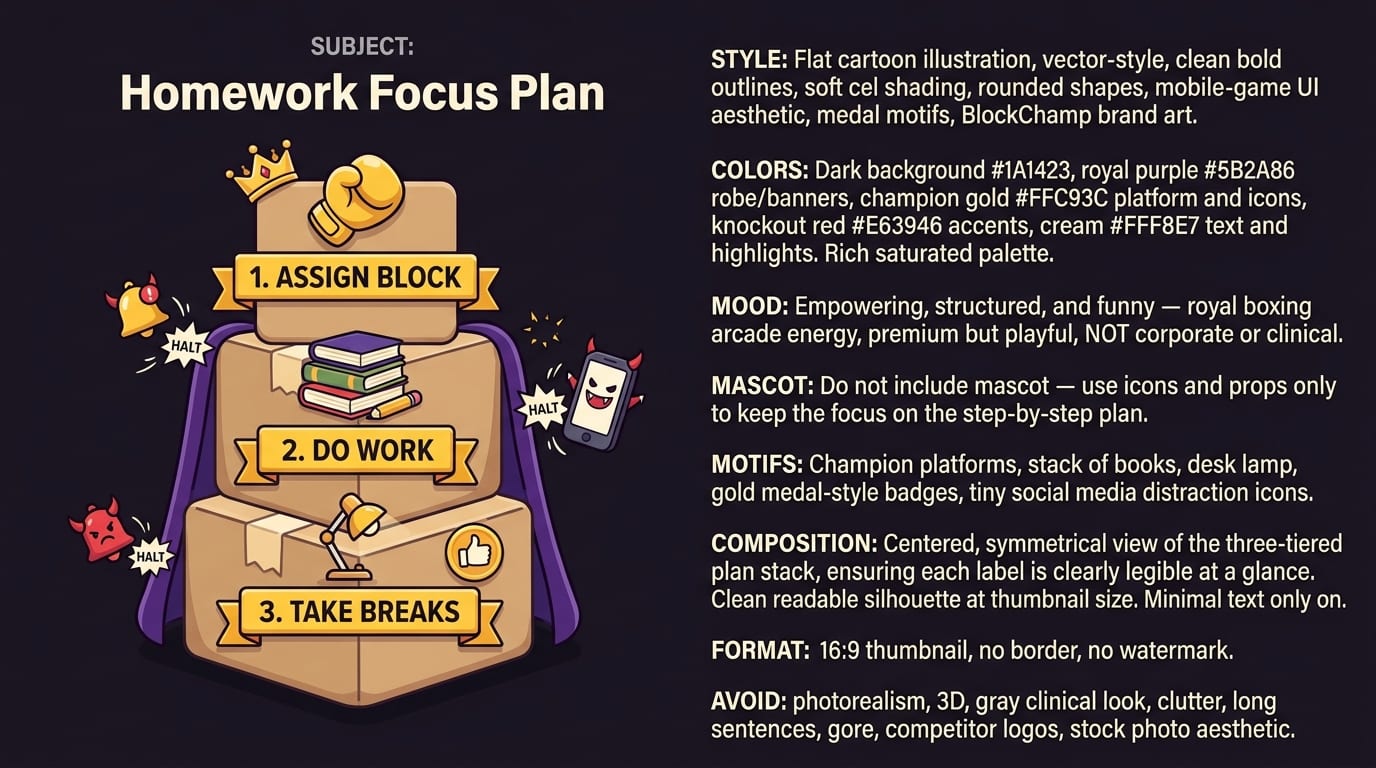
11. A Complete Homework Focus Plan You Can Use Tonight
Let’s put everything together into one practical plan. No fluff. No 47-step productivity cathedral. Just a clean system for how to focus on homework tonight.
Before homework: 10 minutes
- Choose your homework location.
- Clear your desk except for the current assignment.
- Put your phone away from your body. Across the room counts. Under your pillow does not.
- Open only the tabs and materials you need.
- Turn on BlockChamp or another website blocker.
- Write your first task in one sentence.
During homework: 30-minute focus block
- Set a timer for 25–30 minutes.
- Work on one task only.
- If a random thought appears, write it on your distraction note.
- If you get stuck, mark the problem and continue, or write a specific question to ask later.
- When the timer ends, stop and take a real break.
Break: 5–10 minutes
- Stand up.
- Move your body.
- Drink water.
- Avoid scroll-based breaks.
- Return when the timer ends, not when the internet gets boring, because it won’t.
After homework: 5 minutes
- Check that everything is submitted, saved, packed, or ready.
- Write tomorrow’s first homework task.
- Celebrate one thing you finished.
- Leave your workspace ready for next time.
This plan works because it removes ambiguity, reduces distractions, creates urgency, and builds a repeatable habit. You are not hoping focus appears. You are building a tiny fortress and putting a royal boxer at the gate.
Conclusion: Focus Is a System, Not a Personality Trait
If you came here wondering how to focus on homework, remember this: you do not need to become a completely different person. You need a better setup. Clear tasks. Time blocks. Fewer digital traps. Active study methods. Better breaks. Enough sleep. A restart plan for when your brain tries to defect to YouTube.
Homework focus improves when you stop relying on raw willpower and start designing your environment like someone who knows distractions are sneaky little gremlins with Wi-Fi. Make the right action easier. Make the wrong action harder. Repeat until your brain gets the message.
And if distracting websites keep body-slamming your study sessions, let BlockChamp help you defend the throne. It blocks the usual suspects, turns focus into XP, rewards your streaks, and lets The King roast your worst impulses back into submission. Start with a few sites, set your homework hours, and build your reign one focused block at a time.
Long live your focus, champ. Now close the extra tabs, sharpen the pencil, and go knock out that homework before it starts charging rent.
Related posts

Finding Focus For Fiction Writing

Learning To Focus In A Digital World As A Creative

Finding Focus For Personal Growth
