
Finding Focus For Self Publish

Finding focus for self publish is weirdly hard because self-publishing gives you freedom, and freedom immediately puts on a fake mustache and becomes chaos. Nobody is standing over your shoulder asking for chapter 12. No editor is tapping a watch. No professor is threatening your GPA. It is just you, your manuscript, your browser tabs, and the tiny goblin voice whispering, “Maybe research medieval soup ladles for two hours.”
If you are trying to write, edit, format, market, and launch your own book, focus is not a cute bonus skill. It is the entire throne room. Without focus, self-publishing turns into a swamp of half-finished drafts, cover-design spirals, newsletter panic, Amazon category rabbit holes, and “I’ll just check TikTok for book marketing ideas” disasters. Spoiler: TikTok will not gently return you to your outline. TikTok is a glitter cannon aimed at your frontal lobe.
This guide gives you practical strategies for finding focus for self publish projects: goal-setting, time blocks, editing routines, distraction-proof workflows, and the kind of simple systems that help you finish the book instead of endlessly preparing to maybe one day possibly finish the book. We’ll keep it useful, realistic, and only mildly roast-flavored. Crown on, champ. Your manuscript kingdom needs defending.
Quick Answers
Why Self-Publishing Eats Focus for Breakfast
Traditional publishing has deadlines, gatekeepers, and a whole conga line of people who may email you ominously. Self-publishing has opportunity. Beautiful, empowering, terrifying opportunity. You are the author, project manager, marketer, cover critic, metadata gremlin, and final boss.
The problem is not that self-published authors are lazy. Usually, it is the opposite. You care so much that every task feels urgent. Write the next chapter? Important. Fix the blurb? Important. Research trim sizes? Important. Build an email list? Important. Learn ads? Important. Rewatch a video about “seven-figure Kindle secrets” from a man filming in front of rented plants? Somehow also important, apparently.
That is why focus for self-publishing has to be treated as a publishing skill, not just a personality trait. You need a system that tells you what matters today, what can wait, and what belongs in the dungeon with the other shiny distractions.
Attention is also under attack in a very literal business-model sense. Many platforms are designed to keep you scrolling, clicking, refreshing, and returning. The Hootsuite Digital Trends report regularly documents how much of modern life runs through social platforms, which is useful for authors building audiences—but also dangerous when “platform building” becomes “I watched 47 reels and forgot my protagonist’s name.”
Finding focus for self publish work means acknowledging the real enemy: not lack of talent, not lack of ideas, but task-switching, decision fatigue, and easy escape hatches. Your brain loves escape hatches. It decorates them. It names them “research.”
Start With One Publishing Goal, Not a Royal Decree the Size of a Mattress
Most self-publishing focus problems begin with vague goals. “Finish my book” is noble, but it is also enormous. It sits there like a dragon wearing bifocals. Your brain looks at it and says, “Cool. We are doomed. Let’s organize fonts.”
Instead, define one primary publishing goal for the next 30 to 90 days. Make it specific enough that you can win or lose clearly. No fog. No mush. No “work on my author career,” which is productivity soup.
Better self-publishing goals look like this:
- Finish the first draft of my 60,000-word novel by June 30.
- Revise chapters 1–10 by the end of the month.
- Format my ebook and paperback files this week.
- Write and schedule four launch emails before preorders open.
- Complete my book description, keywords, categories, and author bio by Friday.
Notice the pattern: one project, one measurable outcome, one deadline. This is how you stop your brain from juggling flaming swords while riding a unicycle through a bookstore.
If you write fiction, you may also like BlockChamp’s related guide on finding focus for fiction writing, because drafting a novel while the internet screams “look at this raccoon in a tiny hat” is a specialized battlefield.
Once your main goal is clear, break it into weekly targets. If your goal is 60,000 words in 10 weeks, that is 6,000 words per week. If you write five days a week, that is 1,200 words per session. Suddenly the dragon is just a lizard with paperwork.
Build a Self-Publishing Task Map Before You Touch the Internet
The internet is an amazing publishing tool. It is also a carnival mirror maze with affiliate links. Before opening your browser, decide what type of self-publishing work you are doing today.
Self-publishing tasks usually fall into six buckets:
- Drafting: writing new words, scenes, chapters, essays, or sections.
- Editing: revising structure, tightening prose, fixing continuity, proofreading.
- Production: formatting, cover coordination, ISBNs, file uploads, print proofs.
- Marketing: newsletter, social content, launch plan, ads, outreach, promos.
- Admin: finances, metadata, platform accounts, contracts, scheduling.
- Learning: courses, craft books, publishing research, market analysis.
The focus trap is mixing these buckets in one session. You sit down to draft, then remember your subtitle might be weak, then check comparable books, then study ads, then update your author bio, then somehow end up pricing ergonomic chairs. Your book remains unwritten. Your cart contains a lumbar throne.
Pick one bucket per focus block. If it is a drafting block, you draft. If it is an editing block, you edit. If it is a marketing block, you market. The task map protects you from “productive procrastination,” the sneakiest little goblin in the publishing castle.
This also helps you use tools wisely. For example, during drafting and editing blocks, you can use BlockChamp to block social media, video, shopping, news, and even AI distraction sites if those tend to pull you away. During marketing blocks, you might temporarily allow specific platforms you genuinely need, but block the ones that turn into scroll soup. The point is not to ban the internet forever. The point is to stop it from walking into your writing room wearing tap shoes.
Use Time Blocks Like a Professional, Not Like a Productivity Goblin
Time blocking is one of the most useful habits for self-published authors because it turns “someday” into “Tuesday at 8:00.” It gives your book a seat on the calendar instead of forcing it to beg for scraps after work, dishes, emails, and the mysterious 38 minutes you lost looking for a charger.
Research on attention and task-switching suggests that interruptions can be costly. The American Psychological Association has summarized how multitasking can reduce productivity and increase mental load. Translation: your brain is not a majestic octopus. It does not thrive by grabbing eight tasks at once. It gets tired, cranky, and suddenly needs “just one video.”
A simple self-publishing time block system
- Choose a block length: 45, 60, or 90 minutes works well for many writers.
- Assign one outcome: “Draft 1,000 words,” “edit chapter 3,” or “write book description draft.”
- Prepare your materials: outline, manuscript, notes, checklist, coffee, emotional support snack.
- Block distractions: close tabs, silence phone, activate your website blocker.
- Work until the block ends: no switching tasks unless the building is on fire or your cat has become mayor.
- Log the result: words written, pages edited, task completed, next step.
If you are newer to structured focus, begin with two 45-minute blocks per day. One for creation, one for publishing operations. For example, write from 7:00–7:45 a.m., then handle launch/admin tasks from 5:30–6:15 p.m. That is not glamorous. It is better: repeatable.
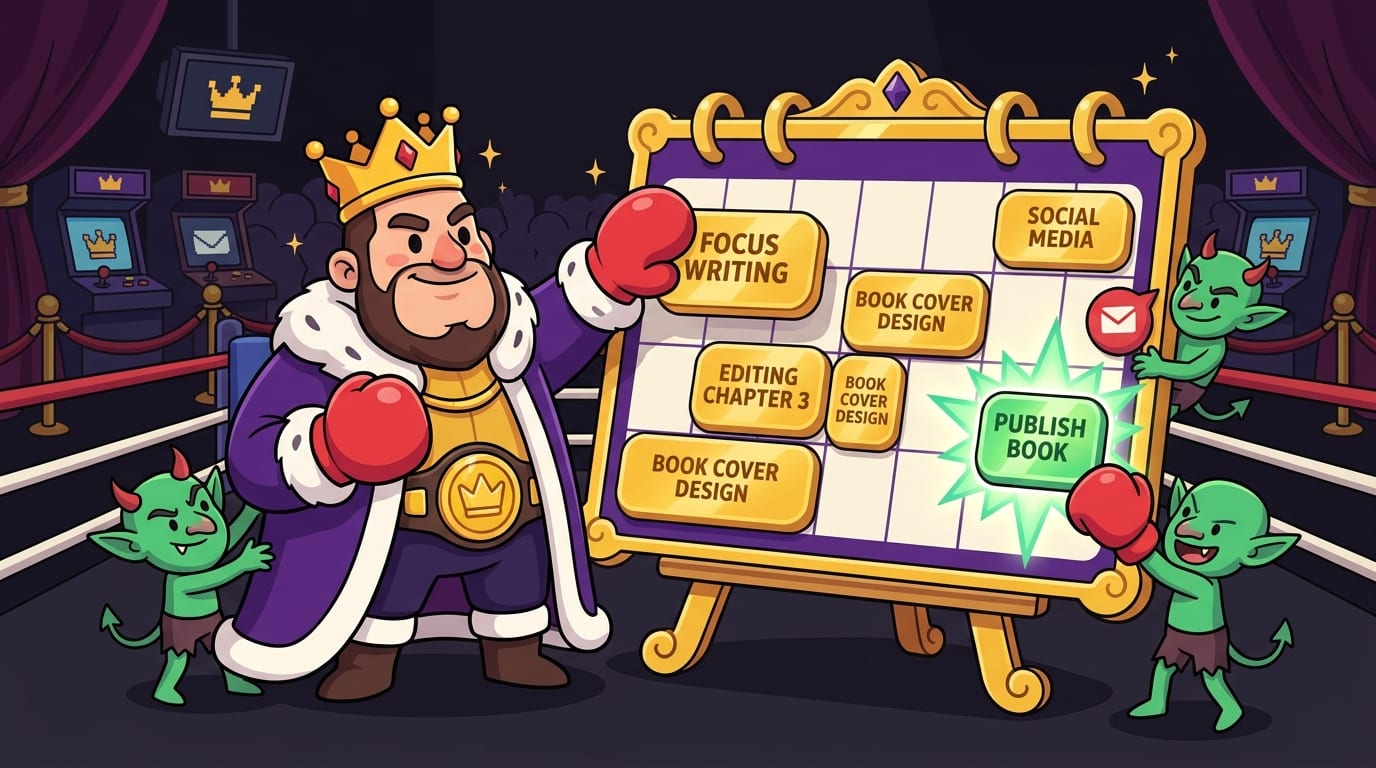
BlockChamp’s Focus Schedule feature is especially handy here. If your writing time is Monday through Friday from 7:00 to 9:00 a.m., schedule blocks to activate automatically. The King stands guard while you write. You do not have to negotiate with yourself at dawn, which is good because morning-you may have the strategic discipline of a sleepy potato.
Create a Drafting Ritual So Your Brain Knows It Is Book Time
Finding focus for self publish success is easier when you stop relying on “feeling inspired.” Inspiration is lovely, but unreliable. It shows up late, wears sunglasses indoors, and refuses to answer emails. Ritual is better.
A drafting ritual is a short sequence that tells your brain: we are entering the writing arena. It does not need candles, moon phases, or a velvet cape—though if the cape helps, long live the cape.
Try this five-minute pre-writing ritual:
- Open only your manuscript and outline.
- Write down the exact scene, section, or chapter you will work on.
- Read the last 300–500 words to regain momentum.
- Set a timer for your focus block.
- Turn on your distraction blocker and place your phone out of reach.
This tiny ritual reduces friction. You do not sit down and ask, “What should I do?” You already know. You are not wandering the castle halls. You are marching to the throne.
If you do creative work beyond books—essays, scripts, courses, comics, newsletters—BlockChamp’s post on finding focus for creative work has more ideas for protecting the messy, magical part of your brain from digital raccoons.
One more drafting rule: never end a session at a dead stop if you can help it. Before you close your document, leave a note for tomorrow. Something like: “Next: Maya enters the archive and finds the forged map.” This gives future-you a runway. Future-you deserves nice things. Future-you also deserves fewer excuses.
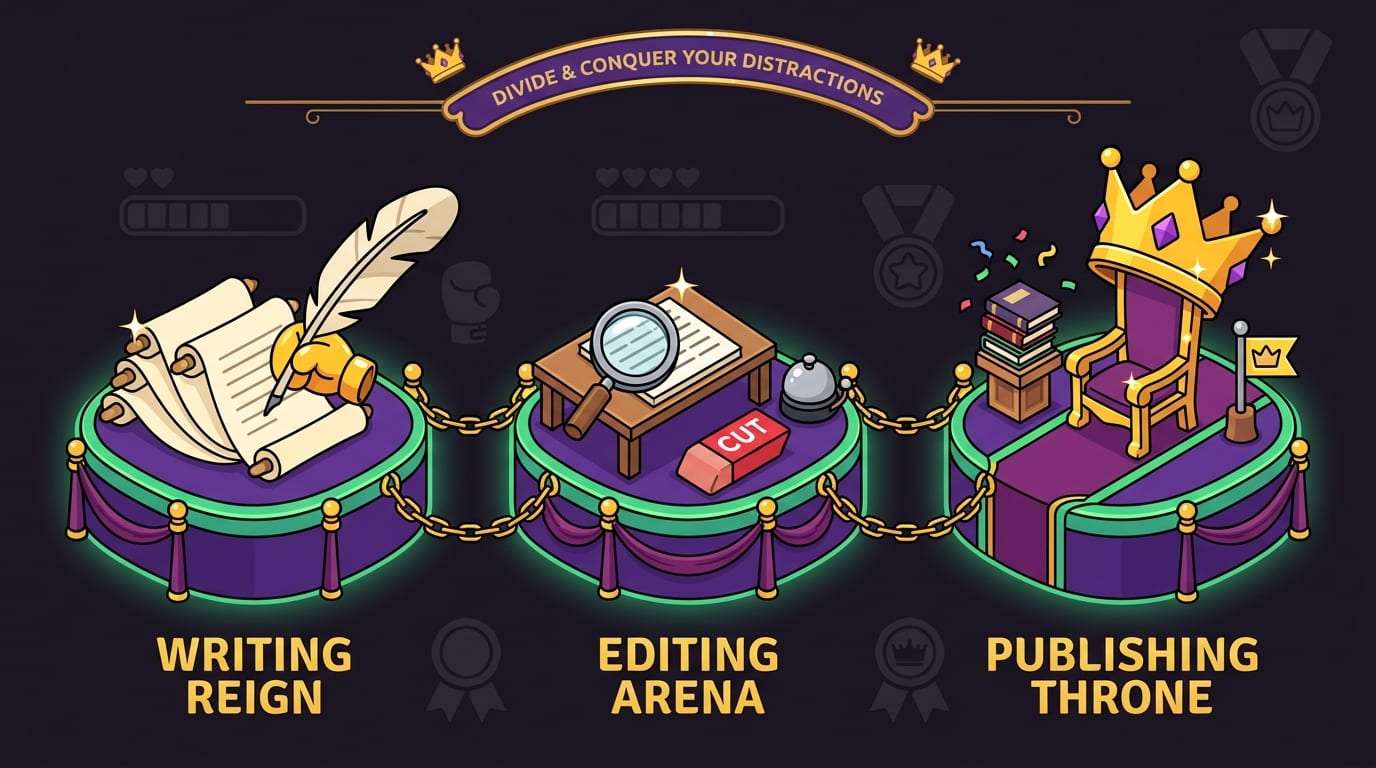
Separate Writing, Editing, and Publishing Like Three Tiny Kingdoms
One reason self-published authors lose focus is that they try to write, edit, and publish at the same time. This is like asking a chef to cook soup, redesign the restaurant, and negotiate rent while the onions burn.
Drafting requires momentum. Editing requires judgment. Publishing requires logistics. These modes use different mental muscles. Mixing them creates friction and self-doubt.
Use mode-based focus sessions
- Drafting sessions: quantity over polish. Keep moving. Notes are allowed; spirals are not.
- Developmental editing sessions: structure, pacing, argument, plot, character arcs, reader promise.
- Line editing sessions: clarity, rhythm, voice, sentence-level improvements.
- Proofreading sessions: typos, punctuation, formatting glitches, consistency.
- Publishing sessions: uploads, metadata, pricing, categories, launch assets.
During drafting, do not research every detail. Use placeholders: [CHECK CITY NAME], [ADD STAT], [FIX FIGHT SCENE]. Keep the train moving. Research can have its own block later. If you stop every paragraph to verify whether a 19th-century carriage had a particular hinge mechanism, congratulations: the hinge has defeated your book.
During editing, make a checklist. Your editing brain loves checklists because they reduce ambiguity. For nonfiction, your checklist might include promise, structure, examples, evidence, transitions, and takeaway. For fiction, it might include goal, conflict, stakes, sensory detail, dialogue, and scene ending. You are not “making it better,” which is vague. You are hunting specific beasts.
External standards help too. The Chicago Manual of Style is a respected reference for publishing and editing conventions, especially for book-length work. You do not need to memorize it like a monk guarding punctuation scrolls, but having a style source prevents endless debates with yourself over commas. Commas are sneaky. They wear tiny capes.
Design a Distraction-Proof Workflow Before the Distractions Arrive Wearing Tap Shoes
Distraction-proofing is not about becoming a perfect productivity statue. It is about making the focused action easier than the distracted action. Humans follow friction. Add friction to bad habits. Remove friction from good ones. Royal decree issued.
Here is a practical setup for self-publishing focus:
- Keep a dedicated writing folder with manuscript, outline, notes, and publishing checklist.
- Use a “parking lot” document for random ideas that appear mid-session.
- Close email, messaging apps, and unnecessary tabs before each block.
- Put your phone in another room or inside a drawer like a cursed artifact.
- Use a website blocker during writing and editing sessions.
- Keep a printed or visible “today’s target” note on your desk.
BlockChamp fits naturally into this workflow because it handles the browser side of the battle. You can block specific sites like YouTube, Reddit, Instagram, X/Twitter, or whatever your personal distraction dragon happens to be. You can also use category blocking for Social Media, Video & Streaming, News, Shopping, Gaming, Gambling, Adult, and AI Distractions. If “quick research” often turns into “I asked an AI 16 versions of my blurb and now hate language,” the AI Distractions category is sitting there with a tiny crown, ready to help.
The best part is that BlockChamp does not scold you with a bland gray screen. If you try to visit a blocked site, you get The Stare-Down: The King judging you like you tried to trade your 12-day reign for a meme. It is funny, but it also works because it interrupts the habit loop. You are forced to notice the impulse. That moment of awareness is where focus sneaks back in and punches distraction in the kneecaps.
For serious crunch time—final edits, launch week, formatting day from the abyss—Champion users can use Hardcore Lockdown. If you try to turn focus off, you must wait through a cooldown or complete a boxing-riddle mini-game. Ridiculous? Yes. Effective? Also yes. Sometimes your future book needs a cartoon king in boxing gloves to stop present-you from surrendering to Reddit. Literature has known stranger muses.
Make Research Obey You, Because Research Is a Sneaky Little Wizard
Research is necessary for many self-publishing projects. It is also one of the easiest places to lose focus because it feels legitimate. You are not procrastinating; you are “studying the market.” You are not avoiding chapter 8; you are “learning reader expectations.” You are not doomscrolling; you are “analyzing trends.” Nice try, wizard.
Use bounded research. That means every research session needs a question, a time limit, and an output.
The focused research formula
- Question: What exactly do I need to know?
- Sources: Where will I look first?
- Time limit: How long will I spend?
- Output: What decision or note will this produce?
Example: “I need three comparable books for my cozy fantasy listing. I will spend 30 minutes on Amazon and Goodreads, then write down titles, categories, covers, and common reader promises.” That is research. “Let me browse fantasy covers until I emotionally become a mushroom” is not research.
For market and platform learning, choose trusted resources instead of endlessly grazing. For example, Amazon KDP’s official help documentation is the place to verify upload requirements, royalties, and publishing basics. For author marketing ideas, reputable sources like HubSpot’s marketing blog can help you understand broader content and audience-building principles without falling into sketchy “guaranteed bestseller by Thursday” swamp water.
Keep a “research later” list in your manuscript. When a question appears mid-draft, capture it and move on. Your goal during drafting is not to answer every question. Your goal is to build the thing that questions can attach to.
Use Public Accountability Without Turning Your Book Into a Circus
Self-publishing can be lonely. Nobody sees the hours you spend revising a paragraph until it stops sounding like a raccoon typed it with elbows. Accountability helps because it gives your work a witness.
But be careful: talking about writing can become a substitute for writing. The goal is support, not performance theater.
Try one of these accountability structures:
- A weekly check-in with another writer: goals, progress, blockers, next steps.
- A private spreadsheet where you log word count, editing pages, and publishing tasks.
- A writing sprint group with cameras optional and actual writing required.
- A monthly self-publishing review: what shipped, what stalled, what changes next.
- A small reader or critique group with clear submission deadlines.
Writing communities can be powerful when they help you return to the page instead of flee from it. For more on that balance, read finding focus through writing communities. The right group can make self-publishing feel less like shouting into a cave and more like building a tiny, determined army.
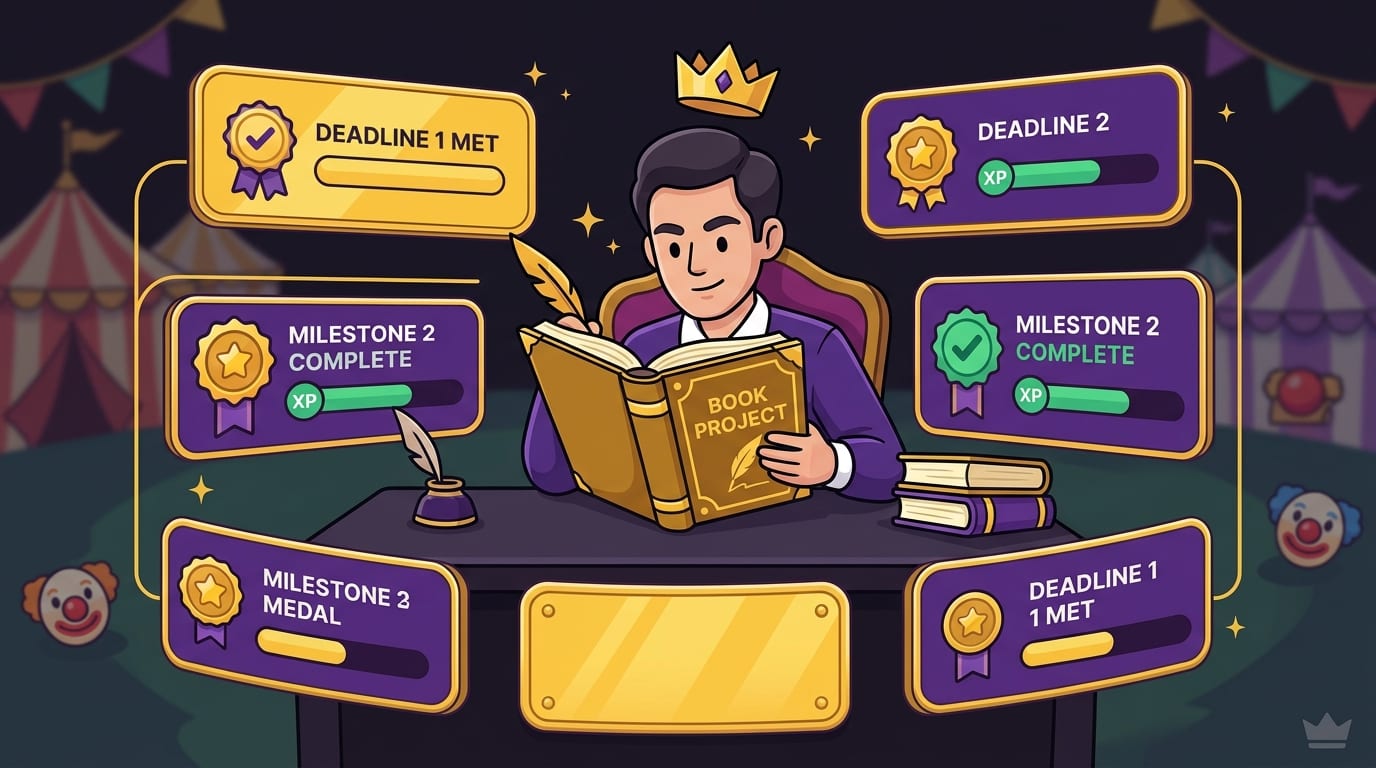
BlockChamp’s gamification also gives you private accountability. XP, reigns, badges, calendar view, and leaderboard rankings turn focus into something visible. That matters because self-publishing progress often feels invisible until launch day. When you can see your focus hours stacking up, your brain gets proof: “Ah yes, I am not merely marinating in ambition. I am doing the work.”
Build a Weekly Self-Publishing Review So You Stop Reinventing the Wheel
A weekly review is where focus becomes a system. Without it, every Monday begins with archaeological digging: Where was I? What mattered? Why is there a note that says “wizard tax scene???”
Your weekly review does not need to be complicated. Set aside 20–30 minutes once a week. Friday afternoon or Sunday evening works well. Bring your calendar, manuscript tracker, task list, and a beverage that makes you feel like a competent adult.
Ask these five questions:
- What did I complete this week?
- What did I avoid, and why?
- What is the single most important publishing outcome for next week?
- Which distractions or obstacles need to be blocked, removed, or handled?
- What are my scheduled focus blocks?
This review is not a shame tribunal. Do not put yourself on trial because Thursday got eaten by life. The point is to adjust. If you missed three evening writing sessions because you were exhausted, try morning blocks. If social media swallowed your marketing time, define specific tasks before opening apps. If formatting took twice as long as expected, congratulations: you have met formatting, the goblin accountant of publishing.
Personal growth as an author is not just about word count. It is about learning how you work, what derails you, and what systems help you recover. If that topic is your jam, BlockChamp has a companion piece on finding focus for personal growth that pairs nicely with this kind of weekly reflection.
Plan Your Launch Without Letting Launch Tasks Devour the Manuscript
Book launches are focus monsters because they create endless micro-tasks. Cover reveal. ARC team. Newsletter swaps. Social posts. Promo graphics. Ads. Metadata. Categories. Pricing. Retailer pages. Review requests. Author website updates. Emergency chocolate.
The solution is to divide launch work into phases instead of letting it invade every day.
A simple launch focus timeline
- 8–12 weeks out: finalize manuscript, cover, description, categories, keywords, ARC plan.
- 4–8 weeks out: build preorder page if using one, contact ARC readers, draft emails, schedule content.
- 2–4 weeks out: confirm files, send reminders, prep launch graphics, test links.
- Launch week: execute scheduled posts, email your list, monitor pages, thank readers, sleep occasionally like a noble mammal.
- Post-launch: collect data, request reviews ethically, adjust ads or promos, document lessons.
Batching helps here. Instead of making one social post every day from scratch, write ten in one session. Instead of tweaking your blurb every time you feel nervous, schedule one focused revision session and then lock it. Nervous tweaking is not strategy. It is anxiety wearing a tiny marketing hat.
During launch, it is tempting to live inside dashboards. Sales rank. Ad spend. Email opens. Reviews. Refresh, refresh, refresh. Some checking is necessary. Constant checking is a focus tax. Set dashboard windows: for example, 10 minutes at noon and 10 minutes at 6 p.m. Outside those windows, work on what you can control: outreach, reader communication, future writing, and not becoming a haunted refresh goblin.

A Practical 7-Day Focus Reset for Self-Publishers
If your self-publishing workflow is currently a flaming shopping cart rolling downhill, do not panic. Try this 7-day reset. It is simple, concrete, and less painful than reorganizing your entire life with a label maker at 1 a.m.
- Day 1: Choose the main goal. Write one clear 30-day publishing target.
- Day 2: Make the task map. List every task, then sort into drafting, editing, production, marketing, admin, and learning.
- Day 3: Schedule focus blocks. Put at least five blocks on your calendar for the next week.
- Day 4: Set up your distraction defenses. Block your top distraction sites and categories. If using BlockChamp, turn the Master Focus Toggle to On Guard and let The King patrol the gates.
- Day 5: Create your ritual. Build a five-minute start routine and a two-minute shutdown note.
- Day 6: Do one deep work session. One task, one timer, one outcome. No tab circus.
- Day 7: Review and adjust. What worked? What broke? What needs more friction?
This reset works because it removes the biggest focus killers: vague goals, mixed tasks, unscheduled work, unblocked distractions, and missing feedback. You are not trying to become a productivity influencer with a perfect desk and suspiciously clean notebooks. You are building a repeatable publishing machine.
Final Thoughts: Protect the Book Like It Pays Rent
Finding focus for self publish projects is not about becoming a monk who never checks the internet and communicates only through fountain pen. You are self-publishing in the real world. You need online tools, author communities, marketing platforms, research, and yes, occasionally a video that teaches you something useful.
The trick is making sure those tools serve the book instead of replacing the book.
Start with one clear goal. Break it into weekly targets. Use time blocks. Separate drafting, editing, and publishing. Put research in a fenced yard. Review weekly. Block the sites that keep stealing your crown. And when your hand drifts toward YouTube during chapter 14, let BlockChamp’s royal boxer glare you back into greatness.
If you want a focus system that feels less like punishment and more like leveling up, try BlockChamp for Chrome. Block distracting websites, earn XP, build your reign, survive The Stare-Down, and become king of your writing time. Your book does not need a perfect author. It needs a consistent one.
Now close the extra tabs, champ. The manuscript is waiting, the throne is warm, and the scroll goblins have had power for long enough.
Related posts

Building Focus To Create What Matters

How To Write A Novel With Sustained Focus

Finding Focus For Fiction Writing
