
Expert Daniel Wong Study Tips For Focus

If you searched for expert daniel wong study tips for focus, you’re probably not looking for another fluffy “just try harder” pep talk. You want practical, student-tested ways to sit down, open the book, and not mysteriously wake up 47 minutes later inside a YouTube rabbit hole titled “Man Builds Underground Pool With Spoon.”
Good news, champ: focus is not a personality trait reserved for monks, chess grandmasters, and that one classmate who color-codes flashcards like they’re preparing for war. Focus is a system. Daniel Wong, a well-known student success coach and author, often emphasizes smart routines, distraction management, active learning, sleep, and consistency over frantic all-night cramming. In other words: stop treating your brain like a vending machine you can kick until an A+ falls out.
This guide breaks down expert Daniel Wong study tips for focus into a practical, step-by-step system you can actually use today. We’ll cover how to set up your environment, plan study sessions, eliminate distractions, use active recall, protect your energy, and build momentum without turning your life into a productivity dungeon. And yes, we’ll also talk about how tools like BlockChamp can help you knock out digital distractions when willpower decides to take a royal nap.
Quick Answers
1. Start With the Real Problem: Your Brain Is Not Broken, Your System Is Leaky
Most students assume poor focus means they’re lazy, undisciplined, or cursed by the ancient gods of procrastination. Usually, the real issue is simpler: their study system has holes big enough for TikTok, Reddit, YouTube, Discord, shopping tabs, news panic, and “just checking one thing” to march through like a medieval army.
Daniel Wong’s student productivity advice frequently points toward building reliable habits and creating conditions that make focus easier. That matters because attention is fragile. Research from the American Psychological Association on multitasking shows that switching between tasks comes with cognitive costs. Translation: every time you jump from calculus to Instagram to your notes to a group chat about noodles, your brain pays a toll. And the toll booth is run by goblins.
The goal is not to become a robot. The goal is to reduce unnecessary attention leaks. You want your study environment to make the right action obvious and the wrong action annoying. That’s why website blockers, phone distance, planned breaks, and specific study goals work better than vague promises like “I’ll be focused today.” Cute promise. Terrible strategy.
A strong focus system has three parts:
- Clarity: You know exactly what you’re studying and what “done” looks like.
- Friction: Distractions are harder to access than your study materials.
- Feedback: You can see progress, whether through completed practice questions, focus hours, streaks, or XP.
BlockChamp is built around this exact idea. Instead of relying on heroic self-control, you block distracting websites and categories, then earn XP, levels, badges, and reigns for staying focused. It turns “please don’t scroll” into “defend the throne.” Much better. More crowns, fewer shame spirals.
2. Use the “Study Session Contract” Before You Begin
One of the most useful expert Daniel Wong study tips for focus is to avoid starting a study session with a vague intention. “Study biology” is not a plan. It is a fog machine wearing glasses.
Before you begin, create a simple study session contract. This takes one minute and saves you from wandering around your textbook like a confused raccoon in a library.
Your 60-Second Study Contract
- Write the subject: “Chemistry.”
- Write the specific task: “Complete 20 equilibrium practice questions.”
- Write the time block: “4:00–4:45 p.m.”
- Write the success condition: “Mark every wrong answer and review the solution.”
- Write the reward: “10-minute walk, snack, or one guilt-free meme inspection.”
This tiny contract gives your brain a finish line. Without a finish line, studying expands into a swamp. You “study” for three hours, but half of that time is rereading, reorganizing pens, checking messages, and wondering if you should become a goat farmer instead.
For more student-specific distraction tactics, BlockChamp has a helpful guide on how to study without distraction, which pairs nicely with this approach. The big idea: don’t just say you’ll focus. Design the session so focus has fewer enemies.
Here’s a quick example. Bad study plan: “I’ll revise math tonight.” Better study contract: “From 7:00 to 7:50, I’ll complete 12 quadratic equation problems from chapter 6, check answers, and rewrite the steps for any problem I miss.” That is clear, measurable, and far less likely to dissolve into snack-based philosophy.
3. Remove Digital Distractions Before They Start Swinging
Let’s be honest: your phone is not “nearby in case of emergencies.” It is nearby because it contains infinite novelty, tiny dopamine fireworks, and possibly a group chat named something deeply unserious. Your browser is the same. One tab becomes five. Five becomes fifteen. Suddenly you’re comparing mechanical keyboards while your textbook ages into an archaeological artifact.
Daniel Wong often recommends minimizing distractions proactively rather than trying to resist them after they appear. This aligns with behavioral science: it’s easier to change your environment than to win a wrestling match with temptation every five minutes.
A 2023 report from DataReportal’s Global Digital Overview found that internet users spend an average of several hours per day online, with social media taking a major chunk of that time. That doesn’t mean the internet is evil. It means your attention lives in a very loud marketplace where every app is yelling, “Look at me, majestic peasant!”
Try this pre-study distraction shutdown:
- Put your phone in another room, inside a drawer, or behind an obstacle annoying enough to matter.
- Turn on Do Not Disturb for the full study block.
- Close every browser tab unrelated to the task.
- Block your top distraction sites before you begin.
- Keep only the materials needed for the current session on your desk.
This is where BlockChamp becomes your royal bouncer. You can block specific sites like YouTube, Reddit, Instagram, or X/Twitter, or use category blocking for Social Media, Video & Streaming, News, Shopping, Gaming, Gambling, Adult, and AI Distractions. Free users can block up to 3 sites and enable 2 categories, which is plenty for knocking out the biggest villains. Champion users can go full fortress mode with unlimited sites, all categories, keyword blocking, schedules, and Hardcore Lockdown.
And when you try to sneak onto a blocked site? The King appears in a full-screen Stare-Down and judges you like you just tried to eat cereal with orange juice. It’s funny, slightly humiliating, and weirdly effective.
4. Study Actively, Not Like a Highlighter With Legs
Many students confuse time spent near notes with studying. This is how you end up “reviewing” for two hours by gently coloring textbook sentences neon yellow while absorbing the intellectual equivalent of soup steam.
Expert Daniel Wong study tips for focus often emphasize active learning: testing yourself, explaining concepts, solving problems, and identifying weak spots. This is supported by cognitive science. A famous review on learning techniques published in Psychological Science in the Public Interest found that practice testing and distributed practice are among the most effective study strategies.
Active studying keeps your brain engaged because it forces retrieval, decision-making, and correction. Passive rereading lets your brain cosplay as productive while secretly thinking about sandwiches.
Use the 3-Part Active Study Loop
- Recall: Close the book and write what you remember.
- Check: Compare your answer to the textbook, notes, or mark scheme.
- Repair: Fix gaps by rewriting the concept in your own words or doing another practice question.
For example, if you’re studying history, don’t just reread the causes of World War I. Close the book and list them from memory. Then explain how they connect. Then check what you missed. If you’re studying physics, don’t admire solved examples like museum art. Cover the solution and solve the problem yourself. Yes, it may hurt. That’s your brain doing push-ups.
If you want a broader productivity foundation, read BlockChamp’s post on becoming a productivity expert through focus. It digs into why focus is less about magical motivation and more about repeatable systems.

5. Use Time Blocks That Respect Your Brain’s Battery Life
Another core principle in Daniel Wong-style study advice is to work with your energy, not against it. Most students plan like fantasy warriors: “I shall study for six uninterrupted hours and emerge victorious.” Then 27 minutes later they are lying sideways in a chair, scrolling memes, questioning the education system.
Instead, use structured time blocks. The Pomodoro Technique is popular for a reason: short bursts reduce resistance and make focus feel manageable. You can do the classic 25 minutes focused, 5 minutes break. Or use longer blocks like 45/10 or 50/10 if you’re doing deep practice.
The key is to choose the block based on task difficulty:
- 25/5: Good for starting when motivation is low.
- 45/10: Great for practice questions, essay planning, and problem-solving.
- 60/15: Useful for deep work if you already have momentum.
- 90/20: Best for advanced students doing demanding work, not for “I slept four hours and had cereal dust for breakfast” days.
During breaks, avoid opening the exact apps you blocked during study. A five-minute break on TikTok is not a break; it is a trapdoor with music. Better options include stretching, walking, water, breathing, sunlight, or a snack that does not require a full archaeological dig through the pantry.
BlockChamp can support this by keeping your focus blocks protected while you work. Champion users can even set recurring schedules, so blocks activate automatically during study hours. That means Monday to Friday from 7 p.m. to 9 p.m., The King stands guard while you do battle with equations, essays, and whatever biology is doing with mitochondria these days.
6. Build a Distraction List Instead of Obeying Every Random Thought
One of the sneakiest focus killers is not external distraction. It’s internal distraction: “I should check my email.” “What was that actor’s name?” “Do penguins have knees?” “Should I reorganize my entire life right now?” Your brain is a suggestion machine. Some suggestions are useful. Many are tiny clowns in lab coats.
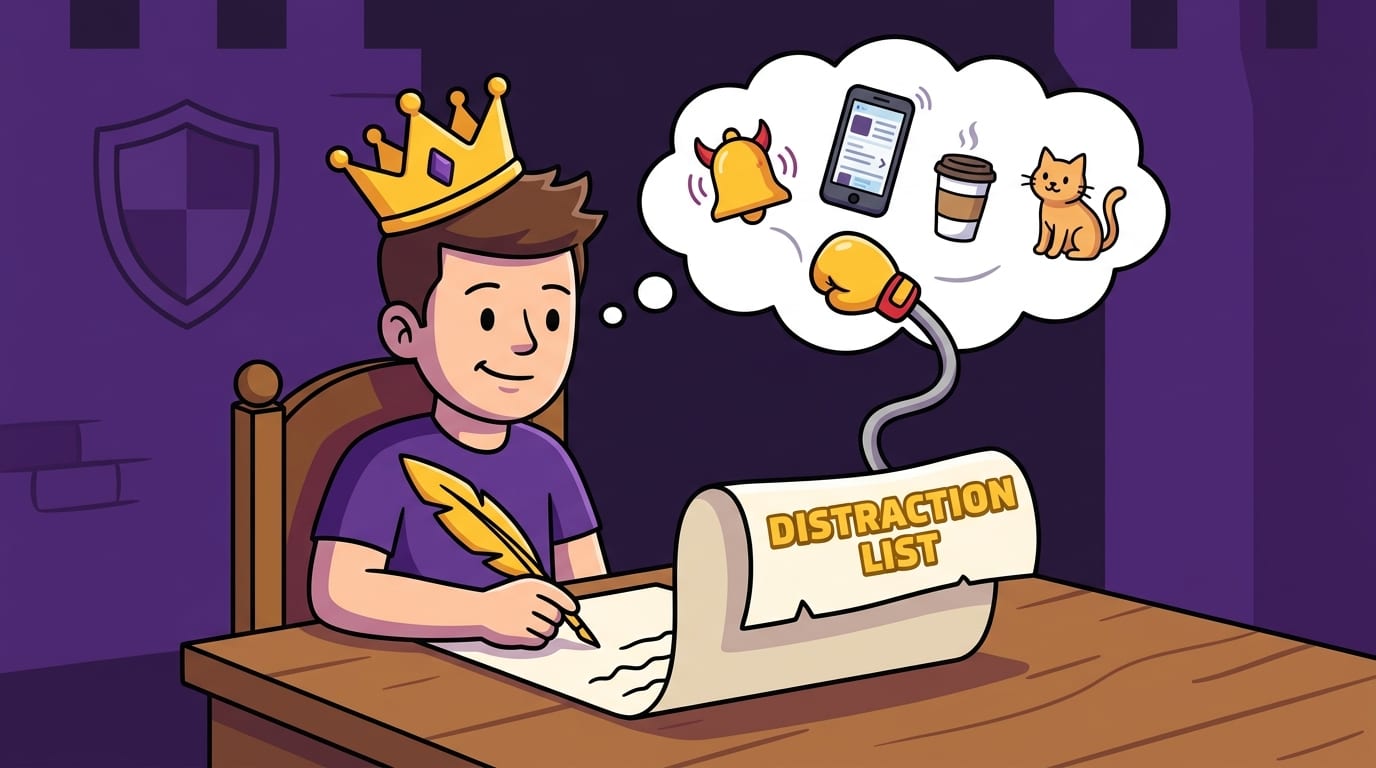
Daniel Wong’s practical approach to student focus encourages planning and self-management. A distraction list is one of the simplest tools for this. Keep a piece of paper next to you. Whenever an unrelated thought pops up, write it down and return to studying.
Your list might look like this:
- Check scholarship deadline
- Reply to group project message
- Look up exam room location
- Buy shampoo
- Find out whether penguins have knees
Writing the thought down reassures your brain that it won’t be forgotten. Then you can deal with it after the study block. This is not glamorous. There is no confetti. But it works because it separates “remember this later” from “abandon the throne immediately.”
If your distractions are mostly browser-based, combine the list with website blocking. For example, if you suddenly feel the urge to check Reddit for “just one answer,” write it down, keep working, and let BlockChamp’s Stare-Down handle any attempted rebellion. The King sees you, peasant. Back to work.
7. Protect Sleep Like It’s Part of Studying, Because It Is
Here is the tragic comedy of student life: people sacrifice sleep to study more, then become too tired to learn efficiently, then need more time to study, then sacrifice more sleep. This is not discipline. This is a hamster wheel wearing a graduation cap.
Daniel Wong frequently stresses the importance of sleep, routines, and sustainable habits. Science backs that up. The Sleep Foundation explains the relationship between sleep, learning, and memory, including how sleep supports memory consolidation. Basically, your brain needs sleep to file away what you studied. Skip sleep, and your mental filing cabinet becomes a junk drawer full of panic.
Here are practical sleep-friendly study rules:
- Stop intense studying at least 30–60 minutes before bed when possible.
- Do light review, flashcards, or planning in the final stretch instead of brand-new difficult material.
- Keep your wake-up time consistent, especially during exam season.
- Avoid revenge bedtime scrolling, the official sport of tired students everywhere.
- Use a browser blocker in the evening if late-night YouTube keeps stealing your sleep.
BlockChamp’s category blocking can help here too. If Video & Streaming or Social Media are your bedtime goblins, block them during your wind-down hours. Champion users can schedule this automatically. Your future morning self will thank you. Possibly with coffee. Possibly with fewer under-eye shadows.
8. Make Progress Visible So Motivation Has Something to Chew On
Motivation is not reliable as a starting engine. But it becomes stronger when you can see progress. This is why checklists, streaks, scoreboards, and habit trackers work. They convert invisible effort into visible proof.
Expert Daniel Wong study tips for focus often come back to consistency: small actions repeated over time beat dramatic last-minute panic. The trick is making consistency rewarding enough that you keep going even when the novelty fades.
Try tracking these study metrics:
- Focused minutes completed
- Practice questions attempted
- Errors corrected
- Flashcards reviewed
- Days you started on time
- Distraction attempts resisted
This is where BlockChamp’s gamification gets deliciously useful. Every minute of focus earns XP. Every focused day adds to your reign. Every blocked-site attempt you survive earns more XP. You can level up from Peasant of Procrastination to Squire of Focus, Knight of the Block, Duke of Discipline, Prince of Productivity, and eventually BLOCK CHAMP — King of Your Time. Is it ridiculous? Yes. Is it more motivating than a sad spreadsheet named “study hours final final v3”? Also yes.
For more on building focus around study and work routines, check out BlockChamp’s guide to studying and work. It expands on how to structure your day when both school and responsibilities are fighting for the same tired brain cells.
9. Use Spaced Repetition: Cramming Is a Drama Queen
Cramming feels productive because it is intense. Your notes are everywhere. Your eyes are heroic. Your snacks are questionable. But intensity is not the same as retention.
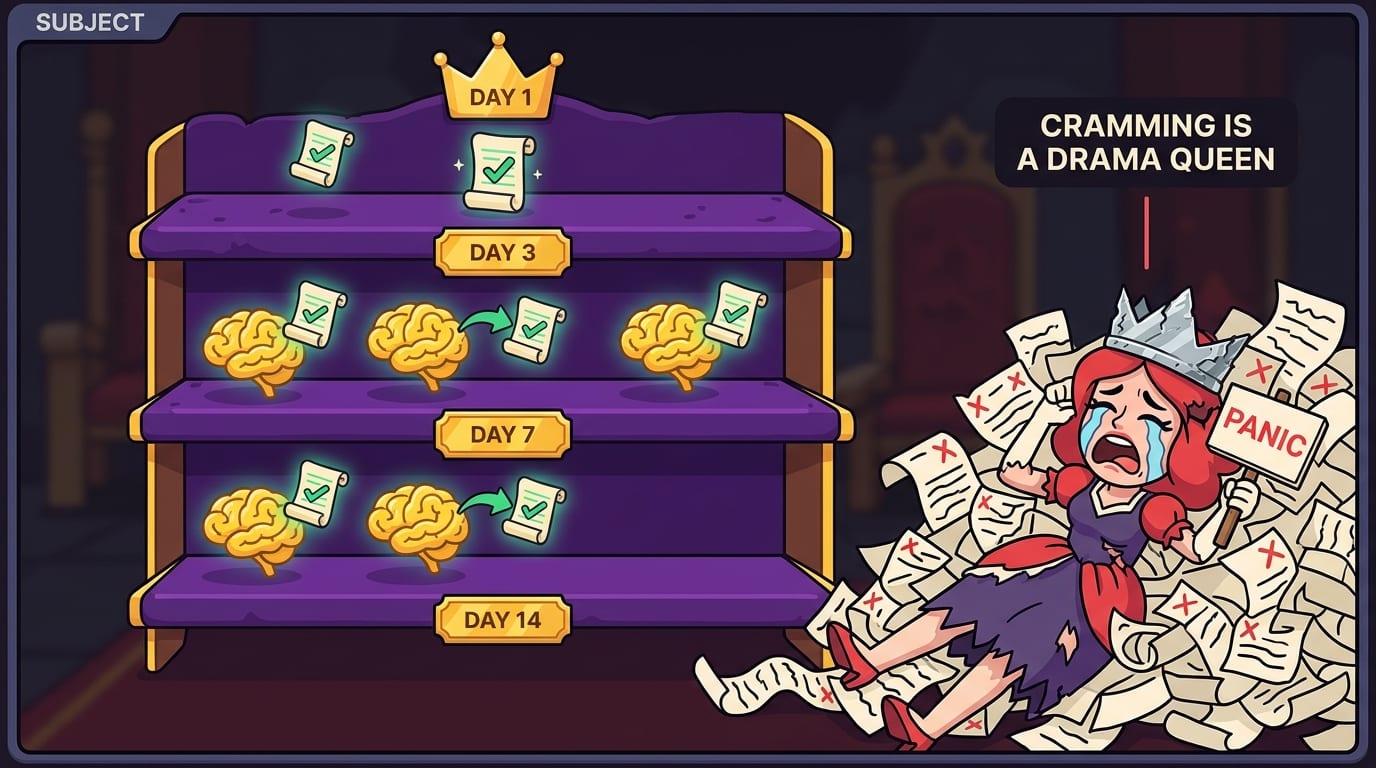
Spaced repetition means reviewing information across multiple sessions over time instead of smashing it into your skull the night before the exam. It works because memory strengthens when you revisit material just as you’re beginning to forget it. Your brain says, “Oh, this again? Fine, I’ll keep it.”
A simple spaced repetition plan:
- Review new material within 24 hours.
- Review again after 3 days.
- Review again after 1 week.
- Review again after 2–3 weeks.
- Increase practice questions as the exam gets closer.
You don’t need a fancy system to start. A calendar, spreadsheet, or flashcard app can do the job. The important part is scheduling review before panic season. Panic season is expensive. It charges interest in caffeine and tears.
Pair spaced repetition with active recall. Don’t just look at old notes. Test yourself. Explain the concept. Do a question. Teach it to an imaginary student, your dog, or a houseplant with academic ambitions.
10. Create a “Focus Ritual” So Your Brain Knows It’s Go Time
A focus ritual is a short sequence you do before every study session. It tells your brain, “The kingdom is now closed for nonsense.” Over time, the ritual becomes a cue that helps you transition into work faster.
Keep it simple. If your ritual requires candles, seven apps, three notebooks, and a ceremonial robe, you have accidentally invented procrastination in a costume.
A 5-Minute Focus Ritual
- Clear your desk except for the current task.
- Fill a water bottle.
- Write your study session contract.
- Turn on BlockChamp and block your distraction categories.
- Set a timer and begin with the first tiny action.
The first tiny action matters. Don’t begin with “master the entire chapter.” Begin with “open the practice set and answer question 1.” Momentum often arrives after action, not before. Motivation is a late guest. Start without it.
If you struggle specifically with website temptation while studying, this BlockChamp article on how to block websites for studying gives a practical walkthrough. It’s especially useful if your browser has become less “research tool” and more “circus cannon aimed at your attention span.”
11. Plan for Failure Like a Strategist, Not a Sad Potato
Even with the best system, you will sometimes get distracted. You are human. Your brain evolved to notice novelty, not to calmly ignore 14 notifications and a thumbnail that says “You won’t believe what happened next.”
The difference between successful students and permanently frazzled students is not perfection. It’s recovery speed. When you slip, don’t turn one distraction into a full-day collapse. Use a reset script.
The 2-Minute Reset Script
- Say: “I got distracted. That’s data, not doom.”
- Close the distraction immediately.
- Write down what triggered it: boredom, confusion, fatigue, anxiety, habit.
- Choose one fix: easier starting point, short break, blocked site, clearer goal, or help from a teacher/classmate.
- Restart with a 10-minute mini-session.
This keeps your identity intact. You are not “bad at focus.” You found a leak. Patch it. Continue the reign.
BlockChamp is intentionally built around consistency, not shame. If you hit a blocked site, The King roasts you, yes, but you also earn XP for surviving the Stare-Down and going back to work. That’s the right mindset: mistakes become feedback, not evidence that you should abandon the throne and live in the swamp.

12. A Complete Daniel Wong-Inspired Focus Routine You Can Use Today
Let’s turn all of this into a practical routine. Here’s a study system based on expert Daniel Wong study tips for focus, combined with distraction-proofing and active learning.
Before the Session
- Choose one subject and one specific outcome.
- Write your study contract.
- Put your phone out of reach.
- Turn on a website blocker like BlockChamp.
- Set a timer for 25, 45, or 50 minutes.
During the Session
- Use active recall instead of passive rereading.
- Do practice questions early, not only at the end.
- Write distractions on a list instead of following them.
- Mark mistakes clearly and correct them.
- Stay with one task until the timer ends.
After the Session
- Record what you completed.
- Note the hardest concept or most common mistake.
- Schedule the next review using spaced repetition.
- Take a real break away from high-stimulation apps.
- Celebrate the win, even if it was imperfect.
This routine works because it doesn’t depend on you feeling inspired. It gives you structure, removes temptation, forces active learning, and creates feedback. That is the royal combo. Left glove: clarity. Right glove: friction. Knockout punch: consistency.
Final Thoughts: Focus Is a Kingdom, Not a Mood
The best expert Daniel Wong study tips for focus all point to the same truth: you don’t rise to the level of your wishes; you fall to the strength of your systems. If your system is “I’ll just try harder while surrounded by notifications, open tabs, and a phone glowing like a cursed treasure chest,” focus will be difficult. Not because you’re weak. Because the setup is rigged.
Instead, build a study routine that makes concentration easier. Define the task. Block the distractions. Use active recall. Study in focused blocks. Protect your sleep. Track visible progress. Recover quickly when you slip. Repeat until your results stop looking like chaos wearing a backpack.
And if the internet keeps stealing your study time, let BlockChamp stand guard. It blocks distracting websites, turns focus into a game, rewards you with XP and badges, and sends The King to stare you down when you try to sneak back into the scroll pit. A little ridiculous? Absolutely. Effective? That’s the crown jewel.
So pick one study session today. Write the contract. Turn on your blocker. Start the timer. Defend the throne. Your future self is waiting with better grades, calmer evenings, and hopefully fewer emergency cram sessions powered by panic and cereal dust.
Long live your focus, champ. Now go knock out the next chapter.
Related posts

Finding Focus For Fiction Writing

Learning To Focus In A Digital World As A Creative

Finding Focus For Personal Growth
