
Best Time To Work

Finding the best time to work sounds like it should be simple. Wake up, drink the magic bean water, open laptop, become productivity wizard. Unfortunately, your brain is not a toaster. You cannot just press “focus” and expect golden waffles of output to appear.
Some people do their sharpest thinking at 6:30 a.m., glowing like smug sunrise goblins. Others hit peak performance at 10 p.m., surrounded by tea, chaos, and 47 browser tabs they swear are “research.” The truth is: the best time to work depends on your biology, energy patterns, task type, environment, and whether TikTok has currently seized the throne of your attention kingdom.
The good news? You can figure it out. Not by copying a billionaire’s 4 a.m. routine like a sleep-deprived peasant, but by tracking your energy, matching tasks to your natural rhythm, protecting focus windows, and building routines that make work easier to start. This guide will help you discover your personal productivity prime time, design a workday around it, and defend it from the goblin army of distractions.
Quick Answers
What Does “Best Time to Work” Actually Mean?
The “best time to work” is not just the hour when you are technically awake and not actively drooling into your keyboard. It is the period of the day when your brain has the right mix of alertness, energy, motivation, and mental clarity for the work you need to do.
That last part matters. The best time for deep writing may not be the best time for answering email. The best time for coding may not be the best time for meetings. The best time for creative brainstorming may arrive when your brain is slightly loose and weird, while analytical work may demand your crispest, freshest attention.
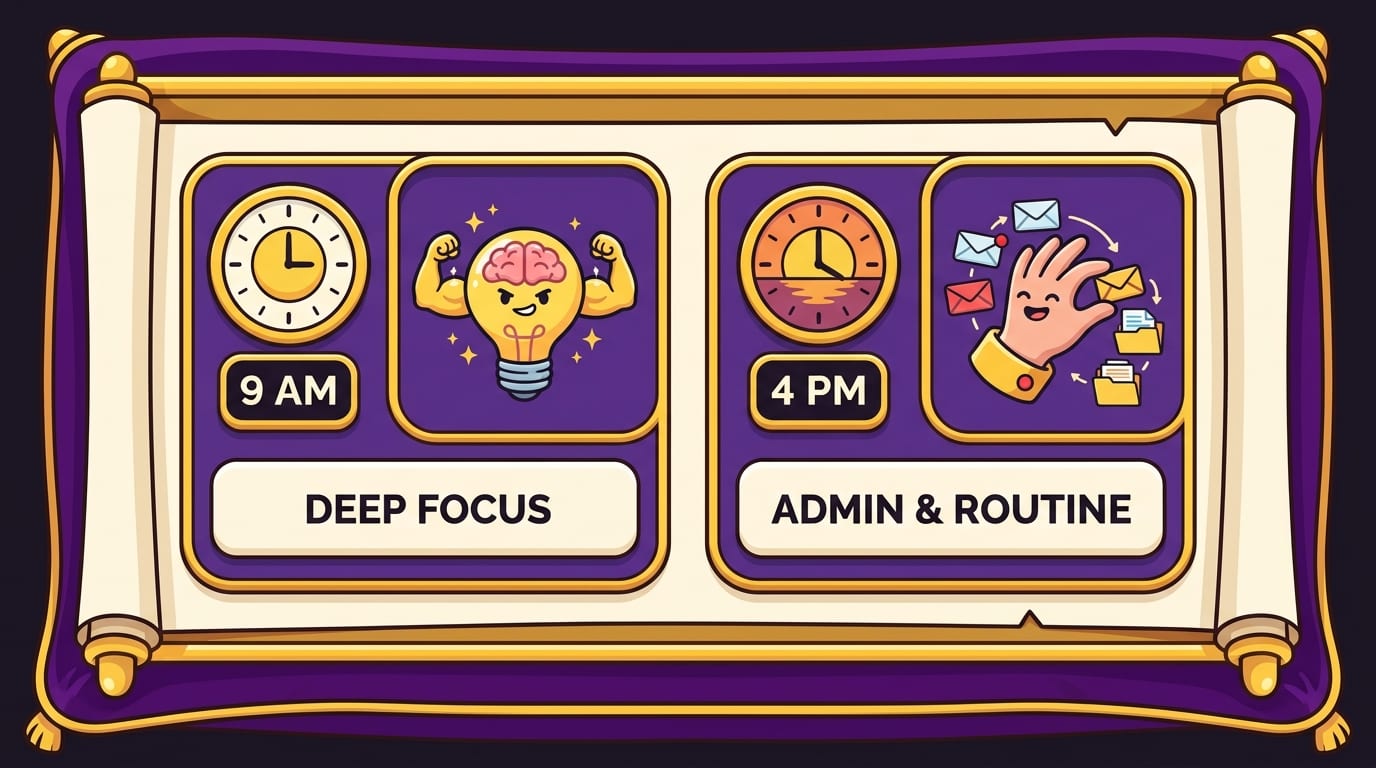
Think of your workday like a boxing card. Not every match is the title fight. Some tasks are heavyweight bouts: strategy, studying, writing, solving hard problems, building, designing, making decisions. Other tasks are lighter rounds: admin, inbox maintenance, scheduling, filing, checking dashboards, politely replying “Sounds good!” while your soul leaves your body.
Your goal is to schedule the title fights when your brain is strongest, and save the lighter rounds for when your energy dips. That is the royal move. That is how you stop wasting your best mental horsepower on email newsletters and calendar invites with names like “Quick Sync Alignment Touchpoint.”
Your Brain Has a Daily Rhythm, Whether You Like It or Not
Humans run on circadian rhythms: roughly 24-hour biological cycles that influence sleep, alertness, hormone release, digestion, body temperature, and cognitive performance. In plain English: your brain has opening hours. Respect the sign on the door.
The Sleep Foundation’s overview of circadian rhythm explains how these internal cycles help regulate when you feel alert and when you feel sleepy. While everyone is different, many people experience higher alertness in the morning, a dip in the early afternoon, and a second smaller wave of energy later in the day.
But before every night owl throws a cape over their shoulders and declares themselves biologically superior after midnight, there is nuance. Research on chronotypes shows that people vary in their preferred timing for sleep and activity. Some are morning types, some are evening types, and many are somewhere in the mushy middle. A large body of research summarized by the National Institutes of Health discusses how chronotype can affect sleep, health, and daily functioning.
So yes, your friend who “just wakes up naturally at 5” may not be morally superior. They may simply be wired that way. Annoying? Absolutely. Evil? Not necessarily.
The common energy pattern
Many people experience something like this:
- Early morning: Good for quiet focus if you are rested, but terrible if you are pretending four hours of sleep is “hustle.”
- Mid-morning: Often a strong window for deep work, analysis, studying, writing, or important decisions.
- Early afternoon: Energy dip territory. Beware the post-lunch productivity swamp.
- Late afternoon: Decent for collaboration, meetings, planning, and lower-intensity work.
- Evening: Can be great for creative work or study for night owls, but risky if it steals sleep.
Your version may differ. That is the point. The best time to work is not universal. It is personal, and you find it by paying attention instead of letting your calendar bully you around like a tiny Outlook dictator.
Morning Work: The Crown Jewel for Many People
For many workers and students, the morning is the easiest time to protect deep focus. The world is quieter. Fewer people are sending emails with “just circling back.” Your willpower is usually fresher. Your brain has not yet been tenderized by notifications, meetings, and the psychic damage of group chats.
Morning work is especially powerful for tasks that require concentration and decision-making. If you write, study, code, analyze data, build strategy, or create anything that demands serious attention, mid-morning may be your golden arena.
There is also evidence that interruptions are expensive. A famous study by Gloria Mark and colleagues found that after interruptions, it can take people significant time to return to their original task. You can explore more of Mark’s research on attention and workplace interruptions through this University of California Irvine paper on interrupted work. Translation: one “quick” check of Reddit can turn your work session into a haunted corn maze.
To make mornings work better, try this simple setup:
- Choose one important task the night before.
- Open only the tools needed for that task.
- Block distracting websites before you begin.
- Work for 60 to 90 minutes before checking messages.
- Take a real break, not a fake break where you scroll until your soul becomes soup.
This is where a tool like BlockChamp fits naturally. If your best work window is 8:30 to 10:30 a.m., you can turn on blocks before you start and keep the kingdom clean. Block social media, video, news, shopping, gaming, or whatever your personal attention goblin prefers. If you try to sneak into a blocked site, The King gives you The Stare-Down and sends you back to work. It is productivity with a crown and mild emotional damage. Beautiful.
Afternoon Work: Use the Slump, Don’t Fight It Like a Foolish Knight
The afternoon gets a bad reputation, and honestly, it has earned some of it. Many people hit an energy dip after lunch, especially between 1 p.m. and 3 p.m. This does not mean the afternoon is useless. It means you should stop scheduling your hardest brain battles during your mashed-potato era.
The best time to work on lighter tasks may actually be the afternoon. When your deep focus is lower, switch to work that needs motion more than brilliance. Process email. Update project boards. Schedule meetings. Review notes. Do maintenance tasks. Make phone calls. Do the work equivalent of tidying the castle courtyard.
Afternoons are also good for collaborative work because other people are awake, online, and full of opinions. Save meetings for times when you are less likely to produce your deepest solo work anyway. That way, meetings do not eat your prime focus hours like a dragon with a Google Calendar invite.
Try creating an “afternoon menu” of tasks. These are useful jobs you can do when your energy is medium or low:
- Reply to non-urgent emails
- Clean up your task list
- Review documents
- Handle admin work
- Plan tomorrow’s top priorities
- Do simple research or reading
- Organize files, notes, or bookmarks
If time management feels like trying to herd caffeinated pigeons, you may also like BlockChamp’s guide to practical work time management tips. It pairs nicely with this idea: put the right work in the right slot instead of treating every hour like it has the same magical powers.

Night Work: Secret Weapon or Sleep-Stealing Gremlin?
Evening work can be excellent for some people. Night owls often feel more creative, calmer, and more mentally available after the noise of the day dies down. If you are a student, freelancer, creator, or remote worker with flexible hours, your best time to work might genuinely be after dinner.
But night work has one enormous catch: sleep. If your evening productivity regularly pushes bedtime later, you may be borrowing focus from tomorrow with a brutal interest rate. Sleep loss can harm attention, memory, mood, and decision-making. The CDC recommends adults get at least 7 hours of sleep per night, which is inconvenient for everyone trying to become a midnight empire-builder fueled by cereal and panic.
Night work is best when it is intentional, bounded, and not a revenge bedtime procrastination festival. Give it rules:
- Set a hard stop time at least 30 to 60 minutes before bed.
- Use evening sessions for creative work, review, or studying if that is when you feel sharp.
- Avoid high-stress tasks right before sleep.
- Keep your workspace dimmer and reduce blue-light exposure if possible.
- Do not let “one more task” become “why are birds screaming outside?”
If your nights keep getting hijacked by streaming, social media, or “I’ll just watch one video” lies from the Algorithm Goblin, consider scheduling blocks during your evening work hours. BlockChamp’s Champion features include recurring focus schedules, so your blocks can activate automatically. The King stands guard while you work, instead of napping on the throne while YouTube eats your thesis.
Match the Task to the Time: The Productivity Pairing Menu
The best time to work depends heavily on what kind of work you mean. Asking “When should I work?” is like asking “When should I eat?” Well, champ, are we talking breakfast, a protein bar, or an entire lasagna at 11:48 p.m.?
Different tasks require different mental states. Here is a practical pairing menu:
Deep work and problem-solving
Schedule this during your highest-energy window. For many people, that is mid-morning. For night owls, it may be evening. Deep work includes writing, coding, studying, analysis, design, strategy, and anything where distractions punch your results directly in the face.
Creative brainstorming
Creativity can happen during peak energy, but some people brainstorm better when they are slightly less filtered. Late afternoon or evening may work well. Keep a notes app handy, because your brain may deliver a genius idea while you are brushing your teeth like a tiny chaotic oracle.
Meetings and collaboration
Put these in lower-focus zones when possible. Late morning or afternoon often works. Avoid letting meetings fragment your best work block into sad little crumbs.
Email and admin
Batch this. Do not graze your inbox all day like a productivity cow. Pick two or three windows, ideally after your important work. If you need a stronger prioritization system, BlockChamp’s post on the Eisenhower Matrix for time management can help you sort urgent from important without needing a royal decree.
Learning and study
Use your sharpest window for new or difficult material. Use lower-energy windows for review, flashcards, or organizing notes. Students, protect your study block like it contains the crown jewels. Because it does. The crown jewels are your GPA and your will to live.
How to Find Your Personal Best Time to Work
You do not need a lab coat, a sleep tracker, or a productivity guru whispering “optimize” into your ear. You need observation. For one or two weeks, track your energy and focus across the day. The pattern will reveal itself like a raccoon emerging from a trash can: surprising, but useful.
Use a simple 1-to-5 scale every couple of hours:
- Energy level
- Focus quality
- Mood
- Distraction cravings
- Task difficulty
Also note what you ate, how you slept, whether you exercised, and how many meetings ambushed you. Context matters. A bad morning after four hours of sleep does not mean mornings are bad. It means your brain filed a formal complaint.
Here is a simple experiment:
- Pick one important type of work: writing, studying, coding, planning, etc.
- Try doing it at three different times: morning, afternoon, and evening.
- Measure output, not vibes. Pages written, problems solved, tasks completed, concepts learned.
- Rate how hard it felt.
- Repeat for at least one week.
You are looking for a window where work feels cleaner, faster, and less like dragging a couch through wet cement. That is probably your best work time.
If you struggle to protect that window once you find it, use an attention system. The BlockChamp article on how to stay focused at work with an attention charter is a great companion because it helps you define what deserves your attention and what gets booted from the castle.
Build a Routine Around Your Peak Hours
Once you identify your best time to work, do not leave it exposed like a sandwich at a seagull convention. Protect it with a routine.
A good focus routine has three parts: a start ritual, a protected block, and a shutdown. This helps your brain know when it is time to enter work mode and when it can stop pretending to be a productivity machine.
1. Create a start ritual
Your start ritual should be short and repeatable. You are not summoning a productivity demon. You are just telling your brain, “We work now.”
- Make coffee or tea
- Put your phone away
- Open your task document
- Turn on website blocks
- Set a timer for 50, 75, or 90 minutes
- Write the first tiny action: “Open draft,” “Solve problem 1,” “Review notes”
2. Defend the focus block
This is where most people lose the match. They identify a great work window, then let Slack, email, news, social media, and “urgent” nonsense storm the throne room.
During your peak block, remove choices. Close extra tabs. Silence notifications. Tell teammates when you are unavailable. If needed, use BlockChamp to block categories like Social Media, Video & Streaming, News, Shopping, Gaming, or AI Distractions. Yes, even AI tools can become distractions if you start asking a chatbot for “quick ideas” and emerge 38 minutes later with a business plan for raccoon-themed socks.
3. End with a shutdown
At the end of the session, capture what you finished and what comes next. This prevents tomorrow-you from opening the laptop and thinking, “What was I doing?” like a confused medieval villager seeing electricity for the first time.
A strong shutdown includes:
- One sentence summarizing progress
- The next action for tomorrow
- Any blockers or questions
- A quick reset of your workspace
This is especially useful if you are balancing work through chaotic seasons. For a more reflective angle, read productivity lessons from working through life changes. Sometimes the best time to work changes because life changes. The crown must adapt.
Beware the Fake Best Time: When You Feel Busy but Produce Dust
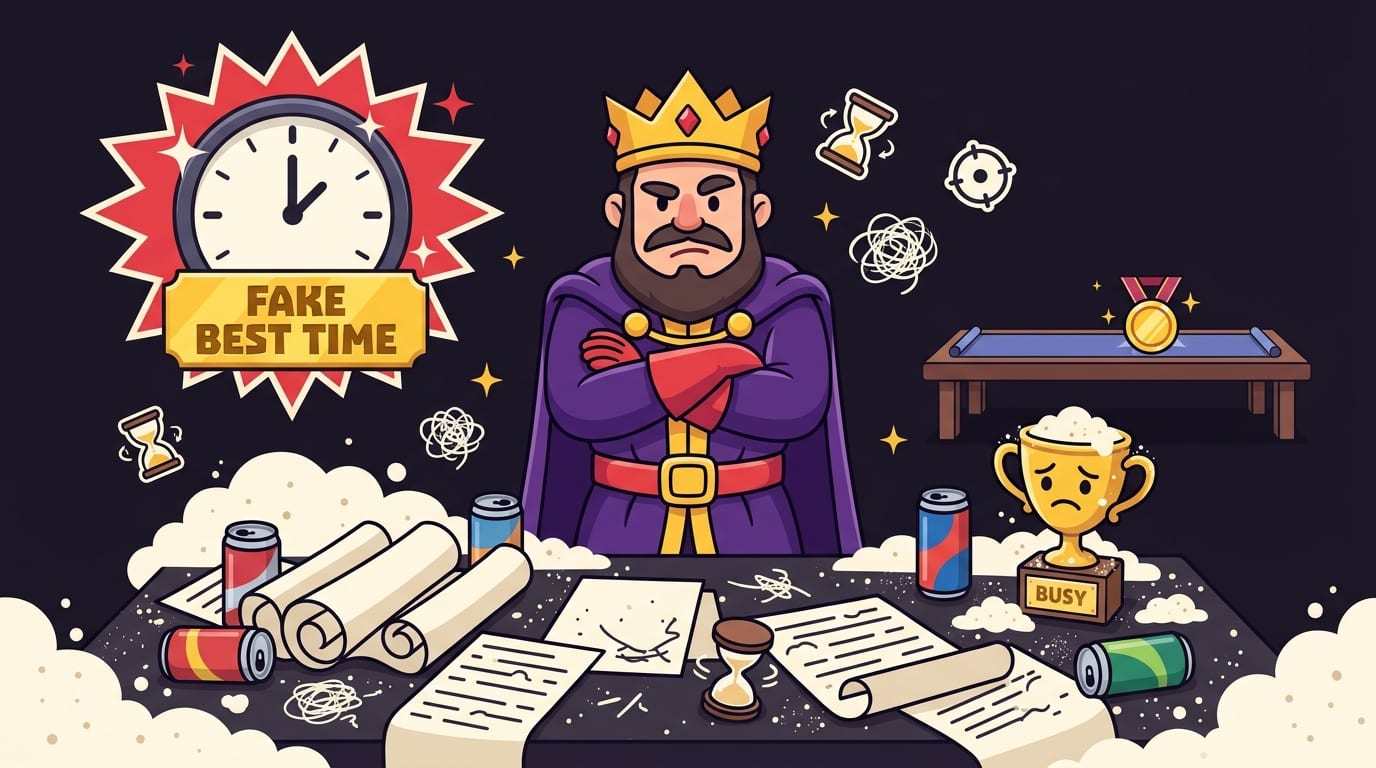
Not all “productive” hours are productive. Some are just busy hours wearing a tiny fake mustache.
You might feel active because you answered emails, checked dashboards, skimmed articles, reorganized your task app, changed the color of your Notion icons, and researched the best chair for “deep work posture.” But if the important work did not move, your kingdom did not expand. You just polished the drawbridge.
Productivity research often points to the cost of context switching. The American Psychological Association notes that switching between tasks can reduce efficiency, especially when tasks are complex or unfamiliar. Their overview on multitasking and task switching explains why trying to juggle several tasks at once tends to hurt performance. In royal terms: one knight per horse, please.
To avoid fake productivity, define a win before each work block. A win is specific:
- Draft 800 words
- Finish one lecture review
- Build the landing page hero section
- Analyze the campaign data and write three recommendations
- Complete five practice problems
“Work on project” is not a win. That is fog wearing pants. Make the target visible, then schedule it during your best work time.
Protect Your Best Work Time from Digital Distractions
Even if you find your perfect productivity window, distractions will still try to break in wearing a fake delivery uniform. Modern apps are built to capture attention. Infinite scroll, autoplay, notifications, trending feeds, and recommendation engines are not accidents. They are attention traps with better branding.
Data from DataReportal’s Digital 2024 Global Overview Report shows that people spend huge amounts of time online and on social platforms each day. That does not mean the internet is evil. It means your attention is valuable, and many companies brought shovels.
So do not rely on willpower alone. Willpower is great until you are tired, bored, stressed, hungry, or one thumbnail away from “Top 10 Medieval Weapons You Won’t Believe Existed.” Build barriers.
Practical ways to protect your best time to work:
- Use website blocking during your peak hours.
- Put your phone in another room or inside a drawer.
- Turn off non-essential notifications.
- Use full-screen mode for your main work app.
- Keep a distraction list nearby: write urges down instead of acting on them.
- Schedule “scroll time” later so your brain does not panic like a toddler denied crackers.
BlockChamp makes this part more fun than traditional blockers. Instead of a gray punishment screen, you get The King, a royal boxer mascot who judges your attempt to visit blocked sites. Every focused minute earns XP. Every day your blocks stay active builds your reign. Every Stare-Down survived gives you a little victory. It turns “I must avoid distractions” into “I am defending the throne.” Ridiculous? Slightly. Effective? That is the point.
A Sample Daily Schedule for Different Work Styles
Need examples? Good. The kingdom provides.
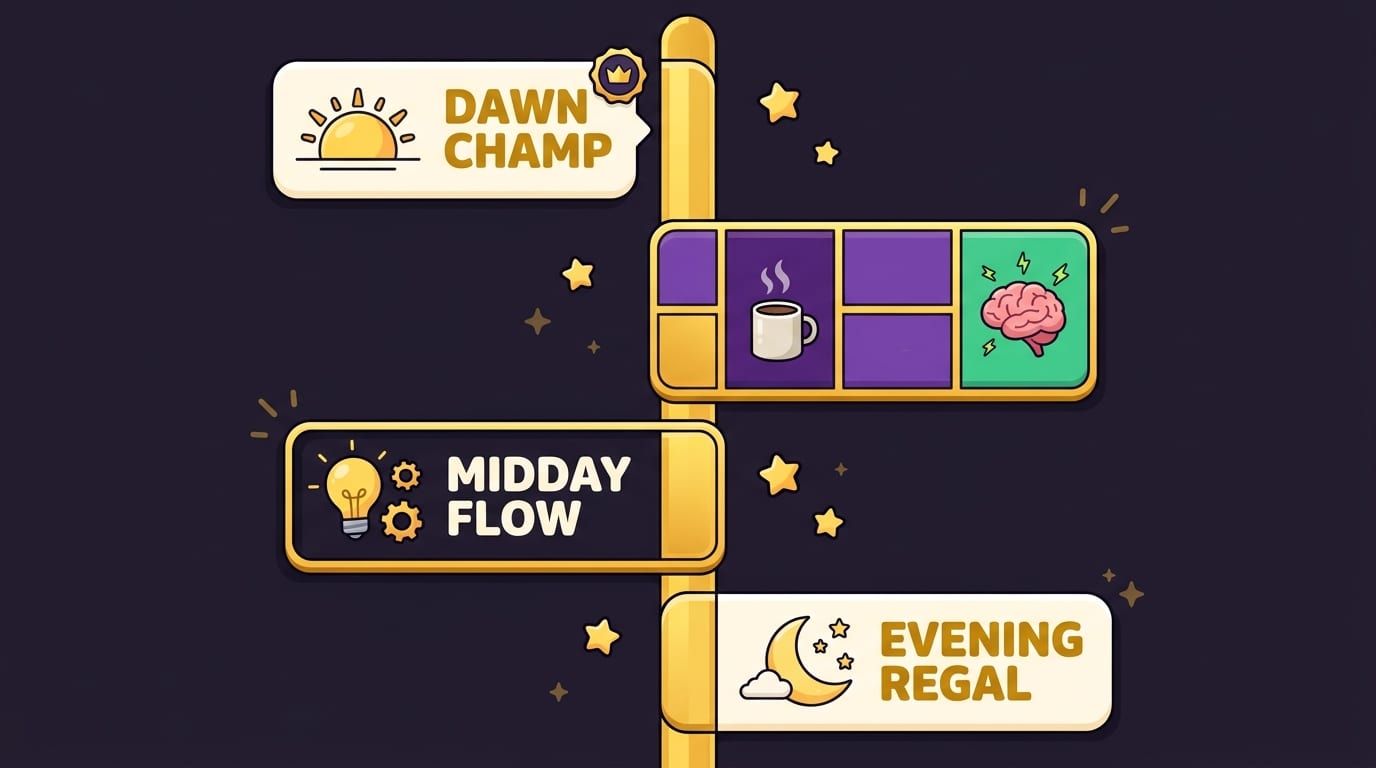
For morning-focused workers
- 7:30 a.m. — Wake, hydrate, light movement
- 8:00 a.m. — Plan top task and turn on focus blocks
- 8:15 a.m. to 10:15 a.m. — Deep work
- 10:15 a.m. — Break and messages
- 11:00 a.m. — Secondary task or meeting
- 1:30 p.m. — Admin and email
- 3:00 p.m. — Collaboration, review, planning
For afternoon peak workers
- 9:00 a.m. — Easy start, admin, planning
- 10:30 a.m. — Meetings or lighter tasks
- 12:00 p.m. — Lunch and reset
- 1:30 p.m. to 3:30 p.m. — Deep work block
- 3:45 p.m. — Review and communication
- 5:00 p.m. — Shutdown note for tomorrow
For night owls
- 10:00 a.m. — Start with admin or low-intensity work
- 12:00 p.m. — Meetings, errands, routine tasks
- 3:00 p.m. — Planning and prep
- 7:30 p.m. to 9:30 p.m. — Deep work or study
- 9:30 p.m. — Shutdown, no new rabbit holes
- 10:30 p.m. onward — Wind down like a civilized monarch
None of these schedules are sacred. Steal what works. Toss what does not. The best time to work is discovered, not downloaded from a LinkedIn post by a man named Chad who takes ice baths next to a whiteboard.
How to Keep Your Best Work Time Consistent
Finding your best work time is step one. Keeping it consistent is where the crown is won.
Consistency reduces decision fatigue. If your brain knows that 9 a.m. to 11 a.m. is always deep work, you waste less energy negotiating with yourself. The fewer negotiations, the fewer loopholes. The fewer loopholes, the fewer surprise visits to Instagram “for business reasons.”
Try these consistency rules:
- Same cue: Start with the same drink, playlist, workspace, or timer.
- Same first action: Begin with a tiny repeatable step, like opening your draft or reviewing yesterday’s notes.
- Same protection: Turn on blockers, silence alerts, and close extra tabs every time.
- Same review: End by recording what worked and what to do next.
You can also treat your best work time like money. Spend it carefully. Do not blow your premium focus hours on digital pocket lint. BlockChamp has a whole post on this mindset: save your time like your money. Your attention budget deserves a bodyguard with gloves.
If your schedule changes often, aim for a flexible anchor instead of a fixed hour. For example: “My first 90-minute block after breakfast is deep work,” or “My first quiet block after classes is study time.” Anchors survive chaos better than perfect schedules.
Final Verdict: The Best Time to Work Is the Time You Can Actually Defend
The best time to work is not always the prettiest time, the earliest time, or the time some productivity influencer claims changed their life, jawline, and stock portfolio. It is the time when your energy, task type, environment, and attention protection line up.
For many people, that will be the morning. For others, afternoon or evening will win. The royal secret is to test your own rhythm, match demanding tasks to your strongest hours, save lighter work for dips, and build routines that make focus automatic. No mystical nonsense required. Just observation, structure, and fewer opportunities for the internet to steal your crown.
And when you do find that golden window? Defend it like The King defends the throne. Block the sites that ambush you. Silence the chaos. Give your best hours to your best work, not to doomscrolling, shopping carts, hot takes, or “one quick video” that somehow becomes a documentary about competitive cheese rolling.
If you want help protecting your peak focus hours, try BlockChamp for Chrome. Set your distractions as opponents, turn on Focus, earn XP for staying on guard, and let The King roast you back to work when you attempt treason against your own schedule. Long live your focus, champ. Now go find your best time to work — and defend the crown.
Related posts

Finding Focus For Fiction Writing

Learning To Focus In A Digital World As A Creative

Finding Focus For Personal Growth
