
Productivity Process For Writers

Your laptop is open. Your coffee is heroic. Your outline is… somewhere. Then one tiny “research” click becomes 47 minutes of YouTube, two Reddit threads, one oddly intense argument about fountain pens, and a cart full of notebooks you absolutely do not need. Behold: the modern writer’s natural predator.
A strong productivity process for writers is not about becoming a joyless typing goblin who produces 5,000 perfect words before sunrise while drinking boiled kale. It is about building a repeatable system that helps you move from idea to finished draft without relying on vibes, panic, or the moon being in the correct emotional zip code.
Writing is creative, yes. But it is also operational. You need inputs, planning, focused drafting, revision, publishing, recovery, and tools that protect your attention when your brain tries to defect to TikTok. This guide breaks down a practical productivity process for writers—one you can actually use whether you write blog posts, essays, newsletters, fiction, scripts, client work, or your 19th “final_final_reallyfinal.docx.”
Quick Answers
1. Start With a Writer’s Workflow, Not a Wish and a Candle
Most writers do not have a productivity problem. They have a workflow problem wearing a fake mustache. If your process is “sit down, open document, experience dread, check email, reorganize desk, vanish,” your brain has no clear runway. It is trying to land a plane in a foggy goat field.
A reliable productivity process for writers starts by separating the work into stages. Writing is not one task. It is several different tasks stacked in a trench coat:
- Capture: collect ideas, notes, quotes, observations, questions, and sparks.
- Clarify: decide which ideas are worth developing and why.
- Plan: create an outline, angle, structure, and goal.
- Draft: produce words without over-polishing every sentence like it is royal silverware.
- Revise: reshape, strengthen, cut, reorganize, and improve.
- Edit: fix grammar, style, flow, formatting, links, and final details.
- Publish or submit: ship the thing instead of keeping it in a cave.
- Review: learn what worked and update your system.
When you mix these stages, productivity collapses. You try to draft while researching, edit while outlining, and judge the whole piece before it exists. That is like trying to bake a cake while eating the batter and reviewing it on Yelp. Chaos. Sticky chaos.
Instead, treat each stage as a separate mode. Your goal in drafting mode is not to create polished prose. Your goal is to create material. Your goal in revision mode is not to “feel inspired.” Your goal is to make the piece clearer, sharper, and more useful. Each mode gets its own tools, environment, and success metric.
If you want a deeper dive into building the identity and habits behind this kind of system, BlockChamp has a useful companion piece on becoming a productivity expert through focus. Spoiler: it does not require becoming a monk, but it may require telling Instagram to sit in the corner.
2. Build an Idea Capture System Before Your Brain Starts Leaking
Writers are idea factories with terrible inventory management. Great ideas arrive in the shower, on walks, during conversations, while making toast, and exactly 11 seconds before sleep. If you do not capture them, they evaporate into the same void that holds missing socks and your motivation from last Tuesday.
Your capture system should be fast, boring, and available everywhere. Do not overcomplicate this. The best tool is the one you actually use when your brain whispers, “What if the article opened with a raccoon metaphor?”
Use one inbox for raw ideas
Choose a single place where all writing ideas go first. That could be Apple Notes, Google Keep, Notion, Obsidian, Todoist, a paper notebook, or a notes app that looks like it was designed by a sleepy accountant. The tool matters less than the rule: everything lands in one inbox before it gets organized.
Capture ideas in rough form:
- Article titles
- Questions your audience asks
- Interesting quotes or stats
- Personal stories
- Strong opinions
- Metaphors, jokes, and examples
- Problems you notice repeatedly
Once or twice a week, review the inbox and sort ideas into categories: “write soon,” “needs research,” “maybe later,” and “this was clearly written by 1:13 a.m. goblin-me.” This keeps your writing pipeline stocked so you are not starting from a blank page every time.
Keep a research parking lot
Research is useful. Research is also a trapdoor with Wi-Fi. One moment you are verifying a statistic; the next, you are reading a 2017 forum debate about medieval bread. A research parking lot gives you a place to store links and facts without derailing your draft.
Create a section in every project called “Research Parking Lot.” Dump links, studies, screenshots, quotes, and notes there. During drafting, if you need a fact, type “[STAT ABOUT ATTENTION HERE]” and keep moving. Later, during research mode, fill the gap.
This separation is especially important because the internet is designed to hijack attention. The American Psychological Association’s research on multitasking notes that task switching can reduce efficiency because the brain pays a mental “switching cost.” Writers feel this cost brutally. Every tab detour makes it harder to return to the sentence you were building.
3. Plan the Piece Like a Tiny Writing General
Outlining does not kill creativity. Bad outlining does. A good outline is not a prison; it is a map. It says, “Here is where the dragon lives, here is where the reader gets confused, and here is where we bring snacks.”
Before drafting, answer five planning questions:
- Who is this for? Define the reader clearly. Beginner freelancer? Busy founder? Student? Fiction writer?
- What problem are they trying to solve? Be specific. “Write faster” is vague. “Finish a 1,500-word article without spiraling into research chaos” is useful.
- What promise does this piece make? What will the reader be able to do after reading?
- What structure fits best? Step-by-step guide, list, argument, story, comparison, tutorial, checklist?
- What is the next action? Subscribe, try a tool, use a template, revise a process, publish?
Then create a working outline. For blog posts, this might mean H2 sections and bullet points under each. For fiction, it might mean scene beats. For newsletters, it might mean hook, story, lesson, takeaway. For client content, it might include SEO keywords, internal links, external sources, and call-to-action notes.
A useful outline includes enough direction that you never stare at a heading and think, “What was I going to say here? Was I… smart yesterday?” Future-you deserves breadcrumbs. Future-you is tired.
The 10-minute outline sprint
If you hate outlining, try this quick method:
- Set a timer for 10 minutes.
- Write the title or central idea at the top.
- List every point you might include, messy and fast.
- Group related points into sections.
- Delete anything that does not support the main promise.
- Put the sections in the reader’s likely order of need.
This gives you a workable structure without turning planning into ceremonial procrastination. Beware the productivity cosplay: color-coded templates, 14 dashboards, and no actual words. The crown does not approve.

4. Batch Similar Writing Tasks So Your Brain Stops Changing Costumes
Batching means doing similar tasks together instead of constantly switching between different types of work. For writers, batching is a cheat code because writing involves several mental gears: idea generation, research, drafting, editing, formatting, promotion, admin. Switching between those gears all day burns energy like a dragon with a credit card.
A strong productivity process for writers uses batching to protect attention. Here is a simple weekly batching model:
- Monday: idea review and content planning
- Tuesday: research and outlining
- Wednesday: first drafts
- Thursday: revision and editing
- Friday: formatting, publishing, pitching, and review
You do not have to follow that exact schedule. The point is to reduce the number of mental costume changes. If you are writing three blog posts this week, outline all three before drafting any. If you have five newsletters to plan, brainstorm them in one session. If you need to edit, edit in a dedicated block with your ruthless little editor hat on.
Content teams and solo creators use batching because it lowers friction. Buffer’s guide to content batching for social media and content creation explains how grouping similar work helps creators stay consistent without reinventing the wheel every day. Writers can steal this idea shamelessly. Put it in a velvet bag. It is yours now.
Batching examples for different writers
For freelance writers, batch client admin separately from writing. Do invoices, emails, proposals, and follow-ups in one or two windows per day. Do not let your inbox nibble your draft to death.
For bloggers, batch SEO tasks: keyword research, competitor review, internal link planning, meta descriptions, and image alt text. These are important, but they use a different brain than drafting.
For fiction writers, batch worldbuilding and research separately from scene drafting. If you stop mid-scene to research 18th-century soup spoons, your plot may never return from war.
For academic writers, batch citation management, literature review notes, and argument drafting. Your source work and your writing work need boundaries, or the bibliography will seize the throne.
5. Design Focus Blocks That Actually Respect Human Brains
“Write for eight hours” is not a productivity plan. It is a dare issued by someone who has never met a nervous system. Most writers do better with focused blocks: defined periods of distraction-free work aimed at one specific outcome.
A focus block has four parts:
- Duration: 25, 45, 60, or 90 minutes
- Target: one measurable goal
- Environment: tabs closed, phone away, distractions blocked
- Recovery: a short break after the block
Examples of good writing block targets include:
- Draft the introduction and first two sections
- Write 800 rough words
- Revise the argument structure
- Edit for clarity and remove 10% of word count
- Find and insert five credible sources
Notice these are specific. “Work on article” is too mushy. Your brain sees mush and opens Reddit. A specific target gives your attention a job.
The Pomodoro Technique—working in timed intervals with breaks—is popular for a reason. The official Pomodoro Technique framework uses focused sessions to reduce overwhelm and make progress visible. Writers can adapt it: 25 minutes for warm-up drafting, 45 minutes for deeper scenes or sections, 90 minutes for high-focus revision if you are trained for longer work.
Use a shutdown ritual for distractions
Before each focus block, run a tiny ritual:
- Write the target at the top of your document.
- Close unrelated tabs.
- Put your phone out of reach or in another room.
- Turn on your website blocker.
- Start a timer.
- Begin with an ugly sentence to break the ice.
This is where BlockChamp fits beautifully into a writer’s process. If your writing session is constantly ambushed by YouTube, Reddit, X/Twitter, TikTok, news, shopping, or “just checking one thing,” BlockChamp lets you block specific sites, keywords, or entire categories. The Master Focus Toggle arms your blocks, and if you try to sneak into a blocked site, The King hits you with the Stare-Down. It is like having a royal boxing coach guarding your draft from your worst impulses. Slightly ridiculous. Surprisingly effective.
For more on protecting attention from digital chaos, read BlockChamp’s guide to digital minimalism and taking back control of your attention. Your tabs may protest. Ignore them. They have no constitutional rights.
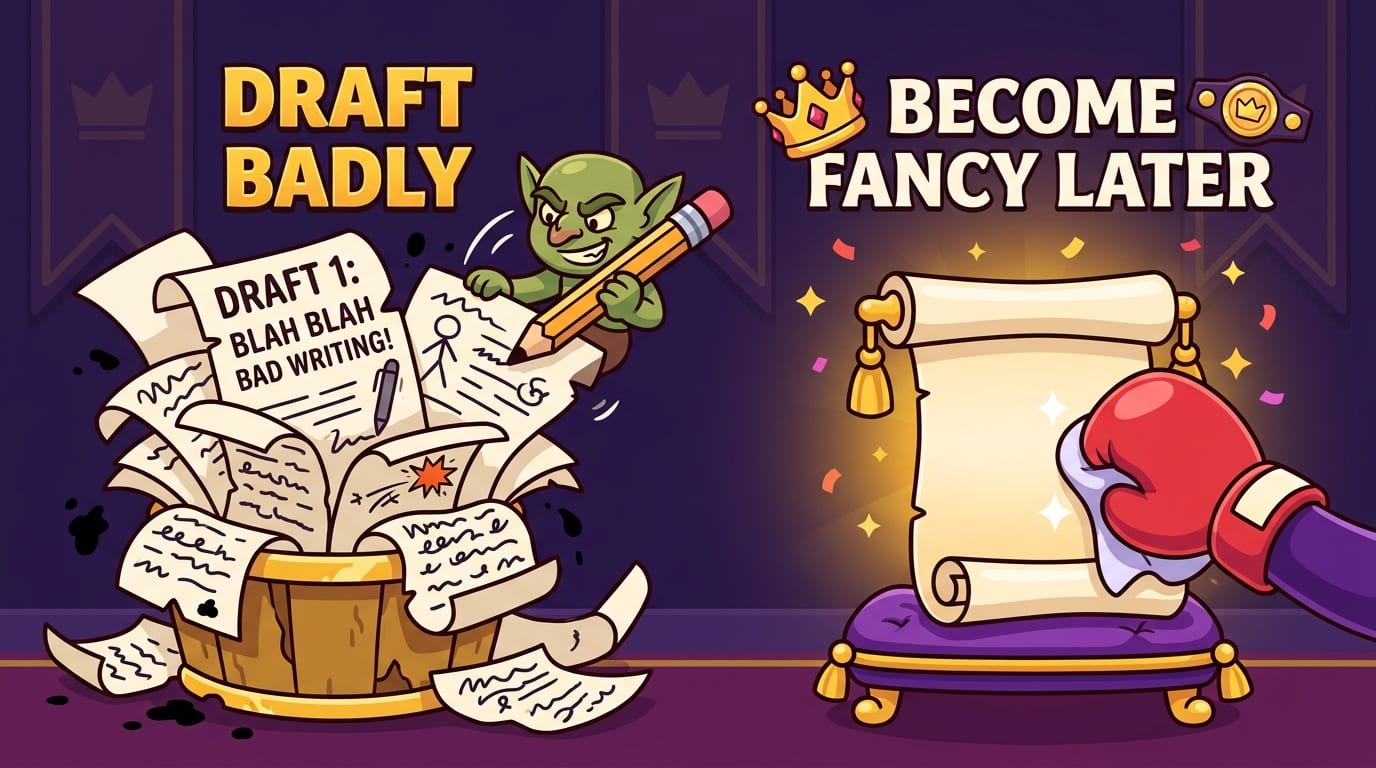
6. Draft Badly on Purpose, Then Become Fancy Later
The first draft’s job is to exist. That is it. Not sparkle. Not win awards. Not make your old English teacher weep into a cardigan. Exist.
Many writers stall because they judge sentences too early. They write one line, hate it, rewrite it, hate the rewrite, check a synonym, wonder if they are a fraud, and somehow end up watching a video titled “Man Builds Underground Pool With Stick.” The sentence never stood a chance.
Separate drafting from editing. During the first draft, move forward. Use placeholders. Write clunky transitions. Type “explain this better” and keep going. Momentum matters because writing reveals thinking. You often do not know what you mean until the draft coughs it up like a cat with a hairball.
Try the “dirty draft” rule
For your next piece, create a rule: no sentence-level editing until the full draft is complete. You may only:
- Add missing ideas
- Move to the next section
- Leave placeholders
- Correct typos only if they genuinely block comprehension
This rule keeps your inner critic from grabbing the steering wheel. The critic is useful later. During drafting, the critic belongs in a tiny royal dungeon with snacks.
You can also use word-count sprints. Set a timer for 20 minutes and write as many usable-ish words as possible. Not perfect words. Usable-ish. A noble category. If you do four 20-minute sprints, you may have the bones of a full article before lunch. Will some sentences be weird? Yes. That is what revision is for. Nobody sees the skeleton wearing its first hat.
7. Revise in Passes, Not One Giant Panic Cloud
Revision is where writing becomes good. It is also where many writers get lost because they try to fix everything at once: argument, structure, tone, grammar, examples, links, headline, formatting, and whether the word “moist” should be legally banned. Too much.
Use revision passes. Each pass has one purpose. This makes revision calmer, faster, and less likely to turn into a dramatic staring contest with your document.
A five-pass revision workflow
- Structure pass: Does the piece flow logically? Are sections in the right order? Is anything missing or repetitive?
- Clarity pass: Are the ideas easy to understand? Where would the reader get confused?
- Usefulness pass: Are there examples, steps, tools, and takeaways? Does the reader leave with something actionable?
- Style pass: Does it sound like you or the brand? Are sentences varied? Is the tone consistent?
- Proofing pass: Grammar, typos, links, formatting, headings, meta description, and final polish.
If you write online content, include an SEO pass too. Check the title, headings, target keyword, semantic terms, internal links, external links, image alt text, and search intent. But do not let SEO turn your writing into a robot wearing a cardigan. The goal is helpful content that search engines can understand, not keyword soup ladled into the reader’s lap.
Moz’s Beginner’s Guide to SEO is a solid reference if you want to understand search basics without wandering into snake-oil territory. For writers, the big takeaway is simple: answer the reader’s query better than the competition, structure the page clearly, and make it trustworthy.
8. Track Output Without Turning Yourself Into a Spreadsheet Gremlin
Writers need feedback loops. If you do not track anything, every week feels mysterious. Did you write more in the morning or afternoon? Which projects took too long? Where did your time go? Why is Thursday always cursed? Data can help. Not in a “quantify your soul” way. In a “stop lying to yourself with elegance” way.
Track a few useful metrics:
- Words drafted per session
- Time spent in deep writing
- Number of completed drafts
- Revision time per piece
- Publishing consistency
- Distraction attempts during focus blocks
- Energy level by time of day
Keep it simple. A weekly note or spreadsheet is enough. You are looking for patterns, not building mission control for a moon landing.
BlockChamp’s gamified focus tracking can support this feedback loop. Every focused minute earns XP. Every blocked-site attempt you resist earns more XP. Your reign shows how long you have kept focus mode active, and the calendar makes your focus history visible. For writers who respond to streaks, badges, and “I refuse to lose to a website with autoplay,” this kind of visible progress can make the process stick.
If time tracking interests you, BlockChamp has a related article on how using a time tracker can increase your productivity. Pair time awareness with distraction blocking and you get a much clearer picture of your writing kingdom: where the gold is, where the goblins are, and which browser tab keeps trying to stage a coup.
9. Create a Distraction Defense Plan Because Willpower Is a Wet Napkin
Willpower is useful, but it is not a strategy. It is more like a tiny umbrella in a hurricane. Writers face constant temptation because writing is cognitively demanding and the internet offers instant relief. Your brain wants novelty, certainty, and snacks. A hard paragraph offers none of those. TikTok offers all three and possibly a raccoon in a hoodie.
A distraction defense plan removes choices before the session starts. The fewer decisions you have to make mid-draft, the better.
Build your writer’s block list
Make a list of your top writing-session enemies. Common offenders include:
- Social media: Instagram, X/Twitter, Facebook, TikTok, LinkedIn
- Community sites: Reddit, Discord, forums
- Video and streaming: YouTube, Netflix, Twitch
- News and doomscrolling sites
- Shopping sites when you suddenly “need” a new keyboard
- AI tools when they become avoidance instead of assistance
- Email and analytics dashboards
Then block them during writing sessions. BlockChamp is handy here because you can block by site or turn on entire categories like Social Media, Video & Streaming, News, Shopping, Gaming, and AI Distractions. Champion users can also use keyword blocking and recurring schedules, which is excellent if you write every weekday from 9 to noon and do not want to negotiate with your inner raccoon each morning.
For serious “do not let me out of this castle” sessions, BlockChamp’s Hardcore Lockdown adds a cooldown timer or boxing-riddle mini-game before you can turn focus off. That delay matters. Urges often fade if you do not immediately obey them. Instead of surrendering your draft for “five minutes” of Reddit—which, as scholars agree, is goblin math—you have to pause, choose, and maybe get roasted by The King. Fair trade.
This is the practical side of the classic motivation versus discipline debate. Motivation is lovely when it shows up, but systems carry you when it does not. BlockChamp’s post on motivation vs. discipline explores that distinction in more depth. Short version: build the guardrails before your brain starts bargaining.
10. Use a Weekly Review to Improve the Process, Not Insult Yourself
A productivity process for writers should evolve. Your first version will not be perfect. Good. Perfect systems are usually imaginary systems, and imaginary systems have suspiciously clean desks.
At the end of each week, spend 15 minutes reviewing what happened. Keep the tone curious, not cruel. You are not hosting a courtroom drama. You are tuning the machine.
Ask:
- What did I finish?
- What moved forward?
- Where did I get stuck?
- Which writing blocks felt easiest?
- Which distractions showed up repeatedly?
- Did I over-plan, under-plan, or avoid one stage?
- What is one small process change for next week?
Then choose one improvement. Not seven. One. Maybe you need to outline the day before drafting. Maybe you need to block news sites before morning writing. Maybe your 90-minute sessions are too long and 45-minute blocks work better. Maybe you draft well at 8 a.m. and edit better at 3 p.m. Congratulations: you have discovered data. The crown sparkles.
A simple weekly writer review template
Copy this into your notes app:
- Wins: What got finished or improved?
- Words: How many words or pages did I draft?
- Focus: How many deep work sessions did I complete?
- Friction: What slowed me down?
- Distractions: What tried to steal the throne?
- Lesson: What did I learn about my writing process?
- Next experiment: What one change will I test next week?
Over time, this turns productivity from a personality trait into a process. You stop asking, “Am I disciplined?” and start asking, “What does my system need?” Much healthier. Far fewer dramatic ceiling stares.
11. The Complete Productivity Process for Writers: A Step-by-Step Template
Let’s put the whole kingdom together. Here is a practical writing workflow you can use this week.
- Capture ideas daily: Put all ideas, quotes, questions, and examples into one inbox.
- Review ideas weekly: Sort your inbox into “write soon,” “research,” “maybe,” and “trash goblin.”
- Choose one project: Define the reader, problem, promise, format, and next action.
- Create a fast outline: Build sections, bullets, examples, and placeholders.
- Batch research: Collect sources and notes in a parking lot without drafting yet.
- Prepare your focus block: Set a target, close tabs, block distractions, start a timer.
- Draft without editing: Produce the rough version. Use placeholders. Keep moving.
- Take a break: Let the draft cool so you can see it clearly.
- Revise in passes: Structure, clarity, usefulness, style, proofing, and SEO if needed.
- Publish or submit: Ship it. The draft cannot help anyone from your hard drive dungeon.
- Track and review: Note what worked, what broke, and what to improve next time.
This process works because it reduces ambiguity. You always know which mode you are in and what success looks like. It also gives you room to be creative without letting chaos run the castle. A productivity process for writers should not make writing robotic. It should make writing repeatable enough that creativity has somewhere to land.

Conclusion: Protect the Draft, Defend the Throne
Writing will always involve some uncertainty. That is part of the job. But your process does not have to be a haunted maze full of open tabs and emotional support snacks.
A strong productivity process for writers gives you clear stages: capture, plan, batch, focus, draft, revise, publish, and review. It helps you stop treating every writing session like a heroic rescue mission and start treating it like a repeatable craft. Less panic. More pages. Fewer “research” spirals into the swamp.
And because distractions are not going to politely leave you alone, build defenses. Use focus blocks. Close tabs. Track patterns. Block the sites that keep body-slamming your attention. If you want a fun, slightly unhinged ally, try BlockChamp for Chrome. The King will guard your writing sessions, roast your distraction attempts, reward your focus with XP, and help you turn “I should write” into “I defended the throne and actually shipped the thing.”
Long live your focus, champ. Now close the shiny tabs and go make words.
Related posts

Finding Focus For Fiction Writing

Learning To Focus In A Digital World As A Creative

Finding Focus For Personal Growth
