
Overcoming Creative Block

Creative block has a rude habit of showing up right when you finally have time to make something. You open a blank document, pick up your guitar, sketch a promising circle, or launch your design app—and suddenly reorganizing your desk feels like a serious artistic contribution. If you’re looking for ways of overcoming creative block, the answer usually isn’t to wait for a lightning bolt. It’s to understand what’s getting in the way, lower the pressure, and give your brain a practical next step.
Creative block can feel like a mysterious failure of talent. More often, it’s a mix of fatigue, distraction, perfectionism, uncertainty, or too many demands competing for your attention. The good news: you don’t have to feel inspired before you begin. You can build conditions that make creative work easier to start—and easier to return to when the muse has apparently taken a long weekend.
Quick Answers
What creative block is—and what it isn’t
Creative block is a period when generating ideas, developing a project, or making progress feels unusually difficult. It can affect writers, designers, musicians, students, entrepreneurs, and anyone whose work involves solving problems or making choices. It may show up as a blank page, an unfinished project, endless second-guessing, or a suspicious urge to research “best pens for creative people” for three hours.
A block does not automatically mean you’ve lost your ability or that your project is doomed. Creativity isn’t a faucet that produces perfect ideas on command. It involves exploring options, making imperfect attempts, noticing what works, and revising. Sometimes the difficulty is not a shortage of ideas but a shortage of energy, clarity, confidence, or uninterrupted time.
It also helps to distinguish creative block from ordinary resistance. A task may feel awkward because you’re tired, because the next step is unclear, or because starting means risking a result that isn’t brilliant. Those are real obstacles, but they call for different responses. Rest may help fatigue. A tiny task can reduce resistance. A clearer brief can solve uncertainty. No amount of staring sternly at a blank page will do all four.
If your creative slump is tied to fear of judgment, comparison, or perfectionism, our guide to overcoming creative fear and staying focused explores how those pressures can interrupt your work—and how to move forward without waiting to feel fearless.
Find the actual obstacle before you try to defeat it
Before you overhaul your routine, ask yourself what is making the work difficult today. “I can’t create” is a broad verdict. A more specific diagnosis gives you something useful to do. Try finishing this sentence: “I would make progress if only…”
- If only I knew what to do next: You may need to define the next action, gather a few references, or ask for feedback.
- If only I had a good idea: You may need a quick idea-generation exercise, a change of input, or permission to make several bad ideas first.
- If only I could concentrate: Your environment or digital habits may be interrupting the session.
- If only this didn’t have to be perfect: Perfectionism may be turning each decision into a final exam.
- If only I had more energy: A break, meal, walk, or proper night’s sleep may be more useful than another productivity trick.
This simple check prevents you from treating every block as a motivation problem. It also helps you choose a response that fits the situation. If you’re exhausted, forcing a three-hour sprint is not a heroic plot twist. If you’re distracted, a new notebook probably won’t solve it. And if you’re unclear about the brief, a timer can help you work faster in the wrong direction.
When your head feels crowded, try a short “brain unload.” Write down every concern, task, idea, and unrelated reminder competing for your attention. Then mark what belongs to the project, what can wait, and what needs one small action. For more ways to make mental space before a creative session, see five steps to clear your mind and make room for creative work.
Lower the bar for starting—not for caring
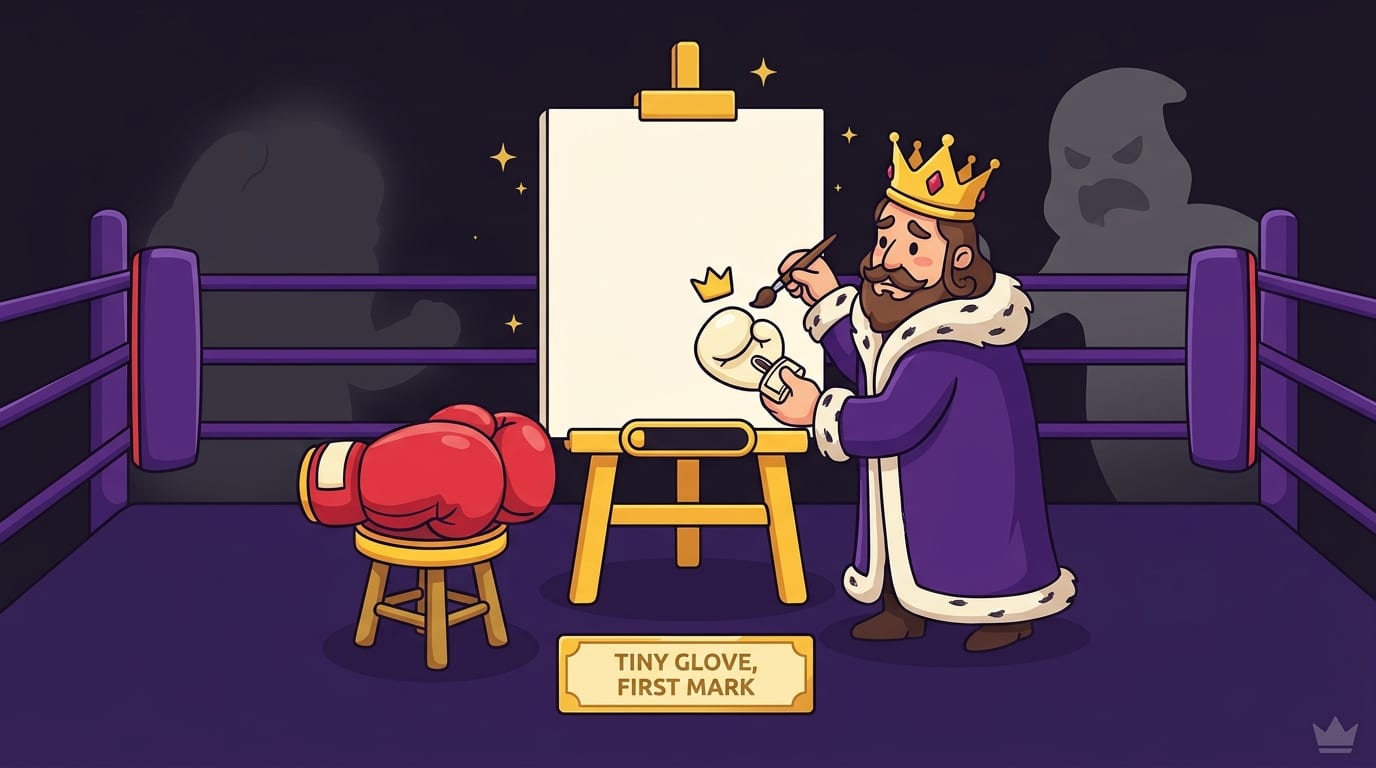
One of the most dependable ways of overcoming creative block is to make the first step so small that your inner critic has nothing impressive to object to. Don’t commit to writing a chapter. Write three rough sentences. Don’t promise to finish a painting. Choose a palette and make a few test marks. Don’t produce a polished logo. Sketch five deliberately rough shapes.
The purpose is not to trick yourself into caring less. It’s to separate starting from judging. A first attempt is raw material, not a public statement about your worth. Once something exists, you can respond to it, improve it, or discover that it points in a more interesting direction than the one you planned.
Try a ten-minute start:
- Choose one project and name a specific task you can complete in ten minutes.
- Set a timer and work only on that task. No polishing the project plan, selecting a new font, or checking whether your favorite creator has posted.
- When the timer ends, write down what you did and what the next action should be.
- Decide whether to continue, take a break, or stop for now. The session still counts either way.
This small-start approach is especially useful when a project has become too big in your mind. “Finish the portfolio” sounds like a fog bank with a deadline. “Choose two pieces for the homepage” is a task you can actually approach. A clear next step reduces the number of decisions you have to make before beginning.
You can also create a deliberately bad first draft. Write the clumsiest version of the paragraph. Draw the awkward thumbnail. Record the rough melody without deciding whether it deserves to exist. The point is to generate something you can shape. You’re not lowering your standards for the finished work; you’re postponing the critic until there’s work to critique.
Change your inputs when your ideas feel stale
Creative work depends on both making things and taking things in. If you’ve been trying to produce ideas from the same narrow pool of inputs, a change of scenery or subject can refresh your thinking. That doesn’t mean opening twelve tabs and calling it research. It means choosing a few intentional experiences that give your brain different material to combine.
Take a walk without a podcast. Visit a library, gallery, market, park, or unfamiliar part of town. Read about a topic outside your usual field. Listen to a genre you rarely choose. Notice the shapes of buildings, the rhythm of a conversation, or the way a shop displays ordinary objects. The aim is to pay attention, not to force every interesting thing into a project immediately.
For a more focused reset, give yourself a creative prompt with constraints. Write a scene using only dialogue. Design an object for someone with one specific need. Create a melody using three notes. Constraints narrow the field of possibilities, which can make beginning easier. If you feel stuck because the options are endless, a boundary can be liberating rather than restrictive.
Keep an idea bank where you collect observations, phrases, sketches, questions, and links worth revisiting. Don’t demand that each note become a masterpiece. An idea bank is a pantry, not a restaurant review. When you’re low on inspiration, browse what you’ve gathered and combine two unrelated items. A familiar problem paired with an unfamiliar perspective can become a useful starting point.
Be thoughtful about the difference between inspiration and comparison. Looking at other people’s work can teach you techniques and expand your sense of possibility. It can also convince you that everyone else has already made the thing you’re struggling to make. If that happens, step away from the feed and return to the specific problem in front of you. For practical ideas on protecting creative attention, read how to fight distraction as a creative professional.
Build a routine that helps creativity show up
Waiting to feel inspired puts your work schedule in the hands of a feeling that may or may not arrive. A routine gives creativity a dependable place to land. It doesn’t need to be elaborate. A regular time, a familiar workspace, a short warm-up, and one clear task can make starting more automatic.
Choose a realistic session length. If you’re building a habit, twenty focused minutes may be more sustainable than announcing a heroic four-hour creative retreat every Monday and then avoiding your desk until Thursday. Put the session on your calendar, decide what you’ll work on beforehand, and prepare your materials so the first minutes aren’t spent hunting for a charger or searching through old files.
Use a repeatable opening ritual: make tea, clear the desk, reread yesterday’s notes, or write one sentence about today’s goal. A ritual gives your brain a cue that it is time to shift into the task. It can also preserve momentum between sessions. Before you stop, leave yourself a short note describing what you did and what to try next. Future-you will appreciate the handoff.
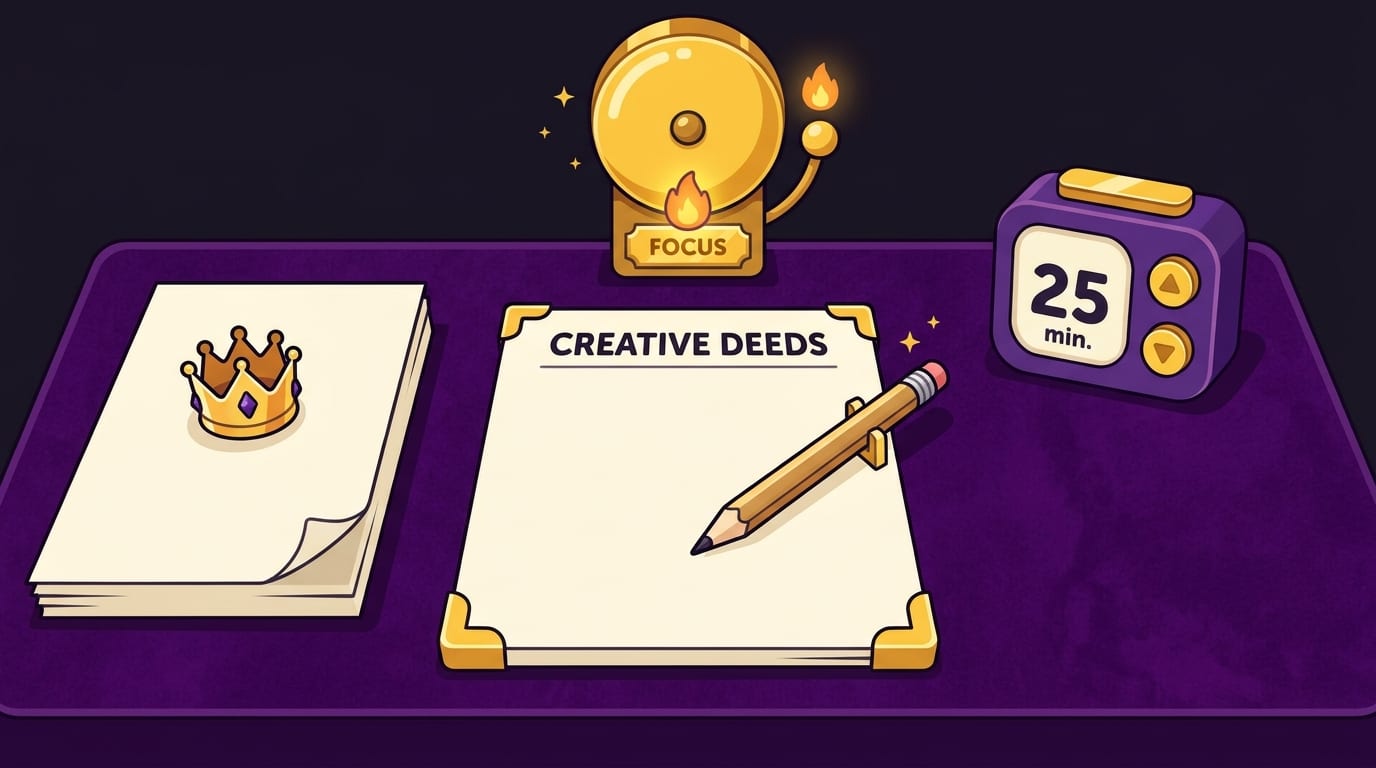
It may help to experiment with different work periods. Some people like a 25-minute focus session followed by a short break; others do better with longer stretches or a flexible timer. Treat the timing as a tool, not a law handed down from the Productivity Mountain. Notice when your attention is strongest and schedule demanding creative work accordingly, if your responsibilities allow it.
For creative professionals balancing deadlines, clients, and life outside work, a routine also needs room for recovery. Our article on work-life balance for creative professionals looks at how sustainable boundaries can protect both your energy and your creative practice.
Defend your attention from the distraction goblin
Sometimes the idea isn’t missing; it keeps getting interrupted before it can develop. Email, social platforms, video sites, shopping, news, and online rabbit holes make it easy to switch tasks whenever the work becomes uncomfortable. Each interruption can break your train of thought, and returning to the original task takes effort. Your browser may be open for work, but it also contains an entire carnival of tiny escape routes.
Before a creative session, make distractions less convenient. Put your phone in another room or turn on a focus setting. Close tabs you don’t need. Keep a note beside you for unrelated thoughts—“check that parcel,” “reply to Sam,” “look up chair”—so you can capture them without acting on them immediately. Then return to the work in front of you.
If particular websites routinely pull you away, a website blocker can add useful friction. BlockChamp is a gamified blocker for Google Chrome that lets you block specific sites and, depending on your setup, categories or keywords. Its focus system turns consistency into XP, levels, badges, and reigns. If you try to open a blocked site, The King’s Stare-Down page steps in with a judgmental royal glare instead of a dull error message. Apparently, the kingdom has rules.
The goal isn’t to block the internet forever or treat every break as a moral failure. It’s to protect a chosen stretch of time for a task you care about. BlockChamp’s free version supports blocking up to three sites and two categories, while Champion features include more blocking options and scheduled focus sessions. You can explore the tool at BlockChamp if a little playful accountability would make it easier to stay on guard.
For a deeper look at how digital habits affect creative attention, read learning to focus in a digital world as a creative. The broader lesson is practical: don’t rely on willpower alone when your environment can do some of the work for you.
Use feedback and constraints to get unstuck
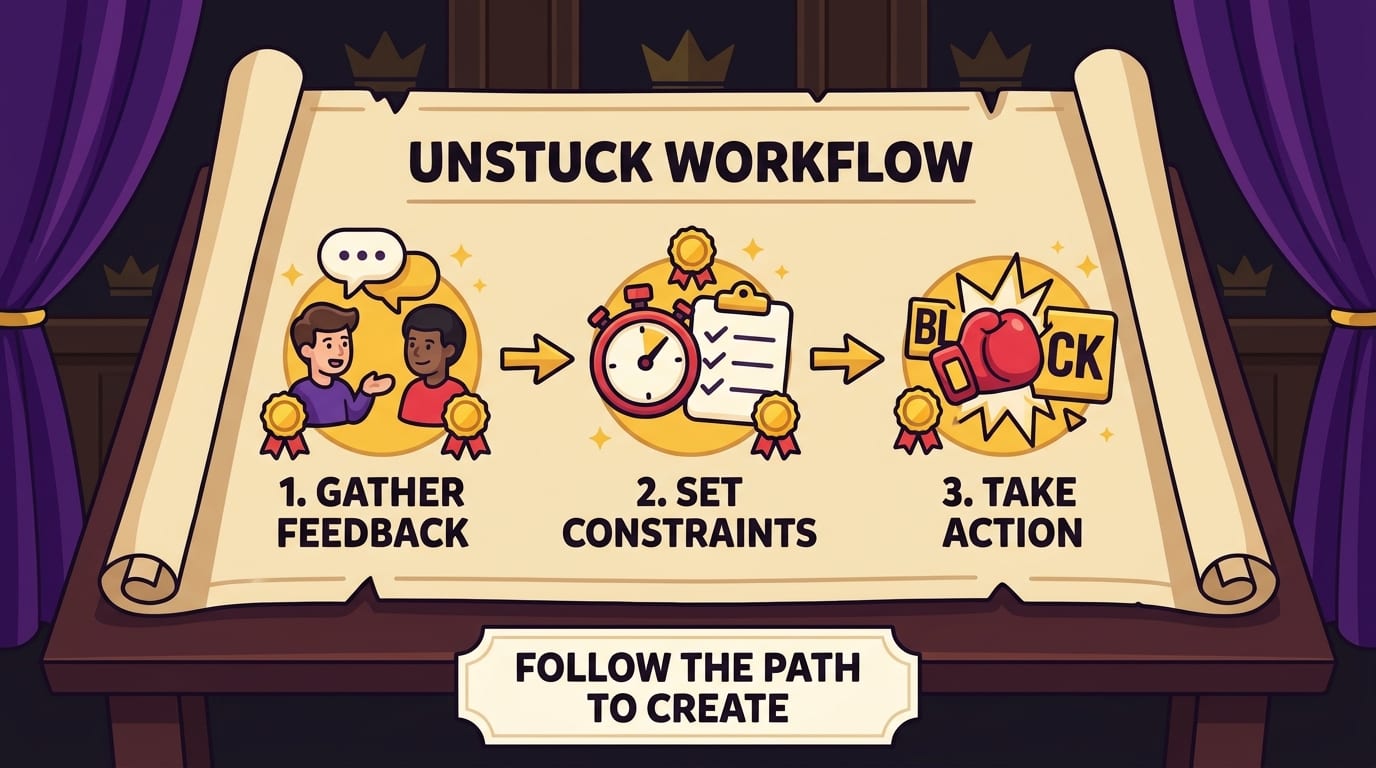
When you’ve been alone with a project for too long, every choice can start to feel enormous. A trusted outside perspective can help you see the actual problem more clearly. Ask for specific feedback rather than a verdict on the entire project. Questions such as “Which of these two openings is clearer?” or “Where did you lose interest?” are easier to answer than “Is this any good?”
Choose your feedback partner carefully. Someone who understands your goal may offer more useful notes than a person who simply has strong opinions. Explain what stage the work is in and what kind of feedback you want. Early drafts may need questions and possibilities; a nearly finished piece may need a close read for clarity or detail. You do not have to follow every suggestion. Feedback is information, not a royal command.
Constraints can play a similar role by turning a vague creative challenge into a solvable one. Set a word limit, a limited palette, a fixed number of elements, a particular audience, or a short deadline for the first draft. A constraint provides a frame for decision-making. If you feel boxed in, revise the rule; if you feel lost in endless possibilities, add one.
Another useful technique is to make several versions before choosing. Instead of trying to create the one perfect headline, write ten options. Instead of refining the first composition, sketch four alternatives. Generating options shifts your attention from “Is this the answer?” to “What possibilities are available?” You can then evaluate them with more perspective.
Know when a break is the creative move
Not every block should be punched through. If you’re tired, overstimulated, or emotionally drained, rest may be the most productive next step. Creativity uses attention and energy. A short walk, meal, stretch, quiet break, or proper time away from the project can help you return with a fresher perspective. The trick is to choose restorative breaks rather than accidentally disappearing into an endless scroll that leaves you more frazzled than before.
Try a break with a clear beginning and end. Step outside for ten minutes. Make lunch away from your screen. Do a simple household task, then return to the project at a planned time. If you need a longer rest, take it without pretending that exhaustion is a character flaw. Sustainable creative work depends on recovery as well as effort.
It can also help to stop while you still know what comes next. If you finish a session with the project at a clear stopping point, write a note for tomorrow: the question you’re exploring, the section to continue, or the next sketch to make. If you’re already stuck, choose a tiny re-entry task—read the last page, open the working file, or list three possible next steps. This makes returning less intimidating.
If a low mood, anxiety, exhaustion, or loss of interest is persistent and affecting life beyond one project, consider speaking with a qualified professional or someone you trust. Creative work can be demanding, but you don’t need to diagnose or solve every difficult feeling by becoming more productive.
A simple plan for overcoming creative block today
When you need a practical reset, use this short sequence. It combines clarity, attention, and small action without requiring you to become a different person before lunch.
- Name the obstacle. Is the issue energy, distraction, uncertainty, fear, or lack of ideas?
- Choose one small action. Make it concrete enough to begin in ten minutes.
- Prepare the space. Gather what you need and remove one likely distraction.
- Work before judging. Generate a rough attempt, several options, or a simple outline.
- Record the next step. Leave a note so the next session has a clear starting point.
- Review what helped. Keep the useful parts of the routine and adjust what didn’t.
For example, a designer stuck on a landing page might identify the problem as “too many layout choices.” Their small action could be sketching three rough wireframes in ten minutes. They can close unrelated tabs, avoid refining the sketches, and leave a note about which version seems clearest. That’s meaningful progress, even if the final page is still a few decisions away.
A writer facing a blank page might decide that the obstacle is fear of producing a bad opening. Their action could be drafting a deliberately rough paragraph, then listing the three points the piece needs to make. They don’t need to solve the whole article in one sitting. They just need to create a workable foothold.
Conclusion: the next idea starts with the next move
Overcoming creative block isn’t about waiting for perfect inspiration or bullying yourself into endless output. It’s about noticing what’s getting in the way and responding with the right tool: a smaller task, a new input, a clearer routine, fewer digital distractions, useful feedback, or genuine rest.
Start with one small move today. Open the file. Make the rough sketch. Write the awkward first line. Protect ten minutes from the scroll. If you want a playful way to defend that time, try BlockChamp and let The King guard the gates while you work. Your crown doesn’t require a masterpiece by noon—just a start.
Related posts

Reclaiming Quality Time

Healthy Tech Habits Kids

Can Children Resist Screens A Couples Home Experiment
