
Overcome Analysis Paralysis

You can overcome analysis paralysis without moving to a cabin, deleting every app, and becoming a mysterious productivity goblin who writes with a feather quill. Analysis paralysis happens when your brain keeps asking for “just one more piece of information” before acting—then suddenly it’s 2:13 a.m., you have 47 tabs open, and you’re comparing project management apps like the fate of civilization depends on it.
The cure is not “try harder.” The cure is building a decision system that makes action easier than spiraling. In this guide, we’ll break down practical steps to overcome analysis paralysis using decision frameworks, timeboxing, option reduction, confidence-building habits, and a few distraction knockouts from the royal boxing ring. Because at some point, champ, the crown goes to the person who ships—not the person still researching crown polish.
Quick Answers
What Is Analysis Paralysis? The Fancy Name for Brain Traffic Jam
Analysis paralysis is what happens when overthinking prevents decision-making. You gather more information, compare more options, imagine more outcomes, and wait for a “perfect” choice that never arrives. It feels responsible. It looks productive. But underneath the spreadsheet and the 19 browser tabs, you are stuck.
This shows up everywhere:
- You want to start studying, but first you research the best note-taking method.
- You need to write an article, but you spend an hour choosing the “right” outline format.
- You want to launch a side project, but you keep comparing tools, logos, platforms, and domain names.
- You need to reply to an important email, but you rewrite the opening sentence until it sounds like it was approved by a committee of nervous owls.
- You want to buy a simple desk lamp, but now you know too much about lumens. Dangerous knowledge.
Analysis is useful. Paralysis is the problem. Good thinking helps you choose. Overthinking delays the discomfort of choosing. That distinction matters because the goal is not to become reckless. The goal is to make clear enough decisions with enough information, then move.
Research on decision-making often points to a sneaky villain: too many options. In a famous study published in the Journal of Personality and Social Psychology, shoppers were more likely to buy jam when presented with fewer choices than when faced with a huge selection. Translation: the human brain likes freedom, but too much freedom turns it into a confused raccoon in a grocery aisle.
So if you want to overcome analysis paralysis, don’t start by demanding heroic willpower. Start by making decisions smaller, cleaner, and less dramatic.
Why Your Brain Gets Stuck: Fear Wearing a Clipboard
Analysis paralysis usually disguises itself as logic. “I’m just being thorough,” you say, while opening another Reddit thread titled “Best productivity system for people who hate productivity systems.” But often, the real driver is fear.
Common fears behind overthinking include:
- Fear of being wrong: You want the choice to be guaranteed before you act.
- Fear of regret: You imagine the pain of picking Option A and later discovering Option B had shinier buttons.
- Fear of judgment: You worry other people will see the result and silently assign you a low star rating as a human.
- Fear of wasted effort: You don’t want to spend hours on something that might not work.
- Fear of identity damage: If the project fails, you might interpret that as “I’m bad at this,” instead of “this attempt taught me something.”
There’s also the modern internet problem: information overload. According to Statista’s global digital population data, billions of people are online, creating, sharing, ranking, reviewing, reacting, and shouting into the content tornado. That means for almost any decision, you can find infinite opinions. Some are helpful. Some are sponsored. Some were written by a man named “CryptoFalcon93” at 4 a.m. Choose your sages carefully.
Decision fatigue also plays a role. The American Psychological Association has discussed how mental load and stress can affect attention, self-control, and choices in its resources on stress and behavior. When your brain is tired, every decision feels heavier. Picking dinner becomes a constitutional crisis. Starting work feels like climbing a mountain while wearing wet jeans.
The move, then, is to reduce the emotional drama around decisions. You don’t need certainty. You need a process.
The “Good Enough to Go” Rule: Your First Weapon Against Overthinking
To overcome analysis paralysis, adopt this rule: if a decision is reversible, choose when you have roughly 70% of the information you need.
Why 70%? Because waiting for 100% usually means waiting forever. By the time you feel perfectly ready, the opportunity may have packed its little suitcase and left. Most everyday decisions do not require courtroom-level evidence. They require a reasonable choice and a feedback loop.
Use this quick test:
- Is this decision reversible?
- Will the downside be manageable?
- Can I learn more by trying than by researching?
- Would a smart person with limited time make a decent choice now?
If the answer is yes, act. You are not launching a moon mission. You are choosing a task manager, drafting a proposal, starting a workout plan, or writing the first ugly paragraph. The first version is allowed to have goblin energy. That is what editing is for.
For example, say you’re trying to start a morning routine. You could spend weeks comparing routines from CEOs, athletes, monks, and that one guy on YouTube who wakes up at 3:47 a.m. and drinks mineral water facing east. Or you could pick three actions—wake up, drink water, work for 25 minutes—and begin tomorrow. If you want a practical starting point, we’ve got a full guide to building a morning routine for all-day productivity that doesn’t require becoming a productivity robot with cheekbones.
The “good enough to go” rule does not mean sloppy decisions. It means progress beats theoretical perfection. The throne belongs to the person who begins.
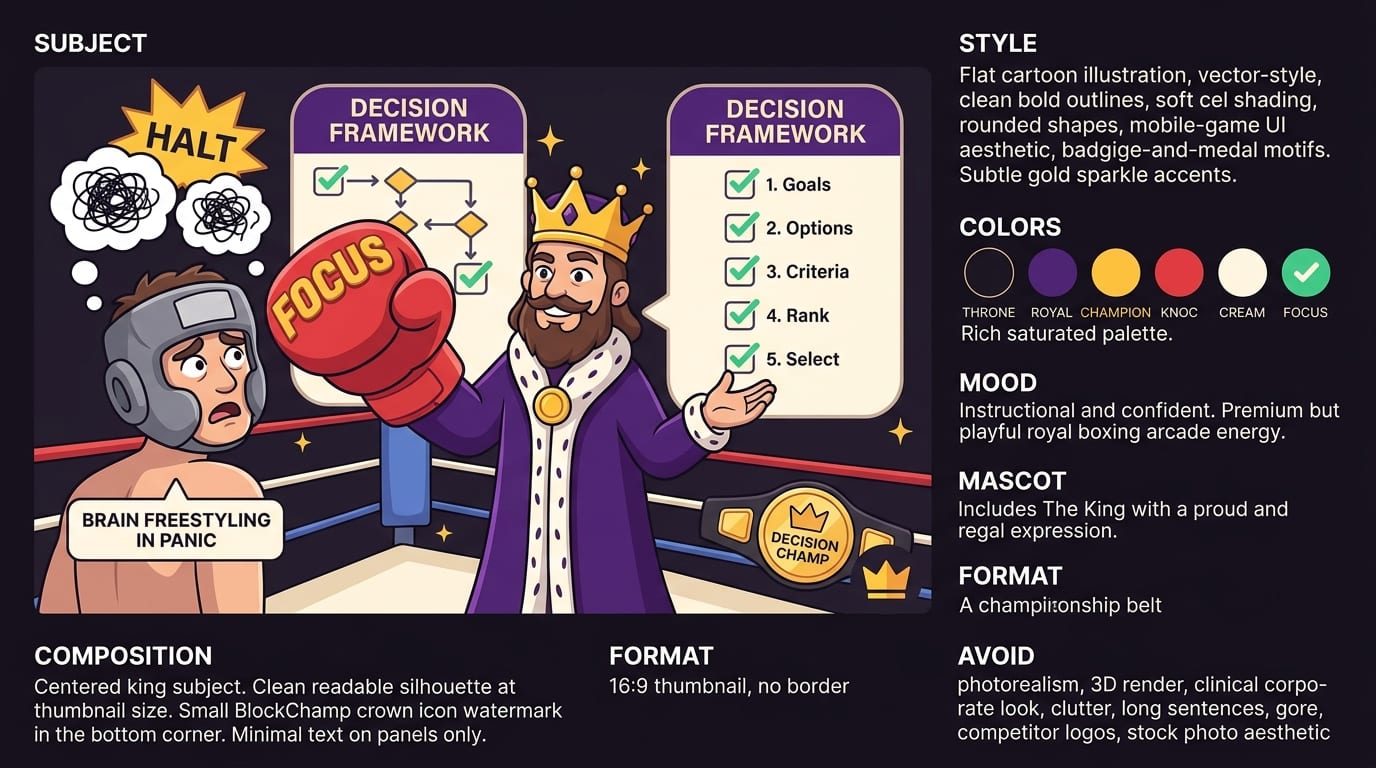
Use Decision Frameworks So Your Brain Stops Freestyling in Panic Mode
A decision framework is a repeatable method for choosing. It removes some of the emotional noise because you’re not reinventing the wheel every time. You’re following a map. Preferably one not drawn by your anxious inner goblin.
1. The Two-Way Door Test
Ask whether the decision is a one-way door or a two-way door.
- Two-way door: You can reverse or adjust it later. Example: trying a new study schedule, choosing a writing tool, testing a marketing idea.
- One-way door: Hard or expensive to reverse. Example: signing a long lease, making a major hire, quitting a job without savings.
Two-way door decisions should be made quickly. Give them a short research window, choose, and move. One-way door decisions deserve more thought, but even then, give the process structure so it does not become an eternal council meeting in your skull.
2. The 10/10/10 Rule
Ask yourself:
- How will I feel about this decision in 10 minutes?
- How will I feel in 10 months?
- How will I feel in 10 years?
This helps separate temporary discomfort from meaningful consequences. Sending the email might feel scary for 10 minutes. In 10 months, you’ll barely remember it. In 10 years, if you are still thinking about that email, please consider taking up pottery or joining a pirate crew. You need lore.
3. The Weighted Scorecard
For decisions with multiple options, create a simple scorecard. List your criteria, weight each one by importance, then score each option from 1 to 5.
Example: choosing a course for learning design.
- Cost: weight 3
- Instructor quality: weight 5
- Time commitment: weight 4
- Portfolio projects: weight 5
- Community support: weight 2
Multiply score by weight, total it up, choose the winner. Is this perfect? No. But it gives your brain a boxing glove and points it at the problem. That’s enough.
Timebox the Research Before Research Becomes Your New Hobby
Research can help you make better decisions. It can also become a velvet-lined procrastination dungeon. The difference is whether you define an endpoint before you start.
Timeboxing means setting a fixed amount of time for a task. When the time ends, you stop and move to the next step. No “just one more video.” No “just one more review.” No “what if page 7 of Google has wisdom?” Page 7 of Google is where abandoned PDFs go to whisper.
Here’s a simple timeboxing system to overcome analysis paralysis:
- Define the decision in one sentence.
- Set a research limit: 15, 30, 60, or 120 minutes depending on importance.
- Write down the top three options.
- Choose the best option based on your current criteria.
- Commit to a test period.
For example: “I need to choose a writing process for my weekly newsletter.” Give yourself 45 minutes. Read two credible sources. Pick a structure. Try it for four issues. Adjust later.
This is especially important for creative work. Writers, creators, students, and freelancers often confuse preparation with production. If that’s you, our guide on building a productivity process for writers can help you turn vague intentions into actual drafts. Drafts are good. Drafts can be edited. A perfect idea trapped in your head is just a ghost wearing a tiny crown.
Need help enforcing the timebox? That’s where tools can help. With BlockChamp, you can block the websites that turn “quick research” into a six-hour safari through YouTube, Reddit, news, AI chat tools, and “best desk setup 2025” videos. The Master Focus Toggle puts your blocks On Guard, and The King’s Stare-Down catches you if you try to wander into the distraction kingdom. You can still think. You just can’t flee into tab chaos like a caffeinated ferret.
Reduce Your Options: Fewer Choices, Fewer Brain Goblins
If you want to overcome analysis paralysis fast, reduce the number of options. This feels almost too simple, which is exactly why people ignore it and continue comparing 23 nearly identical tools with the seriousness of a royal succession crisis.
Try the Rule of Three:
- Gather no more than three viable options.
- Eliminate anything that clearly fails your must-have criteria.
- Choose from the remaining three—or fewer.
Why three? Because it gives you meaningful comparison without turning the decision into a spreadsheet swamp. Two can feel too narrow. Ten is chaos in a hat. Three is enough.
You can also create default choices. Defaults are pre-decisions that reduce mental clutter. For example:
- Default work block: 9:00 a.m. to 11:00 a.m.
- Default writing tool: Google Docs.
- Default workout: 30-minute walk if no plan exists.
- Default lunch: the same simple meal on workdays.
- Default research limit: 30 minutes for reversible decisions.
Defaults are not boring. Defaults are royal infrastructure. The King does not debate every brick in the castle wall each morning. He has a wall. He gets on with reigning.
This is also why category blocking in BlockChamp is useful. Instead of manually listing every possible distraction, you can block entire categories like Social Media, Video & Streaming, News, Shopping, Gaming, Gambling, Adult, and AI Distractions. Fewer decisions. Less fiddling. More focus. Your future self bows politely.
Separate Big Decisions from Tiny Decisions, Because Not Every Choice Needs a Crown Ceremony
One reason people get stuck is that they treat every decision like it deserves equal seriousness. It does not. Some decisions deserve a strategy session. Others deserve a shrug and forward motion.
Use three decision tiers:
Tier 1: Tiny Decisions
These have low stakes and are easy to reverse. Examples: what notebook to use, what article title to test, which coffee shop to work from, whether to start with task A or task B. Give these 30 seconds to 5 minutes. Then choose.
Tier 2: Medium Decisions
These matter, but they’re still adjustable. Examples: choosing a course, picking a freelancer, setting a weekly schedule, launching a landing page, selecting a software tool. Give these 30 minutes to 2 hours. Use a scorecard if needed. Then run a test.
Tier 3: Major Decisions
These are costly, emotional, or hard to reverse. Examples: changing careers, moving cities, ending a business partnership, taking on debt. Give these more time, gather advice, sleep on it, and define risks clearly. But still set a decision deadline. “Important” does not mean “infinite.”
A useful question: “What is the cost of waiting?”
Sometimes waiting reduces risk. Often, waiting quietly drains opportunity. You don’t notice the cost because nothing explodes. But weeks pass. Momentum fades. Confidence shrinks. The project becomes heavier because now it has emotional barnacles.
McKinsey has written about how faster, better decision-making can be a major organizational advantage in its work on decision-making in the age of urgency. That applies personally too. If you can make decent decisions faster, you learn faster. If you learn faster, you improve faster. If you improve faster, you become mildly terrifying in the best way.

Build Confidence Through Tiny Acts of Completion
Confidence does not arrive before action. Confidence is usually a receipt you get after doing the thing. Annoying? Yes. True? Also yes.
If you are stuck in analysis paralysis, don’t try to think your way into confidence. Act your way into evidence. Create a habit of small completions.
Examples:
- Write 200 words instead of planning the whole essay.
- Study for 20 minutes instead of designing the perfect semester system.
- Send one pitch instead of rewriting your entire portfolio.
- Record one rough video instead of buying lights, a microphone, and a spiritual identity as a content creator.
- Clean one corner of your desk instead of reorganizing your life like a medieval archive.
Completion builds trust with yourself. Every finished action says, “I can decide and survive.” That is how you shrink fear. Not with motivational wallpaper. With receipts.
This is where gamified focus can be surprisingly powerful. BlockChamp gives you XP for every minute of focus, every focused day, and every Stare-Down survived. You build a reign—your streak of staying On Guard—and see your progress in a calendar, badges, levels, and leaderboard. It turns action into visible proof. You’re not just “trying to focus.” You’re defending the throne. Slightly dramatic? Absolutely. Effective? That’s the point.
If you want to go deeper on the difference between waiting to “feel ready” and building reliable systems, read our post on motivation vs. discipline. Spoiler: motivation is a flaky court jester. Discipline is the guard who actually shows up.
Use the “Next Action” Method When the Project Feels Like a Dragon
Big projects create analysis paralysis because they are vague. “Build my portfolio” sounds like a fog monster. “Choose three projects to feature” is doable. “Write a book” is terrifying. “Draft the first ugly scene” is manageable. “Get healthy” is abstract. “Walk for 15 minutes after lunch” is real.
When stuck, ask: “What is the next visible action?”
A visible action is something another person could watch you do. “Think about my career” is not visible. “List five roles I might apply for” is visible. “Improve my website” is vague. “Rewrite the homepage headline” is visible. “Become more productive” is a motivational soup cloud. “Block YouTube from 9 to 12” is concrete.
Try this format:
Project: Launch my freelance portfolio.
Next action: Open a document and list five services I can offer.
Time limit: 15 minutes.
Success: A messy list exists.
Notice that success is not “solve my entire career.” Success is “create the next piece of evidence.” That’s how momentum works. It’s a breadcrumb trail, not a lightning strike.
For people chasing mindful productivity—not frantic goblin productivity—this approach is especially useful. You can get more done without turning your nervous system into a toaster. Our guide to mindful productivity for getting more done with less stress pairs nicely with this mindset: clear next action, calm execution, fewer panic-tabs.
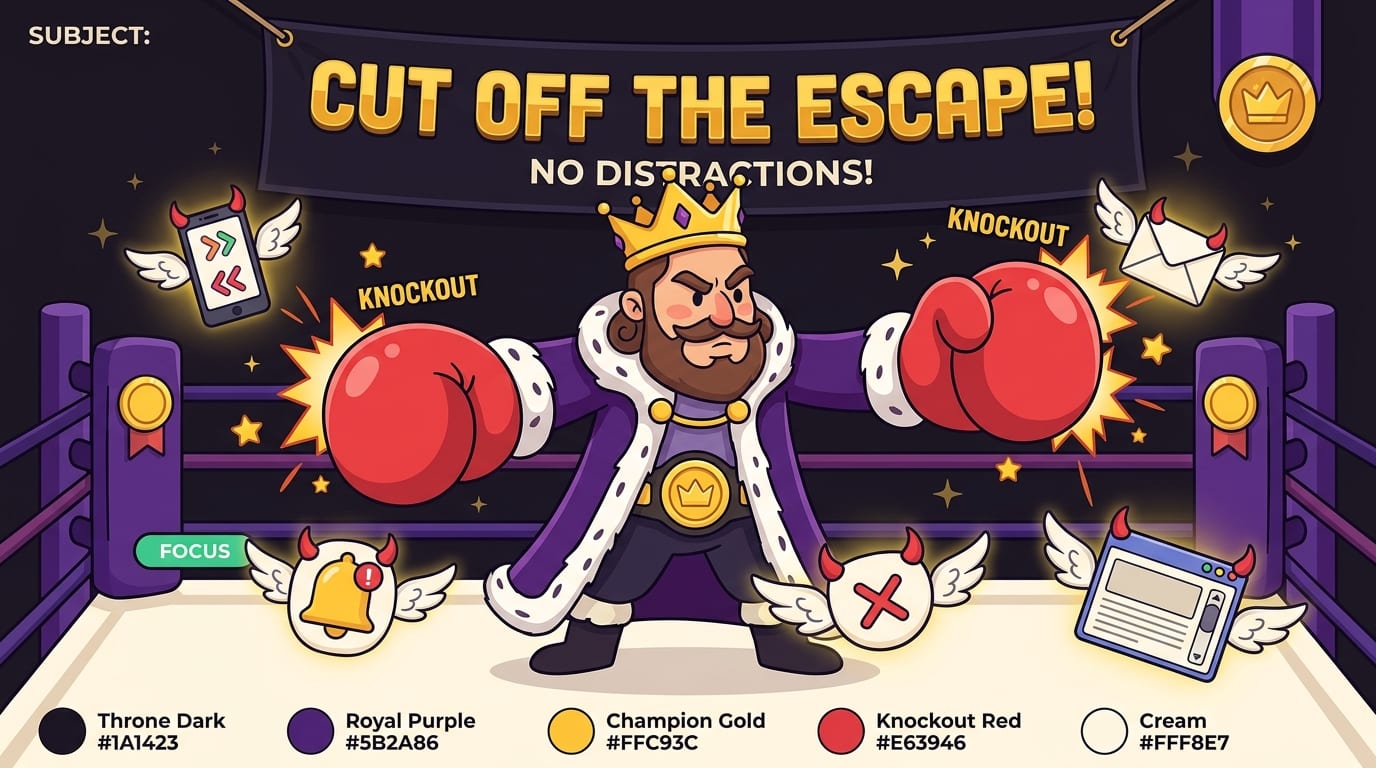
Cut Off the Escape Routes: Distraction Is Analysis Paralysis’ Sneaky Cousin
Here’s the part nobody likes: sometimes analysis paralysis isn’t really analysis. It’s avoidance wearing glasses.
You sit down to decide. It feels uncomfortable. Your brain whispers, “Let’s check one more thing.” Suddenly you are on social media. Then the news. Then a video. Then an AI chatbot. Then a shopping site because maybe a better keyboard would fix your life. The royal court has collapsed. Peasants are in the pantry.
Distractions are dangerous because they give you relief without resolution. You feel temporarily better, but the decision is still waiting. And now it has grown fangs.
According to DataReportal’s Digital 2024 Global Overview Report, people spend a significant amount of daily time online and on social platforms. That does not mean the internet is evil. It means your attention is valuable, and many platforms are built to capture it. If your decision-making environment includes endless escape hatches, you will use them. You are human. Humans click things. It’s our species’ tragic little tap dance.
So design your environment for action:
- Close unnecessary tabs before making a decision.
- Put your phone in another room during decision blocks.
- Use a website blocker during research and execution windows.
- Write the decision question at the top of a page to stay anchored.
- Set a timer and commit to choosing when it ends.
BlockChamp helps here by making focus playful instead of punishment-flavored. You can block specific sites, keywords, or whole categories. If you try to sneak onto a blocked site, The King appears with a full-screen Stare-Down and politely—okay, not politely—sends you back to work. Champion users can also use Hardcore Lockdown, which adds a cooldown timer or boxing riddle before turning focus off. In other words, your impulse has to fight a royal boxer. Good luck, impulse.
Create a Personal Decision Playbook
Once you understand your patterns, make a simple decision playbook. This is a set of rules you follow when your brain starts spinning. Keep it short. If your anti-overthinking system requires a 42-page manual, congratulations, you have invented overthinking with stationery.
Here’s a practical template:
My Analysis Paralysis Playbook
- If the decision is reversible, I decide with 70% of the information.
- If I have more than five options, I reduce them to three.
- If I am researching, I set a timer before I begin.
- If I feel stuck, I define the next visible action.
- If I am avoiding, I block distracting sites and work for 25 minutes.
- If the decision is major, I write down risks, talk to one trusted person, and set a deadline.
- If I make the “wrong” choice, I extract the lesson instead of holding a dramatic funeral for my self-esteem.
You can also create decision deadlines by category:
- Small purchases under $50: 10 minutes.
- Work tools: 1 hour of research, 7-day test.
- Content topics: choose from three ideas every Monday.
- Daily priorities: pick top three tasks before opening email.
- Career moves: 2-week research window, then decide next experiment.
The point is not to eliminate thought. The point is to stop renegotiating the process every time. A playbook lets you conserve mental energy for the work that actually matters.
If your larger goal is becoming consistently focused—not just escaping one overthinking spiral—check out our article on becoming a productivity expert through focus. Focus is a skill. Skills improve with reps. Preferably reps that do not include doomscrolling between sets.
Practice Making Decisions Faster With Low-Stakes Reps
You can train decision-making like a muscle. Start with low-stakes choices and practice making them quickly. This reduces the fear response around choosing.
Try these exercises for one week:
- Choose meals in under two minutes.
- Pick your daily top three tasks in under five minutes.
- Set a 10-minute limit for small purchases.
- Choose between entertainment options quickly—movie, book, game, done.
- Publish or send small pieces of work before they feel perfect.
After each decision, resist the urge to reopen the case. No post-decision courtroom drama. If the choice was reasonable, move on. Your brain may crave reassurance. Give it action instead.
You can also do a “decision review” at the end of the week. Not to shame yourself. The King frowns upon shame. He prefers mildly savage accountability.
Ask:
- Which decisions did I make faster?
- Which ones still triggered overthinking?
- Was the outcome actually as dangerous as I imagined?
- What rule would help next time?
This builds self-trust. Over time, your brain learns that decisions are not cliffs. They are doors. You open one, walk through, and adjust your route.
When to Keep Analyzing: Not All Caution Is Cowardice
Let’s be fair to your brain. Sometimes analysis is appropriate. You should not use “take action” as an excuse to make reckless decisions with a confetti cannon. Some choices deserve slower thinking.
Keep analyzing when:
- The decision is hard to reverse.
- The financial, legal, health, or relationship consequences are significant.
- You don’t understand the basic risks yet.
- You are emotionally activated and likely to choose impulsively.
- You need input from people affected by the decision.
Even then, structure the analysis. Define what information is missing. Decide who to ask. Set a deadline. Create a “minimum evidence threshold.” Otherwise, important analysis can still become a luxury swamp.
A good rule: analyze until the next step becomes clear, not until all uncertainty disappears. Uncertainty is part of action. You don’t defeat it completely. You learn to carry it without letting it drive the carriage into a ditch.
A Simple 15-Minute Reset to Overcome Analysis Paralysis Today
If you are stuck right now, use this reset. Not tomorrow. Not after watching a 38-minute video about decision-making while lying sideways like a defeated shrimp. Now.
- Minute 1: Write the decision in one sentence.
- Minutes 2-4: List your options. No more than five.
- Minutes 5-7: Cross out anything that fails your must-have criteria.
- Minutes 8-10: Pick the top two or three remaining options.
- Minutes 11-12: Ask, “Is this reversible?” If yes, choose now.
- Minutes 13-14: Define the next visible action.
- Minute 15: Start the action before your brain files an appeal.
Optional but powerful: turn on a focus tool before you start. Block the sites you normally use to escape. Set a 25-minute timer. Tell your brain, “We are not debating the kingdom today. We are laying one brick.”
That’s how you beat analysis paralysis: not with one grand heroic decision, but with a series of smaller decisions that teach your brain action is safe.
Final Round: Choose, Act, Adjust, Repeat
To overcome analysis paralysis, you do not need perfect confidence, perfect timing, perfect tools, or a heavenly beam of clarity shining onto your desk. You need a decision process that reduces options, limits research, defines the next action, and protects your focus long enough to move.
Remember the core moves:
- Use the 70% rule for reversible decisions.
- Timebox research before it mutates into procrastination.
- Reduce choices to three whenever possible.
- Separate tiny, medium, and major decisions.
- Build confidence through small completions.
- Cut off distraction escape routes.
- Create a personal decision playbook.
And when your brain tries to flee into YouTube, Reddit, shopping tabs, news spirals, or AI rabbit holes, put the castle guards on duty. BlockChamp helps you knock out distractions with website blocking, category blocking, XP, streaks, badges, and The King’s glorious Stare-Down when you try to betray your own focus. It’s productivity with a crown, boxing gloves, and just enough roast to keep you honest.
Make the decision. Take the next step. Defend the throne. Long live your focus, champ.
Related posts

Finding Focus For Fiction Writing

Learning To Focus In A Digital World As A Creative

Finding Focus For Personal Growth
