
Long Term Goals

Long term goals are the big, shiny quests on your life map: build a business, finish a degree, write a book, get promoted, save for a house, run a marathon, become the sort of person who owns matching food storage containers. Noble stuff. The problem? Your brain wants the reward now, preferably in the form of a “quick” scroll that somehow turns into 47 minutes of raccoon videos and one deeply unnecessary argument in a comment section.
That is why long term goals need more than motivation. Motivation is a dramatic little goblin. It shows up with fireworks on Monday and disappears by Wednesday because someone mentioned pizza. To actually achieve meaningful goals, you need a system: clear targets, useful milestones, repeatable habits, honest tracking, and a review routine that keeps your crown from rolling under the couch.
This guide breaks down how to set, track, and achieve long term goals without turning your life into a beige spreadsheet dungeon. We’ll cover goal types, planning frameworks, milestones, habits, distractions, reviews, and how tools like BlockChamp can help you defend your focus when the internet starts throwing digital banana peels at your feet.
Quick Answers
What Are Long Term Goals, Really? Big Dreams With Shoes On
Long term goals are objectives that take months or years to accomplish. They usually require sustained effort, multiple stages, and behavior change over time. Think “earn a professional certification,” not “answer that email from Greg.” Although, to be fair, Greg has been waiting since Tuesday.
A long term goal is different from a wish because it has structure. “I want to be healthier” is a wish. “I want to lose 25 pounds in 10 months by strength training three times per week, walking daily, and tracking meals” is a goal. The second one has a finish line, a method, and fewer vibes floating around like motivational confetti.
Common long term goals include:
- Career goals: earn a promotion, switch industries, start freelancing, launch a company, become a manager, build a portfolio.
- Financial goals: pay off debt, save an emergency fund, invest consistently, buy a home, reach a specific net worth.
- Education goals: finish a degree, learn a language, get certified, master a technical skill, pass an exam.
- Health goals: run a half marathon, build muscle, improve sleep, lower blood pressure, create a sustainable fitness routine.
- Creative goals: write a book, start a podcast, grow a YouTube channel, publish music, build an art practice.
- Personal growth goals: improve relationships, become more confident, develop emotional regulation, practice mindfulness, build discipline.
The key phrase is sustained effort. Long term goals are not conquered in one heroic sprint while chugging coffee like a medieval wizard. They are won through boring-but-powerful repetition. Tiny actions. Daily decisions. Saying “not today, goblin” to distractions.
If you struggle with phrasing goals clearly, it may help to avoid fluffy wording that makes goals vague. BlockChamp has a useful companion read on words you should avoid when setting new goals, especially if your goal currently includes suspicious phrases like “maybe,” “try,” or “someday.” The crown does not approve of “someday.”
Why Long Term Goals Fail: The Villains in the Productivity Kingdom
Most long term goals do not fail because people are lazy. They fail because the planning system is weak, the environment is chaotic, and the reward is too far away to feel real. A six-month goal often loses to a six-second dopamine snack. That is not a moral failure. That is human design meeting billion-dollar attention engineering. Not exactly a fair boxing match.
Research on habit formation shows that behavior becomes easier when it is repeated in stable contexts. A famous study published in the European Journal of Social Psychology found that habits can take an average of 66 days to become automatic, though the timeline varies widely depending on the behavior. Translation: if your goal needs a new habit, expect a training arc. You are not failing after 10 days. You are still in the montage.
Here are the usual culprits behind abandoned long term goals:
- The goal is vague. “Get better at writing” sounds nice but gives your brain nowhere to march.
- The timeline is unrealistic. “Become fluent in Japanese in 30 days” is not ambition; it is a Netflix subtitle fever dream.
- There are no milestones. Without checkpoints, progress feels invisible and motivation leaks out.
- The environment is full of traps. You cannot out-willpower TikTok forever. TikTok has engineers. You have a tired prefrontal cortex and leftover noodles.
- Tracking is inconsistent. If you do not measure progress, you cannot tell whether you are winning, drifting, or being mugged by procrastination.
- The review loop is missing. Plans need updates. Life changes. Goals need steering, not just wishing.
There is also the attention problem. According to the American Psychological Association’s research summary on multitasking, switching between tasks can reduce productivity because the brain pays a “switching cost.” That matters for long term goals because deep progress often requires uninterrupted focus: studying, writing, coding, practicing, analyzing, building. If your work session is interrupted every four minutes by notifications and tab-hopping, your goal is trying to run a marathon while wearing clown shoes.
This is where focus tools can help. BlockChamp, for example, lets you block distracting websites by site, category, or keyword, then rewards focused time with XP, levels, badges, reigns, and calendar tracking. Instead of relying on heroic willpower, you build a moat around your attention. The King stands guard. Reddit trembles. Mostly.
Step 1: Choose the Right Long Term Goal Before You Start Swinging
Before you build a plan, make sure the goal deserves a throne in your life. A long term goal will demand time, energy, tradeoffs, and occasional awkward conversations with your past self. Choose wisely, champ.
A good long term goal sits at the intersection of three things:
- Meaning: Why does this matter to you?
- Feasibility: Can you realistically make progress with your current resources?
- Leverage: Will achieving it improve other parts of your life?
For example, learning data analytics might improve your income, career flexibility, and confidence. That is leverage. Running a marathon might improve health, discipline, and identity. Writing a book might build authority, creativity, and future opportunities. Buying a novelty sword because it “feels aligned” may improve your hallway decor, but check the leverage before declaring it your five-year plan.
One useful exercise is the “future proof” test. Ask yourself:
- If I achieved this goal two years from now, would I be proud?
- Would this still matter if nobody applauded?
- Does this goal support the kind of person I want to become?
- What will I have to stop doing to make room for it?
- Am I choosing this because I want it, or because the internet made it look shiny?
If you are not sure what kind of goal fits your deeper values, explore the concept of purpose and motivation. BlockChamp’s article on how ikigai shapes a fulfilling career and daily happiness is a great next read. Ikigai is basically your personal compass, but without the pirate map smell.
Once you choose the goal, write it down in a clear sentence. Not a paragraph. Not a fog machine. One sentence.
Example: “I will build a freelance writing business that earns $4,000 per month within 18 months.”
That sentence gives you a target, a metric, and a timeline. The kingdom has coordinates.
Step 2: Turn the Goal Into a Measurable Target, Because Vibes Don’t Fit on a Dashboard
Measuring long term goals is not about becoming a robot with a clipboard. It is about making progress visible. Your brain likes visible wins. Invisible progress feels like pushing a boulder through soup.
Start by defining the outcome metric. This is the final scoreboard. Examples:
- Save $15,000 for an emergency fund.
- Complete 36 college credits.
- Run a 10K in under 55 minutes.
- Publish 50 blog posts in one year.
- Earn $100,000 in annual revenue.
- Read 24 books in 12 months.
Then define the process metrics. These measure the behavior that creates the outcome. If the outcome is the castle, process metrics are the bricks. Less glamorous. More important.
Examples:
- Write 500 words per weekday.
- Study for 45 minutes, five days per week.
- Apply to 10 jobs per week.
- Train four times per week.
- Save $300 per paycheck.
- Spend two focused hours per day building the product.
The process metrics matter because you can control them. You cannot fully control whether a hiring manager replies. You can control sending high-quality applications. You cannot fully control whether your first business idea becomes a yacht-funded empire. You can control customer interviews, experiments, outreach, and shipping.
If your goal involves writing, career growth, or business outcomes, you may like this practical guide on how to measure your goals as a writer and business professional. It pairs nicely with this section, like productivity peanut butter and spreadsheet jelly.
For extra clarity, use the SMART goal framework: Specific, Measurable, Achievable, Relevant, and Time-bound. Mind Tools has a helpful overview of how SMART goals work. Just remember: SMART is a framework, not a personality replacement. Your goal still needs meaning, energy, and a realistic plan.

Step 3: Break Long Term Goals Into Milestones That Don’t Make You Cry Into a Notebook
A long term goal without milestones is like saying, “I shall cross the ocean,” then jumping into the water with a granola bar and confidence. Admirable. Also damp.
Milestones create short-term wins that keep you moving. They turn a 12-month objective into monthly or quarterly checkpoints. This matters because your brain needs proof that effort is working. Milestones are motivational breadcrumbs. Follow them. Do not eat them all at once.
Here is a simple milestone structure:
- Annual target: What should be true one year from now?
- Quarterly milestones: What must be achieved every three months?
- Monthly projects: What projects move the quarterly milestone forward?
- Weekly actions: What repeatable tasks must happen this week?
- Daily habits: What small action keeps the chain alive today?
Let’s say your long term goal is to launch a profitable online course in 12 months. Your milestones might look like this:
- Quarter 1: Validate the topic, interview 20 potential customers, outline the course.
- Quarter 2: Build the first module, grow an email list to 500 subscribers, publish weekly content.
- Quarter 3: Run a beta cohort, collect testimonials, improve lessons.
- Quarter 4: Launch publicly, refine the sales page, reach $10,000 in course revenue.
That is much easier to act on than “become an online education tycoon.” The tycoon robe comes later.
Milestones also reveal whether your timeline is fantasy. If your first quarterly milestone requires 400 hours and you have four hours per week, your plan is not ambitious; it is doing parkour over reality. Adjust the scope, extend the timeline, or reduce competing commitments.
A good milestone should be:
- Clear enough that you can say “done” or “not done.”
- Close enough to feel relevant.
- Meaningful enough to prove progress.
- Flexible enough to adapt when life throws a flaming pineapple.
Step 4: Build Habits That Carry the Goal When Motivation Leaves the Castle
Long term goals are achieved through habits, not dramatic declarations. Declarations are fun. You get to buy a new notebook. Maybe a fancy pen. Maybe you write “My New Era” on page one like a caffeinated prophet. But after the ceremony, the daily behavior must survive.
James Clear, author of Atomic Habits, popularized the idea that small improvements compound over time. His 1% better concept is useful here: tiny gains may look unimpressive today, but they stack into meaningful change. Long term goals love compounding. They eat it for breakfast.
To build goal-supporting habits, use this four-part recipe:
- Anchor the habit: Attach it to something you already do. “After I make coffee, I study for 25 minutes.”
- Make it small: Start with a version so easy it feels silly. “Write 100 words” beats “write a masterpiece before breakfast.”
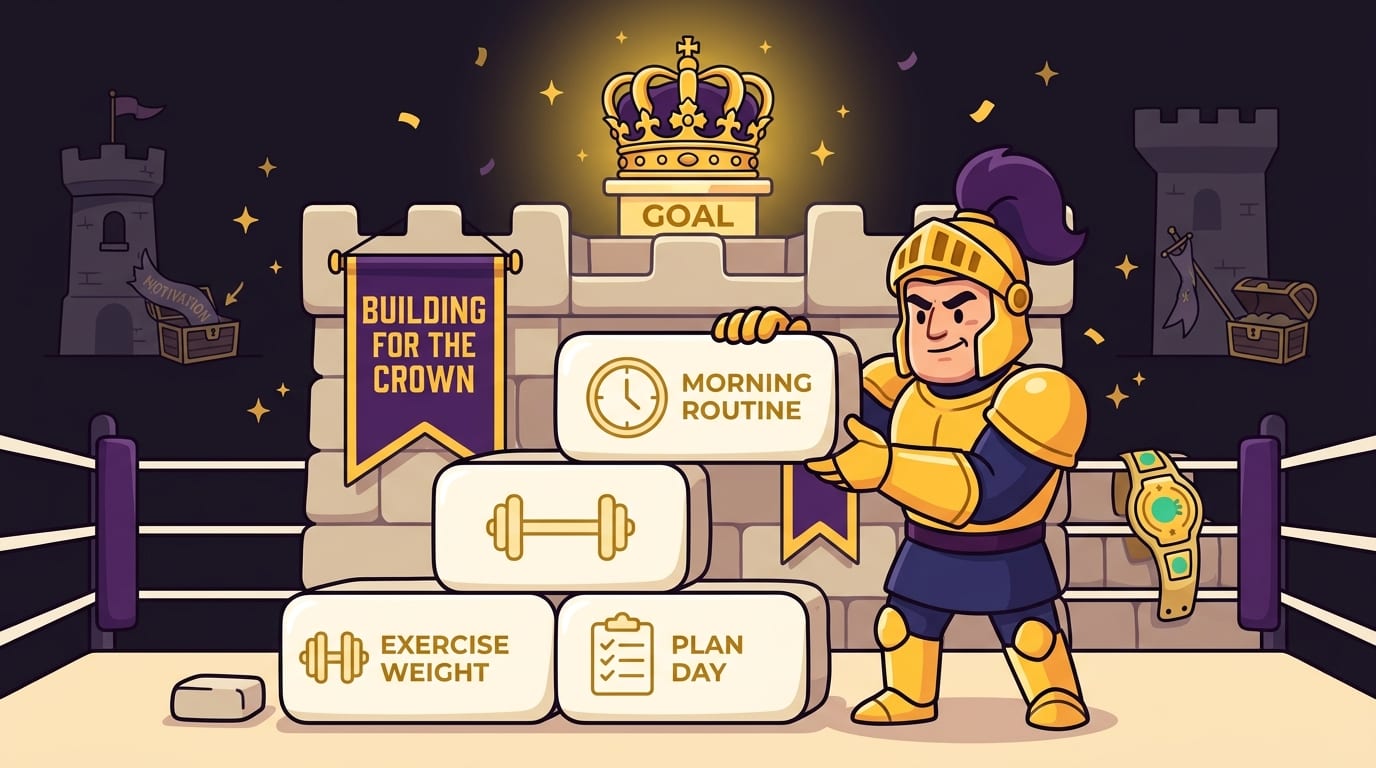
- Remove friction: Prepare the environment. Open the document. Lay out gym clothes. Block distracting sites.
- Reward completion: Track the win, celebrate briefly, and let your brain know the kingdom approves.
For example, if your goal is to write a novel, your daily habit might be “write for 30 minutes before opening email.” If your goal is a career switch, it might be “complete one lesson or portfolio task every weekday at 7 p.m.” If your goal is better fitness, it might be “walk for 20 minutes after lunch.” The habit should be boringly repeatable. Boring is not the enemy. Boring is where empires are built.
This is also where BlockChamp fits naturally. If your long term goal requires computer work, distractions are not tiny inconveniences. They are goal termites. BlockChamp helps you create a focused habit loop by blocking categories like Social Media, Video & Streaming, News, Shopping, Gaming, Gambling, Adult, and AI Distractions. You can flip the Master Focus Toggle to “On Guard,” keep a reign going, earn XP for focused minutes, and watch your progress grow like a little productivity dragon.
Even better, the Stare-Down block page interrupts impulsive browsing with The King’s royal judgment. Instead of wandering into YouTube, you get a full-screen “HALT” and a reminder not to throw away your reign for a video titled something like “Man Teaches Duck to Pay Taxes.” Honestly, the duck can wait.
Step 5: Design Your Environment So Discipline Isn’t Doing All the Heavy Lifting
Willpower is useful, but it is not a strategy you should force to fight alone in a dark alley. Your environment should make the right action easier and the wrong action harder. This is the secret sauce behind many successful long term goals: not more intensity, but better design.
Start with your digital environment. The modern browser is a productivity palace with trapdoors. One tab is your project. The next tab is news. Then messages. Then a shopping cart. Then a thread about whether cereal is soup. Congratulations, your 90-minute deep work block has been assassinated by breakfast discourse.
Try these environment upgrades:
- Block your biggest distraction sites during work blocks. Use a website blocker instead of negotiating with yourself every 12 minutes.
- Keep only the tools you need open. Fewer tabs, fewer temptations, fewer “how did I get here?” moments.
- Use separate browser profiles. One for work, one for personal browsing. Keep the candy store away from the gym.
- Turn off nonessential notifications. If everything is urgent, nothing is. Also your group chat does not need live access to your nervous system.
- Schedule focus blocks. Treat goal work like a meeting with your future self, who is cooler and slightly less chaotic.
BlockChamp’s Champion plan adds recurring Focus Schedules, so you can automatically activate blocks during specific days and hours. That is perfect for students, remote workers, creators, and anyone whose long term goals require consistent deep work. You can also use Hardcore Lockdown, which makes turning focus off intentionally inconvenient through a cooldown timer or a boxing-riddle mini-game. It is not punishment. It is a bouncer for your impulses wearing a crown and gloves.
If you want to go deeper on protecting attention, read BlockChamp’s guide on how to write an attention charter. It helps you define what deserves your focus and what should be banished from the kingdom before it starts juggling knives in your calendar.
Step 6: Track Progress Without Becoming a Spreadsheet Goblin
Tracking is how you keep long term goals honest. But tracking should help you, not turn you into a haunted accountant of your own life. The goal is feedback, not self-punishment.
Choose a tracking method that fits the goal:
- Habit tracker: Best for daily behaviors like writing, studying, training, or meditating.
- Scorecard: Best for weekly metrics like applications sent, hours practiced, pages written, workouts completed.
- Milestone board: Best for projects with stages, like launching a business or completing a certification.
- Calendar view: Best for consistency goals where visual streaks keep you motivated.
- Journal: Best for reflective goals like confidence, leadership, relationships, or creative growth.
Use a simple weekly scorecard with three categories:
- Actions completed: Did you do the planned work?
- Results created: What changed because of the work?
- Lessons learned: What needs adjusting?
For example, if your goal is to build a portfolio and change careers, your weekly scorecard might say:
- Completed 5 study sessions.
- Finished one portfolio project draft.
- Reached out to three professionals for informational interviews.
- Lesson: evening study fails when I start after 9 p.m.; move sessions to morning.
That last line is gold. Tracking is not just about counting. It is about learning. Every week gives you data. Every data point helps you steer.
BlockChamp’s built-in tracking can support this process for focus-based goals. The calendar view shows focused hours, reign status, and stare-downs survived. XP and levels make progress visible, while badges reward consistency. Instead of asking “Did I focus enough?” you can see the receipts. The King keeps records. Royal bureaucracy, but fun.
For broader productivity planning, the Todoist guide to productivity methods offers useful frameworks like time blocking, Getting Things Done, and Eat the Frog. Pick a method that helps you act. Do not collect productivity systems like rare frogs. One frog is enough.
Step 7: Review Your Goals Like a Strategist, Not a Guilty Peasant
Reviews are where long term goals stay alive. A plan made in January might be outdated by March because your workload changed, your priorities shifted, or your dog ate your morning routine. Reviews help you adapt instead of quitting dramatically and blaming Mercury retrograde.
Use three review rhythms:
- Weekly review: Check actions, plan the next week, identify blockers.
- Monthly review: Review milestones, metrics, and habit consistency.
- Quarterly review: Reassess the goal itself, adjust strategy, reset priorities.
During your weekly review, ask:
- What did I complete?
- What did I avoid?
- Where did distractions win?
- What one change would make next week easier?
- What is the most important next action?
During your monthly review, look for patterns. Are you consistently missing Monday workouts? Are writing sessions stronger in the morning? Is social media devouring your best energy like a tiny glowing dragon? Use the evidence.
During your quarterly review, ask whether the goal still matters. Sometimes the goal is right, but the plan is wrong. Sometimes the plan is right, but the timeline is wrong. Sometimes the entire goal was adopted from a podcast episode you listened to while emotionally vulnerable in a grocery store. It happens.
If deep focus is part of your review findings, BlockChamp’s article on deep work and disconnecting from distractions is worth reading. Long term goals often require deep work, and deep work requires fewer interruptions than a medieval banquet with Wi-Fi.
Step 8: Plan for Slumps, Because Future You Is Still a Mammal
Every long term goal has a slump zone. The beginning is exciting. The end is motivating. The middle is where enthusiasm goes to wear sweatpants and whisper, “What if we just start over next month?” This is normal. Plan for it.
Slumps usually happen when progress slows, novelty fades, or life gets noisy. The solution is not to demand perfect discipline forever. The solution is to create fallback plans.
Use these anti-slump strategies:
- Create a minimum viable habit. On bad days, do the tiny version: 10 pushups, 100 words, 5 minutes of study, one outreach message.
- Use restart rules. If you miss a day, resume the next day. Never miss twice if you can help it.
- Change the environment. Work at a library, café, co-working space, or different desk. Sometimes your brain needs new scenery, like a noble houseplant.
- Review your why. Reconnect the daily grind to the long term reward.
- Make progress social. Use accountability partners, groups, coaches, or leaderboards.
- Celebrate milestones. Do not wait until the final boss to acknowledge wins.
Gamification helps because it gives your brain smaller rewards along the way. That is why BlockChamp uses XP, levels, rank titles, badges, reigns, and leaderboards. You may be months away from finishing your certification or writing your book, but you can still win today’s focus session. Every focused minute earns XP. Every blocked distraction survived gives feedback. Every day your reign continues, your identity strengthens: “I am someone who defends my time.” Fancy? Yes. Effective? Also yes.
This identity shift matters. Long term goals become easier when they are not just tasks on a list, but evidence of who you are becoming. You are not “trying to study.” You are a student who protects study time. You are not “trying to write.” You are a writer who shows up. You are not “trying to stop wasting time.” You are the Block Champ. Crown slightly crooked. Glorious.
Examples of Long Term Goals With Step-by-Step Plans
Let’s make this practical. Here are three examples of long term goals broken into outcomes, milestones, habits, tracking, and distraction defense.
Example 1: Career Goal — Get Promoted Within 12 Months
- Outcome: Earn promotion to senior analyst by the next annual review.
- Quarterly milestones: Identify promotion criteria, lead one project, improve a key skill, collect performance evidence.
- Weekly habits: Spend two hours on skill development, send a progress update to manager, document wins.
- Tracking: Maintain a promotion file with completed projects, metrics, feedback, and examples of leadership.
- Distraction defense: Block social media and news during morning deep work so important projects get your best brain cells, not the leftover crumbs.
Example 2: Creative Goal — Write a 60,000-Word Novel in One Year
- Outcome: Complete a polished first draft of 60,000 words in 12 months.
- Quarterly milestones: Outline, draft 20,000 words, draft 40,000 words, finish and revise.
- Weekly habits: Write 1,250 words per week, ideally in four short sessions.
- Tracking: Track word count, writing sessions, and chapter completion.
- Distraction defense: Use BlockChamp to block YouTube, Reddit, and AI distraction tools during writing blocks if “research” keeps becoming “watching sword reviews.”
Example 3: Education Goal — Learn a New Skill in Six Months
- Outcome: Build three portfolio projects using the new skill.
- Monthly milestones: Finish foundational lessons, complete practice exercises, build project one, build project two, build project three, polish portfolio.
- Weekly habits: Study four times per week for 45 minutes.
- Tracking: Log lessons completed, problems solved, project progress, and questions.
- Distraction defense: Set a recurring focus schedule during study hours so entertainment sites stay outside the castle walls.
Notice the pattern: outcome, milestones, habits, tracking, environment. This works for almost any long term goal because it turns ambition into behavior. The crown is not awarded for wanting. It is awarded for showing up.

Your Long Term Goal Planning Template
Use this template to build your own plan. Copy it into your notes app, planner, or suspiciously fancy notebook.
- Goal statement: What exactly do I want to achieve, and by when?
- Why it matters: What will this goal make possible?
- Success metric: How will I know I achieved it?
- Quarterly milestones: What are the major checkpoints?
- Monthly projects: What needs to be built, completed, learned, or improved?
- Weekly actions: What recurring actions move the goal forward?
- Daily habit: What is the smallest useful action I can repeat?
- Tracking method: How will I measure progress?
- Review routine: When will I check and adjust the plan?
- Distraction plan: What will I block, remove, or redesign to protect focus?
That last question deserves special attention. Many people plan the goal but not the battlefield. If your goal needs focus, plan your focus environment before the distractions arrive wearing fake mustaches. Block the sites. Silence the alerts. Set the schedule. Put The King on guard if you use BlockChamp. Make the good behavior easier than the bad behavior.
Conclusion: Long Term Goals Are Won One Focused Day at a Time
Long term goals are not magic spells. They are systems. The people who achieve them are not always the most motivated, talented, or naturally disciplined. They are usually the people who pick meaningful targets, break them into milestones, build repeatable habits, track progress, review honestly, and protect their attention like it is a royal treasure chest full of tiny golden minutes.
Start with one goal. Make it specific. Choose your milestones. Build one daily habit. Create a weekly review. Then defend the time needed to do the work. Not someday. Not when your inbox is empty, because that mythical beast does not exist. Now.
And if the internet keeps ambushing your plans, bring backup. BlockChamp helps you block distracting websites on Chrome, earn XP for focused time, build reigns, unlock badges, and survive The King’s glorious Stare-Down when you try to sneak into distraction land. It makes focus feel less like punishment and more like leveling up.
Set the goal. Guard the schedule. Knock out the scroll. Long live your focus, champ.
Related posts

Writing Sprint Tips For Focused Output

Paper Or Digital Planner

Generative Ai And Staying Focused At Work
