
Increase Work Productivity

Want to increase work productivity? Start by closing the 27 tabs you opened to “quickly check one thing.” Yes, including the one playing a video you didn’t choose. Better productivity is rarely about squeezing more tasks into every hour. It’s about choosing the right work, giving it your attention, and making distraction a little less powerful.
The good news: you don’t need a color-coded planner, a 4 a.m. cold plunge, or a motivational quote starring a wolf. A few practical changes to your priorities, environment, routines, and breaks can help you make real progress without turning your workday into an endurance sport. Here’s how to build a system that works in actual life—notifications, meetings, and all.
Quick Answers
1. Choose What Matters Before Your Inbox Chooses for You
It’s easy to start the day by opening email and reacting to whatever has the loudest subject line. That can make you feel busy while your most important work sits untouched, quietly judging you from the task list.
Before checking messages, identify one to three meaningful outcomes for the day. Phrase them as results, not vague activities. “Finish the first draft of the proposal” is clearer than “work on proposal.” “Review the budget and send recommendations” is more useful than “budget stuff.” A defined outcome gives you a finish line.
Try this five-minute planning routine:
- Write down every task currently occupying your brain.
- Mark each task as important, urgent, or neither. A task can be urgent without being important; a dramatic email is not automatically a royal decree.
- Choose one high-impact task to tackle first, then one or two smaller priorities.
- Estimate how long each task will take and reserve time for it on your calendar.
- Leave some open space for unexpected work. A schedule with no breathing room is a fantasy novel with a calendar invite.
For a simple prioritization check, ask: “What would make today feel successful if everything else took longer than expected?” That question helps you distinguish essential work from tasks that merely make you look occupied.
If you want more ways to organize your workload, explore these practical strategies for increasing productivity. The key is not completing every task. It’s making deliberate progress on the tasks that matter most.
2. Make Your Workday a Series of Focused Rounds
Trying to concentrate for eight uninterrupted hours is ambitious. So is trying to eat soup with a fork. Most people do better when work is divided into manageable periods with clear goals and planned pauses.
Choose a focus block that suits the task and your attention. You might work for 25 minutes and take a five-minute break, or focus for 50 minutes before stepping away for ten. These intervals are starting points, not commandments handed down from the Productivity Mountain. If you’re writing, analyzing data, or solving a complex problem, you may need a longer block to get into the work. If you’re tired or just beginning a habit, a shorter one can feel more achievable.
Before each block, define the next action. “Prepare presentation” is too broad to guide you. “Draft the opening three slides” gives you something concrete to begin. When the timer starts, focus on that task alone. If another idea pops up, write it on a note and return to the work instead of following it into a browser maze.
At the end of the block, record where you stopped and what comes next. This small handoff makes it easier to restart later. For example: “Next: add the customer results chart, then check the slide titles.” Your future self now has instructions instead of a mystery novel called What Was I Doing?
BlockChamp can support this approach by helping you block distracting websites in Google Chrome while you work. You can use the master focus toggle to put your chosen blocks on guard, then treat each focused session as a round in which you defend your attention. It won’t decide what deserves your effort—that’s your job, champ—but it can make the “I’ll just check social media” detour less automatic.
3. Give Distractions Fewer Ways to Get in the Ring
Distractions are not a personal character flaw. They’re often the result of easy access, frequent interruptions, and habits that have become automatic. If you keep a tempting site one click away, eventually your hand may visit it before your brain has filed the proper paperwork.
Start by noticing what interrupts you. For a few days, keep a simple distraction log. Each time you switch away from work unexpectedly, note the time, what pulled you away, and what you were feeling. You might discover that you check news whenever a task gets difficult, shop when a meeting becomes dull, or open video sites during a brief moment of uncertainty. The pattern matters more than the individual slip.
Then add a little friction:
- Turn off nonessential desktop and phone notifications during focus periods.
- Close tabs that are not needed for the current task.
- Keep your phone out of reach, or place it in another room for a short work block.
- Sign out of distracting accounts when you need a stronger barrier.
- Use a website blocker to restrict the sites you repeatedly visit on autopilot.
Make your environment fit the work. If you’re writing, keep research materials available but move social feeds out of sight. If you’re doing detailed calculations, reduce visual clutter and keep only the relevant spreadsheet or reference open. The goal isn’t to create a perfect cave of concentration. It’s to make the useful choice easier than the distracting one.
Research on interruptions suggests that switching tasks can carry a mental cost, even when the interruption is brief. The American Psychological Association’s overview of multitasking research explains why rapidly switching attention can interfere with performance. So when you can, group similar small tasks together rather than bouncing between email, chat, planning, and deep work every few minutes.
BlockChamp takes a playful approach to this friction. You can block specific websites, use category bundles for common distractions, and—on its Champion plan—block keywords and schedule recurring focus hours. If you try to visit a blocked site, The Stare-Down replaces a plain error message with The King delivering a dramatic royal judgment. It’s a memorable reminder to get back to work, minus the gray screen and guilt trip.

4. Make Meetings and Messages Earn Their Place
Messages and meetings are part of work, but they can easily claim every available minute. If you check email after each notification, your priorities are effectively being set by whoever sent the most recent subject line. That is not a productivity system; it is inbox monarchy, and the inbox has terrible policies.
Instead, batch communication where your role allows it. Choose specific times to review email and chat—perhaps midmorning, after lunch, and late afternoon. Let colleagues know when you’re working on focused tasks and when you’ll next be available. If your job requires rapid responses, set realistic check-in intervals rather than trying to go fully offline.
Before accepting a meeting, clarify its purpose. Ask whether a decision is needed, whether the topic could be handled asynchronously, and who needs to attend. A short written update may be enough for routine status sharing. For meetings that do happen, use an agenda and end with owners and next steps. “Great chat, everyone” is not a task assignment.
For remote or hybrid teams, make availability visible. Shared calendars, agreed response expectations, and clear handoffs can reduce the pressure to be constantly online. Block time for concentrated work just as you would block time for a meeting. A calendar is not merely a record of other people’s claims on you; it can also protect the work you’re responsible for delivering.
If your workday is remote, lessons from remote work and productivity can help you think about boundaries, communication, and the difference between being available and being effective.
5. Build a Routine That Helps You Start
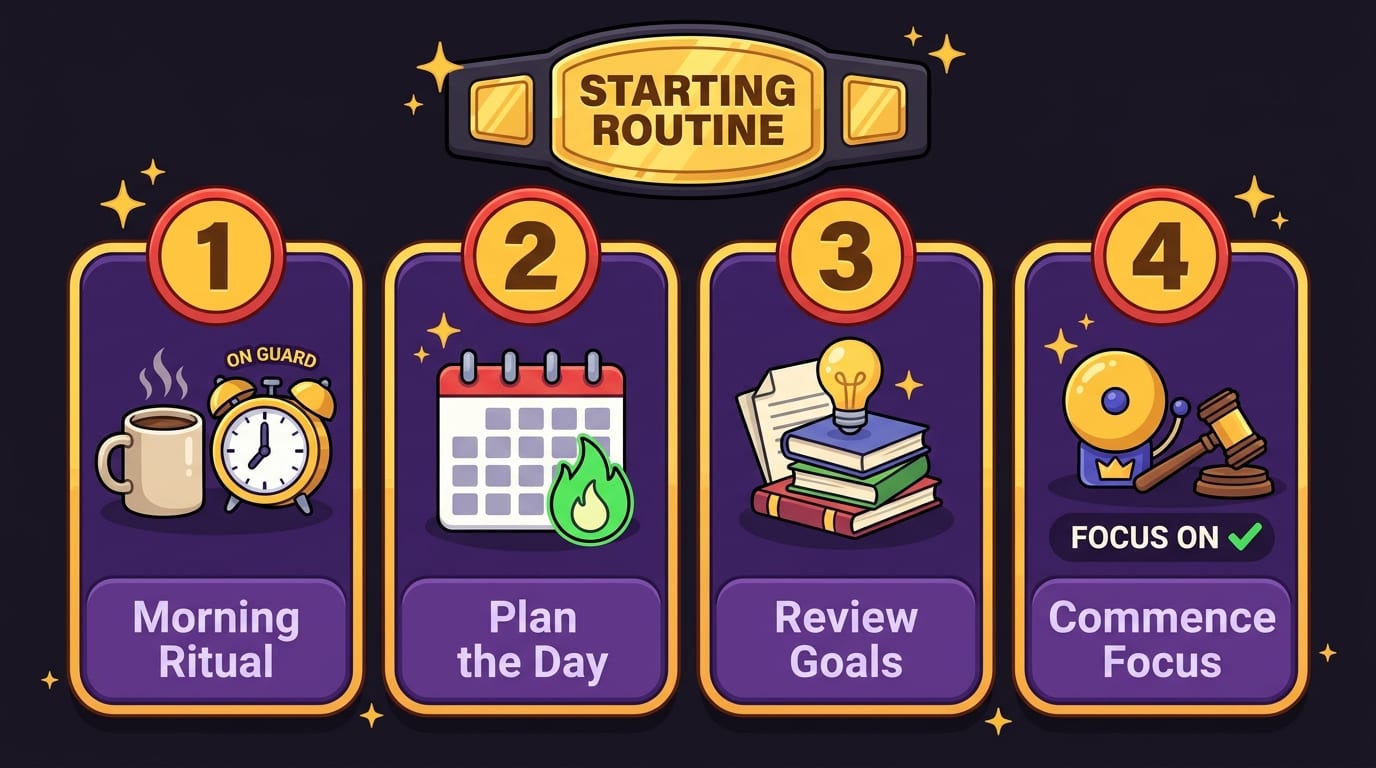
Waiting until you feel motivated can turn a small task into a long negotiation with yourself. A consistent start-up routine can lower that resistance. It might be as simple as clearing your desk, opening the document you need, reviewing your top priority, and setting a focus timer.
Keep the routine short enough that it doesn’t become another project. The point is to create a cue: this is when work begins. If you work from home, a brief walk, a fresh cup of tea, or changing into daytime clothes can help mark the transition. You don’t need a ceremonial gong. You do need a repeatable signal.
Use the same idea to end the workday. Spend five minutes noting what you finished, what remains, and the first step for tomorrow. Close unnecessary tabs and put away work materials if you can. This shutdown ritual reduces the chance that unfinished tasks will keep spinning around your head during dinner.
Routines should support your real schedule, not an imaginary one. If your mornings are unpredictable, a routine that depends on a perfect 90-minute sunrise ritual will collapse the first time life happens. Build a minimum version: choose today’s priority, clear one distraction, and begin a 15-minute work block. Small rituals that survive busy days are more valuable than elaborate ones you abandon by Thursday.
Gamification can make routines easier to repeat for people who enjoy visible progress. BlockChamp awards XP for focused time and consistent days, with levels, badges, and reigns to mark progress. Those rewards don’t replace useful work, but they can make the habit of protecting your attention feel more engaging. You’re not just “trying to focus.” You’re defending your reign. Slightly dramatic? Yes. Memorable? Also yes.
6. Take Breaks That Actually Restore You
A break is not a crime against productivity. It’s maintenance. After sustained concentration, a short pause can help you return with more energy and a clearer head. The trick is choosing a break that feels like a reset rather than a trapdoor into 45 minutes of scrolling.
Good breaks often involve changing your physical or mental state. Stand up, stretch, refill your water, look outside, take a short walk, or chat with someone. If you’ve been staring at a screen, stepping away from another screen may be especially refreshing. If you need a mental reset, try a few minutes of quiet breathing or an easy, low-stakes task.
Be specific about the length. “I’ll take a quick break” can expand like a cartoon balloon. Set a timer or decide in advance what you’ll do and when you’ll return. For instance: “I’ll walk to the kitchen, refill my water, and be back in eight minutes.” That’s a break with a door back to work.
Take longer breaks around meals and avoid treating every pause as something you have to earn by suffering first. Regular recovery can make a demanding day more sustainable. If you want more ideas, read how to take better breaks for productivity and wellbeing.
One caution: a break filled with the same rapid-fire notifications that interrupted your work may not feel restful. Consider separating work breaks from social media checks. You can choose to scroll intentionally later; you don’t have to let an algorithm appoint itself your break manager.

7. Measure Progress Without Turning Into Your Own Boss From Hell
To improve productivity, track a few useful signals—but don’t measure every breath. A detailed dashboard can become a new distraction, especially if you spend more time adjusting the tracking system than doing the work.
Pick one or two measures connected to what you want to improve. Examples include:
- How many planned focus blocks you completed.
- Whether your highest-priority task moved forward.
- How often you were interrupted during a focus session.
- How much time you spent on a particular project.
- Whether you finished work at a reasonable time.
Review your results once a week. Look for patterns rather than grading yourself. If your best work happens before lunch, reserve that time for demanding tasks. If meetings routinely break up your afternoon, group them where possible. If you keep getting pulled into a particular website, add a barrier or change the device setup.
Be careful about confusing activity with impact. A full calendar, a rapidly shrinking inbox, and a list of crossed-off minor tasks can feel satisfying, but they don’t necessarily mean your most important work is getting done. Ask whether the work you completed created a useful result for your team, customers, studies, or business.
Productivity is also not a contest to work the longest. The CDC’s guidance on long work hours and fatigue discusses how extended hours and insufficient recovery can affect safety and wellbeing. If you’re persistently exhausted, extending the workday may make performance worse, not better. Protecting rest is part of a sensible productivity strategy.
8. Make Your Productivity System Easy to Restart
No routine survives every week untouched. A deadline appears, a child gets sick, a computer decides it has always wanted to install updates, and the perfect plan waves goodbye from the horizon. The important skill is returning to your system without declaring the entire week a failure.
When you fall behind, don’t try to recover by scheduling every minute of the next day. Reassess the work, choose the most important task, and set a small first step. If you missed your planned morning focus session, try one 20-minute block in the afternoon. If a distraction won, note what made it easy and adjust the setup before your next session.
Use rules that are easy to remember. “Check messages at three planned times” is more durable than a complex 18-step inbox protocol. “Block social sites during writing” is clearer than “be more disciplined online.” A good system reduces the number of decisions you need to make when your energy is low.
That’s where a blocker can help. BlockChamp works in Chrome and lets you block up to three specific sites and enable two categories for free, with more options in its Champion plan. The free experience includes XP, levels, badges, reigns, and The Stare-Down block page. For people who want a stronger barrier, Champion features include scheduled blocking and Hardcore Lockdown, which adds a cooldown or a boxing-riddle challenge before focus can be turned off. Think of it as putting a velvet rope between you and the scroll—not because you can’t be trusted, but because even champions benefit from a good setup.
Increase Work Productivity by Protecting Your Attention
To increase work productivity, start with the essentials: decide what matters, reserve time for it, reduce predictable distractions, and take breaks that help you recover. Make communication more intentional, create simple routines, and review what’s working without turning your day into a performance report.
Try one change tomorrow, not twelve. Choose your top priority before opening email. Put your phone out of reach for one focus block. Or schedule a real break and return with a clear next step. Small changes build trust in your system, and a system you can restart is far more useful than a perfect plan you use once.
If distracting websites keep ambushing your work sessions, give them fewer chances to get through the ropes. Explore BlockChamp, set your focus guard, and start building a workday that belongs to you. Defend the throne, crush the scroll, and get the important stuff done. 👑
Related posts

Reclaiming Quality Time

Healthy Tech Habits Kids

Can Children Resist Screens A Couples Home Experiment
