
Improve Focus And Concentration

Your brain is not broken. It is simply living in a carnival where every app is a clown with a megaphone yelling, “Look at me! I have memes!” If you want to improve focus and concentration, you do not need to move to a mountain cave, delete civilization, and communicate only through smoke signals. You need better systems, a friendlier environment, and a few brain-friendly habits that make attention easier to protect.
Focus is not just “try harder.” Trying harder while your phone glows beside you like a cursed wizard orb is a terrible strategy. Concentration improves when you reduce temptation, train attention gradually, protect your energy, and make distractions inconvenient enough that your impulse gets bored and wanders off to annoy someone else.
In this guide, we’ll cover practical, science-backed ways to improve focus and concentration: routines, workspace tweaks, attention exercises, break strategies, food and sleep basics, and digital distraction defenses. We’ll also talk about how tools like BlockChamp can help you knock out distracting websites before they steal your entire afternoon and leave you wondering why you know 14 facts about raccoons but finished zero tasks.
Quick Answers
Why Focus Feels So Hard Now: Your Attention Is Under Siege
Modern concentration is difficult because your attention has become a business model. Social feeds, streaming platforms, news alerts, shopping apps, and infinite-scroll goblin tunnels are designed to keep you engaged. Not casually. Aggressively. Like a tiny dopamine casino in your pocket.
Research on digital interruption backs up what your fried little brain already suspects: interruptions can seriously disrupt performance. A widely cited study from the University of California, Irvine found that after interruptions, people often take significant time to return to their original task, and they tend to work faster afterward, increasing stress in the process. You can read more about Gloria Mark’s research on attention and interruptions through this UC Irvine paper on interrupted work.
Meanwhile, the American Psychological Association notes that multitasking comes with “switching costs,” meaning your brain loses time and efficiency when jumping between tasks. Translation: “I’m just checking Slack while writing this report” is not productivity. It is cognitive parkour with ankle weights. The APA explains this well in its overview of multitasking and mental efficiency.
The good news? Focus can be rebuilt. Your attention is trainable, but only if you stop expecting it to survive in a tab-filled thunderstorm. The goal is not to become a productivity robot with cold dead eyes. The goal is to create conditions where your brain can do one meaningful thing at a time without being body-slammed by YouTube recommendations.
Start With a Focus Baseline: Know Thy Distraction Goblins
Before you improve focus and concentration, you need to know what is currently stealing it. Most people underestimate how often they switch tasks, check websites, pick up their phone, or “quickly” look something up and return 37 minutes later with a new opinion about medieval bread.
For one day, track your distractions without judging yourself. Seriously. No shame. You are gathering intel for the kingdom. Write down:
- Which websites or apps you open when avoiding work
- What time of day your focus collapses
- What emotions trigger distraction: boredom, stress, confusion, fatigue, fear of starting
- How long you can work before you want to escape
- Which tasks feel easiest to avoid
You may notice patterns. Maybe you fall into Reddit whenever a task becomes ambiguous. Maybe YouTube attacks after lunch. Maybe online shopping appears when you feel stressed. Maybe LinkedIn becomes “research,” which is adorable, champ, but no.
Once you identify your top distraction enemies, block or reduce them during focus hours. This is where a website blocker becomes less “strict parent” and more “royal bodyguard.” With BlockChamp, you can block specific sites like YouTube, Reddit, Instagram, or X/Twitter, or use category bundles like Social Media, Video & Streaming, News, Shopping, Gaming, Gambling, Adult, and AI Distractions. Instead of manually fighting the same temptation 74 times, you let The King stand guard. Crown on. Gloves up.
If your biggest focus challenge happens while working remotely, you may also like BlockChamp’s guide on how to stay focused from home. Home offices are powerful, but so is the fridge. The fridge has never missed a meeting.
Build a Focus Ritual: Tell Your Brain It’s Time for Battle
Your brain loves cues. A consistent starting ritual helps shift you from scattered mode into focus mode. Think of it as walking into the arena. The crowd roars. The King nods. Your inbox trembles.
A good focus ritual should be short, repeatable, and boring enough that you’ll actually do it. Not a 47-step ceremony involving imported candles and a productivity gong named Gerald. Try this five-minute routine:
- Clear your desk of anything unrelated to the next task.
- Write down the single outcome you want from the session.
- Set a timer for 25, 45, or 60 minutes.
- Turn on website blocking or focus mode.
- Take three slow breaths and begin.
The key is deciding what “done” looks like before you start. “Work on essay” is foggy. “Write the introduction and outline three body sections” is clear. Your brain handles concrete targets better than vague productivity soup.
Here are examples of strong focus session goals:
- “Draft 500 words of the blog post.”
- “Review chapters 4 and 5 and create 20 flashcards.”
- “Reply to the 12 priority emails, then close inbox.”
- “Fix the checkout bug and write a short test plan.”
- “Create the first version of the client presentation deck.”
BlockChamp fits nicely into this ritual because it makes “turn off distractions” a single deliberate action. Hit the Master Focus Toggle, go “On Guard,” and your blocked sites are defended. If you try to sneak into a blocked site anyway, The Stare-Down appears: The King catches you, judges you, maybe roasts you out loud, and sends you back to work. It is oddly motivating. Like being supervised by a tiny royal boxing coach with zero patience for your “quick scroll.”
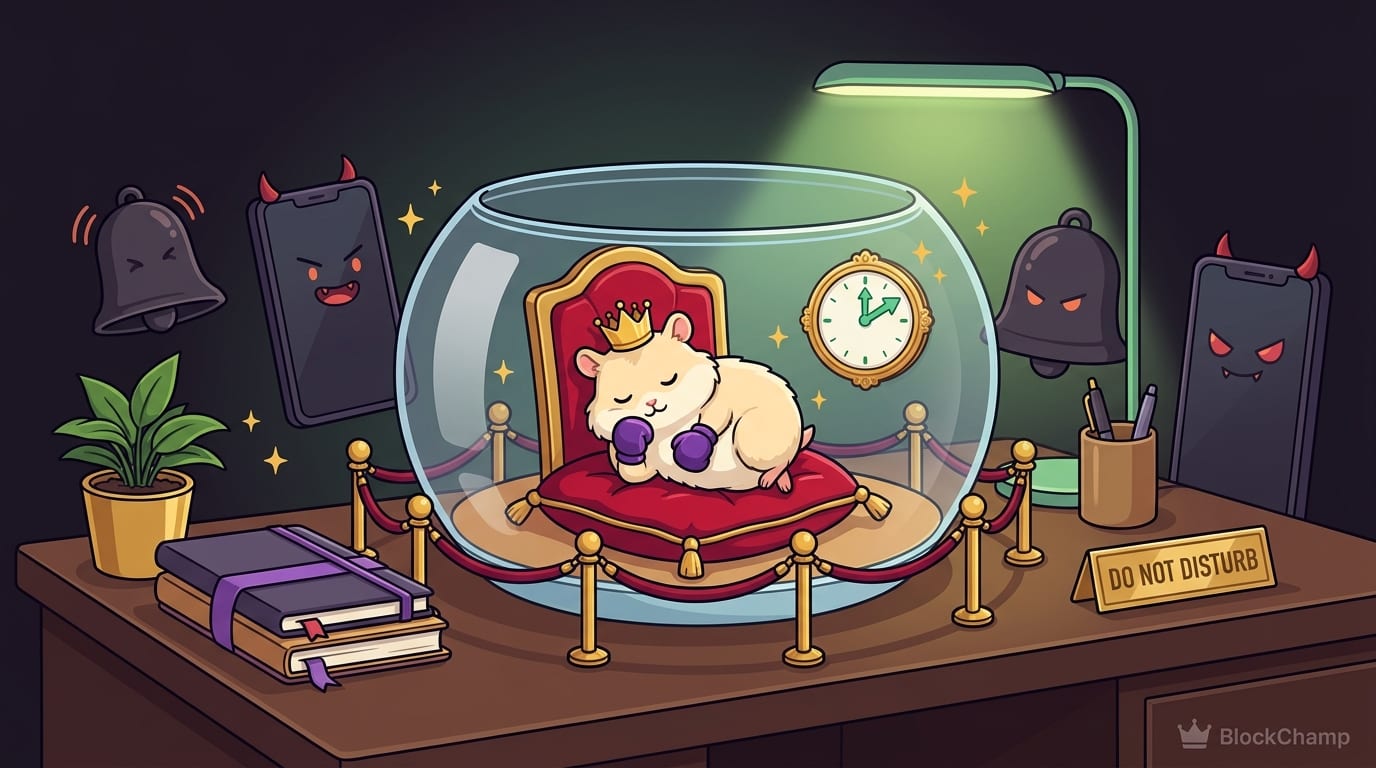
Design Your Environment Like Your Willpower Is a Tiny Tired Hamster
Willpower is useful, but it is not a reliable long-term strategy. Environment beats motivation because environment is always there. Motivation, meanwhile, occasionally disappears into the bushes wearing a fake mustache.
If you want to improve focus and concentration, make focused work easier to start and distracted behavior harder to access. This is called friction. Add friction to distractions. Remove friction from good work. Simple. Slightly annoying. Very effective.
Physical environment tweaks
- Put your phone in another room during focus sessions.
- Use headphones or white noise if your environment is noisy.
- Keep only the materials you need on your desk.
- Face away from TVs, windows with heavy traffic, or chatty humans.
- Use a water bottle so “I need water” does not become a 20-minute kitchen expedition.
Digital environment tweaks
- Close unused tabs before starting deep work.
- Log out of distracting websites.
- Disable nonessential notifications.
- Use full-screen mode for writing, coding, or studying.
- Block your top distraction sites during work blocks.
Digital clutter is still clutter. A browser with 38 tabs is not a workspace; it is a raccoon nest with bookmarks. If your tabs include work docs, social feeds, shopping carts, and an article titled “Can frogs feel ambition?” your brain will bounce around like a caffeinated ping-pong ball.
For workplace-specific strategies, check out BlockChamp’s guide on how to focus at work. It covers practical ways to protect attention in office and digital environments where meetings, messages, and “urgent quick things” multiply like gremlins in a hot tub.
Use Time Blocks: Give Your Attention a Fence
Time blocking works because it gives your attention boundaries. Instead of keeping an endless to-do list and hoping your brain behaves like a noble scholar, you assign specific tasks to specific windows. This reduces decision fatigue and helps you avoid the classic productivity swamp: “What should I do now?” followed by opening Instagram for absolutely no reason.
A simple focus-friendly day might look like this:
- 8:30–9:00: Plan day and answer urgent messages
- 9:00–10:30: Deep work task one
- 10:30–10:45: Break
- 10:45–12:00: Deep work task two
- 12:00–1:00: Lunch and walk
- 1:00–2:00: Meetings or collaboration
- 2:00–3:30: Execution block
- 3:30–4:00: Admin and inbox
- 4:00–4:15: Plan tomorrow
You do not need to schedule every breath like a productivity cyborg. Just protect your highest-energy hours for your hardest work. For many people, that is morning. For others, it is late afternoon or evening. The best focus schedule is the one that matches your actual energy, not the one some billionaire claims to use after waking at 4:03 a.m. to drink moon water.
Time blocking pairs beautifully with scheduled website blocking. BlockChamp Champion users can set recurring Focus Schedules so blocks automatically activate during work or study windows. That means fewer decisions, fewer loopholes, and fewer “oops, I somehow watched seven laptop reviews even though I already own a laptop” incidents.
If you work a mix of home and office days, focus can get extra slippery because your environment keeps changing. BlockChamp has a full guide to help you stay focused in hybrid work without letting your routine collapse like a wet cardboard castle.
Train Attention With Short Sprints, Not Heroic Suffering
If your concentration is currently weak, do not start with a three-hour deep work marathon. That is like trying to run a marathon because you successfully walked to the mailbox. Begin with focus sprints and build stamina gradually.
The Pomodoro Technique is a popular option: work for 25 minutes, then take a 5-minute break. After four rounds, take a longer break. It works because it lowers the emotional barrier to starting. “Write report for three hours” sounds awful. “Work for 25 minutes” sounds survivable. Maybe even noble. A tiny crown appears.
You can adjust the timing based on task intensity:
- 25/5: Great for studying, admin, or getting started when motivation is hiding under the bed.
- 45/10: Good for writing, coding, design, or analytical work.
- 60/15: Useful when you have momentum and need longer uninterrupted focus.
- 90/20: Best for experienced deep work sessions, not for beginners or people fueled only by vibes and espresso.
During the sprint, your rule is simple: one task, no switching. If a random thought appears—“buy toothpaste,” “email Sam,” “what if penguins had jobs?”—write it on a capture list and return to the task. This teaches your brain that thoughts can be acknowledged without becoming side quests.
According to Cal Newport’s concept of deep work, high-value cognitive output often requires sustained, distraction-free concentration. Newport’s book and writing popularized the idea that deep work is increasingly rare and valuable in a noisy digital economy. You can explore more on Cal Newport’s writing about deep work and focus.
BlockChamp adds a game layer to these focus sprints. Every minute of focus earns XP. Every focused day builds your reign. Every survived Stare-Down gives you points instead of shame. This matters because motivation becomes easier when progress is visible. Your brain likes rewards. Give it a shiny badge instead of another lecture.
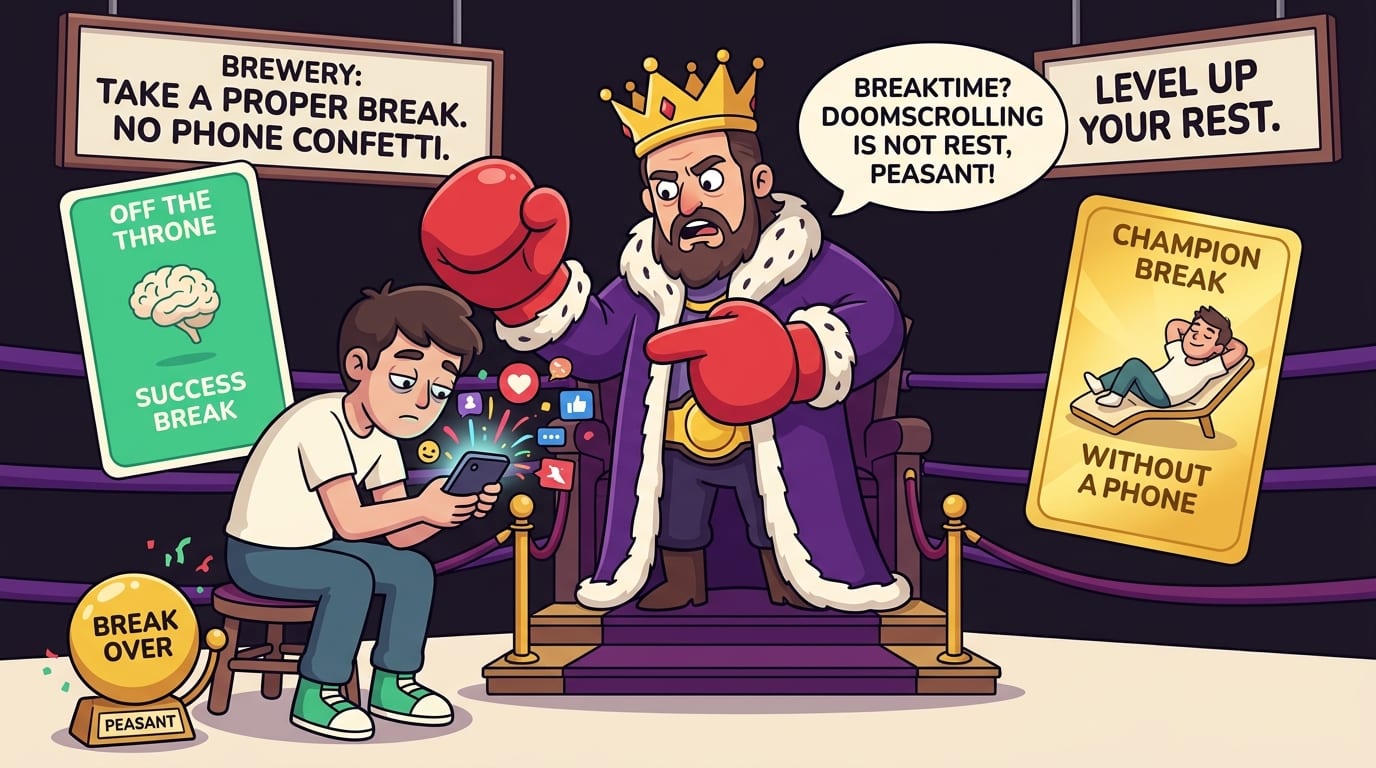
Take Better Breaks: Scrolling Is Not Rest, It’s Brain Confetti
Breaks are essential for concentration. The problem is that many people take “breaks” by opening the exact apps that shredded their attention in the first place. That is not recovery. That is throwing your brain into a glitter cannon and asking it to return refreshed.
A good break should reduce cognitive load. It should help your nervous system settle, your eyes relax, and your body move a little. Social media, breaking news, and short-form video often do the opposite: they flood you with novelty, emotion, comparison, and tiny little outrage snacks.
Better break options include:
- Walking outside for five to ten minutes
- Stretching your neck, shoulders, hips, and wrists
- Looking out a window to rest your eyes
- Making tea or coffee without checking your phone
- Doing a short breathing exercise
- Cleaning one small physical area
- Reading a few pages of a physical book
There is also evidence that brief movement can support cognitive function and mood. Harvard Health has covered how exercise can help memory and thinking skills, especially through mechanisms like improved sleep, reduced stress, and better brain health. See this overview from Harvard Health on exercise and thinking skills.
If you struggle to avoid digital rabbit holes during breaks, pre-decide what counts as a real break. Put it on a sticky note if needed: “Break = walk, stretch, water. Break ≠ TikTok courtroom drama.” Then block the biggest trap sites during your workday. BlockChamp’s Video & Streaming and Social Media categories are especially helpful here because they remove the “just one clip” lie from the menu. The King sees you, champ. The King has receipts.
Feed and Rest the Focus Machine: Sleep, Food, and Caffeine Without Chaos
You cannot productivity-hack your way around being exhausted. Sleep is one of the biggest concentration levers, and yet many ambitious people treat it like an optional software update. “Remind me later.” Forever.
Sleep affects attention, working memory, decision-making, mood, and impulse control. The CDC reports that about one in three U.S. adults do not get enough sleep, and insufficient sleep is linked to multiple health and performance issues. You can review the CDC’s sleep facts and recommendations through its sleep and sleep disorders resource.
To improve focus and concentration through better sleep, start with boring fundamentals. Boring fundamentals work. That is why they are annoying.
- Keep a consistent wake time most days.
- Get bright light in the morning.
- Avoid heavy caffeine late in the day.
- Stop working in bed if possible.
- Create a 20-minute wind-down routine.
- Keep your phone away from your pillow like it owes you money.
Food matters too. Giant sugar spikes, skipped meals, and “lunch” consisting of three crackers and panic are not great for attention. You do not need a perfect diet. Just aim for stable energy: protein, fiber, healthy fats, water, and meals that do not leave you sleepy enough to merge spiritually with your chair.
Caffeine can help alertness, but it is not a personality. Use it strategically. A coffee before a focus sprint? Fine. Six coffees and a trembling belief that you can hear colors? Maybe not. If caffeine makes you anxious, your concentration may get worse because your brain starts treating a spreadsheet like a tiger attack.
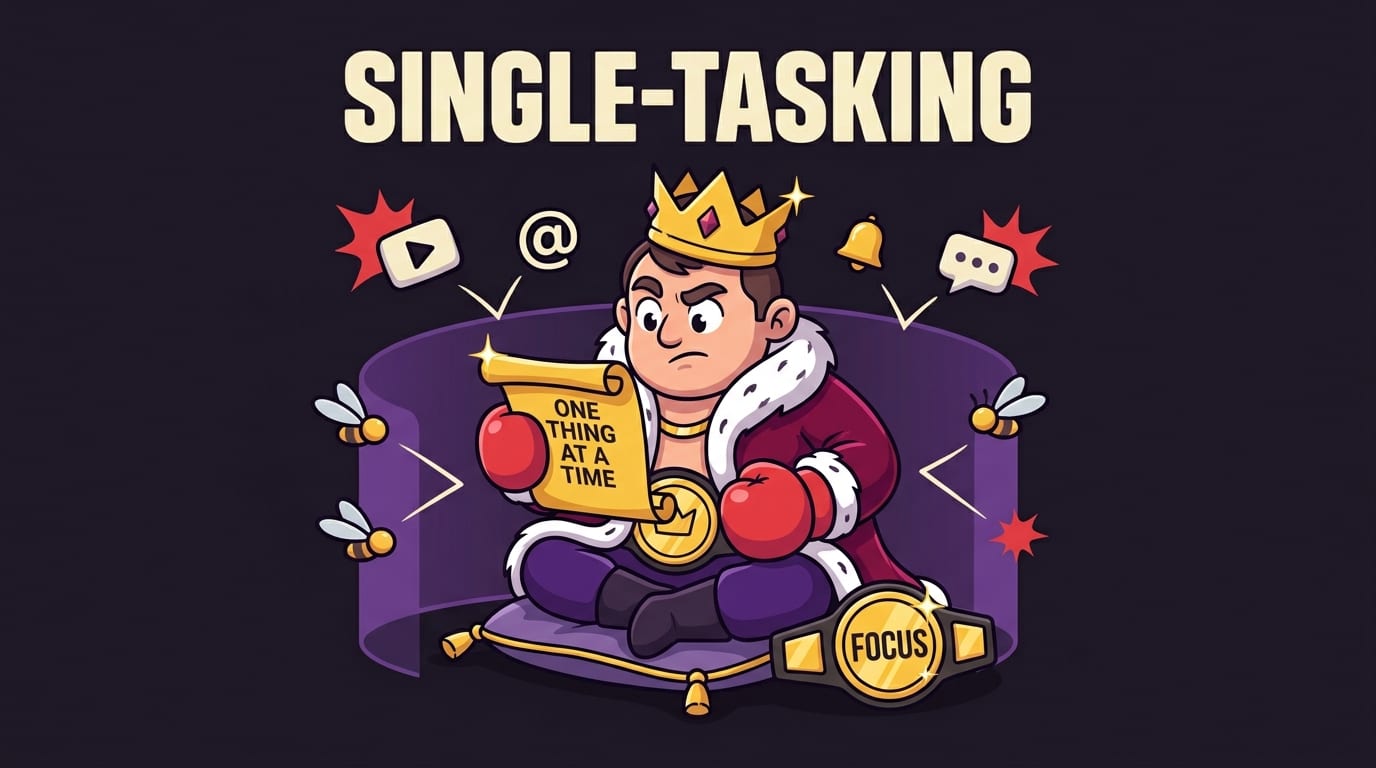
Practice Single-Tasking: The Lost Art of Doing One Thing Like a Majestic Weirdo
Single-tasking is one of the most underrated ways to improve focus and concentration. It sounds obvious, but it is weirdly radical now. Doing one thing at a time? In this economy? Scandalous.
Start by choosing a “primary task” and defining what is allowed during that task. For example, if you are writing a report, allowed tools might be your document, one research source, and notes. Not allowed: email, chat, social media, news, analytics dashboards, online shopping, or checking whether your favorite creator uploaded again. They did. They always do. That is the trap.
Use these single-tasking rules:
- Keep only one main app or document visible.
- Batch communication instead of checking messages constantly.
- Use a capture list for unrelated thoughts.
- Set a clear stopping point before switching tasks.
- When interrupted, write down exactly where to resume.
The “resume note” is especially useful. If you must stop mid-task, write something like: “Next: add three examples under section two and verify the source.” When you return, you avoid the foggy re-entry ritual of staring at your screen like a medieval villager seeing an iPad for the first time.
For teams and managers, improving concentration is not just personal. Digital distractions affect performance, morale, and output. BlockChamp has written about how distraction management can improve employee performance, especially when organizations create environments where people can actually think instead of constantly react.
Use Attention Exercises: Tiny Workouts for Your Wandering Brain
Attention is trainable. You do not need to become a monk. You can start with tiny exercises that strengthen your ability to notice distraction and return to the task. That “return” is the rep. Every time you bring your attention back, you are doing a mental push-up. Less glamorous than a boxing montage, but still powerful.
Exercise 1: The five-minute breath anchor
Set a timer for five minutes. Focus on your breathing. When your mind wanders, gently label it “thinking” and return to the breath. That is it. Your mind will wander. Congratulations, you have a mind. The win is returning without turning it into a courtroom drama.
Exercise 2: Object focus
Pick one object, like a pen or mug. Observe it for three minutes. Notice shape, texture, color, shadow, and detail. When thoughts drift, return to the object. This builds observation and attention control.
Exercise 3: Reading reps
Read one page of a book or article without checking your phone or switching tabs. If one page is easy, do three. If three is easy, do ten. This is attention stamina training for people whose brains have been seasoned by notifications.
Exercise 4: Distraction delay
When you feel the urge to check a site, wait ten minutes. Write the urge down: “Wanted to check YouTube at 2:14 because task got hard.” Often, the urge fades. If it does not, you still gained awareness, which is the first step toward control.
BlockChamp’s Hardcore Lockdown is basically distraction delay wearing boxing gloves. If you try to turn focus off, Champion users can require a cooldown timer or a three-round boxing riddle before surrendering. That extra friction gives the impulse time to pass. Many distractions are not deep desires; they are tiny storms. Wait them out and they vanish, sulking.
Make Focus Rewarding: Your Brain Likes Gold Stars, Don’t Be Snooty
People stick with habits when progress feels visible. This is why streaks, levels, badges, and scoreboards work. They turn invisible effort into something you can see and chase. Is it a little silly? Yes. Does it work on grown adults? Also yes. We are all just sophisticated raccoons collecting shiny objects.
Gamification can support motivation when it rewards the right behavior: consistency, effort, and recovery after slips. The best systems do not demand perfection. They encourage you to keep showing up.
To make focus rewarding, try:
- Tracking daily focused hours
- Keeping a streak for distraction-free work blocks
- Rewarding yourself after completing difficult sessions
- Creating milestones like 7 focused days or 30 completed sprints
- Competing with a friend or team in a friendly way
This is where BlockChamp gets delightfully extra. You earn XP for focus minutes, daily active blocks, stare-downs survived, and reign bonuses. You level up from Peasant of Procrastination to Squire of Focus, Knight of the Block, Duke of Discipline, Prince of Productivity, and eventually BLOCK CHAMP — King of Your Time. There are badges, a Trophy Room, a focus calendar, and a Hall of Champions leaderboard.
Most website blockers feel like punishment. BlockChamp feels like a game where the boss battle is your own urge to open TikTok. When you slip and try a blocked site, The King’s Stare-Down turns the moment into a funny reset instead of a shame spiral. You are not “bad at focus.” You are simply being escorted out of the distraction kingdom by a short royal boxer with a tremendous attitude.
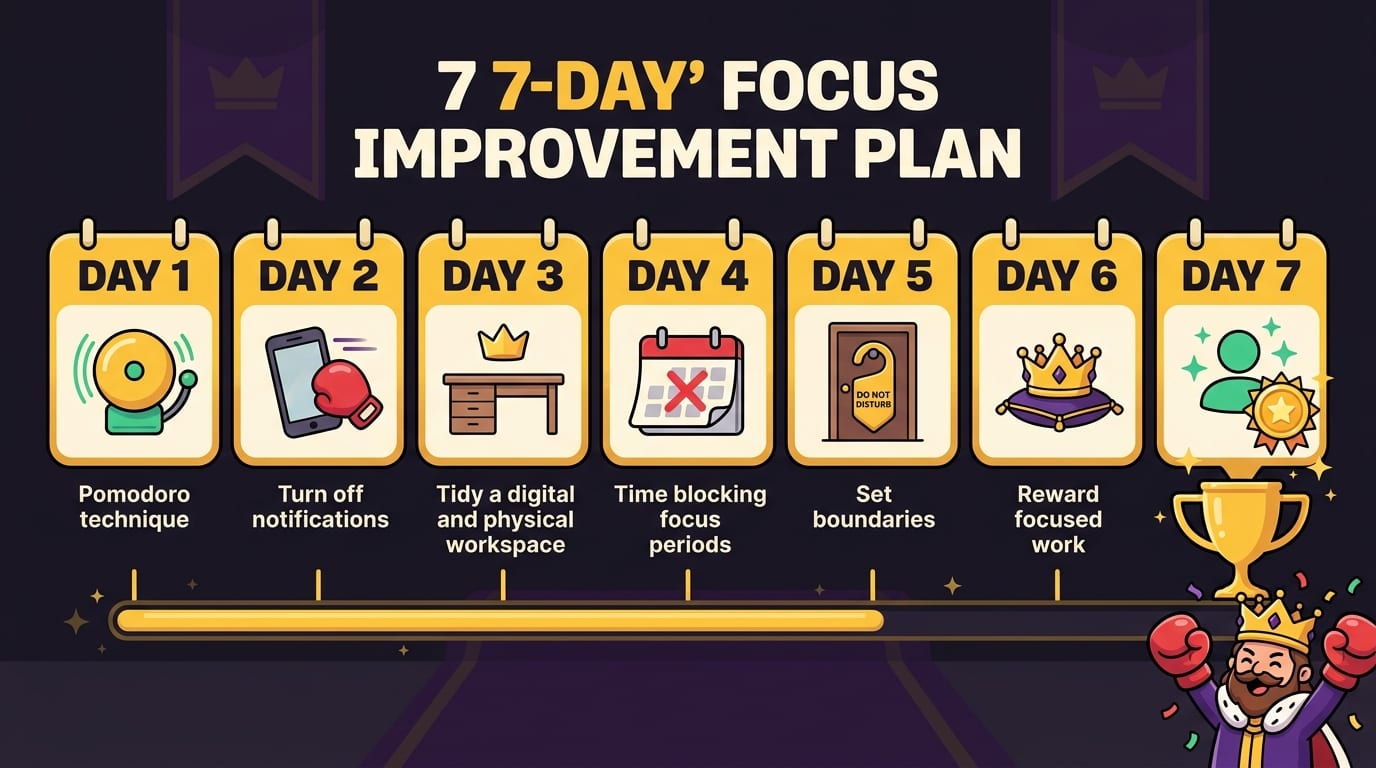
A Practical 7-Day Plan to Improve Focus and Concentration
Let’s turn all this into a simple plan. No dramatic life overhaul. No buying 19 notebooks. No chanting “deep work” into a mirror. Just seven days of practical upgrades.
Day 1: Audit your distractions
Track where your attention goes. Write down your top five distracting sites, apps, and situations. Notice the emotional trigger behind each one.
Day 2: Clean your work environment
Remove visual clutter, silence notifications, close extra tabs, and put your phone out of reach. Make your workspace boring enough that your actual task becomes the most interesting thing available. Sad? Maybe. Effective? Absolutely.
Day 3: Create your focus ritual
Use the five-minute start routine: clear desk, choose one outcome, set timer, block distractions, begin. Repeat it before every serious work session.
Day 4: Try three focus sprints
Do three 25-minute sessions with five-minute breaks. During each sprint, work on one task only. Keep a capture list for random thoughts.
Day 5: Upgrade your breaks
Replace scrolling breaks with movement, hydration, stretching, or outdoor light. Notice whether your next session feels easier.
Day 6: Add stronger digital boundaries
Block your biggest distraction sites during your most important work hours. If you use BlockChamp, enable categories or specific sites and let The King defend the throne while you do the work.
Day 7: Review and adjust
Look at what worked. Which time of day was best? Which distractions returned? Which tasks need clearer definitions? Keep the habits that helped and simplify anything that felt too complicated.
This plan works because it improves the system around your attention. You are not asking your brain to become superhuman. You are giving it a fighting chance. Tiny crown. Big difference.
Common Focus Mistakes That Secretly Sabotage You
Sometimes the best way to improve concentration is to stop doing the things that quietly wreck it. Here are the usual suspects:
- Starting with vague tasks: “Study” is too broad. “Review 20 biology flashcards” is better.
- Keeping notifications on: Every ping is a tiny attention tax.
- Using social media as a break: That is not rest; it is novelty soup.
- Working when exhausted: Sometimes the productivity hack is sleep. Rude but true.
- Expecting perfection: One distracted session does not ruin your progress. Reset and continue.
- Leaving temptations available: If you can access your favorite distraction in one click, you probably will.
The sneakiest mistake is relying on future-you to behave better without changing the setup. Future-you is not a magical disciplined wizard. Future-you is you, but tired. Help that poor creature. Block the sites. Plan the task. Prepare the workspace. Put the phone elsewhere. Give The King the keys to the gate.
Final Bell: Focus Is a System, Not a Personality Trait
To improve focus and concentration, stop treating attention like a moral test. It is not about being “disciplined enough” to defeat billion-dollar distraction machines with raw willpower and a stern facial expression. It is about building a system that protects your best mental energy.
Start small. Audit your distractions. Create a focus ritual. Work in sprints. Take real breaks. Sleep like a human, not a haunted laptop. Single-task. Train attention. Block the sites that keep ambushing your day. Then reward consistency so your brain actually wants to keep going.
If distracting websites are your biggest enemy, BlockChamp is built for exactly this fight. It blocks tempting sites and categories, turns focus into a game with XP and badges, and lets The King roast you back to work when you try to sneak into the scroll mines. Free users can block up to three sites and two categories with full gamification, while Champion users unlock unlimited sites, all categories, keyword blocking, schedules, and Hardcore Lockdown.
Your attention is your kingdom. Defend the throne. Crush the scroll. And if you catch yourself opening YouTube during a focus sprint, do not panic. The King sees you, peasant. Back to work.
Related posts

Curt Steinhorst How To Create A Focus Vault

Benefits Of Productivity Tools

Finding Focus For Uninterrupted Writing
