
Improve Employee Performance

If you want to improve employee performance, please do not start by buying everyone a motivational mug that says “Teamwork makes the dream work.” The dream is already buried under Slack pings, vague goals, back-to-back meetings, and Brenda from accounting asking if “this is a quick question” when it is, in fact, a 37-minute side quest.
Real performance improvement is not about squeezing humans like productivity lemons. It is about creating the conditions where people can do great work consistently: clear expectations, useful feedback, fewer distractions, better tools, stronger managers, and enough recognition that employees do not feel like background NPCs in the company kingdom.
This guide breaks down practical, non-cringe strategies to improve employee performance across teams. We will cover coaching, goal-setting, feedback, recognition, training, workflow fixes, digital distraction management, and how tools like BlockChamp can help employees defend their focus without turning work into a joyless spreadsheet dungeon.
Quick Answers
1. Start With Clear Expectations: No One Can Hit a Target Hidden in Fog
The fastest way to improve employee performance is also the least glamorous: make sure everyone knows what “good” actually means. Many performance problems are not caused by laziness, incompetence, or a tragic shortage of inspirational LinkedIn posts. They happen because expectations are fuzzy.
If an employee hears “be more proactive,” they may wonder: proactive how? Send more updates? Suggest new projects? Wrestle a printer? Without specifics, people guess. And when people guess, managers get inconsistent results and employees get frustrated.
Clear expectations should answer three basic questions:
- What outcomes matter? Revenue, customer satisfaction, project completion, quality, response time, retention, error reduction, or something else?
- What behaviors support those outcomes? Examples: documenting decisions, following up within 24 hours, reviewing work before handoff, or blocking focus time for deep tasks.
- How will success be measured? Define the scorecard before the game begins. Nobody likes surprise rules, except possibly toddlers and tax authorities.
For example, instead of telling a support rep to “improve customer communication,” define it like this: “Respond to new tickets within two business hours, summarize the solution clearly, and maintain a customer satisfaction score above 90%.” Now the employee has a map. A map beats motivational fog every time.
This is where managers should document role expectations, team norms, and project definitions of done. The goal is not bureaucracy. The goal is reducing psychic guesswork. Employees perform better when they can spend less energy decoding what leadership meant and more energy doing the work.
2. Set Goals That Are Ambitious, Not Delusional
Goal-setting can improve employee performance dramatically, but only if goals are specific, measurable, and connected to real business priorities. Otherwise, goals become decorative office confetti: nice to look at, impossible to clean up, and somehow in everyone’s keyboard.
One popular framework is SMART goals: specific, measurable, achievable, relevant, and time-bound. Another is OKRs: objectives and key results. The framework matters less than the clarity. A good goal should create focus, not panic.
According to Gallup research on employee engagement and performance, engaged teams show better business outcomes, including productivity, profitability, and retention. Clear, meaningful goals are a major part of that engagement because people want to know their work matters. “Do more stuff” is not meaningful. “Reduce onboarding time by 20% so new customers see value faster” is much better. Crown-worthy, even.
Here is a simple goal-setting process managers can use:
- Choose one priority outcome. Avoid the classic trap of having 14 “top priorities.” That is not strategy. That is a buffet with anxiety.
- Define the metric. Pick a number or observable result. Examples: close rate, cycle time, quality score, retention, output per sprint, or customer response speed.
- Set a realistic stretch target. A goal should require effort, not dark magic.
- Agree on the support needed. Training, tools, fewer meetings, better documentation, decision access, or more focused work time.
- Review progress regularly. Weekly or biweekly check-ins prevent goals from becoming ancient relics in a forgotten Google Doc.
Good goals also help employees make tradeoffs. When everything feels urgent, employees bounce between tasks like caffeinated squirrels. When goals are clear, they know which work deserves deep focus and which can wait in the moat.
3. Coach Like a Human, Not a Performance Spreadsheet Wearing Shoes
If you want to improve employee performance, coaching is your secret weapon. Not annual-review coaching. Not “we need to talk” coaching that makes everyone’s soul leave their body. Real coaching happens regularly, calmly, and specifically.
Great coaching is built around curiosity and improvement. Managers should ask questions before prescribing fixes. For example:
- “What part of this project felt most unclear?”
- “Where did you get stuck?”
- “What would make this easier next time?”
- “What support do you need from me?”
- “Which task is draining the most time?”
These questions turn performance conversations from courtroom drama into problem-solving. The manager is not there to swing a tiny royal gavel. The manager is there to remove obstacles, sharpen skills, and help the employee level up.
Coaching should be specific. “You need to communicate better” is mush. “In client updates, include the current status, next step, owner, and deadline so stakeholders do not have to chase details” is useful. Specific feedback gives employees something they can actually do.
Managers should also separate skill issues from will issues. If someone is struggling because they lack training, process clarity, or confidence, the solution is coaching and support. If someone has the skill but consistently avoids responsibility, that is a different conversation. Mixing those up creates chaos. It is like bringing boxing gloves to a chess match. Dramatic, but unhelpful.
4. Give Feedback Early, Often, and Without the Thundercloud Entrance
Feedback improves performance when it is timely, specific, and normal. It becomes scary when managers save everything for one giant annual review casserole. Nobody wants to hear 11 months of concerns reheated in December.
Research summarized by Harvard Business Review shows that feedback is most useful when it helps people understand what works and how to repeat or improve it, rather than simply dumping criticism on them. Employees need guidance they can act on, not a dramatic monologue from the balcony.
A helpful feedback formula looks like this:
- Situation: “In yesterday’s project update…”
- Behavior: “…the risks were not clearly listed…”
- Impact: “…so the product team did not know which decision was blocking progress.”
- Next step: “Next time, add a ‘Risks and decisions needed’ section at the top.”
Positive feedback matters too. Managers often assume people know when they are doing well. Spoiler: they do not. Silence is ambiguous. Employees may interpret no news as “I am probably doing okay” or “I am one typo away from exile.” Recognition helps reinforce the exact behaviors you want repeated.
Try giving feedback in smaller doses:
- One quick note after a meeting: “Your summary clarified the decision. Keep doing that.”
- A short message after a customer win: “The way you handled that objection was excellent.”
- A five-minute correction before a habit becomes a monster: “Let’s tighten up your handoff notes before this causes delays.”
Feedback is not a punishment. It is performance GPS. Occasionally it says “recalculating,” and yes, that is annoying. But it is better than driving the whole team into a swamp.
5. Recognition: Tiny Applause, Massive Performance Fuel
Recognition is one of the most underrated ways to improve employee performance. People repeat what gets noticed. If only mistakes get attention, employees learn to avoid risk, hide problems, and do just enough not to get summoned to the manager’s lair.
Recognition does not have to be expensive. It does have to be specific and sincere. “Great job” is nice but forgettable. “Great job reducing the onboarding checklist from 18 steps to 9 without losing quality” is powerful because it tells the employee exactly what mattered.
According to Gallup’s workplace research, recognition is strongly connected to engagement, and engagement is linked to better performance outcomes. Translation: people who feel seen are less likely to mentally turn into a houseplant during work hours.
Recognition can take many forms:
- Public shoutouts in team meetings
- Private thank-you notes from managers
- Peer-nominated awards
- Small bonuses or gift cards
- Extra flexibility after intense project pushes
- Career growth opportunities for consistent contributors
The key is matching recognition to the person. Some employees love public praise. Others would rather fight a goose in a parking lot than be applauded in front of 50 people. Know your team.
Recognition should also reward behaviors that support performance, not just heroic last-minute saves. If you only celebrate firefighters, do not be surprised when everyone starts letting fires grow large enough to be impressive. Recognize planning, documentation, collaboration, focus, and proactive problem prevention too.
6. Train for the Work People Actually Do, Not the Work You Wish They Did
Training is often treated like a box to check: “Everyone watched the webinar, therefore skills have entered the building.” Sadly, no. Skills require practice, context, coaching, and repetition. Humans are not USB drives. You cannot just upload “strategic thinking” and call it a day.
To improve employee performance through training, start with a skill gap analysis. Ask:
- What outcomes are below target?
- Which skills directly affect those outcomes?
- Who already performs well in this area, and what do they do differently?
- What training format fits the skill: workshop, shadowing, documentation, practice tasks, mentoring, or coaching?
For example, if sales reps are losing deals late in the pipeline, they may not need “general sales motivation.” They may need objection-handling practice, better discovery questions, or clearer competitive positioning. If engineers are missing deadlines, they may need better estimation habits, fewer interruptions, or clearer product requirements. If managers are struggling, they may need training on one-on-ones, delegation, and feedback conversations.
The McKinsey people and organizational performance insights frequently emphasize capability building, organizational health, and management practices as drivers of business performance. In plain English: train the right skills, support the right behaviors, and stop expecting people to thrive in systems designed by chaos goblins.
Good training should include application. After a workshop, assign a real task that uses the skill. Pair people with mentors. Review outcomes. Celebrate improvement. Training without follow-through is like buying a treadmill and using it as a very expensive laundry throne.
7. Fix Workflows Before Blaming Workers
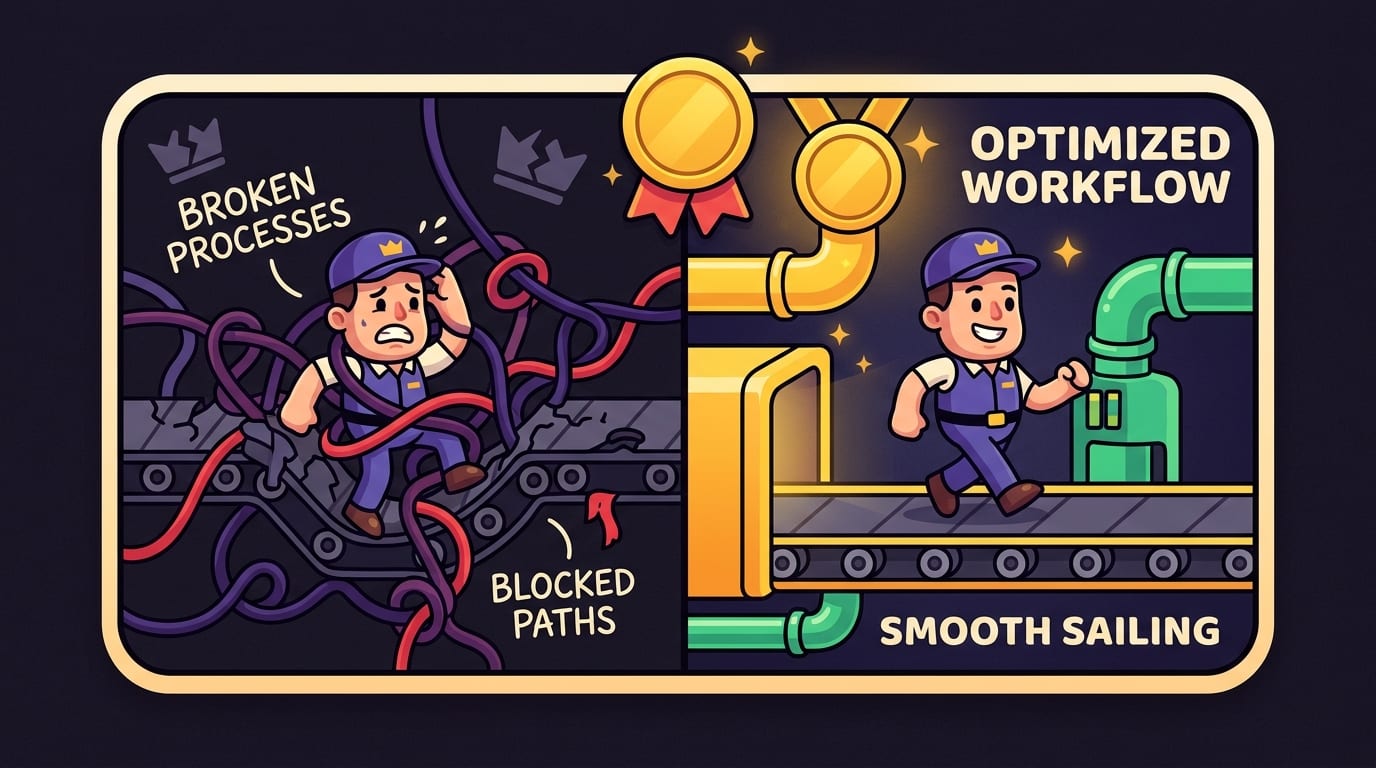
Sometimes employee performance is not the problem. The workflow is the problem wearing a fake mustache. Before assuming someone is underperforming, inspect the system around them.
Common workflow villains include:
- Too many approval layers
- Unclear ownership
- Duplicate tools
- Meetings with no decisions
- Constant context switching
- Manual tasks that should be automated
- Projects starting without requirements
- Urgent requests arriving through five different channels like productivity confetti cannons
Employees cannot perform at their best if the process keeps tackling them from behind. A designer waiting three days for feedback is not “slow.” A support agent searching six systems for customer history is not “inefficient.” A developer interrupted every 12 minutes is not “bad at focus.” They are trapped in a badly defended kingdom.
To improve workflows, run a friction audit. Pick one recurring process and ask the people doing the work:
- Where does work get stuck?
- Which steps add value?
- Which steps exist because “that’s how we’ve always done it,” the official anthem of broken systems?
- What could be automated, removed, or clarified?
- Who needs decision-making authority earlier?
Then fix one bottleneck at a time. Do not attempt a grand transformation named “Project Phoenix Optimization Excellence 360.” That sounds expensive and doomed. Start small: remove one unnecessary meeting, create one template, automate one report, clarify one handoff. Compounding wins improve performance faster than giant initiatives that collapse under their own PowerPoint weight.
8. Protect Focus Like It’s Company Property, Because It Basically Is
Digital distraction is a performance killer hiding in plain sight. Employees may lose focus to social media, news, streaming, shopping, messaging tools, and the eternal gravitational pull of “just checking one thing.” One thing becomes 18 tabs. Suddenly it is 4:42 p.m. and everyone is learning about raccoons who steal cat food. Fascinating? Yes. Strategic? Rarely.
The cost of interruptions is real. Research from the University of California, Irvine found that interrupted work can take significant time to resume, with attention residue and context switching reducing effectiveness. Meanwhile, the American Psychological Association notes that multitasking and task switching can reduce productivity because the brain pays a switching cost. Your brain is not a browser with unlimited tabs. It is more like a noble horse: powerful, but easily spooked by notifications.
Companies that want to improve employee performance should treat focus as a workplace resource. That means designing norms and tools that reduce unnecessary distraction.
Practical focus-protection strategies include:
- Meeting-free focus blocks: Create protected windows for deep work, such as 9–11 a.m. on Tuesdays and Thursdays.
- Notification rules: Define what deserves an immediate ping versus an async update.
- Single source of truth: Keep project updates in one place so employees do not hunt across email, chat, docs, and smoke signals.
- Website blocking during work sessions: Use tools to block known distraction sites when employees need deep focus.
- Breaks on purpose: Encourage real breaks instead of “fake breaks” where employees doomscroll and return more mentally crispy than before.
This is where BlockChamp fits naturally. BlockChamp is a gamified website blocker for Chrome that helps employees block distracting sites, keywords, and categories like social media, video, shopping, news, gaming, gambling, adult content, and AI distractions. Instead of a boring block screen, employees get The Stare-Down: The King catches the attempted distraction, judges it dramatically, and sends them back to work. Is it ridiculous? Absolutely. Does making focus feel like a game help people stick with it? Also yes.
For teams dealing with distraction, BlockChamp can support healthy focus habits without turning managers into surveillance goblins. It runs on the user’s computer and is designed around self-control, XP, streaks, levels, badges, and visible progress. Employees can use it during deep work blocks, writing sessions, studying, coding, planning, or any task where TikTok does not need a royal invitation.
If digital distractions are a major issue on your team, you may also like our deeper guide on 10 ways to improve employee performance by managing digital distractions. It goes full crown-and-gloves on the focus problem.
9. Improve Employee Performance by Building Better Manager Habits
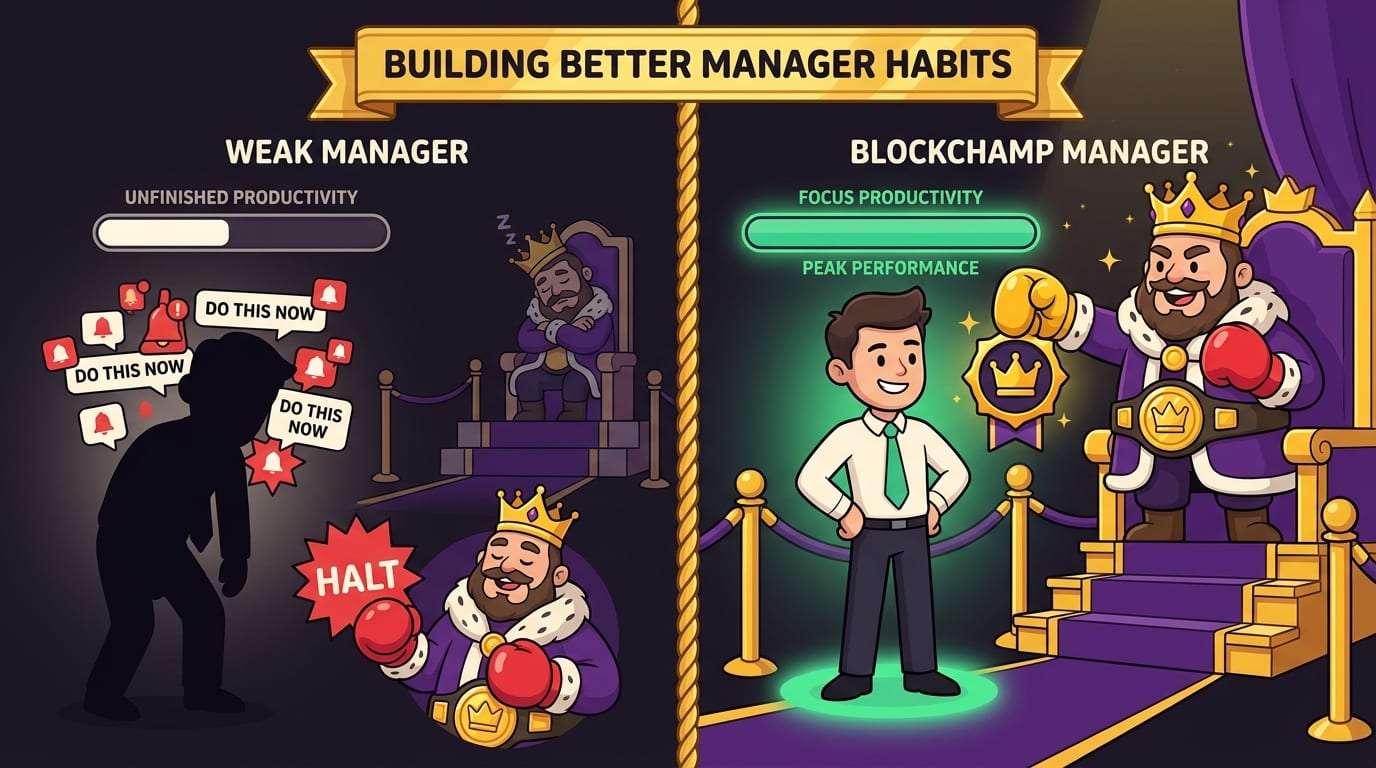
Managers are performance multipliers. A good manager can help average employees become strong contributors. A bad manager can make talented employees update their resumes with the speed of a startled gazelle.
To improve employee performance, focus on manager habits that happen weekly, not just during formal review cycles. The boring consistency is the magic. Annoying? Maybe. Effective? Very.
Strong managers usually do the following:
- Hold regular one-on-ones and protect that time
- Clarify priorities when everything feels urgent
- Give feedback before issues become personality dramas
- Remove blockers instead of simply asking, “Any blockers?” and then staring into space
- Delegate outcomes, not just tasks
- Notice good work and say so
- Connect individual work to team and company goals
One-on-ones are especially powerful when done well. They should not be status meetings in disguise. Status can usually live in a project tool. One-on-ones should cover priorities, blockers, development, feedback, workload, and alignment.
A simple one-on-one agenda:
- What is your top priority this week?
- What is blocking or slowing you down?
- Where do you need a decision or support?
- What feedback do you have for me?
- What skill or goal should we keep developing?
Managers should also model focus. If leadership sends midnight messages, interrupts deep work constantly, and treats every request as urgent, employees will copy the chaos. The crown is heavy, champ. Wear it responsibly.
For personal productivity routines that managers and employees can use together, check out 5 productivity methods to improve your daily routine. It includes practical systems that help turn “I should focus” into actual behavior, which is generally preferable to staring heroically at a to-do list.
10. Support Wellbeing, Because Burned-Out People Do Not Produce Magic
Performance and wellbeing are not enemies. They are roommates. Sometimes they argue over the thermostat, but they need each other. Employees cannot do great work for long if they are exhausted, overwhelmed, or constantly connected.
Burnout reduces creativity, accuracy, collaboration, and motivation. It also makes small problems feel like boss battles. A missing attachment becomes an emotional thunderstorm. A calendar invite becomes a personal attack. Nobody wins.
The World Health Organization describes burnout as an occupational phenomenon resulting from chronic workplace stress that has not been successfully managed. In other words, burnout is not a quirky personality trait. It is a system warning light.
To support wellbeing while improving performance, organizations can:
- Monitor workload and rebalance before people hit the wall
- Encourage employees to use vacation time
- Create realistic deadlines instead of ceremonial panic rituals
- Offer flexibility where possible
- Normalize focused work and real breaks
- Train managers to spot burnout signs early
- Reduce unnecessary after-hours communication
Digital wellbeing also matters. Employees who spend all day in screens and then recover by staring into smaller screens may not actually recover. Shocking, we know. A healthier approach includes intentional breaks, reduced doomscrolling, notification boundaries, and tech tools that help people stop wasting time online.
If your team is exploring healthier screen habits, read how to improve your digital wellbeing and our guide on how a digital detox retreat can improve productivity. You do not need to move to a mountain monastery and befriend a goat named Gerald. But you do need boundaries.
11. Measure Performance Without Turning the Workplace Into a Surveillance Dungeon
You cannot improve what you never measure, but you can absolutely ruin trust by measuring the wrong things. Performance metrics should help teams learn and improve, not make employees feel like they are being hunted by a spreadsheet hawk.
Good performance measurement combines quantitative and qualitative signals. Numbers matter, but context matters too.
Useful metrics might include:
- Output quality
- Project completion rate
- Customer satisfaction
- Cycle time
- Sales conversion rate
- Response time
- Error rate
- Employee engagement
- Peer collaboration feedback
Avoid vanity metrics that encourage silly behavior. For example, measuring only “number of emails sent” rewards busywork. Measuring “hours online” rewards performative availability. Measuring “tickets closed” without quality can encourage people to close easy tickets and dodge complex ones like they owe them money.
Better measurement asks: are we producing valuable outcomes, sustainably, with quality? That is the royal question.
Managers should review metrics with employees, not weaponize them. Use data to ask better questions:
- “Your response time improved. What changed?”
- “This project took longer than expected. Was the estimate wrong, or did blockers appear?”
- “Quality dipped during this sprint. Was workload too high?”
- “You are producing a lot, but are you overloaded?”
When employees trust that metrics are used for improvement, they are more likely to engage honestly. When metrics feel punitive, employees optimize for looking good instead of doing good. And that, dear champ, is how kingdoms fill with dashboards and no actual dragons get slain.
12. Build a Performance Improvement Plan That Does Not Feel Like a Trapdoor
Sometimes performance issues require a more formal plan. A performance improvement plan, or PIP, can be helpful when it is clear, fair, and genuinely designed to support improvement. Unfortunately, many employees hear “PIP” and translate it as “the company has begun constructing my exit catapult.”
If you want a PIP to improve employee performance, it must include:
- Specific performance gaps: What exactly is not meeting expectations?
- Clear success criteria: What must change, by when, and how will it be measured?
- Support provided: Coaching, training, tools, reduced ambiguity, or workload adjustments.
- Regular check-ins: Weekly progress reviews are better than a surprise finale.
- Documented outcomes: Track progress fairly and consistently.
A useful PIP might say: “Over the next 45 days, project updates must be submitted by Friday at 3 p.m., include current status, risks, next steps, and owners, and require no more than one clarification follow-up from stakeholders.” That is measurable. That gives the employee a fighting chance.
A bad PIP says: “Improve communication and ownership.” That is a fog machine in HR clothing.
Formal improvement plans should be reserved for meaningful performance gaps, not used as a surprise punishment. The goal should be clarity and recovery wherever possible. If the role is not a fit, the process should still be respectful. The crown may be stern, but it need not be cruel.
The Quick Performance Checklist: Crown the Basics
If you are trying to improve employee performance this quarter, do not overcomplicate it. Start with the fundamentals and execute them consistently. Here is your no-nonsense checklist:
- Clarify what great performance looks like for each role.
- Set measurable goals connected to business outcomes.
- Hold regular coaching conversations.
- Give timely feedback, both positive and corrective.
- Recognize specific behaviors you want repeated.
- Train employees on real skill gaps.
- Remove workflow bottlenecks.
- Protect focus time and reduce digital distractions.
- Support wellbeing and sustainable workloads.
- Measure outcomes fairly, with context.
You do not need a 90-slide transformation deck. You need clarity, consistency, and fewer distractions charging through the gates like caffeinated raccoons.
Conclusion: Better Performance Starts With Better Conditions
To improve employee performance, stop asking, “How do we make people work harder?” Start asking, “What helps people do their best work more often?” That question changes everything.
Employees perform better when goals are clear, feedback is useful, managers coach consistently, recognition is specific, training is relevant, workflows are sane, and focus is protected. None of this requires corporate wizardry. It requires attention to the daily systems that shape behavior.
And yes, it also requires defending the workplace from the digital goblin army: social media, news spirals, streaming rabbit holes, shopping tabs, random AI tinkering, and the mysterious urge to check one harmless thing that becomes a 42-minute scroll swamp.
If focus is one of your team’s biggest performance blockers, give BlockChamp a look. It is a fun, gamified website blocker for Chrome that helps people block distractions, earn XP, build streaks, and get lovingly roasted by The King when they try to wander into the scroll kingdom. It is productivity with boxing gloves and a crown. Naturally.
Improve the system. Coach the humans. Protect the focus. Long live your team’s performance.
Related posts

Finding Focus For Fiction Writing

Learning To Focus In A Digital World As A Creative

Finding Focus For Personal Growth
