
Expressing Creativity Through Focused Work

Expressing creativity through focused work sounds glamorous until your “creative process” becomes 47 open tabs, three accidental YouTube documentaries, and a suspiciously intense debate with yourself about buying a standing desk. Creativity needs freedom, yes. But it also needs a fence. Not a prison fence. More like a royal castle wall with a moat full of crocodiles wearing tiny productivity headsets.
The truth is simple: your best ideas rarely arrive when your attention is being mugged by notifications, social feeds, news spirals, shopping carts, and “just one quick search” that somehow ends in a video about raccoons stealing cat food. Focus gives creativity the space to stretch, wrestle, build, edit, and ship. Without focus, ideas stay foggy. With focus, they become essays, songs, designs, code, business plans, lesson notes, videos, and actual finished things. The crown jewels, champ.
In this guide, we’ll break down practical strategies for expressing creativity through focused work: routines, mindset shifts, environment design, distraction defense, and realistic habits you can repeat without becoming a productivity monk who only eats almonds and speaks in calendar blocks.
Quick Answers
What “Expressing Creativity Through Focused Work” Actually Means
Let’s retire the myth that creativity is just lightning from the sky. Sure, inspiration happens. Sometimes your brain drops a gorgeous idea while you’re showering, walking, or staring into the fridge like it contains the meaning of life. But creative expression is not only the spark. It is also the craft.
Expressing creativity through focused work means taking ideas seriously enough to give them uninterrupted attention. It is the process of turning imagination into output through deliberate effort. That output might be a draft, a sketch, a prototype, a strategy, a melody, a lesson plan, a product feature, or a better way to solve a problem at work.
Focus does not kill creativity. It protects it. Distraction is the real villain wearing a fake mustache.
Think of it this way:
- Creativity generates possibilities.
- Focus selects one possibility and develops it.
- Consistent work transforms that possibility into something real.
Research on attention supports this. The American Psychological Association has discussed how task switching can reduce efficiency because the brain pays a “switching cost” when moving between tasks. In plain English: every time you bounce from your project to your phone to Slack to a meme to your project again, your brain has to put its shoes back on. Exhausting. See the APA’s overview of multitasking and task-switching costs for the science behind why “I’m multitasking” often means “I am doing several things badly, but with confidence.”
Focused work gives creative ideas continuity. It lets you hold complex thoughts in your mind long enough to connect them, challenge them, refine them, and make them useful. That’s where the magic becomes measurable.
The Creativity Myth: Why Waiting for Inspiration Is a Tiny Trap Door
Waiting for inspiration feels romantic. You, staring out a rain-speckled window, waiting for the muse to descend wearing a velvet cape. Lovely image. Terrible system.
The problem is that inspiration is inconsistent. It visits when it wants. Sometimes it arrives at 2:13 a.m. with a brilliant idea and zero concern for your sleep schedule. If your creative life depends entirely on feeling inspired, your output becomes hostage to mood, weather, vibes, and whether your coffee tasted heroic enough.
Focused routines make creativity dependable. They create a regular appointment with your imagination. You don’t need to feel like a genius before starting. You start, and then your brain often becomes more creative because it has something to respond to.
This is especially important for students, creators, freelancers, remote workers, and anyone doing knowledge work. A blank page can look like a haunted bedsheet. But once you write one bad sentence, sketch one ugly shape, outline one awkward idea, or record one messy voice note, the creative machine begins to warm up. Bad first attempts are not failure. They are the entry fee.
As James Clear often emphasizes in his writing on habits, systems beat goals because systems make action repeatable. His guide on building better habits is a useful reminder that identity and repetition matter more than heroic bursts of motivation. You don’t become a creative person by waiting for the heavens to open. You become one by repeatedly doing creative work, even when the heavens are busy buffering.
So instead of asking, “Am I inspired?” ask:
- What is the smallest creative action I can take right now?
- What environment would make that action easier?
- What distraction is most likely to punch me in the attention glands?
- How can I protect the next 30 to 90 minutes?
That last question is the throne room. Guard it.
Build a Focus Ritual: Your Brain Loves a Starting Whistle
A focus ritual is a repeatable sequence that tells your brain, “We are entering creative work mode now. Put down the mental nachos.” It does not need to be dramatic. No candles required unless candles are your thing, in which case: excellent, wizard.
The goal is to reduce decision fatigue. If you have to invent your routine every day, your brain may cleverly avoid work by optimizing the routine instead. Suddenly you are researching the perfect notebook for 90 minutes. This is not creativity. This is stationery cosplay.
Try this simple five-step ritual:
- Choose one creative target. Example: “Draft the intro,” “Design three logo variations,” “Edit scene two,” or “Write 500 words.”
- Set a time container. Pick 25, 45, 60, or 90 minutes. Short enough to start. Long enough to matter.
- Clear the battlefield. Close unrelated tabs, silence notifications, and remove obvious temptations.
- Start with a warm-up. Freewrite, sketch thumbnails, brainstorm ten bad ideas, or review yesterday’s work.
- End with a bookmark. Leave a note about the next step so tomorrow-you doesn’t wander in like a confused raccoon.
This kind of ritual is especially useful if you work from home or in hybrid environments, where the line between “creative professional” and “person folding laundry during a strategy call” can get blurry. If that sounds familiar, you may like BlockChamp’s guide on how to stay focused when working from home, which covers practical ways to defend attention when your couch is whispering treason.
You can also turn your ritual into a game. That’s where tools like BlockChamp become genuinely useful. Before a creative session, turn on your website blocks, pick your opponents—social media, video, news, shopping, gaming, or whatever goblin portal usually steals your time—and let The King stand guard. If you try to visit a blocked site, you get The Stare-Down instead of a boring error page. It’s hard to justify “quickly checking Reddit” when a cartoon royal boxer is judging your life choices from a full-screen arena.
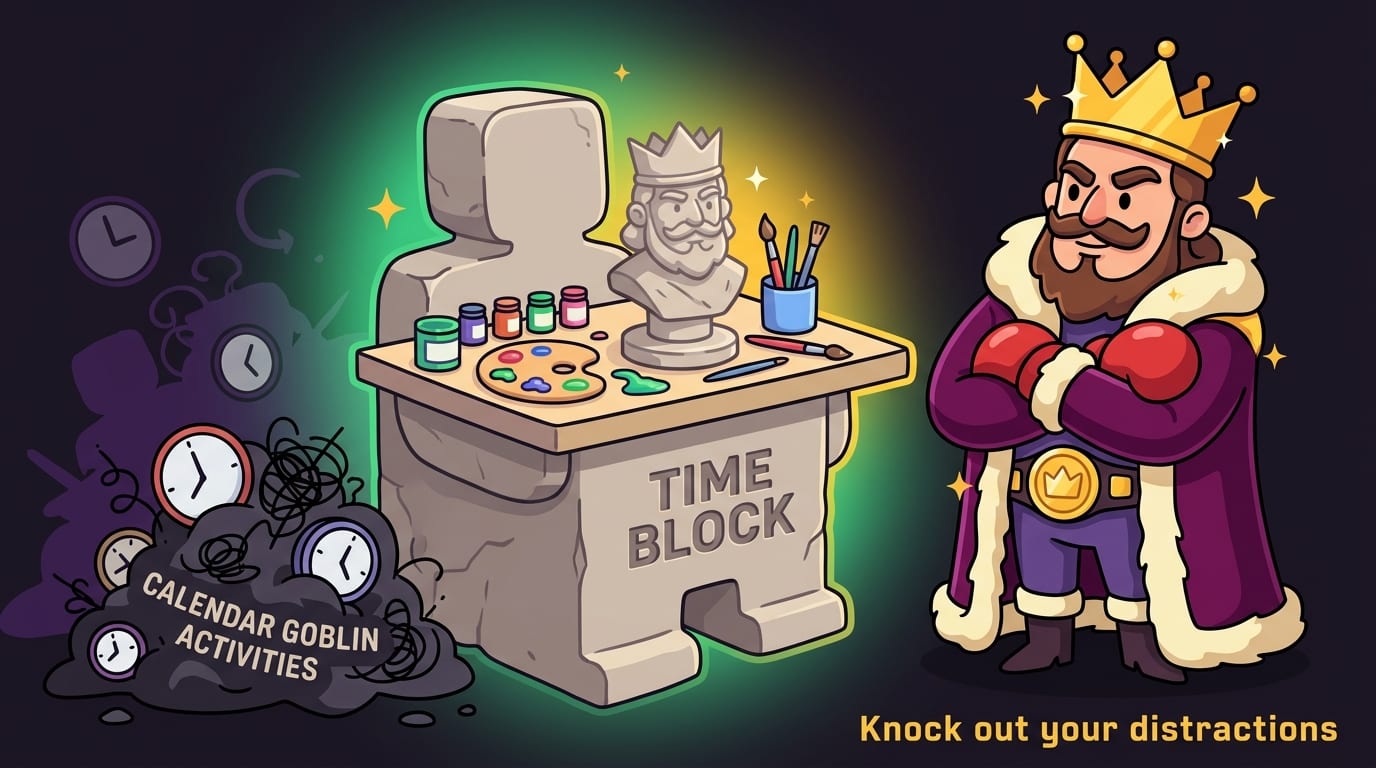
Use Time Blocks Without Becoming a Calendar Goblin
Time blocking is one of the simplest ways to support creative focus. You assign a specific block of time to a specific kind of work. That’s it. No sorcery. No spreadsheet with 19 colors unless you enjoy that, in which case please continue your beautiful goblin art.
The benefit is that time blocking removes ambiguity. Instead of “I should work on my project today,” you decide, “From 9:00 to 10:30, I’m drafting chapter one.” The second version has teeth. Tiny productive teeth.
Cal Newport popularized the concept of deep work: cognitively demanding work performed in a state of distraction-free concentration. His writing on deep work and focused success is worth reading if you want a deeper framework for protecting attention in a noisy world.
For creative work, try splitting your schedule into three types of blocks:
- Input blocks: Research, reading, reference gathering, studying examples, collecting material.
- Output blocks: Writing, designing, composing, building, coding, recording, drafting.
- Review blocks: Editing, revising, organizing, publishing, testing, getting feedback.
This matters because not all creative work uses the same mental energy. Research mode is different from drafting mode. Editing mode is different from brainstorming mode. If you mush everything together into one giant swamp called “work on project,” your brain may revolt and elect TikTok as its new king.
A strong creative schedule might look like this:
- 8:30–8:45: Plan the session and review notes.
- 8:45–10:15: Deep creative output block.
- 10:15–10:30: Break, walk, water, no doomscrolling.
- 10:30–11:15: Edit or organize what you created.
- 11:15–11:25: Write tomorrow’s next step.
If your days are unpredictable, use smaller blocks. Even 25 minutes can produce momentum if you protect it fiercely. The point is not to build the perfect schedule. The point is to give your creative work an actual appointment instead of hoping it squeezes itself between email, errands, and the mysterious urge to reorganize your files.
Defend Your Attention Like It’s the Last Slice of Pizza
Creative focus is fragile at the beginning. Once you’re deep in a project, momentum helps carry you. But the first 10 minutes? Danger zone. That is when your brain starts suggesting side quests: check email, look up one fact, respond to one message, change the playlist, adjust the chair, become a beekeeper. Classic brain nonsense.
Distraction is not just a personal weakness. Many digital platforms are intentionally designed to capture and keep attention. The Center for Humane Technology has written extensively about how persuasive technology shapes behavior; their resources on social media and the brain are especially useful for understanding why apps can feel so sticky. Spoiler: it’s not because you lack character. It’s because the casino has engineers.
To defend your attention, build friction around your biggest distractions:
- Log out of social platforms before creative sessions.
- Move your phone across the room or into another room.
- Use browser profiles: one for work, one for fun.
- Close every tab that does not serve the current task.
- Block distracting websites during your focus window.
- Keep a “later list” for urges and random thoughts.
The “later list” is ridiculously effective. When you feel the urge to check something unrelated, write it down instead of doing it. “Look up noise-canceling headphones.” “Check message from Alex.” “Find best ramen place.” “Investigate whether pigeons have knees.” Great. Later. Not now, Sir Pigeon Knees.
BlockChamp helps here because it turns attention defense into a game instead of a grim punishment ritual. You can block specific sites, use category bundles like Social Media or Video & Streaming, and earn XP for focused time. Every resisted temptation becomes progress. Every stare-down survived becomes a tiny victory. It’s productivity with a championship belt.
If you work in an office or shared environment, distractions may come from people rather than platforms. For that, check out this guide on how to stay focused at work with an attention charter. It’s a practical way to set expectations with teammates so your focus block doesn’t get dropkicked by “quick question?” ambushes.
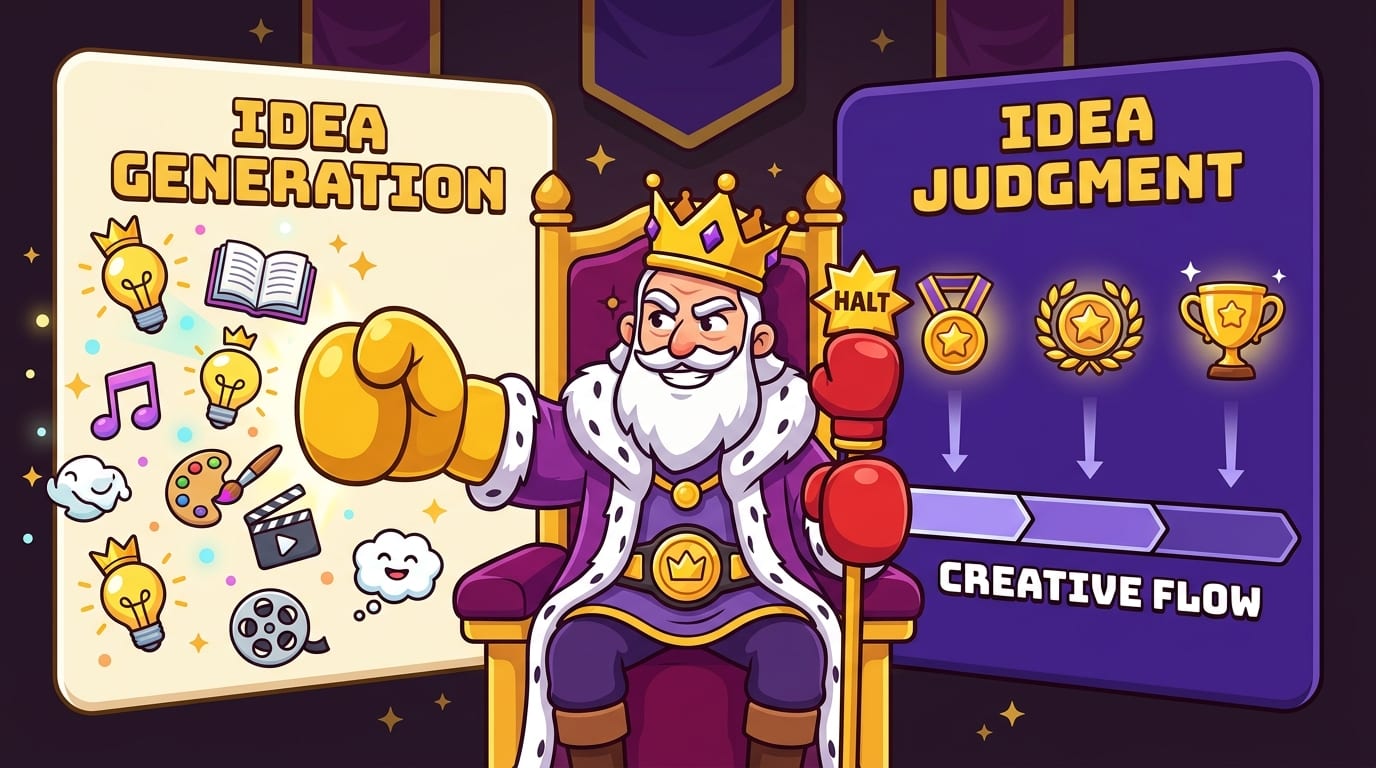
Separate Idea Generation From Idea Judgment
One of the sneakiest creativity killers is judging ideas too early. You start writing a paragraph and immediately think, “This is bad.” You sketch a concept and think, “A potato with a pencil could do better.” You brainstorm campaign ideas and reject all of them before they have shoes.
Focused creative work works better when you separate generating from judging.
During generation, your job is quantity, exploration, and looseness. During judgment, your job is selection, structure, and improvement. Mixing the two too early is like inviting a boxing referee to a baby shower. Wrong energy.
Try this two-pass method:
Pass 1: Make the Mess
Set a timer for 20 to 45 minutes and produce without editing. Write bad sentences. Sketch ugly thumbnails. Record rough melodies. List foolish ideas. Build the clunky prototype. Your only rule is forward motion.
Useful prompts include:
- What are 10 ways to solve this?
- What would I make if nobody could judge it?
- What is the obvious version?
- What is the weird version?
- What would make this more useful, funny, elegant, or clear?
Pass 2: Polish the Crown
After a break, return as an editor. Now you can evaluate. Cut what’s weak. Combine ideas. Improve structure. Ask what the audience needs. Turn chaos into something presentable. This is where focused work becomes creative expression instead of creative soup.
The separation reduces self-consciousness and increases output. It also makes focus easier because each session has a clear mode. Today you are not “making a masterpiece.” You are generating raw material. Tomorrow you are refining it. The crown gets polished in stages.
Design Your Environment for Fewer Heroic Willpower Moments
Willpower is useful, but relying on it all day is a terrible strategy. It’s like using a teaspoon to defend a castle. Brave? Yes. Effective? Please stop.
Environment design means arranging your physical and digital spaces so focused work becomes the default path. You reduce the number of times you must “choose discipline” because the better choice is already easier.
Start with your physical space:
- Keep your desk boring during creative sessions. Boring is beautiful. Boring gets things done.
- Put only the materials you need within reach.
- Use headphones or ambient sound if noise distracts you.
- Keep water nearby so thirst does not become a royal expedition.
- Have a notebook for stray thoughts, not a second screen full of chaos.
Then fix your digital space:
- Remove bookmarks to distracting sites from your toolbar.
- Turn off nonessential notifications.
- Use full-screen mode for writing, designing, coding, or editing.
- Create templates for repeated creative tasks.
- Schedule blocks with automatic protection when possible.
If you have ADHD or attention regulation challenges, environmental design becomes even more important. It is not about “trying harder.” It is about reducing friction, increasing cues, and creating external structure. BlockChamp has a dedicated article on how to stay focused when you have ADHD that includes practical strategies for making focus less dependent on raw willpower.
BlockChamp’s Focus Schedule can also help if you want your blocks to activate automatically during recurring creative hours. That way, your system doesn’t rely on remembering to be disciplined. The King simply shows up on guard, gloves raised, ready to bonk distractions back into the moat.
Use Constraints to Make Creativity Easier, Not Smaller
Creative people often resist constraints because constraints sound like limits. But constraints can be rocket fuel. A blank page offers infinite options, which sounds exciting until your brain curls into a tiny fear pretzel. Constraints reduce the field so you can actually move.
Examples of useful creative constraints:
- Write the first draft in 45 minutes.
- Use only three colors in the design.
- Create five headline options before choosing one.
- Explain the idea in fewer than 100 words.
- Make a prototype using only tools you already know.
- Record a rough demo in one take.
Constraints force decisions. They turn the creative process from “wander the entire kingdom” into “cross this bridge.” That can be liberating.
One practical constraint is the “minimum viable session.” Decide the smallest focused session that counts as a win. Maybe it’s 25 minutes. Maybe it’s 300 words. Maybe it’s one sketch. Maybe it’s one edited section. This helps you build consistency without needing a six-hour retreat in a cabin where the Wi-Fi is afraid of you.
Another useful constraint is a “no input before output” rule. Before consuming articles, videos, tutorials, social posts, or examples, create something first. Even a rough attempt. This prevents research from becoming procrastination in a lab coat.
According to RescueTime’s analysis of context switching, frequent switching between tools and tasks can fracture the workday and make it harder to maintain momentum. Constraints help because they keep you inside one lane long enough to build speed. Creativity likes speed. Not frantic speed. Focused speed. Championship treadmill, not hamster wheel.
Create a Feedback Loop: Track Progress Without Becoming a Spreadsheet Dragon
Creative work can feel invisible until the final product exists. That’s dangerous because if you can’t see progress, you may assume nothing is happening. But drafts, experiments, attempts, revisions, and focus hours all count. They are the bricks. The castle does not appear in one dramatic poof unless you are cheating with medieval CGI.
A simple feedback loop keeps motivation alive. Track effort and outcomes separately:
- Effort metrics: minutes focused, sessions completed, drafts created, revisions made.
- Outcome metrics: pieces published, projects shipped, client work delivered, lessons learned, audience response.
Effort metrics matter because outcomes can lag. You may spend a week developing an idea before anything public exists. That does not mean the week was wasted. It means the roots were growing underground like sneaky little productivity carrots.
BlockChamp’s gamified system is useful because it makes focus visible. You earn XP for focus time, daily active blocks, and stare-downs survived. You build a reign by keeping focus on. You unlock badges and see your calendar fill with focused days. It’s not just “I tried to focus.” It’s “I defended the throne for 12 hours and survived four attempted scroll crimes.” Much better.
If you’re navigating life changes, unstable schedules, or major transitions, visible progress becomes even more helpful. The article on productivity lessons from working through life changes explores how to adapt your expectations without abandoning your creative goals completely. Sometimes the win is not a perfect routine. Sometimes the win is keeping the candle lit during a windy week.
Recover Like a Creative Athlete, Not a Burned-Out Gremlin
Focused work is powerful, but more focus is not always better. Your brain needs recovery to make connections, consolidate learning, and avoid turning into oatmeal with opinions.
Creative breakthroughs often happen during downtime because the brain continues processing in the background. Walks, showers, chores, naps, and quiet boredom can support insight. The trick is to use recovery intentionally instead of sliding into four hours of algorithmic sludge and calling it “rest.” That is not rest. That is being composted by content.
Healthy recovery options include:
- Taking a walk without headphones.
- Doing light exercise or stretching.
- Reading something unrelated but nourishing.
- Cooking, cleaning, or doing a simple hands-on task.
- Sleeping properly, the ancient forbidden productivity spell.
- Spending time with people who do not require you to perform.
The National Institute of Neurological Disorders and Stroke explains that sleep supports many brain functions, including learning and memory. Their resource on understanding sleep and the brain is a helpful reminder that your creative genius still requires maintenance. Even kings nap. The BlockChamp King literally sleeps when focus is off. Royal science.
Build breaks into your routine before your brain steals them in the form of distraction. A planned break is recovery. An unplanned 90-minute scroll spiral is a goblin coup.
A Practical Weekly Routine for Creative Focus
Let’s turn the theory into a usable routine. This is designed for students, creators, freelancers, side-hustlers, and professionals who want to express more creativity without quitting society and moving into a cave with excellent acoustics.
Monday: Plan the Kingdom
Choose one creative priority for the week. Not twelve. One main project. Define what “done” looks like by Friday. Then schedule three to five focus blocks. If your calendar is chaotic, make them shorter but protected.
Tuesday and Wednesday: Output Like a Champ
Use your best energy for creation, not admin. Start each block with a clear target: draft, design, build, compose, outline, record. Turn on website blocking before you begin. If you use BlockChamp, activate the Master Focus Toggle and let The King guard the gates while you work.
Thursday: Review and Improve
Switch from creator mode to editor mode. Tighten the draft. Refine the design. Fix the structure. Test the prototype. Ask what is confusing, bloated, weak, or missing. Be honest, but don’t be a jerk to yourself. The goal is improvement, not emotional cage fighting.
Friday: Ship or Share
Creative expression needs delivery. Publish the post, send the proposal, share the sketch, submit the assignment, record the demo, or show the prototype to a trusted person. Shipping creates feedback. Feedback creates growth. Growth creates momentum. Momentum gets a tiny crown.
Weekend: Refill the Well
Collect inputs that inspire you. Read, explore, watch something meaningful, visit somewhere new, talk to people, rest. Just don’t confuse numbing out with refilling. Your creativity needs nourishment, not infinite snack content.
If you’re juggling hybrid work, meetings, commutes, and home distractions, this related guide on how to stay focused in hybrid work pairs nicely with a weekly creative routine. Hybrid schedules can be great for creativity, but only if your focus doesn’t get mugged in both locations.
Common Focus Mistakes That Smother Creativity
Even smart, ambitious people sabotage creative focus in predictable ways. No shame. The brain is a slippery little court jester.
- Starting with email. Email turns your day into other people’s agenda soup. Create first when possible.
- Keeping research open forever. Research should feed output, not replace it.
- Editing too early. Generate first. Judge later.
- Using vague goals. “Work on project” is mush. “Draft 700 words” is a sword.
- Leaving distractions available. If YouTube is one click away, part of your brain is already wearing headphones.
- Expecting every session to feel amazing. Some creative sessions feel like wrestling a damp mattress. Still counts.
- Never recovering. Burnout does not make you profound. It makes you tired and weird about fonts.
The fix is not perfection. It’s better defaults. Make the right action easier. Make distraction slightly annoying. Give your creative work a clear target, a protected window, and a repeatable rhythm. Then show up.
Final Round: Creativity Needs a Throne, Not a Tornado
Expressing creativity through focused work is not about becoming rigid, boring, or productivity-obsessed. It’s about giving your imagination enough structure to actually become something. Focus is the studio. The gym. The ring. The royal court where wild ideas are trained into finished work.
You do not need a perfect routine. You need a repeatable one. Start with one protected focus block. Choose one creative target. Remove one major distraction. Create before you consume. Track your effort. Recover like a human being with a nervous system, not a content-powered goblin lantern.
And if the internet keeps barging into your creative kingdom wearing muddy boots, bring in backup. BlockChamp helps you block distracting sites, earn XP for focused time, build reigns, unlock badges, and get roasted by The King when you try to betray your own goals for “just one quick scroll.” It’s focus protection with jokes, crowns, and boxing gloves. Which, frankly, civilization needed.
So pick your next creative block. Defend it. Make the messy thing. Polish it later. Ship when ready. Long live your focus, champ. The throne is waiting.
Related posts

Tuning Into Focus How Music Can Make You More Productive

Insomnia Sleep Hygiene Productivity

Blue Light The Truth Is Out There
