
Addicted To Gaming

If you’ve ever whispered “one more match” at 11:47 p.m. and then looked up to see the sun filing a formal complaint against you, you may have wondered: am I addicted to gaming, or do I just really, really enjoy digital goblins, ranked ladders, and loot that sparkles like forbidden cereal?
First: liking games is not the enemy. Games are fun, social, challenging, creative, and sometimes genuinely beautiful. Gaming can relieve stress, build friendships, and give your brain a satisfying little victory parade. The problem starts when gaming stops being a hobby and becomes the boss fight controlling your sleep, school, work, relationships, mood, money, and self-respect. That’s when the controller is no longer in your hands. It’s wearing a tiny crown and making demands.
This guide will help you recognize the signs of being addicted to gaming, understand why games can be so sticky, and build practical strategies to regain balance without turning your life into a joyless spreadsheet dungeon. We’ll also cover when to seek professional help, how to change your environment, and how tools like BlockChamp can help you block gaming triggers on Chrome while making focus feel like leveling up instead of doing taxes in a beige room.
Quick Answers
What Does “Addicted to Gaming” Actually Mean?
Being addicted to gaming does not mean you played four hours on a Saturday, ordered pizza, and had a great time. That is called “being alive with Wi-Fi.” The real concern is a pattern of gaming that becomes hard to control, continues despite negative consequences, and crowds out important parts of life.
The World Health Organization recognizes “gaming disorder” in the International Classification of Diseases. According to the WHO, gaming disorder involves impaired control over gaming, increased priority given to gaming over other activities, and continuation or escalation despite negative consequences. The pattern is typically severe enough to affect personal, family, social, educational, occupational, or other important areas of functioning.
Translation from official-speak into human: if gaming is repeatedly punching your real life in the kneecaps and you still can’t stop, it’s time to pay attention.
The American Psychiatric Association has also studied “Internet Gaming Disorder” as a condition needing further research. The APA explains that warning signs may include preoccupation, withdrawal symptoms, unsuccessful attempts to cut back, loss of interest in other activities, and deceiving others about gaming time.
It’s important to avoid panic labels. Not every intense gaming phase is addiction. A new game release, a vacation binge, or a tournament grind may temporarily spike your hours. The key question is not simply “How much do I play?” It’s “What is gaming costing me, and can I reliably choose to stop when I need to?”
Signs You Might Be Addicted to Gaming: The Boss Fight Checklist
If you’re worried you may be addicted to gaming, look for patterns. One bad week does not make you doomed. A recurring pattern, though? That’s your brain waving a tiny red flag while wearing a headset.
1. You keep playing longer than planned
You sit down for one match. Three hours later, you’re still there, hydrated only by vibes and the ancient condensation on a water bottle. Losing track of time occasionally happens. But if you regularly intend to stop and repeatedly fail, that’s a major sign your gaming habit has slipped from “fun” into “this thing has admin privileges.”
2. Gaming interferes with sleep
Sleep is often the first kingdom to fall. Maybe you stay up late grinding levels, tell yourself you’ll sleep after the next checkpoint, then wake up exhausted and cranky. Chronic sleep loss can damage mood, focus, learning, and impulse control. Conveniently, poor impulse control then makes it harder to stop gaming. Ah yes, the circle of nope.
3. You neglect responsibilities
Homework, work tasks, chores, exercise, bills, or appointments start getting delayed because gaming feels more urgent. You may still technically “get things done,” but only in last-minute panic mode. If your life is becoming a series of emergency quests caused by avoidable gaming sessions, that’s not a great patch update.
4. You feel irritable, anxious, or empty when you can’t play
Withdrawal-like feelings can show up as restlessness, irritability, boredom, low mood, or obsessively thinking about the game. You might be physically away from the screen but mentally still in the lobby.
5. You hide or downplay your gaming
If you lie about how long you played, minimize purchases, hide tabs, or get defensive when someone mentions your gaming, that secrecy matters. Shame loves dark corners. So do dust bunnies and questionable snack wrappers.
6. Other hobbies start disappearing
You used to draw, read, lift weights, play music, cook, skate, go outside, or talk to humans with faces. Now everything feels dull compared to gaming. That can be a sign your reward system is becoming overly tuned to one source of stimulation.
7. You keep playing despite consequences
This is the big one. You miss deadlines, hurt relationships, spend money you regret, tank your grades, or feel physically awful—and then keep repeating the same pattern. If consequences are piling up like defeated side quests, it’s time to change the strategy.
Why Games Can Be So Hard to Stop
Modern games are not just “fun.” They are often carefully designed engagement machines. That doesn’t make game developers villains living in volcano lairs, but it does mean you’re not weak for struggling. You’re going up against systems built to keep you clicking.
Games use progression loops, rewards, social pressure, competition, variable outcomes, daily quests, limited-time events, battle passes, streaks, rankings, and “just one more” mechanics. Your brain loves progress. It loves rewards. It loves unfinished tasks. It especially loves unpredictable rewards, which can be more compelling than predictable ones.
Research on behavioral addiction often points to reinforcement patterns, reward sensitivity, and impaired control. A review published by the National Institutes of Health discusses how internet gaming can activate reward-related brain systems and share features with other addictive behaviors. Again, this doesn’t mean games are evil. It means your brain is very hackable, and games have excellent lockpicks.
There are also emotional reasons gaming can become excessive:
- Escape: Games can numb stress, loneliness, anxiety, boredom, or depression.
- Competence: Games provide clear goals and instant feedback when real life feels messy.
- Social belonging: Online squads, guilds, and communities can become your main social world.
- Identity: Being “good at the game” can feel more rewarding than struggling in school, work, or relationships.
- Control: Games offer rules, progress bars, and predictable systems. Real life offers laundry. Rude.
If you’re addicted to gaming, the solution is rarely “just stop being lazy.” That advice belongs in the trash, next to expired energy drinks. The better approach is to understand what gaming is doing for you, then replace that function with healthier systems.
The Difference Between Healthy Gaming and Gaming Addiction
Healthy gaming has boundaries. Addictive gaming eats the boundaries and asks for dessert.
With healthy gaming, you can enjoy the session and then move on. You may play for fun, relaxation, social connection, or challenge. You can pause for responsibilities. You can tolerate not playing. You still maintain sleep, hygiene, school or work, friendships, movement, and offline interests.
With problematic gaming, your world shrinks. The game becomes the default answer to stress, boredom, loneliness, celebration, avoidance, and procrastination. Every emotion becomes a loading screen. You may feel guilty while playing, anxious when not playing, and weirdly unsatisfied after long sessions.
Ask yourself these questions:
- Can I stop gaming when I planned to stop?
- Do I choose gaming even when it clearly harms something important?
- Have people close to me expressed concern?
- Do I feel more like myself because of gaming, or less?
- Do I use gaming to avoid emotions I don’t want to deal with?
- Have I tried to cut back and failed repeatedly?
If you answered “yes” to several of the concerning ones, don’t spiral. Awareness is not a prison sentence. It’s the map out of the dungeon.

Step One: Track Your Gaming Honestly, Like a Detective With Snacks
Before you can fix the habit, you need data. Not vibes. Not “I probably played a normal amount.” Actual numbers. Your brain is a charming liar when it wants another match.
For one week, track:
- When you start gaming
- When you stop gaming
- What game or platform you used
- What triggered the session
- How you felt before and after
- What responsibility or activity got displaced
You may notice patterns like “I always play after stressful classes,” “I open Steam whenever I’m stuck on work,” or “I only binge when I start after 10 p.m.” That last one is extremely common. Late-night gaming is where good intentions go to get jump-scared.
Tracking is not about shaming yourself. It’s about finding the weak points in your castle wall. Once you know the pattern, you can defend the throne.
If your gaming habit overlaps with other online loops like YouTube walkthroughs, Twitch streams, Discord browsing, Reddit gaming communities, or shopping for gear, you may need to address the whole ecosystem. We’ve covered related compulsive online patterns in guides like using a website blocklist to regain control of gaming addiction and breaking online shopping addiction, because digital habits often travel in packs like tiny raccoons with credit cards.
Step Two: Change Your Environment, Because Willpower Is a Flaky Intern
Willpower is useful, but it gets tired. Environment design is stronger. If your gaming setup is one click away all day, you’re forcing your brain to fight a hundred tiny battles. Eventually, it will throw the crown into the moat and shout, “Fine, launch the game.”
Make gaming less automatic:
- Remove game launchers from your desktop and taskbar.
- Log out of gaming accounts after each session.
- Uninstall your most problematic game for a set period.
- Move your console out of your bedroom.
- Keep controllers in another room during work or study blocks.
- Disable notifications from gaming apps and communities.
- Use separate browser profiles for work and gaming-related browsing.
Then add friction to the websites that pull you back in. Gaming addiction often doesn’t start with launching the game. It starts with “I’ll just check a patch note,” “I’ll watch one build guide,” or “I’ll see if Steam has a sale.” Suddenly you’re comparing DPS stats at 1:12 a.m. like a medieval accountant.
This is where BlockChamp is genuinely useful. With BlockChamp’s Chrome website blocker, you can block specific sites like Steam, Twitch, YouTube, Reddit, Roblox, or Epic Games, or use the Gaming category to block a bundle of common gaming distractions. The point is not to hate games. The point is to stop your browser from becoming a trapdoor into a six-hour session.
BlockChamp also uses a Master Focus Toggle, focus schedules, and gamified progress. You earn XP for focused minutes, build a reign streak, and survive “stare-downs” when you try to visit blocked sites. Instead of a depressing gray wall, The King appears and judges your attempted escape with royal boxing energy. It’s like parental controls, if your parent were a tiny champion monarch with red gloves and theatrical disappointment.
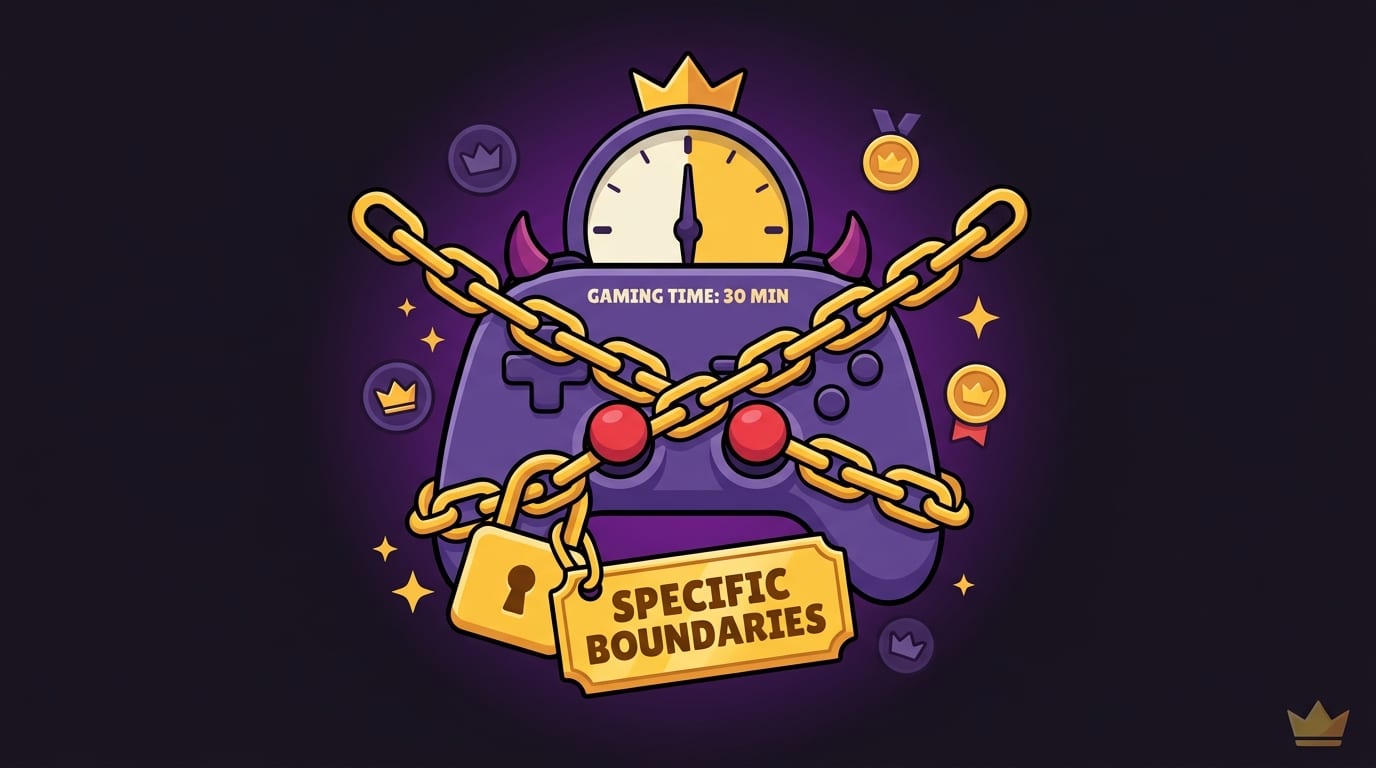
Step Three: Set Gaming Boundaries That Are Specific Enough to Survive Contact With Reality
“I’ll play less” is not a plan. It is a wish wearing a paper hat. A better boundary is specific, measurable, and connected to real life.
Try rules like:
- No gaming before school, work, or studying.
- Gaming only after the top three priorities are finished.
- No gaming after 10 p.m. on weeknights.
- Maximum 90 minutes per day, with a timer across the room.
- Gaming only on Friday and Saturday nights.
- No ranked matches when tired, angry, or avoiding responsibilities.
- No “infinite games” unless you set a hard stop beforehand.
The trick is to decide before the craving hits. If you create rules while calm, your future impulsive gremlin has less room to negotiate.
Use “if-then” plans:
- If I want to game before finishing work, then I will do a 10-minute starter task first.
- If friends invite me to play during study time, then I will reply, “I’m on later after 8.”
- If I miss my planned stop time, then I take the next day off gaming.
- If I feel the urge to reinstall a game, then I wait 24 hours.
Boundaries should be realistic. If you currently play eight hours a day, declaring “I shall never game again” may backfire by Tuesday. Start with a reduction that challenges you but doesn’t require wizard blood. For example, cut weekday gaming by 30%, protect sleep first, or create two gaming-free evenings per week.
Step Four: Replace the Reward, Not Just the Activity
If gaming is your main source of fun, achievement, socializing, stress relief, and identity, removing it without replacement will feel like deleting the sun. You need substitute rewards that serve the same needs.
If gaming gives you achievement, try:
- Strength training with tracked progress
- Learning an instrument
- Coding small projects
- Language learning streaks
- Running plans or cycling goals
- Creative challenges like drawing every day for 30 days
If gaming gives you social connection, try:
- Weekly offline meetups
- Sports clubs or martial arts
- Board game nights
- Study groups
- Calling friends while walking
- Community classes or volunteering
If gaming helps you escape stress, try:
- Walks without your phone
- Breathing exercises
- Journaling for five minutes
- Stretching or mobility work
- Cooking something absurdly simple but real
- Therapy or coaching if stress feels overwhelming
This is also why gamified productivity tools can work well for people who love games. You’re not trying to destroy your love of progression. You’re redirecting it. BlockChamp turns focus into a game with XP, levels, badges, reigns, and a leaderboard. Every focused minute becomes progress. Every blocked temptation becomes a mini-win. The same brain that likes leveling up can learn to level up real life. Sneaky? Yes. Effective? Also yes. The crown approves.
If you’re trying to replace low-value screen time with more useful digital habits, you may also like our guide on replacing social media with productive learning habits. It’s about turning the internet from a distraction buffet into a skill-building gym, minus the smell of protein powder.
Step Five: Handle Urges Without Getting Suplexed by Them
Urges feel like commands, but they are more like weather. Loud weather, maybe. Weather wearing gamer headphones. But still weather. It rises, peaks, and passes if you don’t feed it.
Try urge surfing:
- Notice the urge: “I want to play right now.”
- Rate it from 1 to 10.
- Set a 10-minute timer.
- Do something physical during the timer: walk, stretch, shower, clean your desk, make tea.
- Rate the urge again.
Most urges weaken if you create space. Your brain screams “emergency!” but the emergency is usually “I am bored and there is a shiny button nearby.”
Another tactic: delay, don’t deny. Tell yourself, “I can play later at 8 p.m. if I still want to.” This reduces rebellion. Your brain is less likely to flip a table if it knows the game is scheduled, not banned forever by the Fun Police.
Also watch your HALT states:
- Hungry: You’re not weak. You need food.
- Angry: Gaming may become rage fuel, especially ranked play.
- Lonely: You may need connection, not another lobby.
- Tired: Your impulse control has left the building.
Many gaming binges are really unmet needs in a trench coat. Deal with the need, and the craving often loses power.

When to Seek Professional Help
Self-help strategies are useful, but sometimes the boss fight needs co-op support. Seek professional help if gaming is seriously disrupting your life and you can’t cut back despite repeated attempts.
Consider talking to a mental health professional if:
- You feel unable to control gaming even when consequences are severe.
- Your grades, job, finances, or relationships are suffering.
- You feel depressed, anxious, hopeless, or isolated.
- You use gaming to escape trauma, panic, or painful emotions.
- You become aggressive or distressed when interrupted.
- You neglect hygiene, food, sleep, or medical needs.
- You have thoughts of self-harm or feel life is not worth living.
If you are in immediate danger or thinking about harming yourself, contact emergency services or a crisis hotline in your country right now. This blog post is helpful, but it is not a knight in shining armor with a license to practice medicine.
Treatment approaches may include cognitive behavioral therapy, family therapy, treatment for anxiety or depression, habit-change coaching, support groups, and building healthier routines. The National Center for Biotechnology Information notes that behavioral addictions often benefit from structured treatment targeting triggers, coping skills, and underlying mental health conditions.
Getting help does not mean you failed. It means you stopped trying to solo a raid designed for a party.
Build a 7-Day Reset Plan for Gaming Balance
If “fix my entire life” feels too huge, start with seven days. Short experiments reduce fear. You’re not marrying a lifestyle. You’re test-driving a better operating system.
Day 1: Audit the battlefield
Track your gaming time, triggers, and consequences. Write down your top three problem games, sites, or apps. Include related rabbit holes like Twitch, Discord, Steam sales, YouTube guides, Reddit threads, and esports news.
Day 2: Remove easy access
Uninstall one high-risk game, log out of launchers, move controllers, and block distracting gaming websites during work or study hours. If you use Chrome, set up BlockChamp and enable the Gaming category or add specific sites. When The King catches you trying to sneak into a blocked site, accept the roast and return to the mission.
Day 3: Protect sleep like royal treasure
Create a hard gaming cutoff at least one hour before bed. Charge devices outside the bedroom if possible. Replace late-night gaming with something boring enough to make sleep attractive: reading, stretching, light cleaning, or listening to calm audio. No ranked matches in the bedtime kingdom. Ranked matches are chaos goblins.
Day 4: Schedule replacement rewards
Pick two activities that meet the same needs gaming meets. One physical, one social or creative. Put them on the calendar. If it is not scheduled, it will be eaten by the algorithm wolves.
Day 5: Tell someone your plan
Accountability helps. Tell a friend, roommate, partner, parent, or study buddy: “I’m cutting back gaming this week. Please ask me how it’s going.” Bonus points if they won’t respond with “lol just uninstall bro,” because we are seeking support, not cave-person productivity advice.
Day 6: Create a gaming window
If you’re not quitting completely, set a clear gaming window. For example: Saturday 7–9 p.m. Decide the start and stop time before you begin. Use alarms. Tell your squad your cutoff in advance. Leaving mid-session is easier when you warned people before the dragon appeared.
Day 7: Review and adjust
Look at what worked. Did blocking help? Did urges fade? Did sleep improve? Did you relapse? Good. Data. Not doom. Adjust the next week based on reality.
For a deeper website-blocking approach, read our related guide: Gaming Addiction: Use a Website Blocklist to Regain Control. It pairs nicely with this reset plan, like a sword and shield, except the sword is browser friction and the shield is not ruining your Tuesday.
How BlockChamp Helps Without Making You Feel Like a Spreadsheet Prisoner
Most website blockers feel like punishment. Gray screens. Stern settings. Very “principal’s office, but for your browser.” That can work for some people, but if you’re drawn to games, motivation matters. You may respond better to progress, identity, competition, and humor.
BlockChamp is built around that idea. It helps you block distracting gaming sites, video platforms, social feeds, shopping sites, gambling sites, adult sites, AI distractions, and more. But instead of making focus feel like a sad beige chore, it turns it into a game.
Here’s how that applies if you’re addicted to gaming or trying to regain control:
- Block gaming triggers: Add specific sites like Steam, Twitch, YouTube, Reddit, or game news pages, or use the Gaming category bundle.
- Use focus schedules: Automatically block gaming distractions during school, work, or study hours.
- Survive The Stare-Down: When you try to access a blocked site, The King appears and calls out your nonsense. Lovingly. Mostly.
- Earn XP for focus: Focused minutes become progress, levels, badges, and streaks.
- Protect your reign: Your streak grows as you keep focus active, which gives your brain something healthier to defend.
- Use Hardcore Lockdown: Champion users can add a cooldown timer or boxing-riddle mini-game before turning focus off, giving impulses time to cool down.
The goal is not to become anti-gaming. The goal is to become pro-choice about your time. You decide when gaming belongs in your life. Not the launcher. Not the algorithm. Not the little goblin inside your brain yelling “QUEUE AGAIN.”

Other Digital Traps That Can Feed Gaming Addiction
Gaming rarely exists alone. It often comes wrapped in social media, video content, shopping, and endless recommendation feeds. You may not be playing the game, but you’re watching game clips, reading tier lists, browsing skins, checking forums, or arguing with strangers about patch balance like a tiny courtroom drama.
Social platforms are especially good at keeping attention. The same mechanics that make feeds addictive—variable rewards, social validation, infinite scroll, and algorithmic recommendations—can reinforce gaming habits. If you notice that Instagram, Facebook, TikTok, or YouTube keeps pulling you back toward gaming content, it may help to understand those systems too. We’ve broken down some of those attention traps in how Facebook keeps us addicted and how Instagram keeps users hooked.
Screen time statistics also show how normal constant digital engagement has become. DataReportal’s Digital 2024 Global Overview Report found that people spend an average of more than six hours per day using the internet globally. That doesn’t prove addiction, but it does show the battlefield is crowded. Your attention is valuable, and a lot of companies want a slice. Preferably the whole cake. With sprinkles.
The more you reduce surrounding triggers, the easier it becomes to game intentionally rather than compulsively. Blocking the game itself may help, but blocking the orbit around the game can be just as important.
Final Thoughts: Take Back the Controller, Champ
If you think you’re addicted to gaming, don’t waste your energy beating yourself up. Shame is a terrible strategy. It usually leads to more avoidance, and avoidance often leads right back to the game. Classic villain move.
Instead, treat this like a system problem. Track your patterns. Reduce triggers. Create specific boundaries. Replace the rewards gaming gives you. Ask for support. Seek professional help if gaming is harming your life and you can’t regain control alone.
And remember: the goal is not to destroy fun. The goal is to put fun back where it belongs—inside a balanced life, not sitting on the throne wearing your crown and eating your sleep schedule.
If gaming sites, streams, forums, and launchers keep ambushing your focus through Chrome, give BlockChamp a try. Block the distractions, build your reign, earn XP, and let The King stare down your worst impulses with royal boxing judgment. Knock out your distractions and become king of your time. Long live your focus, champ.
Related posts

Online Shopping Addiction

Stop Shopping Addiction

Finding Focus To Build Creative Projects
