
Escaping Digital Distraction To Read And Write

You sit down to read one chapter or write one page. Then a notification flashes, a new tab appears, and somehow you’re watching a video about a raccoon that steals an entire picnic. The raccoon is delightful. Your unfinished book is less amused.
Escaping digital distraction to read and write isn’t about becoming a monk who lives in a cave with one candle and a strict no-raccoon policy. It’s about making a few practical changes so your attention has a fair chance to settle. You can shape your environment, set clear boundaries, and build routines that make focused reading and writing easier to repeat. Here’s how to reclaim your time without declaring war on every screen in the kingdom.
Quick Answers
Why reading and writing lose to the scroll
Reading and writing ask for sustained attention. A book may take several minutes to get rolling; a draft may take longer to stop sounding like it was typed by a nervous squirrel. Digital distractions offer a different deal: quick novelty, frequent updates, and endless reasons to check “just one thing.” That contrast makes it easy to drift away from a slower task, especially when you’re tired or unsure what to do next.
The problem isn’t that you lack discipline or that your brain has been permanently replaced by a tiny algorithm goblin. Often, the distracting option is simply easier to reach. Your draft requires effort; your favorite feed is one click away. If you leave that click available, you’re asking willpower to win the same contest dozens of times per hour. That’s a tiring job for anyone, even a champion.
It also helps to distinguish useful internet use from distraction. Researching a fact for an essay is useful. Opening a news site to find that fact, reading five unrelated headlines, and then checking the comments is a side quest. The goal isn’t to eliminate technology. It’s to make technology serve the work you chose instead of quietly choosing your next activity for you.
For a closer look at the mechanics of getting pulled away, see our guide to getting rid of digital distraction. Understanding your triggers makes it easier to design a response that fits your actual habits rather than an imaginary version of you who never gets curious about anything.
Escaping digital distraction to read and write starts with a clear target
“I should read more” sounds noble, but it doesn’t tell you what to do at 7:30 tonight when the couch is calling. “Read 15 pages after dinner” gives you a starting point. The same goes for writing: “Work on my novel” is a foggy kingdom. “Draft 300 rough words before lunch” is a door you can walk through.
Before a session, define a small, visible outcome. For reading, that might be one chapter, ten pages, or 20 minutes with a book. For writing, it could be outlining one section, revising a scene, or writing a paragraph without editing it to death. A modest target lowers the pressure to do something impressive and makes it easier to begin.
Try this three-part intention:
- Task: What specific book, chapter, document, or passage will you work on?
- Duration: How long will you stay with it before taking a break?
- Finish line: What will count as “done for now”?
For example: “I’ll read chapter four for 25 minutes, then write one sentence about the main idea.” Or: “I’ll draft the opening 200 words of my article for 20 minutes; I won’t edit until the timer ends.” You can adjust the goal later. The important part is removing the opening question, “What should I do?” before it grows a tiny committee and calls a meeting.
If the task feels too big, shrink it until starting feels almost silly. Open the document. Read one page. Write one deliberately imperfect sentence. Momentum often follows action; it doesn’t always arrive first with a marching band.
Give your attention a room of its own
Your workspace doesn’t need to look like a minimalist influencer’s desk, complete with a plant that appears to have excellent boundaries. It needs to make the intended task obvious and the distractions slightly less convenient. Put the book or document in front of you. Move your phone out of arm’s reach, silence nonessential alerts, and close tabs you don’t need.
For reading, try a comfortable chair, decent light, and a bookmark that prevents the “where was I?” hunt. If you read on a screen, use full-screen mode or a dedicated reading app when possible. If a laptop is needed, keep only the tabs required for the session open. Every spare tab is a tiny doorway to a different kingdom, and some of those kingdoms have autoplay.
For writing, keep a scratch note nearby for distracting thoughts that are useful but not urgent. When you remember that you need to order toothpaste or look up a quote, jot it down and return to the draft. This “later list” lets you acknowledge the thought without granting it control of the browser.
Consider preparing your space before the session begins. Charge your device, fill your water glass, gather reference material, and choose a break activity. A two-minute setup can prevent a 20-minute wandering expedition to the kitchen, the inbox, and the mysterious drawer containing six old chargers.
There’s no single perfect environment. Some people like quiet; others focus better with low-level background sound. Notice what helps you stay with the task, rather than copying someone else’s cinematic writing ritual. The point is to reduce friction, not to purchase a mahogany desk and become a person who says “my process” at brunch.

Set digital boundaries before distraction makes its entrance
Environment helps, but sometimes the tempting site is still one click away. That’s when a clear boundary can be more reliable than a promise to “try harder.” Decide which websites are useful during the session and which are off-limits until the break. If social media, video, shopping, news, or gaming regularly pulls you away, make access harder during your planned focus time.
One simple method is to use a timer and close distracting tabs before you start. Another is to log out of tempting accounts, leave your phone in another room, or use a separate browser profile for work. Small obstacles matter: when an impulse must pass through a pause, you get a moment to remember why you sat down.
For people who work in Chrome, BlockChamp can block distracting websites, keywords, and categories while you focus. Its one-tap master toggle puts your selected blocks on guard, and users can choose categories such as social media, video, news, shopping, or gaming. The free version supports blocking up to three sites and two categories; Champion adds unlimited sites, all eight categories, keyword blocking, and scheduled focus sessions.
BlockChamp makes the interruption memorable rather than presenting a dull error message. When you try to visit a blocked page, The Stare-Down gives you a full-screen reminder from The King. Surviving a stare-down earns XP, while focus time contributes to levels and reigns. It’s a playful way to turn a moment of temptation into a small win instead of another invisible detour.
For more on retraining your focus for creative work, explore retraining your brain to write without distraction. The goal isn’t to block every tool you might need. It’s to build a boundary around the sites that reliably turn a quick check into an extended expedition.
Use focused sprints, not heroic marathons
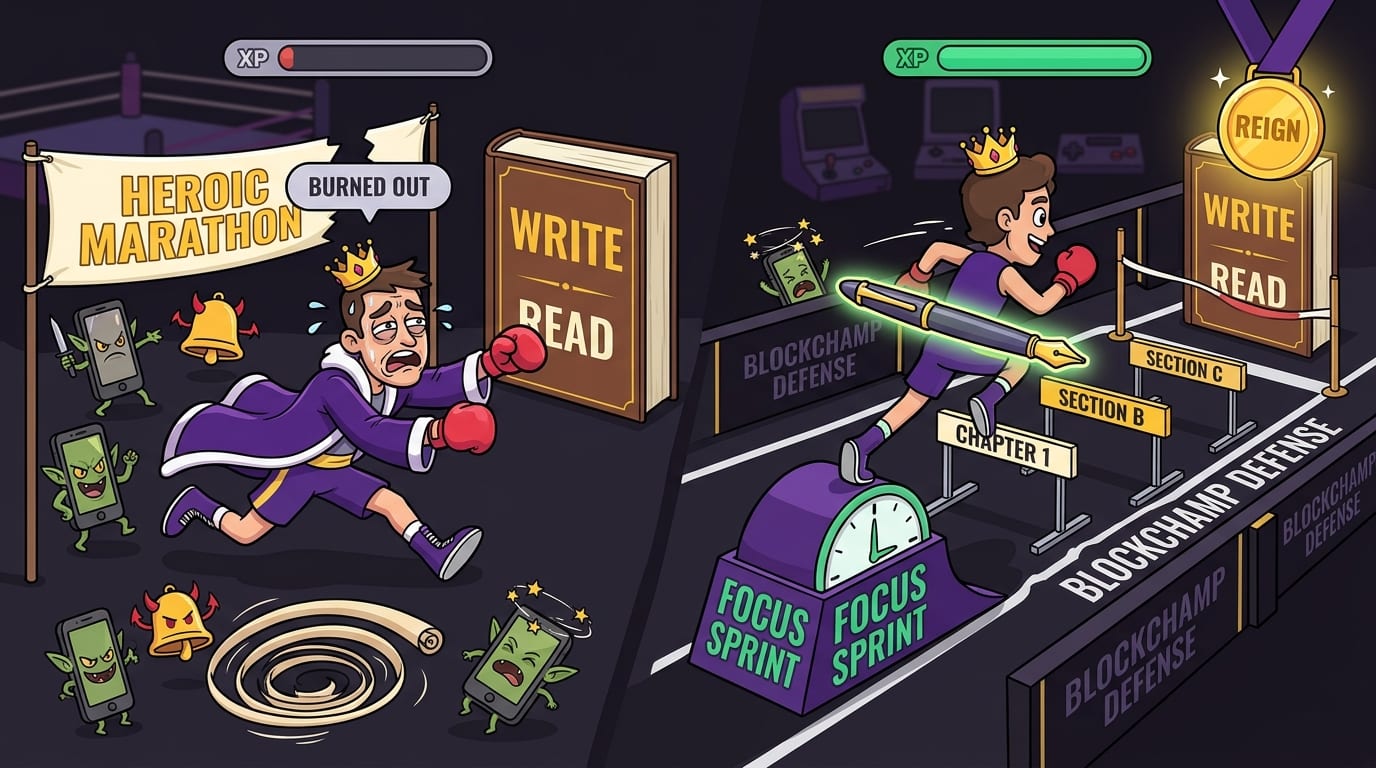
You don’t have to sit still for four hours to make real progress. Many readers and writers do better with a defined work interval followed by a short break. Try 20 or 25 minutes of focused work, then take five minutes away from the screen. If that feels too long, start with ten minutes. If it feels easy, gradually extend the sprint.
During the work interval, keep one task in view. During the break, stand up, stretch, get water, or look out a window. Be cautious about choosing a break that uses the same attention pattern as the distraction you’re trying to escape. Opening a fast-moving feed for “five minutes” can turn a planned pause into a vanishing act worthy of a stage magician.
Use a timer if it helps, but don’t treat the numbers as law. A reading session may naturally continue; a difficult writing task may need a shorter interval. The useful part is the container: a start time, a work period, and a planned pause. That structure gives you permission to focus now and rest later.
At the end of each sprint, leave a breadcrumb for your next return. Writers can jot down the next sentence, question, or scene beat. Readers can note a key idea or mark the page. This small handoff reduces the effort of restarting after a break. You’re leaving a map for your future self, who may otherwise open the document and stare at it like it has personally betrayed them.
If writing is your main challenge, our practical ideas for conquering distraction to write can help you protect the time and attention creative work needs.
Build a routine that survives ordinary life
Consistency is easier when reading or writing is attached to something you already do. Read after breakfast, write for 20 minutes after your first coffee, or spend a few pages with a book before bed. A reliable cue reduces the number of decisions between you and the task.
Choose a routine that fits your real schedule. If mornings are chaotic, don’t build a plan that depends on waking at 5 a.m. and becoming a completely different person. A small, repeatable session on a normal weekday is more useful than an elaborate routine that works once and then collapses under a laundry basket.
Track the habit in a lightweight way: mark a calendar, record the pages read, or note your writing minutes. The purpose is to notice consistency and learn what works, not to create a new spreadsheet that becomes your most polished piece of writing. If you miss a day, resume at the next opportunity. A break in the routine is information, not a courtroom verdict.
Gamification can make progress more visible. BlockChamp awards XP for focus time and active focus days, tracks reigns, and includes badges and a calendar. These features can turn abstract effort into a clear record of showing up. They’re not magic, and they don’t replace a meaningful goal; they can make the process more satisfying while you build one.
Celebrate small milestones in a way that supports the habit. Finish a chapter? Enjoy a cup of tea. Complete a week of writing sessions? Take a proper walk or share your progress with a friend. Rewards should reinforce the activity, not make it feel like you must negotiate with yourself before every paragraph.

Make reading and writing fit their own rhythms
Reading and writing need slightly different kinds of protection. Reading often benefits from a longer settling-in period. Give yourself a few pages before deciding you’re too restless. If your attention wanders, return gently to the last sentence you remember. You don’t need to scold yourself; you need to find your place and continue.
For difficult material, make reading active. Write a short note in the margin, list questions, or summarize a section in your own words. This gives your attention something to do besides noticing every available distraction. If you’re reading for a course or project, set a question before starting: “What does this chapter explain?” A purpose can make a dense page feel less like walking through wet cement.
Writing usually benefits from separating drafting and editing. During a draft, keep moving forward even when a sentence is clumsy. Use placeholders such as “[find example]” or “[check source]” rather than leaving the document to investigate every question immediately. Save research for a planned pass unless the missing information prevents you from continuing.
It can also help to finish a session before you feel completely empty. Stop with a clear next step while you still have some momentum. That way, tomorrow’s start is easier. You aren’t abandoning the work; you’re leaving the door open for your next session.
For a focused look at producing more creative work, see beating distraction to write more books. The techniques are useful beyond books: essays, newsletters, scripts, reports, and other projects all benefit from protected time and a manageable next step.
When you slip, reset without the shame parade
Almost everyone gets distracted. You may open a blocked site, check a notification, or realize you’ve spent ten minutes comparing desk lamps despite already owning a lamp. The important question is not whether distraction happened; it’s how quickly you return.
Try a simple reset:
- Notice what happened without turning it into a personality diagnosis.
- Close the distracting tab or put the device away.
- Remind yourself of the next small action.
- Restart with a short interval, such as five or ten minutes.
Then ask what made the detour easy. Were you tired? Was the task unclear? Did you need information, a break, or a snack? Maybe the website was too accessible. Adjust the setup instead of demanding a dramatic increase in willpower. Good systems reduce the number of times you need to fight the same battle.
It may also help to distinguish a planned break from avoidance. A break restores you; avoidance keeps you circling the task without feeling refreshed. If you return from a break feeling more scattered, choose a quieter activity next time. If you repeatedly avoid one particular writing task, make it smaller or clarify what “finished” means.
For more practical ways to be present and reduce interruptions, read how to be present and reduce digital distractions. Progress is not a perfectly golden calendar with no messy squares. It’s the repeated act of noticing, adjusting, and getting back in the ring.

A simple plan for your next reading or writing session
Here’s a practical routine to try today. Pick one task: a chapter, a passage, a scene, or a page of notes. Decide how long you’ll work, and put the phone out of reach. Close unnecessary tabs. If specific sites routinely pull you away, block them for the session or use a focus tool to make access less immediate.
Start a 20-minute timer. Read actively or draft without editing. When a thought about an unrelated task appears, write it on a later list and return to the page. When the timer ends, take a short screen-free break. Before stopping, leave yourself a note about where to resume.
Repeat this routine a few times and pay attention to the results. Perhaps 15 minutes is your best starting point. Maybe evenings work better than mornings. Perhaps you need a paper book, a library table, or a writing sprint before opening email. Treat each session as a small experiment, not a test you pass or fail.
Escaping digital distraction to read and write is less about becoming immune to temptation and more about setting up the conditions for attention to return. Give your task a clear finish line, make distractions less convenient, and build a routine you can repeat on ordinary days. If you use Chrome and want an extra boundary, BlockChamp can help keep the usual online suspects out of your focus session—with a royal stare-down if you wander toward the wrong tab.
Choose your book or document, set one modest goal, and begin. Defend the throne for 20 minutes. The raccoon can wait.
Related posts

Reclaiming Quality Time

Healthy Tech Habits Kids

Can Children Resist Screens A Couples Home Experiment
