
Beating Procrastination And Distraction To Write

Beating procrastination and distraction to write is not about becoming a serene productivity monk who drinks dew, owns one notebook, and has never opened YouTube “for research.” It is about building a writing system that survives contact with reality: notifications, boredom, browser tabs, snack urges, existential dread, and that one tiny voice whispering, “Maybe check Reddit before paragraph two.”
If writing feels weirdly hard, congratulations: your brain is not broken. Writing demands sustained attention, emotional risk, memory, planning, and decision-making. Meanwhile, the internet offers instant novelty and zero blank-page humiliation. That is not a fair fight. It is a raccoon with a jetpack versus a tired poet holding a pencil.
The good news: you can win. Not by relying on “motivation,” which is basically a flaky friend who says they are five minutes away while still in the shower. You win by designing your environment, rituals, browser, schedule, and expectations so writing becomes the obvious next move. This guide gives you practical methods for beating procrastination and distraction to write more consistently, with fewer dramatic sighs and less tab-hopping treason.
Quick Answers
The Real Enemy: Not Laziness, But Friction and Escape Hatches
Most people assume procrastination means laziness. Usually, it does not. Procrastination is often an emotion-management strategy wearing a fake mustache. You avoid the writing because writing feels uncertain, boring, difficult, exposing, or too big to start. Your brain says, “This document may contain discomfort. Abort mission. Open Instagram.”
Researchers have studied procrastination as a failure of self-regulation rather than a simple time-management problem. A useful overview from the American Psychological Association explains how procrastination is often tied to mood repair: we dodge the task to feel better right now, even if Future You gets clobbered with consequences. Poor Future You. Always catching the chair to the face.
Distraction piles on top of that. Writing requires you to stay with one thread of thought long enough to make something out of it. But digital platforms are engineered to interrupt that thread. According to Pew Research Center’s social media research, social platforms are embedded in daily life for a huge share of adults, which means your writing session is often competing against deeply habitual checking behaviors. You are not “weak.” You are working beside a casino that fits in a tab.
So the first mindset shift is this: beating procrastination and distraction to write is not about becoming tougher. It is about removing escape hatches before your brain starts bargaining like a medieval merchant with Wi-Fi.
- Make the writing task smaller.
- Make distractions harder to access.
- Make starting obvious.
- Make stopping less tempting.
- Make progress visible enough that your brain gets a little treat.
That is the whole kingdom. Now let’s build the castle.
Start With a “Minimum Viable Writing Session”
One reason writers procrastinate is that “write” is a terrible instruction. It is vague, emotionally loaded, and suspiciously large. “Write the article” could mean brainstorming, outlining, drafting, editing, researching, formatting, fact-checking, crying gently into tea, or all of the above. No wonder your brain flees to a video titled “Man Teaches Parrot to Beatbox.”
Instead, define a minimum viable writing session: the smallest writing commitment that counts as a win. Not the heroic version. The tiny royal decree version.
Examples:
- Write 150 messy words.
- Draft one bad paragraph.
- Create a bullet outline for one section.
- Revise the introduction for 15 minutes.
- Write three possible headlines.
- Summarize the argument in five sentences.
This works because starting is often the hardest part. Once you begin, momentum has a chance to show up wearing sunglasses. The trick is to make the first action so small that refusing it feels ridiculous. “I cannot write 1,500 words” is believable. “I cannot write one ugly sentence” is your inner drama goblin overacting.
Try this before your next writing session:
- Open the document.
- Write today’s tiny target at the top: “Goal: 200 rough words on Section 2.”
- Set a timer for 20 minutes.
- Write badly on purpose.
- Stop when the timer ends, or continue if the engine is warm.
The “badly on purpose” part matters. Drafting and judging are different jobs. Do not make the jester and executioner sit in the same chair. Draft first. Judge later.
Build a Pre-Writing Ritual So Your Brain Knows the Bell Has Rung
Rituals sound fancy, but they are really just repeatable cues. Your brain loves cues. It uses them to switch modes. If your current pre-writing ritual is “panic, open twelve tabs, check email, remember laundry, vanish,” then yes, the system could use a tiny upgrade.
A writing ritual does not need candles, chanting, or a robe, although frankly, if a robe helps, defend the throne. The point is consistency. You want a simple sequence that says: “We are writing now. Not scrolling. Not reorganizing folders. Writing.”
Here is a practical pre-writing ritual:
- Put your phone across the room or in another room.
- Close every browser tab except the document and necessary research.
- Turn on a website blocker for your usual traps.
- Set a timer for one focused block.
- Read the last paragraph you wrote yesterday.
- Write the next sentence, even if it is ugly enough to frighten villagers.
If sound helps, use the same playlist or ambient background each time. We have a whole guide on using ambient sounds for beating procrastination, because sometimes your brain needs a rainstorm, a coffee shop murmur, or spaceship hums to stop behaving like a startled squirrel.
Keep the ritual short. If your preparation takes 45 minutes, congratulations, you have invented procrastination with accessories. The ideal ritual is two to five minutes. Enough to create a cue. Not enough to become a hobby.
Use Time Blocks, Not Vibes
“I’ll write later” is not a plan. It is a tiny productivity ghost. Later arrives wearing different pants every day and usually brings a headache.
Schedule writing in time blocks. A time block is a protected appointment with your draft. It answers three questions:
- When will I write?
- What exactly will I work on?
- What distractions are not allowed during that block?
For beating procrastination and distraction to write, shorter blocks are often better than epic marathons. Try 25, 45, or 60 minutes. The best length is the one you can repeat without needing a ceremonial nap afterward.
A strong writing block might look like this:
- 9:00–9:45: Draft section on customer pain points.
- 9:45–9:55: Break, walk, water, no social media.
- 9:55–10:40: Draft examples and transitions.
- 10:40–10:50: Capture next steps for tomorrow.
This is especially useful for remote workers, freelancers, students, and anyone whose schedule has the structural integrity of wet cardboard. If home is your office and your office contains snacks, laundry, pets, roommates, and the eternal siren song of “quickly checking something,” read our guide to staying distraction-free while working remotely. The remote work kingdom has many goblins. Name them early.
Time blocking also reduces decision fatigue. You do not have to decide whether now is a writing time. The calendar already decided. The crown has spoken.

Block the Distractions Before They Challenge You to a Duel
Willpower is useful, but it is a terrible bouncer. It gets tired, accepts bribes, and somehow lets TikTok into the VIP section. If you want to write consistently, do not rely on resisting distractions after they appear. Remove them before the session starts.
This is where a website blocker becomes less of a “nice productivity tool” and more of a writing seatbelt. You may not need it every second, but when the impulse hits, you will be glad it is there.
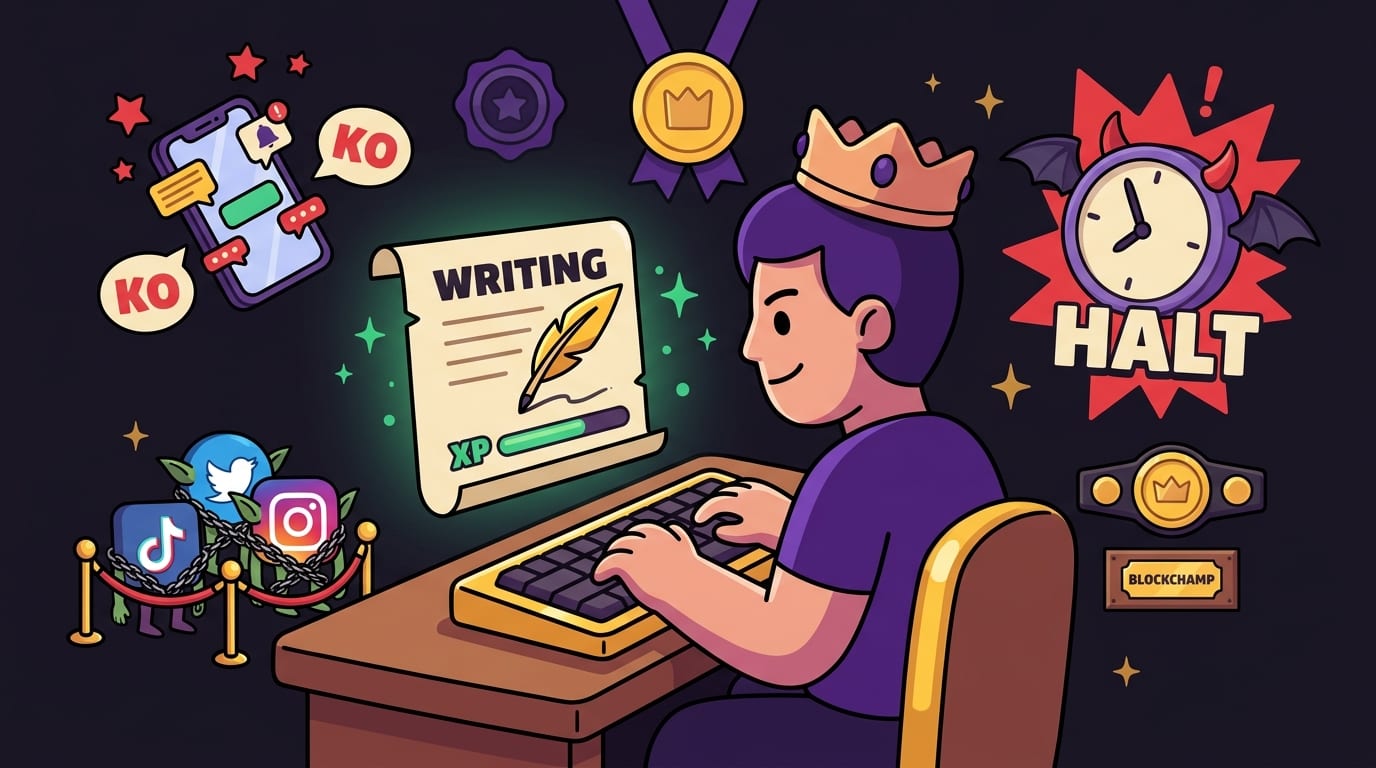
BlockChamp is built for this exact battle. It is a gamified website blocker for Chrome that lets you block distracting sites, keywords, and categories, then rewards focused time with XP, levels, badges, streaks, and leaderboard progress. Instead of a sad gray block screen, you get The King: a cartoon royal boxer who stares you down when you try to visit blocked sites. Very professional? No. Effective and memorable? Absolutely. Sometimes your draft needs a writing coach. Sometimes it needs a tiny monarch with boxing gloves saying, “Nice try, peasant.”
For writing sessions, consider blocking:
- Social media: Instagram, X/Twitter, TikTok, Facebook, Reddit, LinkedIn.
- Video and streaming: YouTube, Netflix, Twitch.
- News sites, especially if doomscrolling is your emotional support dragon.
- Shopping sites, because buying a new keyboard is not the same as writing.
- AI tools if you keep using them to avoid thinking instead of supporting your thinking.
BlockChamp’s category blocking is handy because you can flip on whole bundles instead of playing whack-a-mole with individual URLs. Pro users can also use recurring schedules, so your writing hours automatically become “On Guard” hours. That matters because the most dangerous distractions are the ones you did not plan for. One innocent search becomes a tab buffet. Suddenly you know the history of medieval spoons and your article has not gained a single sentence.
The goal is not to become anti-internet. The goal is to stop letting the internet vote during draft time.
Separate Research From Writing, or the Browser Will Eat Your Manuscript
Research feels productive because it is productive—until it is not. There is a slippery little trap where “I need one more source” becomes “I have opened 37 tabs and now understand the supply chain of ceramic mugs.” This is distraction disguised as diligence. Sneaky little duke.
For beating procrastination and distraction to write, split your workflow into separate modes:
- Research mode: collect sources, quotes, examples, data, and links.
- Outline mode: decide the structure and key points.
- Draft mode: write without browsing unless absolutely necessary.
- Edit mode: improve clarity, accuracy, flow, and style.
Each mode has different rules. During research, browsing is allowed. During drafting, browsing is the court jester trying to steal the crown.
Use placeholders when you hit a missing fact. For example:
- [Find statistic about attention switching]
- [Add example from client project]
- [Verify quote later]
Then keep writing. This prevents one missing detail from opening a portal to the internet swamp. You can batch all fact-checking later, when your draft actually exists.
This also helps with creative work. Many creators get stuck because they try to ideate, research, write, polish, and publish simultaneously. That is like trying to cook, plate, photograph, review, and eat dinner at the same time. Messy. Sauce everywhere. If you make creative work, you may enjoy our deeper dive on productivity, procrastination, and focus for creatives.
Use the “Distraction Capture” Method Instead of Obeying Every Thought
During writing, your brain will generate urgent nonsense. This is normal. You will remember emails, errands, better titles, a person you forgot to text, a mysterious need to Google whether penguins have knees. They do, sort of. But not now, champ.
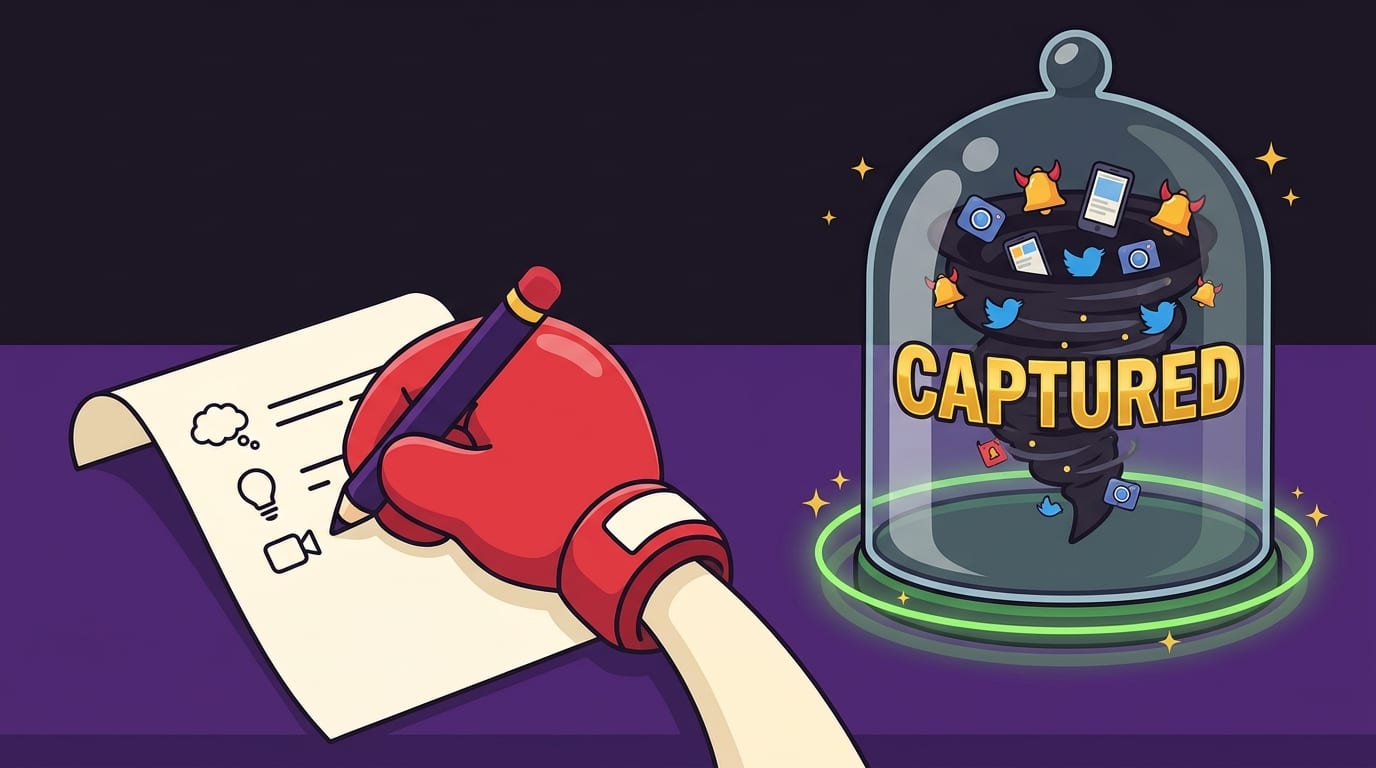
The distraction capture method is simple: keep a small note beside your writing space called “Later.” When a distracting thought appears, write it down and return to the draft.
Examples:
- Check invoice status.
- Look up quote source.
- Buy printer ink.
- Ask Sam about meeting notes.
- Google penguin knees after work because apparently this is who I am.
This works because your brain often repeats intrusive reminders because it fears you will forget them. Writing them down reassures the tiny bureaucrat in your skull. “Yes, Gerald, the printer ink is logged. Please stop setting off alarms during paragraph four.”
At the end of your writing block, review the list. Some items will be real. Some will be nonsense wearing a fake badge. Handle the real ones later. Delete the nonsense with royal authority.
Design Better Breaks: Rest Without Falling Into the Scroll Pit
Breaks are not the enemy. Bad breaks are. A good break restores attention. A bad break hijacks it, sells it to an algorithm, and returns it sticky with memes.
Attention has limits. Research on task switching suggests that interruptions can create a measurable cost as we reorient back to the original task. The American Psychological Association’s overview of multitasking research notes that switching tasks can reduce efficiency, especially when tasks are complex. Writing is complex. It is not folding socks. Although, to be fair, some drafts do resemble laundry.
Instead of taking breaks that involve high-stimulation feeds, choose recovery breaks:
- Stand up and stretch.
- Walk outside for five minutes.
- Drink water like a hydrated champion.
- Look out a window.
- Do a small chore with a clear endpoint.
- Breathe slowly for one minute.
Avoid “just checking” social media during short breaks. Social apps are not breaks; they are slot machines with comments. As Hootsuite’s Digital Trends reporting regularly shows, social platforms are a massive part of global internet behavior. They are built to hold attention. Your five-minute break can easily become a twenty-minute scroll goblin parade.
If you use BlockChamp, leave your blocks active during breaks. This is important. Your brain will absolutely argue that a break means “throne empty, chaos permitted.” No. The King stays on guard. A break should refresh your writing session, not overthrow it.
Make Progress Visible So Your Brain Gets Paid
Writing progress is often invisible until late in the process. That is demotivating. You can spend an hour thinking, cutting, moving, and drafting, then feel like nothing happened because the page is still rude enough to need work.
Make progress visible with simple tracking. You can track:
- Minutes written.
- Words drafted.
- Sections completed.
- Days in a row you started.
- Distraction attempts resisted.
- Drafting sessions completed before noon.
This is one reason gamification can help. BlockChamp turns focus into visible progress: XP for focus time, XP for surviving stare-downs, streaks called reigns, badges, a calendar, and leaderboard rankings. It does not pretend every day will be perfect. It rewards consistency. That matters because many writers quit after one “bad” day, which is like dropping your crown because it got a fingerprint on it.
For writing, try creating your own “writer scoreboard”:
- One point for opening the document.
- Two points for completing a 25-minute writing block.
- Five points for finishing a section draft.
- Five bonus points for resisting a blocked site.
- Ten points for publishing or submitting.
This sounds silly. Good. Silly works. Habits stick better when they are rewarding, not just morally impressive. If you want more motivation tactics without the beige corporate fog machine, read our guide on conquering distraction and staying motivated.
Know Your Procrastination Personality
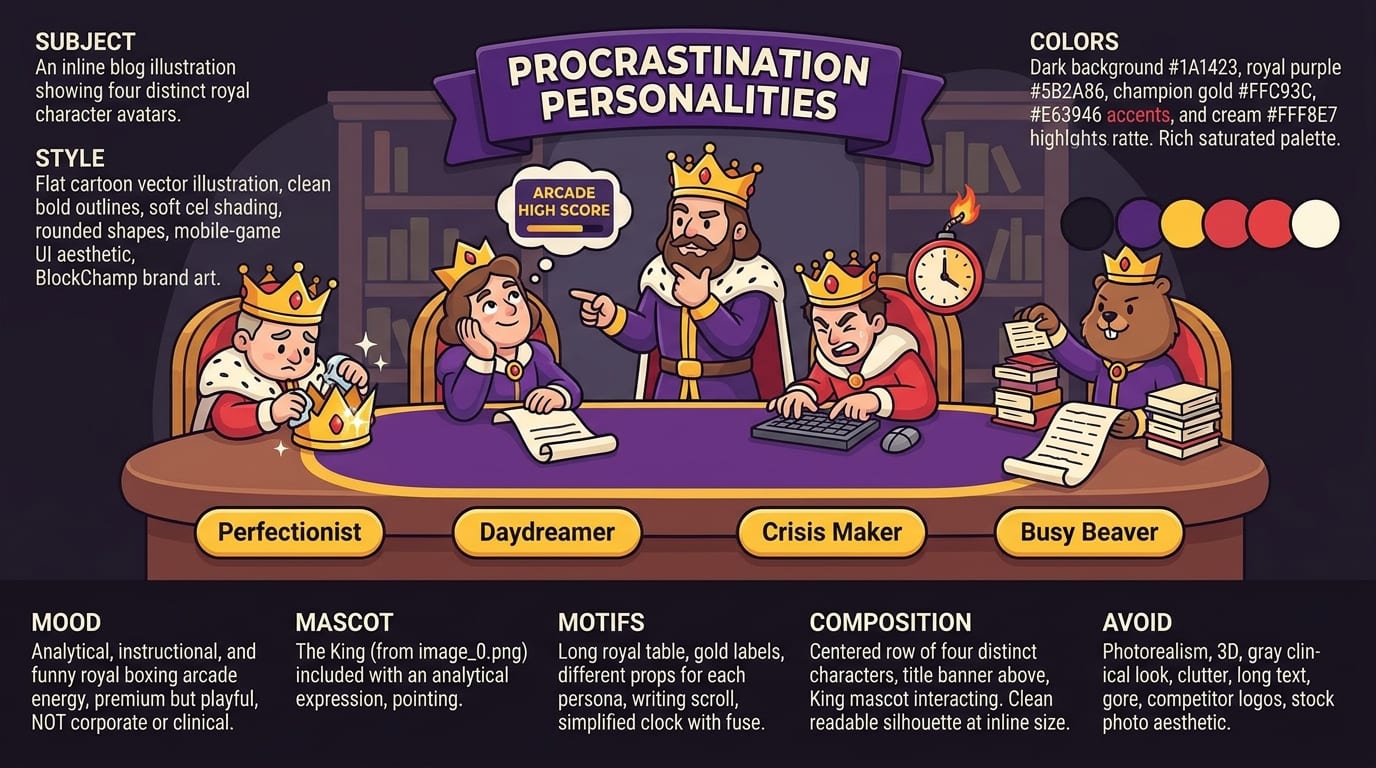
Not all procrastination looks the same. If you use the wrong fix for your pattern, you may end up beautifully organizing your desk while your deadline quietly sharpens an axe.
The Perfectionist Procrastinator
You delay because the draft might be bad. Spoiler: the first draft will be bad. That is its job. A first draft is not a palace; it is scaffolding with snacks. Your fix is to lower the quality bar for drafting and raise it later during editing.
Try this rule: “No editing until 500 words exist.” If you must fix something, mark it with brackets and keep going.
The Overwhelmed Procrastinator
You delay because the project feels too large. Your fix is decomposition. Break the writing into tiny next actions: choose title, outline section one, write intro anecdote, add three examples, revise conclusion.
Ask: “What is the next visible action?” Not “finish essay.” That is a mountain. “Write three bullets for the argument” is a foothold.
The Novelty-Seeking Procrastinator
You delay because writing feels less stimulating than the internet circus. Your fix is environmental control and gamification. Use timers, website blocking, rewards, and sprints. Race the clock. Earn XP. Make focus feel like a game instead of a punishment dungeon.
The Research-Loop Procrastinator
You delay by gathering more information forever. Your fix is a research budget. Decide in advance: “I get 30 minutes and five sources. Then I draft.” You can verify details later, but you cannot keep feeding the research dragon until it owns your afternoon.
There is a brilliant related idea in our post on overcoming distraction disguised as productivity. Some tasks look responsible while quietly stealing the main event. Beware the productive decoy.
Create a Writing Environment With Fewer Decisions
Decision fatigue is real in the ordinary sense: the more choices you face, the more tempting it becomes to default to easy rewards. Writing already contains hundreds of micro-decisions. What is the point? What comes next? Is this sentence good? Should this example stay? Why did I use the word “moist”? Terrifying.
Reduce surrounding choices so the writing gets more of your mental energy.
Set up a default writing environment:
- Same writing app.
- Same writing time when possible.
- Same focus playlist or silence.
- Same blocked websites.
- Same timer length.
- Same starting ritual.
Also prepare your next session before ending the current one. This is a criminally underrated move. At the end of each writing block, leave yourself a note:
- “Next: write the example about remote work distractions.”
- “Next: finish section on research vs drafting.”
- “Next: add transition into conclusion.”
This prevents cold starts. Future You opens the document and knows exactly where to swing. No wandering. No “where was I?” No accidental 22-minute email inspection.
Use AI Carefully: Assistant, Not Escape Hatch
AI tools can help writers brainstorm, summarize, outline, and edit. They can also become a glittery procrastination cave where you endlessly prompt instead of writing. The difference is intention.
Use AI for bounded tasks:
- “Give me 10 headline angles for this draft.”
- “Summarize these notes into a rough outline.”
- “Find weak transitions in this section.”
- “Suggest examples for this argument.”
Avoid using AI as a way to dodge the hard thinking. If you keep asking for another outline, another angle, another version, another “more punchy” rewrite before you have committed to what you mean, you are not writing. You are polishing fog.
If AI tools become distracting, BlockChamp’s AI Distractions category can help you block ChatGPT, Claude, Gemini, Copilot, Perplexity, and similar tools during pure drafting sessions. That may sound extreme until you realize you have spent 40 minutes asking an AI to create a “writing routine” instead of writing the first paragraph. The King sees you. Lovingly. But he sees you.
A Step-by-Step Routine for Beating Procrastination and Distraction to Write
Let’s turn all this into a practical routine you can use tomorrow. Not someday. Not after you buy a better notebook. Tomorrow.
- Pick one writing target. Choose a specific outcome: “Draft 400 words of the introduction” or “Outline three sections.”
- Schedule one block. Put 25–60 minutes on your calendar. Treat it like a meeting with your future reputation.
- Prepare your environment. Clear tabs, silence notifications, place phone away from your desk.
- Turn on blocking. Use BlockChamp or your blocker of choice to block social, video, news, and your personal chaos portals.
- Start with a tiny action. Write one sentence, one bullet, or one ugly paragraph.
- Capture distractions. Put stray thoughts on a Later list instead of obeying them.
- Take a real break. Move, stretch, hydrate. Do not enter the scroll pit.
- End by setting the next step. Leave a note for tomorrow so the next session starts cleanly.
Do this for five days. Not perfectly. Just consistently. You will learn which sites pull you away, which writing times work, how long you can focus, and what triggers avoidance. Then adjust. Productivity is not a personality trait. It is a feedback loop with fewer lies.
When You Slip, Do Not Burn the Kingdom Down
You will get distracted sometimes. You will procrastinate. You will break a streak. You will spend 18 minutes reading comments under a video you did not enjoy. This is not ideal, but it is also not a moral collapse. It is Tuesday.
The key is recovery speed. Great writers are not people who never drift. They are people who return faster. When you catch yourself distracted, do not launch a courtroom drama. Just ask:
- What pulled me away?
- Was the task too vague?
- Was I tired, hungry, anxious, or bored?
- Do I need stronger blocking?
- What is the next tiny writing action?
Then resume. If you use BlockChamp and hit a blocked site, The Stare-Down turns the slip into a reset point. You get caught, roasted, redirected, and even earn XP for surviving the temptation. That is much better than spiraling into shame, which is basically procrastination wearing a velvet cape.
Remember: beating procrastination and distraction to write is not about never wanting distraction. It is about building a system that catches you before the distraction becomes your afternoon.
Conclusion: Defend the Draft, Keep the Crown
Writing is hard because it asks your brain to stay with uncertainty long enough to make meaning. Distraction is easy because it asks nothing and gives instant novelty. So if you have been struggling, do not assume you lack discipline. Assume your system needs stronger walls, clearer rituals, smaller tasks, better breaks, and fewer browser-shaped trapdoors.
Start small. Define a minimum viable writing session. Use time blocks. Separate research from drafting. Capture distractions instead of chasing them. Track progress. And for the love of all that is holy and moderately caffeinated, block the sites that keep mugging your attention in broad daylight.
If you want a focus tool that does not feel like being grounded by a spreadsheet, try BlockChamp. It blocks distracting websites in Chrome, turns focus into XP and levels, and sends The King to stare you down when you try to betray your draft for YouTube, Reddit, or the royal swamp of “just checking.”
Your next step is simple: choose one writing block today, block your top distractions, and write the next ugly sentence. Not the perfect sentence. The next one. That is how drafts are built. One defended minute at a time.
Long live your focus. Defend the throne. Crush the scroll. Write the thing.
Related posts

Locked Mode For Building Better Digital Habits

Why Laziness Is A Myth And How To Focus

Staying Indistractable In Uncertain Times
