
5 Reads Help Work Matters

Five minutes into a workday, your browser has opened a project file, three news tabs, and a video titled “How to Organize Your Desk Like a Navy Admiral.” The desk is still a mess. The project is waiting. And the admiral has somehow become your manager.
That’s why the idea behind “5 reads help work matters” is worth taking seriously: reading can help you work better, but only when it connects to the work that actually matters. The goal isn’t to collect more advice or turn your bookshelf into a monument to good intentions. It’s to find useful ideas, test them, and put them into practice.
Here are five kinds of reads that can help you work with more clarity, creativity, and focus—plus a practical method for choosing what to read and turning each useful insight into a real workplace decision. No heroic all-night reading sprints required. The King recommends defending your calendar first.
Quick Answers
What “5 reads help work matters” means in practice
The phrase can be understood as a simple question: what five things should you read to make work better? There isn’t one perfect list for every person. A designer, a student, a project manager, and a freelancer may need different ideas. A more useful approach is to choose five reading categories that address common workplace challenges.
Think of them as five lenses: focus, communication, creativity, decision-making, and wellbeing. Together, they help you understand not only how to complete tasks, but how to choose the right tasks, work with other people, and keep your energy intact.
Reading itself is not a productivity strategy. Applying a useful idea is. A book on deep work won’t rescue your afternoon if you read it while checking messages every 90 seconds. A communication guide won’t improve a meeting if nobody changes how the meeting runs. The value appears when a thought becomes a small experiment.
That distinction matters because advice can become another distraction wearing a little academic hat. Read with a question in mind, look for an idea you can test, and give it a fair trial before hunting for the next recommendation.
Read one: focus and attention, because your brain is not a browser tab
Work that requires concentration—writing, planning, analysis, coding, studying—needs stretches of uninterrupted attention. Yet many workplaces normalize constant task-switching: answer a message, open a document, check a notification, return to the message, and wonder why the document looks personally offended.
For a useful focus read, look for practical ideas about protecting attention, reducing interruptions, and making demanding work easier to begin. The best advice is usually specific: set a clear start time, define what “done” means for one session, and make the distracting alternative harder to reach.
Try this simple reading-to-action exercise:
- Name the work. Choose one important task that needs concentration, such as drafting a proposal or reviewing a report.
- Define a short session. Start with 25 or 45 minutes. The ideal length is the one you can repeat, not the one that sounds most impressive.
- Remove one distraction. Silence nonessential notifications, close unrelated tabs, or place your phone out of reach.
- Record the result. Note what you completed and what interrupted you. Adjust the next session based on evidence, not self-criticism.
Good reading on attention should help you design a work environment, not merely tell you to “try harder.” If social media or streaming sites keep elbowing their way into your focus session, a website blocker can add useful friction. BlockChamp is a gamified website blocker for Chrome that lets you block distracting sites and categories while tracking focused time through XP, levels, badges, and reigns. The humor helps make the boundary feel less like detention and more like defending your throne.
For a practical companion, explore this guide to reclaiming your attention and focusing on what matters. The key is to choose a small number of focus rules you can sustain. A perfect plan that lasts one Tuesday is less useful than a decent plan you follow most weeks.
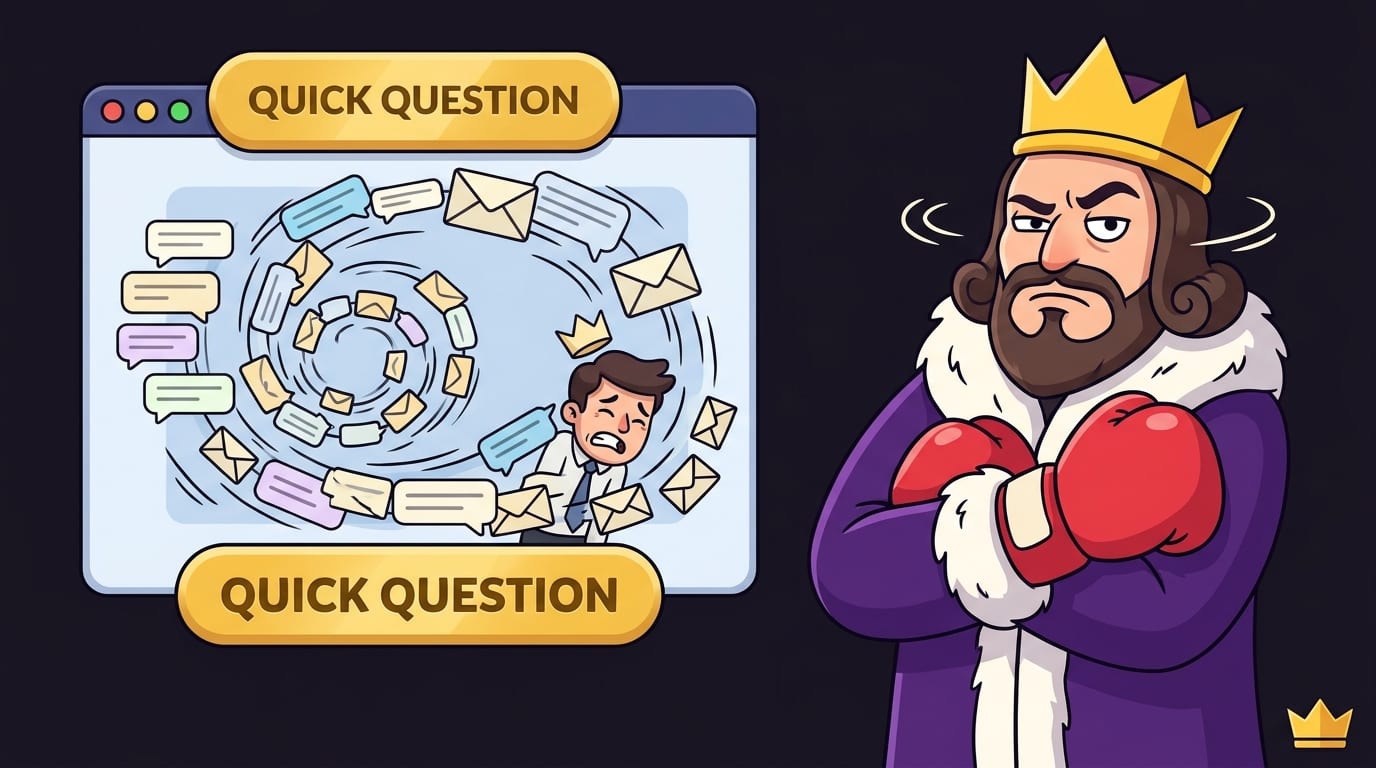
Read two: communication, because “quick question” is rarely quick
Work is full of messages, instructions, feedback, and meetings. A communication read can help you make those exchanges clearer and reduce the unnecessary back-and-forth that turns a simple decision into a six-person email opera.
Look for guidance on writing concise updates, asking better questions, listening actively, and making expectations explicit. One practical habit is to include the context, the decision needed, and the deadline whenever you request help. Instead of sending “Thoughts?” with a 14-page attachment, try: “Could you review sections two and three by Thursday and tell me whether the recommendation is clear?” Your colleagues may even forgive you for attaching the document.
Another useful technique is to separate facts from interpretations. “The draft arrived two days after the agreed date” is an observable fact. “You don’t care about this project” is an interpretation, possibly an inaccurate one with a dramatic soundtrack. Clear communication starts with what happened, then describes the impact and the next step.
In meetings, test a simple structure: purpose, decision or discussion, owner, and follow-up. If no decision is needed, consider whether the meeting can become a short written update. Meetings are useful tools, not mandatory ceremonies honoring the calendar.
After reading a communication tip, use it in one real exchange that week. For example, rewrite an unclear request, summarize a meeting in three bullets, or ask a colleague what outcome they need before you start a task. Small adjustments often do more than memorizing a list of “power phrases.”
Read three: creativity and new perspectives, because the first idea is not always the crown jewel
Creative work often gets stuck when people keep using the same process and expect a different result. A read about creativity, design, or innovation can offer ways to reframe a problem, gather inspiration, and generate options before settling on the first workable answer.
Useful ideas might include changing the environment, collecting examples from outside your industry, brainstorming individually before group discussion, or deliberately creating several rough alternatives. The point is not to make every task “creative.” It is to avoid treating familiar habits as the only possible route.
Suppose a team’s weekly report takes hours to assemble and nobody reads it. The default response might be to polish the formatting. A perspective-shifting question would be: “What decision is this report meant to support?” Maybe the answer is a one-page dashboard, a short risk list, or no report at all. Changing the question can save more time than changing the font.
Keep a small idea log. When something works—a useful meeting format, a clear explanation, a thoughtful product feature—write down what made it effective. Later, borrow the principle rather than copying the surface. A team’s successful workshop may be useful because participants had time to think before sharing, not because everyone used sticky notes in the precise shade of optimistic yellow.
For more on shifting your approach, read about working in new ways and embracing new perspectives. You can also explore five steps for clearing your mind and making room for creative work. Both ideas point toward a helpful habit: make a little space for thinking before you demand a brilliant answer from a brain that is already juggling twelve open loops.
Read four: decision-making and changing how you work
Some work problems are not caused by a lack of effort. They come from a process that no longer fits the task. You might be polishing a low-impact detail, following a meeting routine that no longer serves the team, or repeatedly postponing a decision because nobody has named the trade-off.
Reading about decision-making can help you identify assumptions, compare options, and choose a sensible next step without pretending you can predict the future. A useful method is to write down:
- The decision you need to make.
- The options you genuinely have.
- The evidence that matters most.
- The cost of waiting or choosing incorrectly.
- When you will review the decision.
This turns vague worry into a question you can work with. For a reversible decision, a small test may be better than a long debate. If you are unsure whether a daily check-in improves coordination, try it for two weeks and review the results. If the decision is hard to reverse—such as a major hiring or budget choice—more careful research and consultation may be warranted.
Also ask whether the work itself needs to change. If you keep struggling to focus on a process that is unnecessarily complicated, more discipline may not be the answer. Look for steps to remove, automate, delegate, or redesign. This article on changing how you work, not what you work on is a useful prompt for examining the method before blaming yourself for not moving faster.
The goal is not to turn every decision into a spreadsheet. The goal is to make the reasoning visible enough that you can move forward, learn, and adjust instead of circling the same question like a very diligent pigeon.
Read five: wellbeing and sustainable work, because humans are not office equipment
Work matters, but it is not the only thing that matters. A helpful read on wellbeing can show how rest, boundaries, workload, and personal priorities affect the quality of your work over time. This is especially relevant for creative professionals, freelancers, caregivers, and anyone whose workday has a habit of quietly eating the evening.
Pay attention to practical guidance: define an end-of-day routine, set realistic availability expectations, schedule breaks, and notice which parts of your week consistently drain or restore energy. These habits are not luxuries reserved for people with an assistant and a ceremonial water fountain. They are ways to make work more sustainable.
Try a weekly energy review. At the end of each week, list three tasks that gave you energy and three that drained it. Then ask what can change: could a difficult task happen earlier, could a recurring interruption be prevented, or could a responsibility be shared more clearly? You may not control every constraint, but identifying the pattern gives you a better starting point than simply promising to “be more productive” next week.
If work-life boundaries are a challenge, this guide to work-life balance for creative professionals offers a related perspective. A sustainable routine should support your life, not demand that your life become an accessory to your to-do list.
How to choose reads that actually help your work
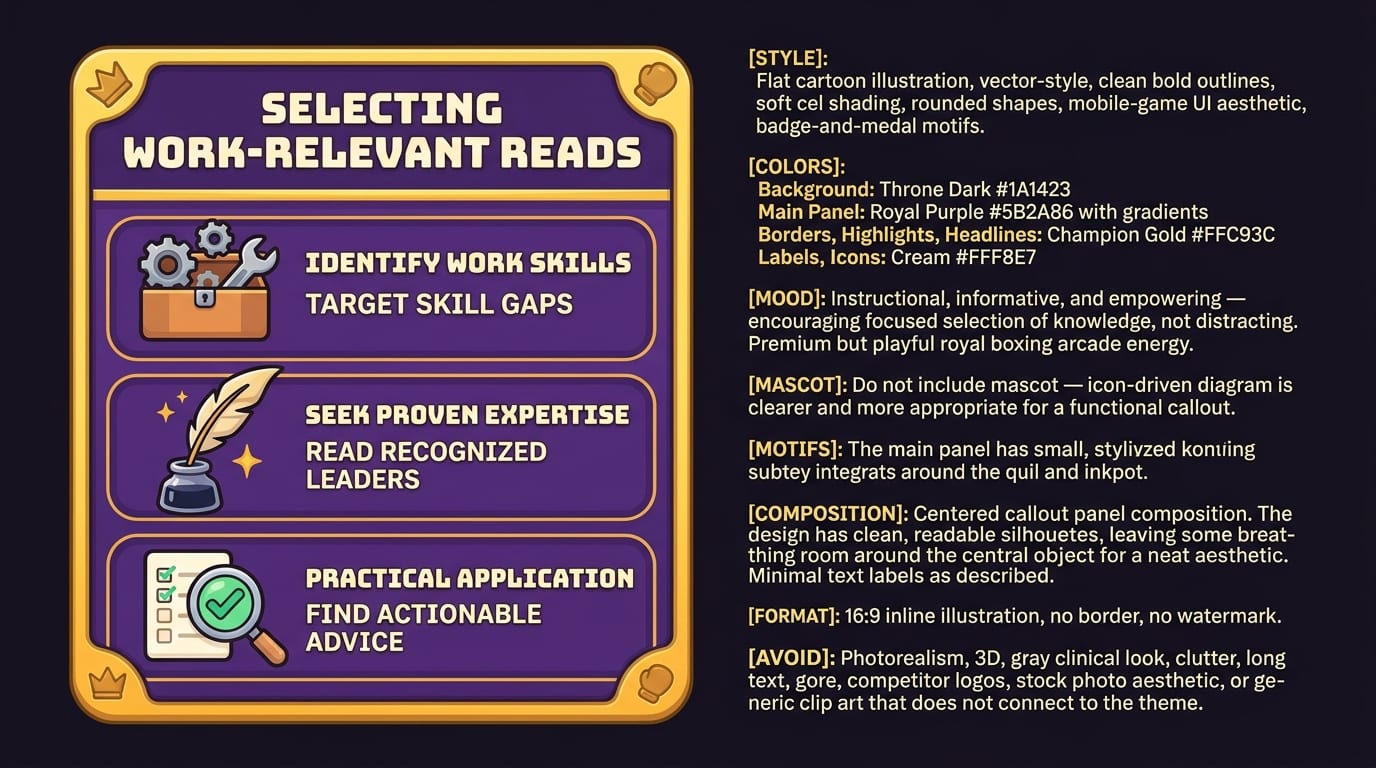
There are more productivity recommendations than there are hours in a week, and the internet would happily sell you all of them. Choose reading based on a real problem you are facing, not because a title promises to transform your morning, inbox, posture, and probably your aura by Thursday.
Use these questions to select a useful book, article, or research-based guide:
- What problem am I trying to solve? Be specific: “I lose focus while writing reports” is more actionable than “I want to be better at work.”
- Does the author explain the reasoning? Prefer useful examples and evidence over confident claims that one trick works for every person.
- Can I test an idea soon? If the advice requires a complete life renovation, look for a smaller first experiment.
- Does it fit my circumstances? Advice for an executive with a large team may not transfer neatly to a student, freelancer, or frontline worker.
Try reading in focused doses. Set a question before you begin, capture one or two useful notes, and stop when you have enough to test. You are not required to finish every book because you paid for it. That book is not a tiny landlord.
For research-backed background on attention and interruptions, explore the American Psychological Association’s overview of multitasking. For workplace wellbeing, the World Health Organization’s guidance on mental health at work provides broader context. These sources can help you distinguish useful principles from dramatic productivity folklore.
Turn each useful idea into a workplace decision
To make “5 reads help work matters” more than a pleasant phrase, use a simple loop: read, choose, test, review. It keeps learning connected to action and stops your notes app from becoming a museum of excellent advice you never used.
- Read with a purpose. Write one question at the top of the page or in your notes. For example: “How can I protect 45 minutes for analysis?”
- Choose one idea. Select the suggestion most likely to address that question. Don’t collect ten changes and launch them all on Monday.
- Make it observable. Decide what you will do differently and when. “I’ll check email after my first writing block” is clearer than “I’ll focus more.”
- Set a trial period. Test the change for a week or two, depending on the task. A single bad afternoon is not enough to declare a method scientifically cursed.
- Review the result. Did the change help? What got in the way? Keep it, adapt it, or discard it.
For example, imagine a project coordinator who reads that batching messages can reduce interruptions. They choose two daily message windows, tell colleagues when to expect replies, and keep urgent channels available. After a week, they review whether their project work moved forward and whether the team had enough access. The outcome might be a refined schedule rather than a rigid rule. That is learning in action.
When distraction is the main obstacle, support the experiment with environmental changes. Block non-work sites during a planned focus session, use a visible timer, or put a note beside your screen describing the next step. BlockChamp can help Chrome users block selected sites, keywords, or distraction categories; its focus schedule is available to Champion subscribers. Its streaks, XP, and Stare-Down page add a playful nudge when a tempting tab tries to lure you away. Tools are not magic, but they can make the useful choice easier to repeat.
Build a reading habit without hiring a second brain
You do not need to read five full books in five days. The “five reads” idea works best as a balanced menu, not a deadline designed by an enthusiastic stationery supplier. One strong article, a chapter, or a well-chosen research summary can be enough to generate a useful experiment.
Try a light weekly routine:
- Choose one work challenge on Monday.
- Read for 15–20 minutes on two or three days.
- Capture one idea and one action, not a transcript of every sentence.
- Test the action before adding another technique.
- Review what changed at the end of the week.
Keep your notes short. A useful format is “Idea / Test / Result.” For example: “Idea: start meetings with the decision needed. Test: use it in the Thursday planning call. Result: the group agreed on an owner faster, but the agenda still needs clearer time limits.” That note can inform your next step without requiring you to reread a 40-page notebook titled “My New System, Version 11.”
Be kind to yourself when an experiment fails. Maybe the change was poorly timed, too ambitious, or simply wrong for the task. Failure is information, not a royal decree that you are doomed to be unproductive forever. Adjust the method and keep the useful parts.
Conclusion: read less randomly, work more intentionally
The best five reads for work are the ones that help you focus, communicate clearly, explore new perspectives, make better decisions, and protect your wellbeing. Their value does not come from the number of pages completed. It comes from the quality of the question you bring and the small action you take afterward.
Choose one work challenge today. Find one trustworthy read that addresses it. Pick one idea, test it for a week, and decide what to keep. If browser distractions keep knocking your attention off course, consider adding a focus boundary with BlockChamp. The King can guard the tabs while you handle the important work.
Read with purpose, test with curiosity, and defend your time like it has a crown. Because, champ, it does.
Related posts

Reclaiming Quality Time

Healthy Tech Habits Kids

Can Children Resist Screens A Couples Home Experiment
